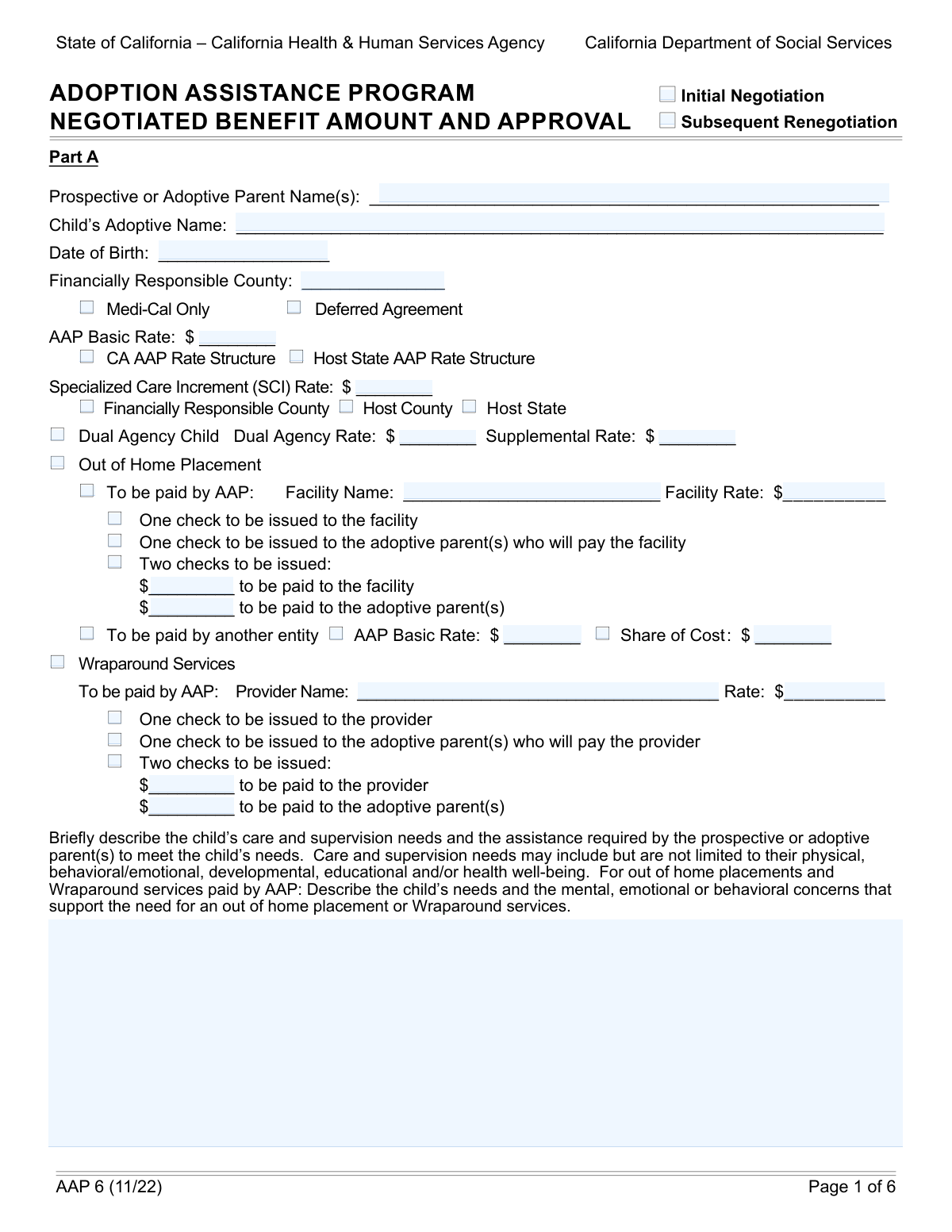
Yes! You can use AI to fill out Form AAP 3, Adoption Assistance Program (AAP) Negotiation Agreement
The AAP 3 form is a critical document used in California to record the negotiated agreement for financial assistance provided to families adopting children with special needs through the Adoption Assistance Program. It details the agreed-upon payment rates, including basic amounts, specialized care increments, and other potential costs, ensuring clarity and legal standing for the support provided. Today, this form can be filled out quickly and accurately using AI-powered services like Instafill.ai, which can also convert non-fillable PDF versions into interactive fillable forms.
Our AI automatically handles information lookup, data retrieval, formatting, and form filling.
It takes less than a minute to fill out AAP 3 using our AI form filling.
Securely upload your data. Information is encrypted in transit and deleted immediately after the form is filled out.
Form specifications
| Form name: | Form AAP 3, Adoption Assistance Program (AAP) Negotiation Agreement |
| Number of fields: | 62 |
| Number of pages: | 6 |
| Language: | English |
| Categories: | adoption forms |
Instafill Demo: How to fill out PDF forms in seconds with AI
How to Fill Out AAP 3 Online for Free in 2026
Are you looking to fill out a AAP 3 form online quickly and accurately? Instafill.ai offers the #1 AI-powered PDF filling software of 2026, allowing you to complete your AAP 3 form in just 37 seconds or less.
Follow these steps to fill out your AAP 3 form online using Instafill.ai:
- 1 Navigate to Instafill.ai and upload your AAP 3 form, or select it from their template library.
- 2 Use the AI assistant to accurately enter the prospective parent(s) and child's information in the designated sections.
- 3 Complete the financial responsibility and rate sections, detailing the AAP basic rate, any Specialized Care Increment (SCI), and other payment structures.
- 4 Describe any special circumstances, such as dual agency status, out-of-home placements, or wraparound services, and specify the payment arrangements.
- 5 Provide a comprehensive description of the child's needs and indicate whether this is an initial negotiation or a renegotiation.
- 6 Review all entered information for accuracy, then electronically sign the agreement. The platform can then route the document to the social worker and supervisor for their required signatures.
- 7 Securely download and save the completed and signed AAP 3 form for your official records.
Our AI-powered system ensures each field is filled out correctly, reducing errors and saving you time.
Why Choose Instafill.ai for Your Fillable AAP 3 Form?
Speed
Complete your AAP 3 in as little as 37 seconds.
Up-to-Date
Always use the latest 2026 AAP 3 form version.
Cost-effective
No need to hire expensive lawyers.
Accuracy
Our AI performs 10 compliance checks to ensure your form is error-free.
Security
Your personal information is protected with bank-level encryption.
Frequently Asked Questions About Form AAP 3
This form is used to negotiate and document the financial assistance amount for the Adoption Assistance Program (AAP). It outlines the child's needs and the corresponding benefit rates being requested and agreed upon.
This form is completed by prospective or adoptive parents in collaboration with their adoption agency social worker. Signatures from both the parents and agency representatives are required to finalize the agreement.
Select 'Initial Negotiation' if this is the first time you are establishing AAP benefits. Select 'Subsequent Renegotiation' if you have an existing AAP agreement and are requesting a change due to the child's evolving needs.
Provide a detailed summary of your child's care and supervision needs. Include any specific physical, behavioral, emotional, developmental, educational, or health-related concerns that justify the requested assistance.
A Specialized Care Increment (SCI) is an additional monthly payment above the basic AAP rate. It is intended to help cover extra costs associated with caring for a child with significant documented physical, mental, or emotional health needs.
A 'Dual Agency Child' is a child who is eligible for services from both the adoption agency and another public agency, like a California Regional Center (CRC). This section is used to coordinate payments if this applies to your child.
If you and the agency cannot reach an agreement, check the 'Unable to Agree' box. The agency will then typically issue a formal notice denying the requested amount, and you will be informed of your right to appeal the decision.
You should attach any required Level of Care (LOC) assessment tools, the SCI schedule if applicable, and other relevant documentation like medical, psychological, or school reports that support the need for the requested benefit amount.
In the 'Out of Home Placement' section, you must indicate how the payment should be distributed. You can choose for one check to go to the facility, one check to you to pay the facility, or for two separate checks to be issued.
Wraparound services are intensive, team-based services designed to support children with complex needs and their families. If your child requires these services and they are paid by AAP, you will detail the provider and payment information in this section.
Yes, services like Instafill.ai use AI to accurately auto-fill form fields based on your information. This can help save time and reduce the chance of errors.
To fill this form online, upload the document to the Instafill.ai platform. The AI will make the fields interactive, allowing you to easily enter your information and generate a completed, downloadable form.
If you have a non-fillable or 'flat' PDF, you can use a service like Instafill.ai. It can convert the document into an interactive, fillable form that you can complete on your computer.
If an agreement is reached, the prospective or adoptive parent(s) must sign and date the form. The Adoption Social Worker and their Supervisor must also sign to indicate the agency's approval.
Compliance AAP 3
Validation Checks by Instafill.ai
1
Child's Date of Birth Format and Validity
This check ensures the 'Date of Birth' field is not empty, is formatted as a valid date (e.g., MM/DD/YYYY), and represents a date in the past. It is crucial for establishing the child's age and eligibility for various programs. A failure would prevent form submission and prompt the user to enter a valid, historical date.
2
Mutually Exclusive AAP Rate Structure Selection
This validation verifies that only one of the two checkboxes, 'CA AAP Rate Structure' or 'Host State AAP Rate Structure', is selected. The basic rate can only be determined by one structure, so selecting both is a logical contradiction. If both are selected, an error message will instruct the user to choose only the single applicable rate structure.
3
Mutually Exclusive SCI Payer Selection
This check ensures that for the Specialized Care Increment (SCI), only one payer source ('Financially Responsible County', 'Host County', or 'Host State') is selected. A single entity is responsible for payment, and selecting multiple would create ambiguity in financial processing. The validation will fail if more than one box is checked, requiring the user to specify a single payer.
4
Conditional Dual Agency Rate Fields
This validation ensures that the 'Dual Agency Rate' and 'Supplemental Rate' fields are filled only if the 'Dual Agency Child' checkbox is marked as 'Yes'. These rates are irrelevant if the child is not a dual agency case, and filling them could cause processing errors. If the condition is not met, these fields should be disabled or cleared.
5
Mutually Exclusive Out-of-Home Placement Payment Method
This check validates that for an out-of-home placement paid by AAP, only one payment issuance method is selected: 'One check to be issued to the facility', 'One check to be issued to the adoptive parent(s)', or 'Two checks to be issued'. These options are mutually exclusive to prevent conflicting payment instructions. An error will be shown if zero or more than one option is selected.
6
Summation Check for Two-Check Placement Payment
When 'Two checks to be issued' is selected for an out-of-home placement, this validation verifies that the sum of 'Amount Paid to Facility' and 'Amount Paid to Adoptive Parents' equals the total 'Facility Rate'. This ensures the full facility cost is accounted for and correctly distributed. A mismatch would trigger an error, requiring the user to correct the amounts.
7
Summation Check for Two-Check Wraparound Payment
If 'Two checks to be issued' is selected for Wraparound Services, this check confirms that the 'Amount Paid to Provider' plus the 'Amount Paid to Adoptive Parent(s)' equals the total 'Wraparound Services Rate'. This is critical for accurate accounting and ensuring the provider and parents receive the correct, agreed-upon funds. If the amounts do not sum correctly, the form will display an error.
8
Mutually Exclusive Negotiation Type
This validation ensures that the user selects either 'Initial Negotiation' or 'Subsequent Renegotiation', but not both. The form must clearly represent one specific negotiation stage for correct case file processing. If neither or both are selected, the submission will be blocked until a single, valid choice is made.
9
Mutually Exclusive Agreement Status
This check verifies that either 'Agreed on AAP Benefit Amount' or 'Unable to Agree on AAP Benefit Amount' is selected, but not both. The outcome of the negotiation must be clearly and unambiguously stated. A failure to select one, or selecting both, will result in a validation error prompting the user to clarify the agreement status.
10
Conditional Agreement Amount and Signatures
This validation ensures that the 'Agreed AAP Benefit Amount' field and the parent signature fields are filled out if, and only if, the 'Agreed on AAP Benefit Amount' checkbox is selected. These fields are only relevant when an agreement is reached. If the box is not checked, these fields should be locked or cleared to prevent erroneous data entry.
11
Logical Date Sequencing
This check verifies that the dates on the form follow a logical progression, for example, the 'Contact Date' must be on or before the 'Social Worker Signature Date', which must be on or before the 'Approval Date'. This maintains the integrity of the timeline of events. An illogical date sequence would trigger a warning or error, asking the user to review and correct the dates.
12
Required Child's Needs Description for Special Services
This validation ensures the 'Child's Needs Description' text area is not empty if 'Specialized Care Increment Rate', 'Out of Home Placement', or 'Wraparound Services' are requested. A detailed justification is required to approve these additional services and costs. If the description is missing when these services are indicated, the form will not be accepted.
13
Conditional 'Other' Documentation Details
This check ensures that the 'Other Documentation Details' text field is filled out if the 'Other' checkbox under 'Attached Supporting Documentation' is selected. This provides necessary context for any non-standard documents being attached. If the box is checked but the details are empty, a validation error will prompt the user to provide the required description.
14
Completeness of Core Information
This validation performs a check to ensure that essential fields such as 'Prospective or Adoptive Parent Name(s)', 'Child's Adoptive Name', 'Financially Responsible County', and 'AAP Basic Rate' are not left empty. This information is fundamental for identifying the case and processing the application. The form cannot be submitted until all these required fields are completed.
Common Mistakes in Completing AAP 3
Users often check that a child is in an 'Out of Home Placement' and that it's 'To be paid by AAP', but then fail to specify how the payment should be made. They may forget to select one of the three options: 'One check to be issued to the facility', 'One check to be issued to the adoptive parent(s)', or 'Two checks to be issued'. This omission halts the payment process, as the agency does not know how to distribute the funds, causing significant delays in care funding. To avoid this, carefully review the entire section and ensure a payment distribution method is selected whenever AAP is designated as the payer.
The 'Child's Needs Description' field is frequently filled with generic or incomplete information that fails to adequately justify the requested benefits. The form requires a detailed account of the child's specific physical, behavioral, emotional, and educational needs, especially to support out-of-home placements or Wraparound services. A weak description can lead to the denial of necessary services or a lower benefit amount. To prevent this, provide a comprehensive narrative with specific examples and connect them directly to the need for the requested financial assistance.
A common error is selecting conflicting options, such as checking both 'Agreed on AAP Benefit Amount' and 'Unable to Agree'. Another frequent mistake is checking 'Agreed' but failing to enter the 'Agreed AAP Benefit Amount' and obtain the required signatures. These logical errors make the form's intent unclear and lead to immediate rejection and requests for correction. Always ensure only one agreement status is chosen and that all corresponding conditional fields, like the agreed amount and signatures, are completed.
When a user selects 'Two checks to be issued' for either Out-of-Home Placement or Wraparound Services, they often enter amounts for the provider/facility and the parent that do not sum to the total rate. For example, the 'Facility Rate' might be $1000, but the amounts entered for the two checks add up to $950. This discrepancy prevents payment processing and requires manual follow-up to resolve the financial inconsistency. It is crucial to double-check that the 'Amount Paid to Facility/Provider' and 'Amount Paid to Adoptive Parent(s)' exactly equal the total rate specified.
Signatures and dates are often required only if a specific condition is met, such as agreeing on the benefit amount. People frequently overlook these conditional signature fields, especially the 'First Parent Signature' and 'Social Worker Signature' which are required upon agreement. Submitting an agreement without the necessary signatures invalidates it, delaying the finalization of benefits. AI-powered form fillers like Instafill.ai can help by highlighting required signature fields based on your answers, ensuring you don't miss them.
Users will enter a monetary value for the 'AAP Basic Rate' but neglect to check either the 'CA AAP Rate Structure' or 'Host State AAP Rate Structure' box. This leaves the source and justification for the rate ambiguous, which can cause processing delays as the agency must verify which rate structure applies. To avoid this, always specify the origin of the rate by checking the appropriate box, ensuring clarity and faster validation.
In the 'Attached Supporting Documentation' section, it is common for users to check the 'Other' box to indicate they are including additional documents but then forget to fill out the mandatory 'Other Documentation Details' text field. This leaves reviewers guessing about the nature and relevance of the attached materials. To ensure your supporting documents are properly considered, always provide a clear and concise description in the details field whenever you check the 'Other' box.
An applicant may correctly enter a monetary value for the 'Specialized Care Increment Rate' but fail to check the box indicating who is responsible for payment ('Financially Responsible County', 'Host County', or 'Host State'). Without a designated payer, the funds cannot be allocated, and the form will be returned for clarification. It is essential to not only specify the SCI rate but also to explicitly assign the payment responsibility to the correct entity.
This form contains many fields that should only be filled if a preceding checkbox is selected, such as entering a 'Dual Agency Rate' only if 'Dual Agency Child' is checked. A frequent mistake is either filling in these fields unnecessarily or, more critically, leaving them blank when they are required. This creates confusing or incomplete data, leading to processing errors. Using a tool like Instafill.ai can prevent this by automatically showing or hiding fields based on your selections and validating that all required information is provided.
Throughout the form, fields like 'Date of Birth' and various signature dates are prone to incorrect formatting (e.g., DD-MM-YYYY instead of MM/DD/YYYY) or simple typos. Incorrect dates can cause legal and administrative problems, from eligibility miscalculations to invalidating the agreement. Always double-check dates for accuracy and use the standard MM/DD/YYYY format unless otherwise specified. If the form is a non-fillable PDF, a tool like Instafill.ai can convert it and apply date-formatting rules to prevent such errors.
Saved over 80 hours a year
“I was never sure if my IRS forms like W-9 were filled correctly. Now, I can complete the forms accurately without any external help.”
Kevin Martin Green
Your data stays secure with advanced protection from Instafill and our subprocessors

Robust compliance program
Transparent business model
You’re not the product. You always know where your data is and what it is processed for.
ISO 27001, HIPAA, and GDPR
Our subprocesses adhere to multiple compliance standards, including but not limited to ISO 27001, HIPAA, and GDPR.
Security & privacy by design
We consider security and privacy from the initial design phase of any new service or functionality. It’s not an afterthought, it’s built-in, including support for two-factor authentication (2FA) to further protect your account.
Fill out AAP 3 with Instafill.ai
Worried about filling PDFs wrong? Instafill securely fills form-aap-3-adoption-assistance-program-aap-negotiation-agreement forms, ensuring each field is accurate.