Yes! You can use AI to fill out Form ADOPT-220, Adoption of Indian Child
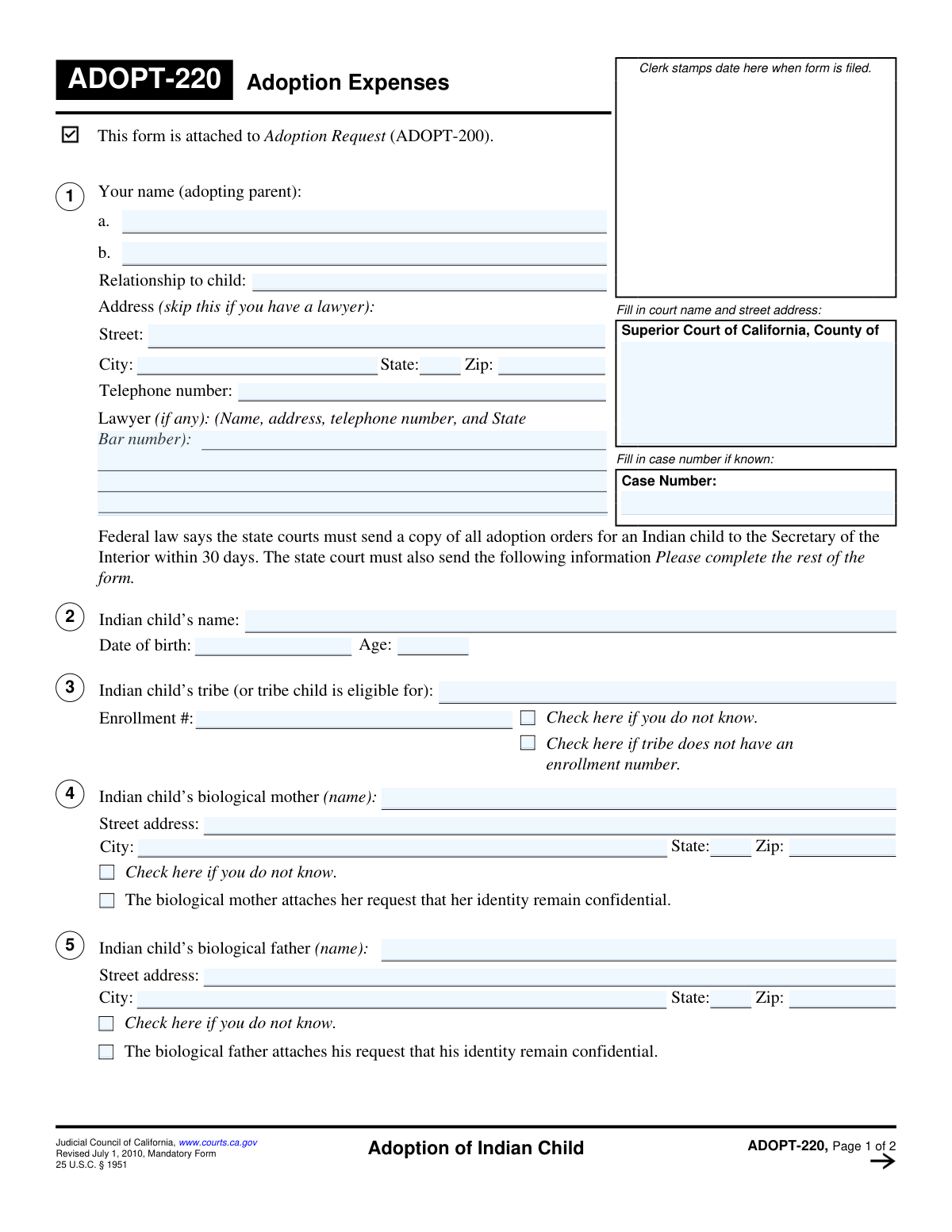
Form ADOPT-220 is a legal document used in California courts to make findings and issue orders for the adoption of an Indian child. It ensures the proceedings comply with the federal Indian Child Welfare Act (ICWA) by gathering detailed information about the child's tribal heritage, biological family, and the circumstances surrounding the termination of parental rights. Proper completion is vital for the legal validity of the adoption. Today, this form can be filled out quickly and accurately using AI-powered services like Instafill.ai, which can also convert non-fillable PDF versions into interactive fillable forms.
Our AI automatically handles information lookup, data retrieval, formatting, and form filling.
It takes less than a minute to fill out ADOPT-220 using our AI form filling.
Securely upload your data. Information is encrypted in transit and deleted immediately after the form is filled out.
Form specifications
| Form name: | Form ADOPT-220, Adoption of Indian Child |
| Number of fields: | 65 |
| Number of pages: | 2 |
| Language: | English |
| Categories: | adoption forms |
Instafill Demo: How to fill out PDF forms in seconds with AI
How to Fill Out ADOPT-220 Online for Free in 2026
Are you looking to fill out a ADOPT-220 form online quickly and accurately? Instafill.ai offers the #1 AI-powered PDF filling software of 2026, allowing you to complete your ADOPT-220 form in just 37 seconds or less.
Follow these steps to fill out your ADOPT-220 form online using Instafill.ai:
- 1 Navigate to Instafill.ai and upload or select the ADOPT-220 form to begin.
- 2 Provide the court and case information at the top of the form, including the county, court address, and case number.
- 3 Enter the personal details for the adopting parent(s) and their legal counsel, if applicable.
- 4 Fill in the required information about the Indian child, including their name, date of birth, age, and any known tribal affiliation or enrollment details.
- 5 Supply comprehensive information about the child's biological parents, grandparents, and any other individuals or agencies with knowledge of the child's ancestry.
- 6 Detail the status of parental rights, indicating how they were terminated (e.g., by court order or voluntary consent) and referencing related forms like ADOPT-225.
- 7 Carefully review all AI-populated fields for accuracy, then sign, date, and prepare the form for filing with the court.
Our AI-powered system ensures each field is filled out correctly, reducing errors and saving you time.
Why Choose Instafill.ai for Your Fillable ADOPT-220 Form?
Speed
Complete your ADOPT-220 in as little as 37 seconds.
Up-to-Date
Always use the latest 2026 ADOPT-220 form version.
Cost-effective
No need to hire expensive lawyers.
Accuracy
Our AI performs 10 compliance checks to ensure your form is error-free.
Security
Your personal information is protected with bank-level encryption.
Frequently Asked Questions About Form ADOPT-220
This form is used in court proceedings for the adoption of a child who is or may be an Indian child. It gathers essential information about the child, their biological family, tribal affiliation, and the adopting parents to comply with the Indian Child Welfare Act (ICWA).
The prospective adopting parent or their legal representative must complete and file this form with the court as part of the adoption process for an Indian child.
No, if you provide your lawyer's full contact information in the designated section, you do not need to fill in your personal street address, city, state, zip code, or telephone number.
The form includes checkboxes to indicate if the biological father's information is unknown or if the biological mother's address is unknown. Simply check the appropriate box if you cannot provide this information.
The form has specific checkboxes for these situations. You can check the box indicating you 'Do not know tribe' or that the 'Tribe does not have enrollment number'.
Yes, the form provides checkboxes in the 'Biological Indian Grandmothers' Information' and 'Biological Indian Grandfathers' Information' sections that you can mark if their names are unknown.
These are related legal forms used in adoption proceedings. ADOPT-200 is the main 'Adoption Request' form, and ADOPT-225 is used when parents voluntarily consent to the adoption of an Indian child.
The form provides checkboxes for both the biological mother and father to indicate that they have attached a request for their identity to remain confidential. Be sure to check the box and attach the required document.
You should gather the court case number (if known), the child's personal details, and any known information about the child's biological parents, grandparents, and tribal affiliation. You will also need your own contact information or that of your lawyer.
You should list any relatives, family friends, or community members who have knowledge of the child's family history and potential tribal connections. This information is crucial for matters related to the Indian Child Welfare Act.
Yes, services like Instafill.ai use AI to accurately auto-fill form fields, which can save you significant time and help reduce errors.
You can use a service like Instafill.ai to easily fill out this form online. Simply upload the form, and the platform will make it interactive for you to complete, sign, and download.
Tools like Instafill.ai can convert flat, non-fillable PDFs into interactive, fillable forms. This allows you to type your information directly into the fields instead of printing and writing by hand.
Compliance ADOPT-220
Validation Checks by Instafill.ai
1
Verifies Child's Age Against Date of Birth
This check calculates the child's current age based on the provided 'Date of Birth' and compares it to the value entered in the 'Age' field. This is crucial for ensuring data accuracy and consistency for legal proceedings. If the values do not match, the user will be prompted to correct either the date of birth or the age to ensure the record is accurate.
2
Ensures Exclusive Contact Information Entry
This validation enforces that either the adopting parent's address details or the 'Lawyer Contact Information' is provided, but not both. This logic prevents redundant or conflicting contact details on the form, as the parent's address is only required if no lawyer is listed. If data is entered in both sections, an error will be displayed, requiring the user to clear one set of fields to proceed.
3
Validates Child's Date of Birth Format and Plausibility
This check ensures the 'Date of Birth' field is entered in a valid format (e.g., MM/DD/YYYY) and represents a date that is in the past. It prevents impossible dates, such as future dates or non-existent dates like February 30th. This is fundamental for establishing the child's identity and eligibility for the proceedings.
4
Conditional Requirement for Tribe Name
This rule validates that the 'Child's Tribe' field is filled out if the 'Do not know tribe' checkbox is left unchecked. It is essential for ICWA (Indian Child Welfare Act) compliance to identify the child's tribe whenever possible. If the box is unchecked and the tribe name is missing, the form will prompt the user to either provide the tribe name or check the box indicating it is unknown.
5
Conditional Requirement for Tribe Enrollment Number
This validation ensures that the 'Tribe Enrollment Number' field is completed unless the 'Tribe does not have enrollment number' box is checked. This number is a key identifier for tribal records and is vital for official communication and verification. Failure to provide it when required will result in an error, asking the user to enter the number or confirm that one does not exist.
6
Conditional Requirement for Biological Mother's Information
This check enforces that the biological mother's name and address details are provided when the 'Biological Mother Address Unknown' checkbox is not selected. This information is critical for legal notifications and establishing family history as required by the adoption process. If the box is unchecked and the fields are empty, the user must either fill in the details or check the box to indicate the information is unknown.
7
Conditional Requirement for Biological Father's Information
This validation ensures the biological father's name and address details are entered if the 'Check here if you do not know' box (within the Biological Father section) is unchecked. Proper notification to the biological father is a legal requirement in adoption cases. The system will flag an error if the information is missing without the user explicitly stating it is unknown.
8
Validates Zip Code Format
This check verifies that all zip code fields contain a valid 5-digit or 9-digit (ZIP+4) format. Correctly formatted zip codes are essential for mail delivery and address verification systems. An invalid format will trigger an error message requesting the user to enter a standard U.S. zip code.
9
Logical Check for ADOPT-225 Signing Date
This validation confirms that the condition 'ADOPT-225 Signed 10 Days After Birth' is logically possible by comparing it to the child's 'Date of Birth'. This is a critical legal requirement to ensure the voluntary relinquishment of parental rights is valid. If this box is checked for a child less than 10 days old, the system will raise an alert, as the condition cannot yet be met.
10
Ensures Court Information is Complete
This validation ensures that the 'Court County and Street Address' field is not empty. This information is fundamental as it identifies the legal jurisdiction and physical location where the case is being filed. A submission with this field empty would be invalid and would be rejected with a prompt to provide the required court details.
11
Conditional Requirement for Parental Rights Termination Date
This rule checks that the 'Court Ended Parental Rights Date' field is filled and contains a valid date if the 'A court ended parental rights' box is checked. This date is a crucial piece of evidence in the adoption case, marking a significant legal event. If the box is checked but the date is missing or invalid, the user will be required to provide a valid date to proceed.
12
Ensures Adopting Parent's Full Name is Provided
This check verifies that both the 'Adopting Parent First Name' and 'Adopting Parent Last Name' fields are filled out. The identity of the adopting parent is the most basic and essential information for the form. The submission will be blocked if either name field is left blank, ensuring the primary party is clearly identified.
13
Consistency Check for Case Number Fields
This validation compares the values entered into the 'Case Number' field in the 'Court and Case Information' section and the 'Case Number' field at the bottom of the form. If both fields are filled, they must match to ensure data consistency throughout the document. A mismatch could indicate a typo or data entry error, and the system will prompt the user to resolve the discrepancy.
14
Conditional Requirement for Grandmothers' Names
This check ensures that at least one of the biological Indian grandmothers' name fields is filled if the 'Grandmothers Unknown' checkbox is not selected. This information is important for establishing ancestry under ICWA. If the box is unchecked and no names are provided, the system will prompt the user to either enter a name or check the box.
Common Mistakes in Completing ADOPT-220
Users often fill out their personal address and phone number even when they have also provided contact information for their lawyer. The form specifies filling the adopting parent's contact details only if the lawyer's information is empty. This creates ambiguity about the primary point of contact, potentially delaying court correspondence. To avoid this, provide information for either yourself or your lawyer, but not both, ensuring all legal notices are sent to the correct party.
A frequent error is entering a child's age that does not accurately correspond to the provided date of birth. This discrepancy can occur from a simple miscalculation or if the form is filled out over a period of time. Such inconsistencies can raise questions about the accuracy of the entire petition and may require clarification, slowing down the legal process. Double-check the calculation before submission; AI-powered tools like Instafill.ai can automatically calculate and populate the age based on the date of birth to prevent this error.
Applicants sometimes enter a tribe name in the 'Child's Tribe' field while simultaneously checking the 'Do not know tribe' box. This contradiction makes it impossible for the court to proceed with the necessary notifications required under the Indian Child Welfare Act (ICWA). This can lead to significant delays or dismissal of the filing. You must choose one option: either provide the specific tribe name or indicate that it is unknown.
People may provide a partial address for a biological parent (e.g., just a city) and also check the box indicating the address is 'Unknown'. This conflicting information hinders the legal requirement to notify biological parents. If any part of the address is known, it should be provided in full; if the entire address is truly unknown, only the 'Unknown' box should be checked. Using a tool like Instafill.ai can help ensure conditional fields are filled correctly, preventing such contradictions.
A critical mistake is checking a box that states a document is attached—such as a confidentiality request or the ADOPT-225 form—without actually including the document with the filing. The court relies on these attachments to verify consent and confidentiality, and their absence will halt the proceedings until they are provided. Always compile all necessary documents before filling out the form and physically attach them before submission.
Users frequently check a box indicating how parental rights were terminated (e.g., 'A court ended parental rights') but then fail to enter the corresponding date in the adjacent field. This missing date is a crucial piece of evidence for the court to confirm the legal status of the parents. Leaving it blank renders the selection incomplete and will require an amended filing, causing delays. Ensure that for every box you check in this section, you also fill in any required dates or additional information.
Filers often enter just the county name or an incomplete street address for the court, assuming the clerk will know the location. However, filings can be rejected if the court cannot be precisely identified, especially in large counties with multiple court locations. Always provide the full street address, city, state, and zip code of the specific courthouse where you are filing the form. If the form is a non-fillable PDF, a tool like Instafill.ai can convert it to a fillable version and help you accurately populate these details.
The form specifically requests the maiden names of the biological grandmothers, but this detail is often overlooked. Maiden names are vital for accurately tracing the child's lineage and confirming eligibility for tribal enrollment under ICWA. Omitting this information when it is known can complicate the verification process and delay the case. Make a diligent effort to find and include the full names, including maiden names, for all relatives listed.
The form contains two separate fields for the 'Case Number,' one at the top and one near the bottom. A common error is entering different numbers in these fields or leaving one blank, which creates confusion and can lead to the document being misfiled. This can cause significant delays and administrative problems in linking the form to the correct case file. To prevent this, carefully copy the exact same case number into both fields every time.
When a child's tribe is known and has enrollment numbers, applicants sometimes fail to provide the 'Tribe Enrollment Number' or incorrectly check the box stating the 'Tribe does not have enrollment number'. This number is a key identifier for the tribe and is essential for ICWA compliance and verifying the child's status. Failing to provide it when available can delay the required tribal notifications and the overall adoption process. Always verify with the tribe if enrollment numbers are used and provide the correct number if applicable.
Saved over 80 hours a year
“I was never sure if my IRS forms like W-9 were filled correctly. Now, I can complete the forms accurately without any external help.”
Kevin Martin Green
Your data stays secure with advanced protection from Instafill and our subprocessors

Robust compliance program
Transparent business model
You’re not the product. You always know where your data is and what it is processed for.
ISO 27001, HIPAA, and GDPR
Our subprocesses adhere to multiple compliance standards, including but not limited to ISO 27001, HIPAA, and GDPR.
Security & privacy by design
We consider security and privacy from the initial design phase of any new service or functionality. It’s not an afterthought, it’s built-in, including support for two-factor authentication (2FA) to further protect your account.
Fill out ADOPT-220 with Instafill.ai
Worried about filling PDFs wrong? Instafill securely fills form-adopt-220-adoption-of-indian-child forms, ensuring each field is accurate.