Yes! You can use AI to fill out Level of Care (LOC) Assessment for Children in Foster Care
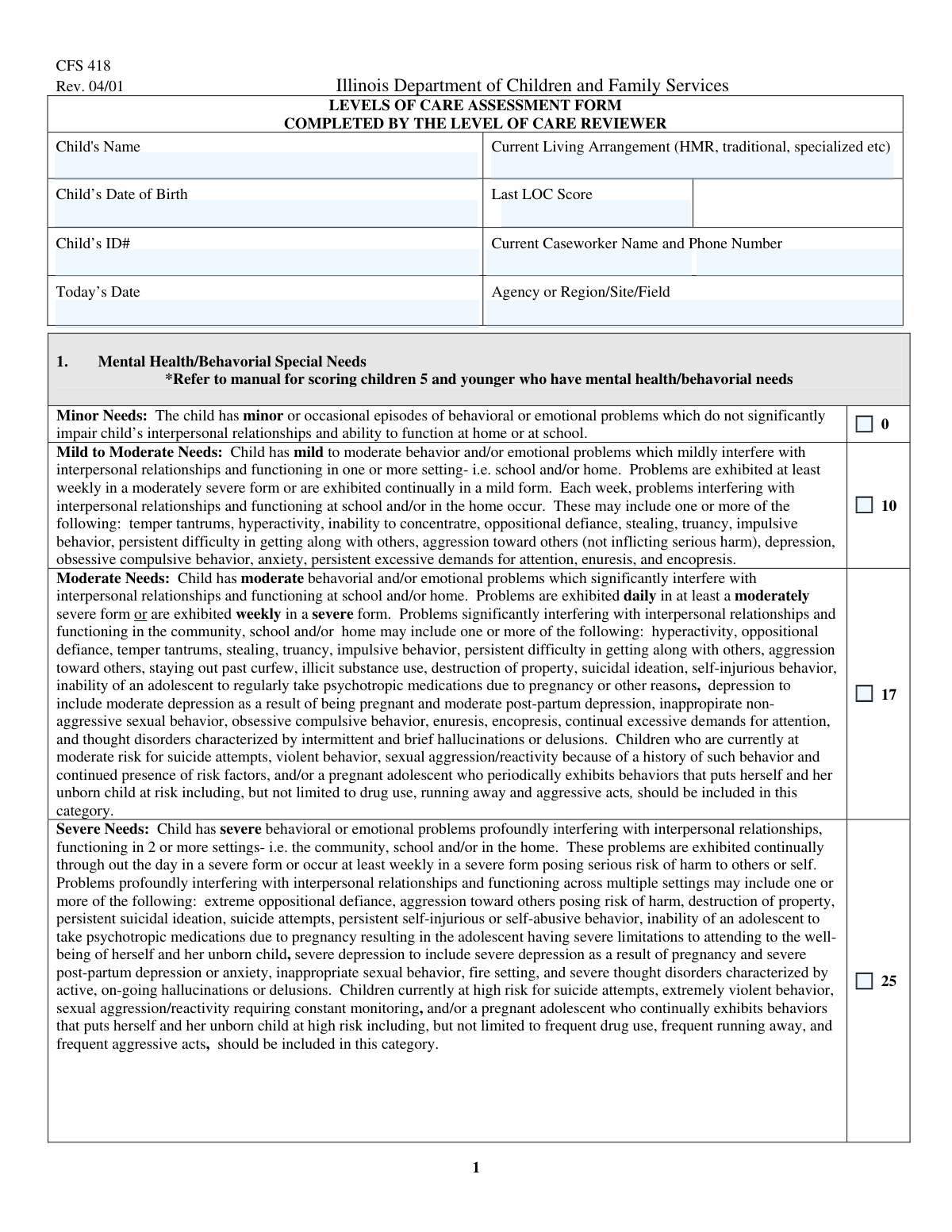
The Level of Care (LOC) Assessment is a critical document used in the child welfare system to systematically evaluate a child's needs across multiple domains, including medical, developmental, behavioral, and educational. This detailed assessment determines the appropriate level of care, supervision, and services the child requires, which in turn influences the support and reimbursement provided to foster parents. Completing this comprehensive form accurately is crucial for ensuring the child receives the best possible care. Today, this form can be filled out quickly and accurately using AI-powered services like Instafill.ai, which can also convert non-fillable PDF versions into interactive fillable forms.
LOC Assessment is part of the
CAR forms, child care forms, foster care forms and L.A. Care forms categories on Instafill.
Our AI automatically handles information lookup, data retrieval, formatting, and form filling.
It takes less than a minute to fill out LOC Assessment using our AI form filling.
Securely upload your data. Information is encrypted in transit and deleted immediately after the form is filled out.
Form specifications
| Form name: | Level of Care (LOC) Assessment for Children in Foster Care |
| Number of fields: | 125 |
| Number of pages: | 6 |
| Filled form examples: | Form LOC Assessment Examples |
| Language: | English |
More forms in CAR forms
Instafill Demo: How to fill out PDF forms in seconds with AI
How to Fill Out LOC Assessment Online for Free in 2026
Are you looking to fill out a LOC ASSESSMENT form online quickly and accurately? Instafill.ai offers the #1 AI-powered PDF filling software of 2026, allowing you to complete your LOC ASSESSMENT form in just 37 seconds or less.
Follow these steps to fill out your LOC ASSESSMENT form online using Instafill.ai:
- 1 Navigate to Instafill.ai and upload the Level of Care (LOC) Assessment form, or select it from a list of available templates.
- 2 Use the AI assistant to quickly populate the Child Information and Case Information sections, including the child's name, ID number, caseworker details, and current date.
- 3 Systematically complete the detailed needs assessment by checking the appropriate boxes for mental health, developmental, supervision, and medical needs based on the child's evaluation.
- 4 Enter the calculated scores for each assessment category, such as the Mental Health/Behavioral Score and Medical/Physical Characteristics Score, ensuring the Total Score on LOC is correctly tallied.
- 5 Fill out the final sections regarding LOC re-review exemptions, effective dates, and appropriate foster care service codes based on the assessment's outcome.
- 6 Input any reviewer comments or service recommendations for the child's treatment plan, then use the AI tool to review the entire form for completeness and accuracy before finalizing and submitting.
Our AI-powered system ensures each field is filled out correctly, reducing errors and saving you time.
Why Choose Instafill.ai for Your Fillable LOC Assessment Form?
Speed
Complete your LOC Assessment in as little as 37 seconds.
Up-to-Date
Always use the latest 2026 LOC Assessment form version.
Cost-effective
No need to hire expensive lawyers.
Accuracy
Our AI performs 10 compliance checks to ensure your form is error-free.
Security
Your personal information is protected with bank-level encryption.
Frequently Asked Questions About Form LOC Assessment
This form is used to assess a child's specific needs across various areas, such as mental health, medical care, and supervision, to determine the appropriate level of care and support required in their living arrangement.
A caseworker, reviewer, or another authorized professional from the associated agency is typically responsible for completing this assessment based on the child's case information and evaluations.
You will need the child's full name, date of birth, and ID number, as well as the caseworker's contact details, agency information, and the child's most recent Level of Care (LOC) score.
Select the level that best describes the amount of supervision the child requires due to their emotional, behavioral, or developmental needs, ranging from 'Minor Needs' for typical supervision to 'Severe Needs' for continual 24-hour monitoring.
Mild to Moderate applies to children with a 504 plan or receiving special education services in a standard classroom. Moderate is for children in a full-day self-contained class, with a one-to-one aide, or who are frequently suspended.
A child may be exempt from re-reviews if they have a chronic medical condition not expected to improve or an IQ of 39 or below, as indicated in the 'LOC Re-review Exemption' section.
These scores are typically calculated based on the selections made within each corresponding section, following a specific scoring guide or rubric provided by your agency.
After submission, the form is reviewed to determine the child's official Level of Care, which then informs the treatment plan, service recommendations, and potentially the foster care payment rate.
These fields should only be completed if the child's current placement is in a home that is officially licensed, as indicated by checking the 'Licensed' box.
This indicates a conditional field that should only be completed if a specific condition in another part of the form is met. This helps ensure you only fill out sections relevant to the child's specific situation.
Yes, services like Instafill.ai use AI to accurately auto-fill form fields from your existing records, which can save significant time and reduce errors.
You can upload the form to the Instafill.ai platform, which will make it fillable online. You can then use its AI capabilities to automatically populate the fields with the correct information from your case files.
You can use a service like Instafill.ai, which can convert flat, non-fillable PDFs into interactive, fillable forms that you can complete and save digitally.
Compliance LOC Assessment
Validation Checks by Instafill.ai
1
Ensures Date of Birth is in the Past
This check validates that the 'Child's Date of Birth' is a date that occurs before 'Today's Date'. This is crucial for ensuring data accuracy and preventing logical impossibilities in the child's record. If the date of birth is not before the current date, the form submission will be rejected with an error prompting the user to enter a valid past date.
2
Validates Total LOC Score Calculation
This validation confirms that the value entered in 'Total Score on LOC' is the correct sum of all individual score components (e.g., 'Mental Health/Behavioral Score', 'Developmental Score', 'Supervision Scores', etc.). This check maintains the integrity of the assessment's final score, which is critical for determining the appropriate level of care. A mismatch would trigger an alert, requiring the user to recalculate or correct the individual or total scores before proceeding.
3
Enforces Re-review Period Conditional Logic
This check ensures that the 'Re-review Period in Months' field is only populated if the 'Yes, Re-review Before One Year' checkbox is selected. This prevents inconsistent or orphaned data where a re-review period is specified without a corresponding trigger. If the condition is not met, the 'Re-review Period in Months' field will be disabled or cleared, guiding the user to follow the correct data entry path.
4
Verifies Exclusive Placement Status Selection
This validation ensures that only one of the three placement status checkboxes ('Licensed', 'Unlicensed Relative', 'N/A') is selected. A child's placement status must be singular and unambiguous for proper case management and service allocation. If more than one option is checked, the form will display an error message asking the user to select only the single, correct placement status.
5
Validates Phone Number Format
This check verifies that the 'Caseworker Phone Number' and 'Reviewer Phone Number' fields adhere to a standard phone number format (e.g., 10 digits, optional parentheses, hyphens). Correctly formatted phone numbers are essential for reliable communication with case personnel. An invalid format will prevent submission and prompt the user to correct the entry to ensure it can be used by communication systems.
6
Confirms LOC Re-review Exemption Criteria
This validation enforces the rule that the 'Yes' checkbox for LOC re-review exemption can only be selected if the 'Developmental Score' is 'Severe Needs' OR the 'Medical/Physical Characteristics Score' is 'Severe Needs'. This ensures that exemptions are only granted based on specific, severe, and chronic conditions as defined by policy. Attempting to check 'Yes' without meeting the criteria will result in an error, preventing incorrect exemptions.
7
Checks for Mandatory Child Information
This validation ensures that critical identifying fields such as 'Child's Name', 'Child's ID Number', and 'Child's Date of Birth' are not empty. This information is fundamental for creating or updating a record and linking it to the correct individual in the system. If any of these fields are left blank, the form cannot be submitted, and the user will be prompted to fill in the required information.
8
Verifies Numeric Format for Score Fields
This check ensures that all fields designated as scores (e.g., 'Mental Health/Behavioral Score', 'Developmental Score', 'Personal Care Score') contain only numeric values. Scores are quantitative measures used in calculations, and non-numeric data would break these calculations and invalidate the assessment. If text or special characters are entered, the user will receive an error and must correct the field to a valid number.
9
Enforces Service Code Dependency on License Status
This validation ensures that the 'Specialized Foster Care Service Code' and 'Treatment Foster Care Service Code' fields can only be populated if the 'Licensed' placement checkbox is selected. These service codes are only applicable to licensed placements, and this rule prevents incorrect billing and service tracking. If 'Licensed' is not checked, these fields will be disabled or hidden.
10
Ensures Exclusive Selection for Needs Levels
This check validates that within a single category, such as 'Developmental Special Needs', only one level ('Minor Needs', 'Mild to Moderate Needs', 'Moderate Needs', or 'Severe Needs') is selected. A child can only be classified at one level of need for a specific domain at any given time. Selecting multiple levels would create ambiguity and will trigger an error requiring the user to choose a single, most appropriate level.
11
Validates Re-review Exemption Reason Dependency
This check ensures that the 'Chronic Medical Condition' or 'IQ 39 or Below' checkboxes can only be selected if the primary 'Yes' checkbox for LOC re-review exemption is also checked. These fields provide the specific reason for an exemption and are meaningless without it. If the primary 'Yes' is not checked, these reason-specific checkboxes will be disabled to guide the user.
12
Confirms Behavior Modification Plan Consistency
This validation enforces that the 'Moderate Needs - Behavior Modification' checkbox can only be selected if the 'Moderate Needs' checkbox in the 'Need for Direct Supervision' section is also selected. This creates a logical link, ensuring that a behavior modification plan's intensity matches the child's assessed supervision needs. A mismatch would trigger a warning, prompting the reviewer to ensure the assessment is consistent.
13
Validates LOC Effective Date Logic
This check ensures the 'LOC Effective Date' is a valid date and falls within a logical timeframe, specifically after the 'Child's Date of Birth' and on or before 'Today's Date'. This prevents clerical errors like future-dating or incorrect year entries that would impact service authorization and payment timelines. An invalid or illogical date will block submission and require correction.
14
Verifies Child ID Number Format and Existence
This validation checks that the 'Child's ID Number' is not only present but also conforms to a predefined format (e.g., a specific number of digits or alphanumeric pattern). It should also be cross-referenced with the system database to confirm it is a valid and active ID. This is critical for preventing data duplication and ensuring the assessment is applied to the correct child's record.
Common Mistakes in Completing LOC Assessment
Users often enter a numerical score in a category (e.g., 'Developmental Score') but then check a box for a non-corresponding needs level (e.g., entering a score for 'Severe Needs' but checking the 'Moderate Needs' box). This contradiction invalidates the assessment for that entire section, as it's unclear what the child's true level of need is. To avoid this, carefully read the definition for each needs level and ensure the checkbox you select directly matches the score you entered, creating a consistent record of the child's needs.
This form contains many fields with 'Fill only if...' instructions, which are frequently missed. For example, a user might enter a 'Treatment Foster Care Service Code' even when the 'Licensed' box is not checked, creating conflicting data. This leads to form rejection and processing delays. Always read the fine print for each field to ensure you are only providing information when the specified conditions are met.
A common error is checking 'Yes' for the 'LOC Re-review Exemption' without the child meeting the strict criteria, which require a 'Severe Needs' score in either the Developmental or Medical/Physical sections. This mistake can improperly remove a child from the annual review cycle, potentially violating policy and causing their future needs to be overlooked. Only claim this exemption if the specific prerequisites are met and then select the correct reason ('Chronic Medical Condition' or 'IQ 39 or Below').
Users may correctly identify that a child needs a re-review in less than one year by checking the 'Yes, Re-review Before One Year' box, but then forget to specify the timeframe in the 'Re-review Period in Months' field. This makes the request for an early review incomplete and unactionable, delaying a timely reassessment of the child's changing needs. If an early re-review is required, you must complete both fields to ensure it is scheduled correctly.
The form specifies that the 'Personal Care Needs Level' section should only be completed if the 'Medical/Physical Characteristics' indicate a need greater than 'Minor'. People often fill out the personal care details anyway, even for children with minor or no medical issues. This creates unnecessary and sometimes contradictory data. To prevent this, first complete the 'Medical/Physical Characteristics' section and only proceed to the 'Personal Care' section if the child's needs are assessed as mild, moderate, or severe.
In fields like 'Current Living Arrangement', users sometimes write in their own descriptions instead of using the specified terms (HMR, traditional, specialized, etc.). This lack of standardization makes data aggregation and reporting difficult and can lead to misclassification of the child's placement. Always use the precise terminology provided in the form's instructions to ensure clarity and consistency.
Key identifiers like 'Child's Name' and 'Child's ID Number' appear in multiple places on the form. It is common for typos or slight variations to occur between these entries, which creates ambiguity and can cause record-matching failures in the system. To avoid this, carefully proofread the entire form before submission to ensure all repeated information is identical. AI-powered tools like Instafill.ai can prevent this by auto-populating repeated fields consistently.
Entering dates in an incorrect format (e.g., DD-MM-YYYY instead of MM/DD/YYYY) is a frequent error that can cause data import failures. Another mistake is entering illogical dates, such as an 'LOC Effective Date' that is earlier than the child's date of birth. These errors can halt the entire application process. Always use the standard MM/DD/YYYY format and double-check that all dates are logical and chronologically correct.
The 'Caseworker Name' and 'Caseworker Phone Number' fields are sometimes left blank, entered with typos, or contain only a first name. This is a critical error, as reviewers often need to contact the caseworker to verify information or clarify details about the child's needs. Missing or incorrect contact information creates significant delays. Ensure the caseworker's full name and a valid, direct phone number are entered correctly.
This complex form assesses needs in multiple overlapping domains like 'Direct Supervision', 'Behavioral Needs', and 'Psychotherapy'. A user might incorrectly select 'Minor Needs' for supervision but 'Severe Needs' for behavior modification, creating a conflicting profile of the child. Such contradictions require manual follow-up and delay the approval process. Review the form holistically to ensure the selections across different categories paint a logical and consistent picture of the child's overall condition.
Saved over 80 hours a year
“I was never sure if my IRS forms like W-9 were filled correctly. Now, I can complete the forms accurately without any external help.”
Kevin Martin Green
Your data stays secure with advanced protection from Instafill and our subprocessors

Robust compliance program
Transparent business model
You’re not the product. You always know where your data is and what it is processed for.
ISO 27001, HIPAA, and GDPR
Our subprocesses adhere to multiple compliance standards, including but not limited to ISO 27001, HIPAA, and GDPR.
Security & privacy by design
We consider security and privacy from the initial design phase of any new service or functionality. It’s not an afterthought, it’s built-in, including support for two-factor authentication (2FA) to further protect your account.
Fill out LOC Assessment with Instafill.ai
Worried about filling PDFs wrong? Instafill securely fills level-of-care-loc-assessment-for-children-in-foster-care forms, ensuring each field is accurate.



