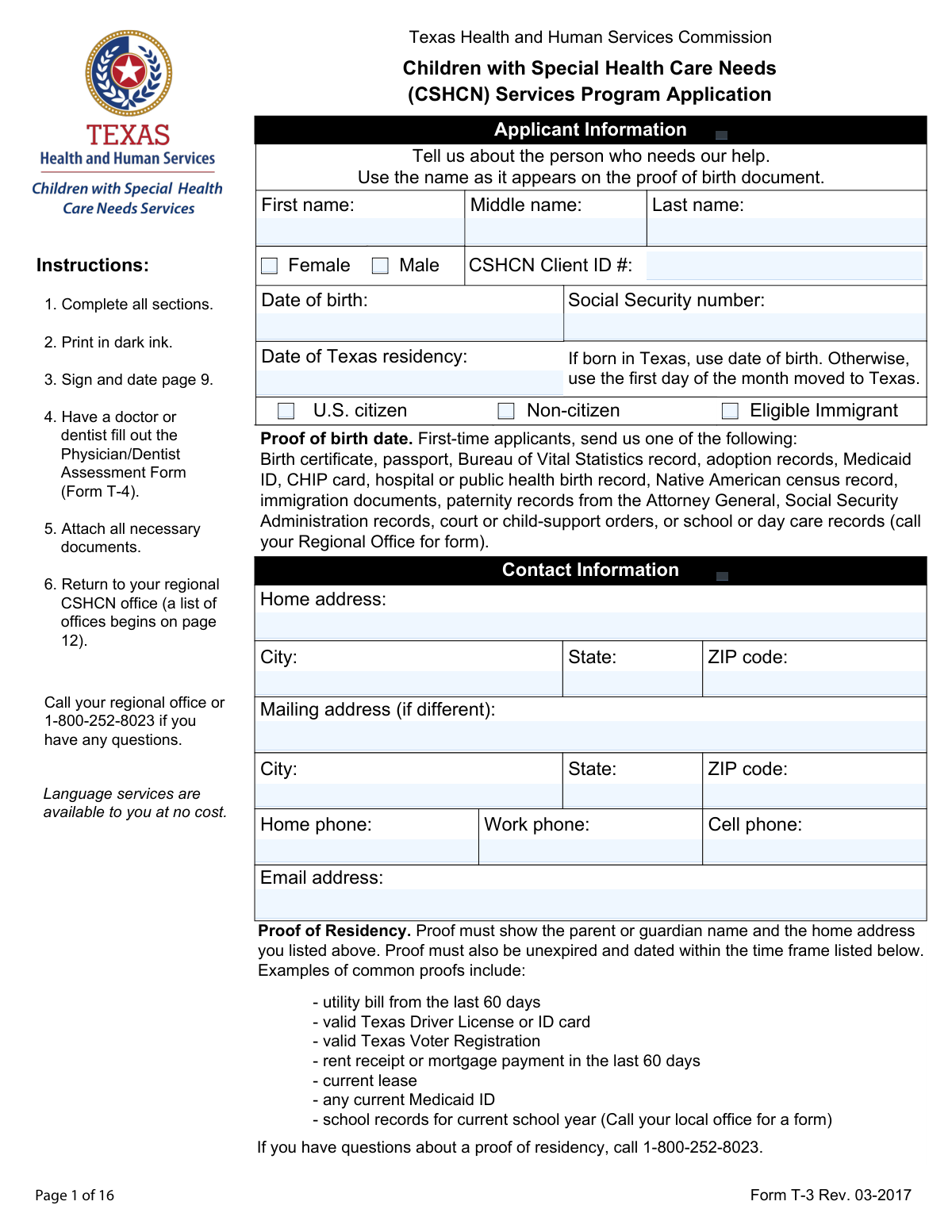
Yes! You can use AI to fill out Form T-3, Children with Special Health Care Needs (CSHCN) Services Program Application
Form T-3 is an application used by the Texas Health and Human Services Commission to enroll children with special health care needs into the CSHCN Services Program. It gathers detailed information about the applicant, their household, income, and insurance to assess eligibility for state-funded health services and support. Completing this multi-page document accurately is crucial for families seeking assistance. Today, this form can be filled out quickly and accurately using AI-powered services like Instafill.ai, which can also convert non-fillable PDF versions into interactive fillable forms.
Our AI automatically handles information lookup, data retrieval, formatting, and form filling.
It takes less than a minute to fill out T-3 using our AI form filling.
Securely upload your data. Information is encrypted in transit and deleted immediately after the form is filled out.
Form specifications
| Form name: | Form T-3, Children with Special Health Care Needs (CSHCN) Services Program Application |
| Number of pages: | 9 |
| Language: | English |
| Categories: | CAR forms, child care forms, health care forms, L.A. Care forms, health services forms, health forms |
Instafill Demo: How to fill out PDF forms in seconds with AI
How to Fill Out T-3 Online for Free in 2026
Are you looking to fill out a T-3 form online quickly and accurately? Instafill.ai offers the #1 AI-powered PDF filling software of 2026, allowing you to complete your T-3 form in just 37 seconds or less.
Follow these steps to fill out your T-3 form online using Instafill.ai:
- 1 Navigate to Instafill.ai and upload or select Form T-3, the CSHCN Services Program Application.
- 2 Use the AI assistant to accurately fill in the applicant's information, including name, address, date of birth, and residency details.
- 3 Provide comprehensive details for all household members, including their income sources and relationship to the applicant.
- 4 Enter all current insurance information for the applicant, such as Medicaid, CHIP, Medicare, or private health coverage.
- 5 Securely upload all required supporting documents, including proof of birth date, residency, income, and insurance cards.
- 6 Review all auto-filled information for accuracy, then proceed to electronically sign and date the application on page 9.
- 7 Download the completed application and all attachments, ready for submission to your regional CSHCN office.
Our AI-powered system ensures each field is filled out correctly, reducing errors and saving you time.
Why Choose Instafill.ai for Your Fillable T-3 Form?
Speed
Complete your T-3 in as little as 37 seconds.
Up-to-Date
Always use the latest 2026 T-3 form version.
Cost-effective
No need to hire expensive lawyers.
Accuracy
Our AI performs 10 compliance checks to ensure your form is error-free.
Security
Your personal information is protected with bank-level encryption.
Frequently Asked Questions About Form T-3
This form is used to apply for the Texas Children with Special Health Care Needs (CSHCN) Services Program. The program provides health benefits and support services for children with special health care needs and their families.
The applicant is the child with special health care needs who requires assistance from the program. A parent or legal guardian must complete and sign the application on the child's behalf.
You must submit proof of birth date (for first-time applicants), proof of Texas residency, proof of income for all legally responsible adults in the household, and copies of any insurance cards. You also need to include the Physician/Dentist Assessment Form (T-4) completed by your child's doctor.
Acceptable proofs of residency include a utility bill from the last 60 days, a valid Texas Driver License or ID card, a current lease agreement, or a recent mortgage payment receipt. A current Medicaid ID or school records for the current year are also valid.
You must provide proof of all income from the last 60 days for every household member legally obligated to support the applicant. This can include paycheck stubs, letters from employers, or benefit award letters. Note that the applicant's own SSI income should not be included.
Form T-4 is a separate medical form that must be filled out and signed by the applicant's doctor or dentist. It provides the CSHCN program with the necessary information about the child's health condition to determine medical eligibility.
After completing all sections and signing page 9, you must return the application and all required documents to your regional CSHCN office. A complete list of regional offices and their addresses begins on page 12 of the form.
You must list the applicant and every other person who lives in your house. This includes parents, guardians, spouses, siblings, and any other children or relatives residing at the same address.
If your household currently has no source of income, you can simply check the 'No household income' box in the Income Information section. You will not be required to submit income proofs.
If the applicant was born in Texas, use their date of birth as the residency date. If the applicant moved to Texas from another state, use the first day of the month in which they moved to Texas.
If you disagree with a decision, you have the right to appeal. You must request an Administrative Review within 30 days, and if you still disagree with the outcome, you can then request a Fair Hearing.
Yes, services like Instafill.ai use AI to accurately auto-fill form fields, which can save you time and help prevent common errors on long applications. This ensures your form is completed correctly before submission.
To fill out the form online, you can upload the CSHCN application PDF to the Instafill.ai platform. The service will make the form interactive, allowing you to easily type your information into the correct fields and save your progress.
If you have a non-fillable or 'flat' PDF, you can upload it to a service like Instafill.ai. The platform's technology can convert the static document into an interactive, fillable form that you can complete on your computer.
Compliance T-3
Validation Checks by Instafill.ai
1
Applicant Date of Birth Validity
This check verifies that the applicant's date of birth is a valid date formatted as MM/DD/YYYY and is in the past. It ensures the applicant is a child, as this program is for Children with Special Health Care Needs. An invalid or future date would make eligibility determination impossible and suggests a data entry error.
2
Texas Residency Date Logic
This validation ensures the 'Date of Texas residency' is a valid date and is not in the future. It also cross-references the applicant's date of birth, as per the form's instruction: 'If born in Texas, use date of birth.' This check prevents logical impossibilities, like residency starting before birth, and ensures compliance with program rules for establishing residency.
3
Social Security Number Format
This check validates that the 'Social Security number' field, if filled, follows the standard XXX-XX-XXXX format. Proper formatting is crucial for correct identification and integration with other state and federal systems. Failure to meet the format will prevent the record from being processed correctly.
4
Signature and Date Completion
This validation confirms that the signature and date fields on page 9 have been filled out. The signature is a legal attestation that the provided information is true, and the date establishes when the attestation was made. An application without a signature is legally incomplete and cannot be accepted for processing.
5
Mutually Exclusive Insurance Status
This check ensures that the user has not selected both 'The applicant has coverage' and 'The applicant is not covered under any medical or dental insurance' on page 7. These two options are contradictory and selecting both creates ambiguity. The form must be rejected for clarification to accurately assess the applicant's insurance situation.
6
Conditional Insurance Number Requirement
This validation ensures that if an applicant checks 'Yes' for having Medicaid, CHIP, or Medicare, the corresponding number field (e.g., 'Medicaid number', 'CHIP number') is not left blank. This number is essential for verifying coverage and coordinating benefits. An application indicating coverage without a corresponding ID number is incomplete and requires correction.
7
Income Source and Pay Cycle Consistency
This check verifies that if any income source (e.g., Employment, Self-employment) is selected for the applicant or a household member, a corresponding 'Pay cycle' is also selected. This information is necessary to calculate the household's total annual income for eligibility determination. If income is declared but the pay frequency is missing, the financial assessment cannot be completed.
8
Required 'Other Relationship' Specification
This validation ensures that if the 'Other' checkbox is selected for a household member's relationship to the applicant, the adjacent text field specifying the relationship is filled in. This is important for understanding the household composition and legal responsibilities. An incomplete entry would require follow-up to clarify the household structure.
9
Required Contact Information
This check validates that at least one phone number (Home, Work, or Cell) has been provided in the 'Contact Information' section on page 1. Having a valid phone number is critical for the CSHCN office to contact the family with questions, provide updates, or communicate eligibility decisions. An application without any contact phone number may be delayed or denied.
10
Household Member Age vs. Relationship Logic
This is a logical check that compares a household member's date of birth with the applicant's date of birth based on the stated relationship. For example, a person listed as 'Parent/Guardian' must be significantly older than the applicant, while a 'Child' must be younger. This helps catch data entry errors and ensures the household structure is reported logically.
11
Conditional Mailing Address Completeness
This validation triggers if any part of the 'Mailing address' section is filled out. It ensures that all related fields (street, city, state, and ZIP code) are also completed. An incomplete mailing address is unusable and could result in critical documents being lost or returned, delaying the application process.
12
Private Insurance Details Requirement
This check ensures that if 'Yes' is selected for 'Does the applicant have any kind of private insurance?', then the key details like 'Insurance provider name', 'Member/policy number', and 'Coverage start date' are mandatory. This information is vital for the program to act as a payer of last resort and to coordinate benefits. Missing this information makes the insurance section incomplete and unusable.
13
Income Declaration Contradiction
This validation ensures that if 'No household income' is checked for the applicant or any household member, no other income source checkboxes (e.g., Employment, SSI) are also checked for that same person. These selections are mutually exclusive and selecting both creates a contradiction. The form must be corrected to accurately reflect the person's income status.
Common Mistakes in Completing T-3
Applicants often enter a nickname or a slightly different version of the child's name than what is on the official birth certificate. The form explicitly requires the name to match the proof of birth document exactly for verification purposes. A mismatch can lead to processing delays or an outright rejection of the application until the discrepancy is corrected.
The form requires proof of residency, such as a utility bill or rent receipt, to be dated within the last 60 days. Many applicants submit documents that are older than the specified time frame or provide a document not on the approved list. This results in an incomplete application and requires the applicant to resubmit valid proof, delaying access to services.
This field has a specific rule that is easily missed: use the date of birth if born in Texas, but use the first day of the month the applicant moved to Texas otherwise. People often enter the exact day they moved or guess the date, which is incorrect. An error here can complicate eligibility verification and cause delays.
Applicants must report every source of income for every legally responsible household member and provide proof dated within the last 60 days. Common errors include forgetting a source of income (like child support), omitting an adult's income, or attaching expired paycheck stubs. This is a primary reason for application rejection, as financial eligibility cannot be determined without complete and current information.
This application requires a separate Form T-4 to be completed and signed by the applicant's doctor or dentist. Because this requires coordinating with a third-party medical provider, it is frequently forgotten or submitted late. An application is considered incomplete and will not be processed without this signed medical assessment.
The form requires listing all health coverage, including Medicaid, CHIP, Medicare, and any private or supplemental plans. Applicants sometimes forget to list a secondary policy, believing it's not relevant. However, the signature page includes a legal attestation that all coverage has been disclosed, and failing to do so can jeopardize eligibility and create billing issues later.
The instructions specifically require a copy of the front and back of every insurance ID card. A frequent oversight is only copying the front of the card, which often omits important information like claims submission addresses and contact numbers found on the back. This slows down the verification process as the office must request the missing information.
The signature and date fields are located on page 9 of a 16-page document, making them easy to overlook. An unsigned or undated application is legally invalid and will be returned immediately without being reviewed. This simple mistake forces the applicant to restart the submission process from the beginning.
The application requires information for every person in the house, but specifically needs income details for those legally responsible for the applicant (e.g., parents, spouse). Applicants may forget to list a parent who lives in the home or fail to provide their income information, leading to an inaccurate assessment of household financial need. This will cause the application to be flagged as incomplete.
The income section explicitly states, 'Do not include the applicant's SSI income' when calculating household income. This instruction is often missed, and parents include the child's SSI benefits along with other family income. Including this income can incorrectly inflate the household's total income, potentially making them appear ineligible for the program.
Saved over 80 hours a year
“I was never sure if my IRS forms like W-9 were filled correctly. Now, I can complete the forms accurately without any external help.”
Kevin Martin Green
Your data stays secure with advanced protection from Instafill and our subprocessors

Robust compliance program
Transparent business model
You’re not the product. You always know where your data is and what it is processed for.
ISO 27001, HIPAA, and GDPR
Our subprocesses adhere to multiple compliance standards, including but not limited to ISO 27001, HIPAA, and GDPR.
Security & privacy by design
We consider security and privacy from the initial design phase of any new service or functionality. It’s not an afterthought, it’s built-in, including support for two-factor authentication (2FA) to further protect your account.
Fill out T-3 with Instafill.ai
Worried about filling PDFs wrong? Instafill securely fills form-t-3-children-with-special-health-care-needs-cshcn-services-program-application forms, ensuring each field is accurate.