Yes! You can use AI to fill out Intact Family Services Child Care Referral Form

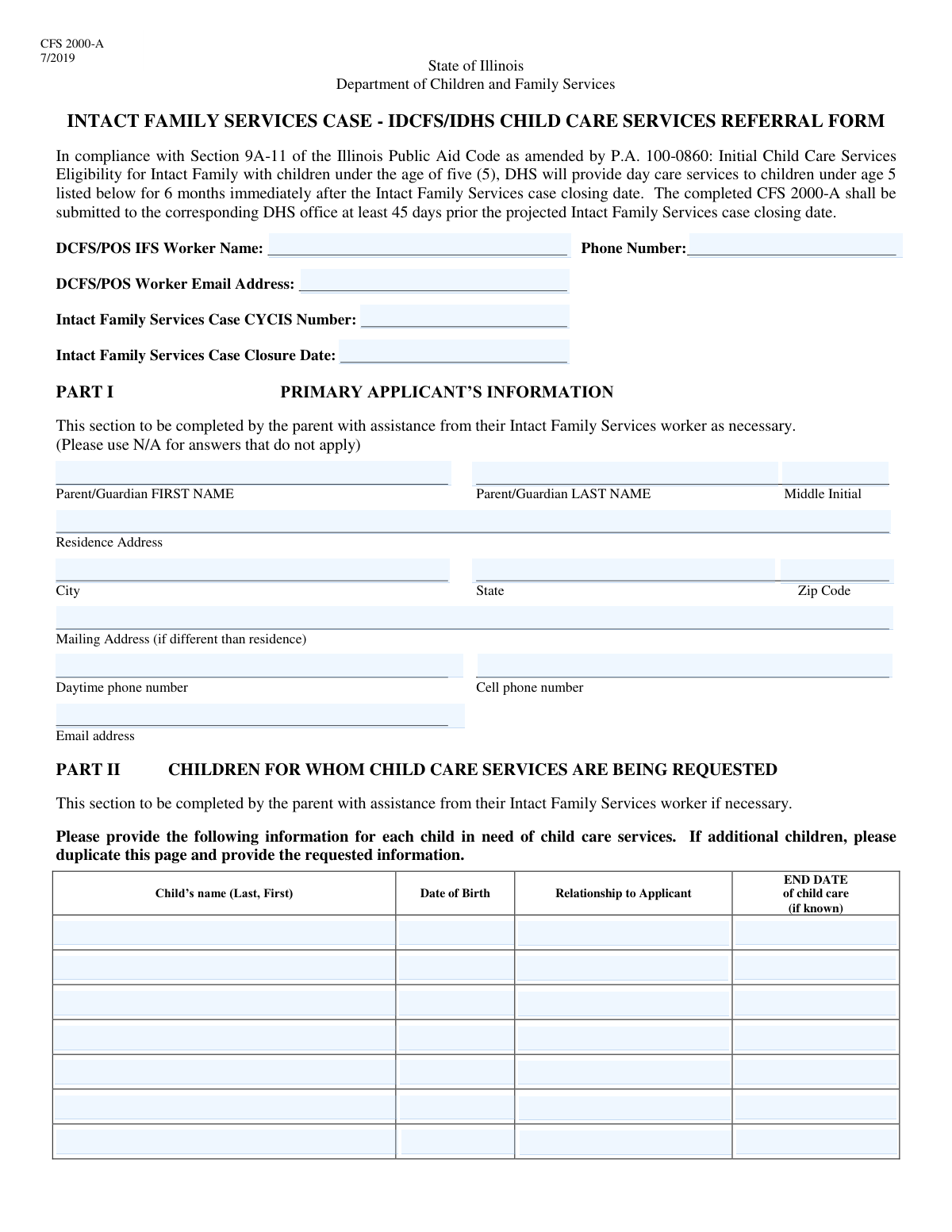
The Intact Family Services Child Care Referral Form is a critical document used by the Department of Children and Family Services (DCFS) to formally refer families for child care assistance. It serves as the official request, capturing essential details about the referring social worker, the family's case, the primary applicant, and the children requiring care, ensuring a smooth transition into receiving support services. Today, this form can be filled out quickly and accurately using AI-powered services like Instafill.ai, which can also convert non-fillable PDF versions into interactive fillable forms.
IFS Child Care Referral is part of the CAR forms, child care forms, referral forms and L.A. Care forms categories on Instafill.
Our AI automatically handles information lookup, data retrieval, formatting, and form filling.
It takes less than a minute to fill out IFS Child Care Referral using our AI form filling.
Securely upload your data. Information is encrypted in transit and deleted immediately after the form is filled out.

Form specifications

Form name: Intact Family Services Child Care Referral Form
Number of fields: 44
Number of pages: 1
Filled form examples: Form IFS Child Care Referral Examples
Language: English
main-image

Instafill Demo: How to fill out PDF forms in seconds with AI

How to Fill Out IFS Child Care Referral Online for Free in 2026

Are you looking to fill out a IFS CHILD CARE REFERRAL form online quickly and accurately? Instafill.ai offers the #1 AI-powered PDF filling software of 2026, allowing you to complete your IFS CHILD CARE REFERRAL form in just 37 seconds or less.
Follow these steps to fill out your IFS CHILD CARE REFERRAL form online using Instafill.ai:
  1. 1 Navigate to Instafill.ai and upload or select the Intact Family Services Child Care Referral Form.
  2. 2 Provide the DCFS/POS IFS worker's name, contact details, and the case CYCIS number in the designated fields.
  3. 3 Enter the primary applicant's full name, residence and mailing addresses, and contact information.
  4. 4 Complete the sections for each child requiring care, including their full name, date of birth, and relationship to the applicant.
  5. 5 Carefully review all the information auto-filled and entered on the form for accuracy and completeness.
  6. 6 Securely submit the completed referral form to the appropriate department or agency as instructed.

Our AI-powered system ensures each field is filled out correctly, reducing errors and saving you time.

Why Choose Instafill.ai for Your Fillable IFS Child Care Referral Form?

Speed

Complete your IFS Child Care Referral in as little as 37 seconds.

Up-to-Date

Always use the latest 2026 IFS Child Care Referral form version.

Cost-effective

No need to hire expensive lawyers.

Accuracy

Our AI performs 10 compliance checks to ensure your form is error-free.

Security

Your personal information is protected with bank-level encryption.

Frequently Asked Questions About Form IFS Child Care Referral

This form is used to gather information for a child care services referral for families involved with the DCFS Intact Family Services (IFS) program.

The form is typically completed by the primary applicant (parent/guardian) in coordination with their DCFS/POS IFS worker, who provides the necessary case and referral information.

The CYCIS number is the official identification number for your Intact Family Services case. Your assigned DCFS/POS IFS worker can provide you with this number.

No, you only need to complete the 'Mailing Address' section if your mailing address is different from your residence address. If they are the same, you can leave that section blank.

The form specifies to enter the end date 'if known'. If you do not have a confirmed end date for child care services, you can leave this field blank.

This form provides space for up to seven children. If you require services for more children, please contact your DCFS/POS IFS worker for instructions on how to add them to the referral.

For each child, you should enter their name in the format 'Last Name, First Name' as indicated by the field labels.

The form does not specify required documents, but you should be prepared to provide birth certificates for your children and proof of address. Ask your DCFS worker if any other specific documents are needed for the referral.

After submission, the referral for child care services will be processed by the relevant agency. Your DCFS worker can provide you with information on the next steps and typical processing times.

Yes, services like Instafill.ai use AI to auto-fill form fields accurately and save time, which can be especially helpful for forms with repetitive information.

You can use a service like Instafill.ai to easily complete this form online. Simply upload the document, and the platform will make it an interactive, fillable form.

If you have a non-fillable PDF, Instafill.ai can convert the flat PDF into an interactive form that you can easily fill out on your computer or mobile device.

Compliance IFS Child Care Referral
Validation Checks by Instafill.ai

1
Worker Phone Number Format Validation
This check verifies that the 'Worker Phone Number' field contains a valid 10-digit US phone number. It should accept common formats like (XXX) XXX-XXXX, XXX-XXX-XXXX, or XXXXXXXXXX. This is crucial for ensuring the referral worker can be contacted. A failed validation would prevent form submission and prompt the user to correct the number.
2
Worker Email Address Format Validation
This validation ensures the 'Worker Email Address' conforms to the standard email format, such as '[email protected]'. It checks for the presence of an '@' symbol and a valid domain structure. Correct email formatting is essential for digital communication and sending case updates or confirmations. If the format is invalid, the system will reject the entry and ask for a correction.
3
Ensures Case Closure Date is a Future Date
This check validates that the 'Case Closure Date' is a valid date and occurs after the current date of form submission. Since this is a projected closure date, it cannot logically be in the past. This ensures logical consistency in case planning. An invalid or past date would trigger an error, requiring the user to enter a valid future date.
4
Primary Applicant Name Completeness
This validation confirms that both the 'Primary Applicant First Name' and 'Primary Applicant Last Name' fields are filled out. These fields are fundamental for identifying the individual applying for services. Leaving either blank would result in an incomplete and unusable record, so the form submission will be blocked until both are provided.
5
Residence Zip Code Format Validation
This check ensures the 'Residence Zip Code' field contains a valid 5-digit or 9-digit (ZIP+4) numeric code. A valid zip code is critical for address verification, mail delivery, and determining service eligibility based on location. An incorrect format would cause an error, prompting the user to enter a valid US zip code.
6
Requires At Least One Applicant Phone Number
This validation rule checks that at least one of the phone number fields for the primary applicant—'Daytime Phone Number' or 'Cell Phone Number'—is filled in. Having a reliable contact number is essential for communication regarding the application. If both fields are left empty, the form cannot be submitted, and the user will be prompted to provide at least one number.
7
Child Name 'Last, First' Format Validation
This check verifies that for every child entered, the name field (e.g., 'Child's Full Name') follows the specified 'Last Name, First Name' format. This standardized format is crucial for correct data entry, sorting, and record matching in the system. If a name does not contain a comma or is otherwise malformed, a validation error will be shown, instructing the user to correct the format.
8
Child's Date of Birth Logical Check
This validation ensures that the 'Child's Date of Birth' is a valid date that occurs in the past. It also checks that the date is reasonable for a child, for example, not more than 18 years ago. This prevents data entry errors like future dates or typos. An invalid date would block submission and require the user to enter a plausible birth date.
9
Child Information Section Completeness
This rule ensures that if any field within a child's information block (e.g., 'Child's Date of Birth' or 'Relationship to Applicant') is filled, the corresponding 'Child's Full Name' field must also be filled. This prevents orphaned data and ensures each child record is complete. A failure would highlight the incomplete child section and require the name to be added before submission.
10
Requires Information for at Least One Child
This validation checks that the information for at least the first child has been entered. Since the form's purpose is to request child care services, an application without any child information is invalid. If the 'First Child Information' section is empty, the form submission will be blocked with a message indicating that at least one child must be listed.
11
Child Care End Date vs. Case Closure Date
This is a logical consistency check that verifies if a 'Child Care End Date' is provided, it must be on or before the 'Case Closure Date'. Child care services cannot extend beyond the projected closure of the family's case. If the child care end date is after the case closure date, an error will be displayed, prompting the user to review and correct the dates.
12
Child Care End Date Follows Child's Birth Date
This validation ensures that if a 'Child Care End Date' is entered, it must be a date that occurs after the corresponding 'Child's Date of Birth'. It is logically impossible for child care to end before a child is born. This check prevents simple but critical data entry errors. A failed validation would require the user to correct one or both of the dates.
13
Primary Applicant Middle Initial Format
This check validates that the 'Primary Applicant Middle Initial' field, if filled, contains only a single alphabetic character. While optional, if data is entered, it should be in the correct format to maintain data integrity. Entering more than one character or a non-alphabetic character would trigger a validation error.
14
Residence State Abbreviation Validation
This check verifies that the 'Residence State' field contains a valid, 2-letter US state or territory abbreviation (e.g., IL, CA, TX). Using a standardized list of abbreviations ensures data consistency and is essential for address verification and reporting. An invalid entry would result in an error, possibly with a dropdown or suggestion list to help the user select a valid state.

Common Mistakes in Completing IFS Child Care Referral

Inconsistent Child Name Formatting

The form inconsistently requests the child's name format, sometimes as 'Last Name, First Name' and other times just 'full name'. This leads to confusion and errors, as applicants may apply one format to all fields or miss the specific instruction for a particular child. These inconsistencies can cause data entry problems and delays in matching records. To avoid this, carefully read the label for each child's name field and enter it exactly as requested.

Entering Incorrect Case Information

The 'Case CYCIS Number' and 'DCFS/POS IFS Worker Name' are critical for linking the application to the correct case file. Applicants often make typos, use unofficial nicknames for the worker, or leave the information incomplete because they don't have it on hand. An incorrect number or name can lead to significant processing delays or the inability to locate the case, potentially resulting in a rejected application. Always verify the exact CYCIS number and the worker's full professional name before starting the form.

Using Ambiguous or Incorrect Date Formats

Fields like 'Case Closure Date' and 'Child's Date of Birth' are susceptible to formatting errors, such as using DD/MM/YYYY instead of MM/DD/YYYY or a two-digit year (YY) instead of four (YYYY). This ambiguity can lead to misinterpretation of critical dates, affecting eligibility and service timelines. To prevent this, always use the standard MM/DD/YYYY format and double-check all dates for accuracy. AI-powered tools like Instafill.ai can automatically format dates correctly.

Improperly Filling the Mailing Address Section

The form instructs applicants to fill the 'Mailing Address' section only if it differs from the 'Residence Address'. A common mistake is either leaving it blank when it is different, causing mail to be sent to the wrong location, or filling it with the same address as the residence, creating redundant data. This can result in missed correspondence and delays. Carefully review if your mailing address is different and only complete the section if necessary.

Omitting Apartment or Unit Numbers

When entering the 'Residence Address Line 1', applicants living in multi-unit buildings frequently forget to include their apartment, suite, or unit number. This omission makes the address incomplete and can lead to returned mail, failed verification checks, and delays in receiving important documents or benefits. Always include the full street address, including any secondary unit designators, to ensure successful delivery.

Leaving 'If Known' Fields Blank

Fields like 'Child Care End Date (if known)' are often left empty when the information is not available. This creates ambiguity for the processor, who may not know if the information was forgotten or is genuinely unknown, which can trigger follow-up requests. The best practice is to explicitly enter 'Unknown' or 'N/A' (Not Applicable) to show the field was reviewed and the information is not available.

Transposing Applicant's First and Last Names

Despite separate fields for 'Primary Applicant First Name' and 'Primary Applicant Last Name', it's a common slip-up to enter the information in the wrong boxes, especially when filling out the form quickly. This simple error can cause significant issues with identity verification and database matching, leading to processing delays. To avoid this, pause and carefully read each field label before entering your name. AI form-filling tools like Instafill.ai can help prevent this by mapping data to the correct fields from a saved profile.

Missing or Incomplete Referral Worker Information

Applicants may not have the full name, direct phone number, or email for their 'DCFS/POS IFS Worker' readily available when filling out the form. They might enter partial information, a general office number, or leave it blank, which makes it difficult for processors to verify the referral. This can halt the application process entirely. Before you begin, gather the specific contact details for your assigned worker to ensure the form is complete.

Illegible Handwriting on Printed Forms

If this form is distributed as a non-fillable PDF, applicants must print and fill it by hand, often leading to illegible entries for complex information like names, addresses, and case numbers. Unclear handwriting is a major source of data entry errors by the processing staff, causing delays and incorrect information. To prevent this, use a tool like Instafill.ai to convert the flat PDF into a fillable version, allowing you to type directly into the fields for perfect clarity before printing.

Omitting the Middle Initial

The form specifically asks for the 'Primary Applicant Middle Initial'. While it may seem minor, omitting it can cause issues if the middle initial is a key differentiator for identity verification, especially for individuals with common names. This can lead to confusion with other records and may require additional verification steps. Always provide the middle initial if you have one to ensure your record is unique and accurate.
Saved over 80 hours a year

“I was never sure if my IRS forms like W-9 were filled correctly. Now, I can complete the forms accurately without any external help.”

Kevin Martin Green

Your data stays secure with advanced protection from Instafill and our subprocessors

Robust compliance program

Transparent business model

You’re not the product. You always know where your data is and what it is processed for.

ISO 27001, HIPAA, and GDPR

Our subprocesses adhere to multiple compliance standards, including but not limited to ISO 27001, HIPAA, and GDPR.

Security & privacy by design

We consider security and privacy from the initial design phase of any new service or functionality. It’s not an afterthought, it’s built-in, including support for two-factor authentication (2FA) to further protect your account.

Fill out IFS Child Care Referral with Instafill.ai

Worried about filling PDFs wrong? Instafill securely fills intact-family-services-child-care-referral-form forms, ensuring each field is accurate.