Yes! You can use AI to fill out CFS 912, Referral Form for Life Skills/Financial Literacy Education
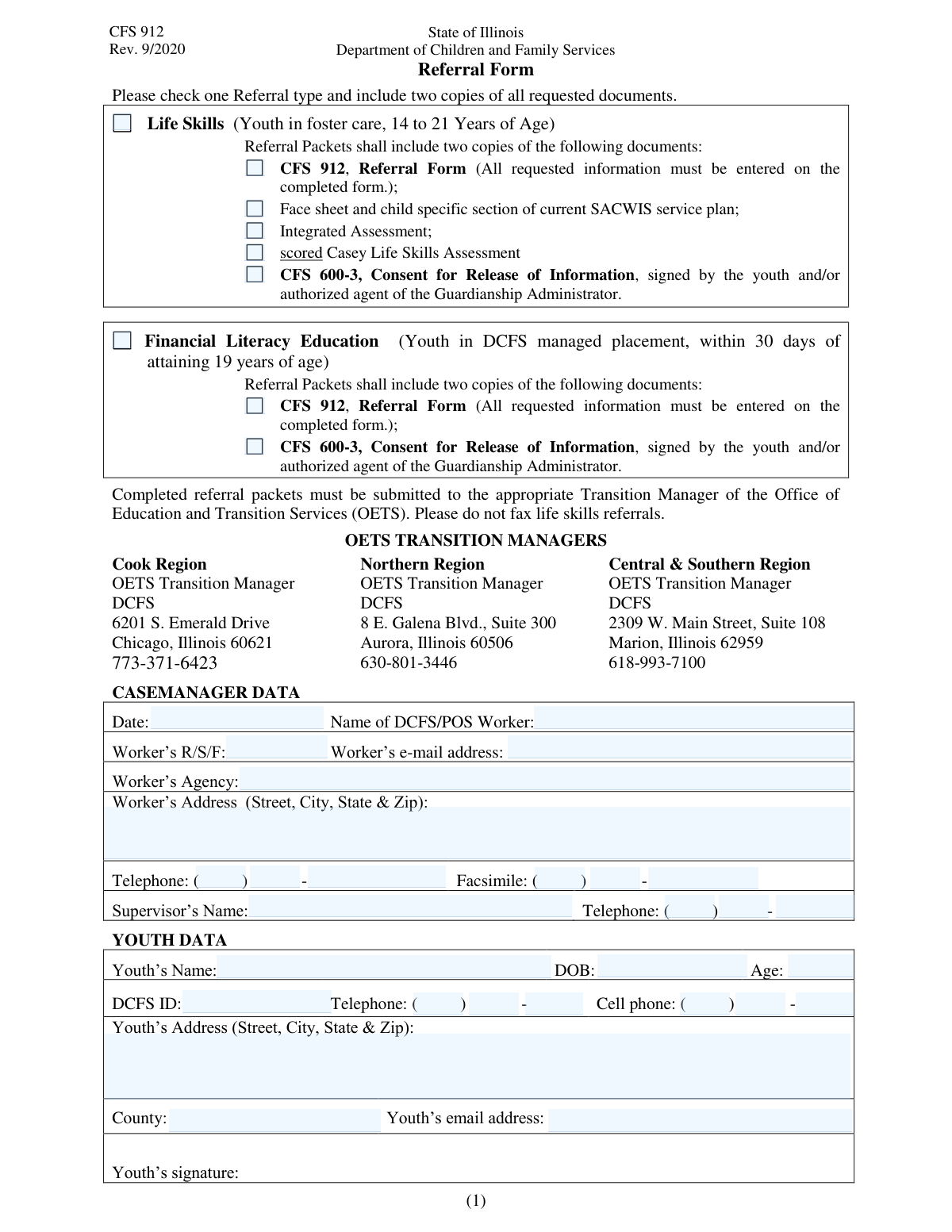
Form CFS 912 is a referral document for youth under the care of the Department of Children and Family Services (DCFS) to access Life Skills and Financial Literacy Education programs. It is completed by a DCFS or POS worker to provide essential information about the youth, including personal details, contact information, specific needs, and any relevant behavioral or safety concerns. This ensures the receiving agency has a comprehensive profile to best serve the youth. Today, this form can be filled out quickly and accurately using AI-powered services like Instafill.ai, which can also convert non-fillable PDF versions into interactive fillable forms.
CFS 912 is part of the
education forms, financial forms, LITE forms and referral forms categories on Instafill.
Our AI automatically handles information lookup, data retrieval, formatting, and form filling.
It takes less than a minute to fill out CFS 912 using our AI form filling.
Securely upload your data. Information is encrypted in transit and deleted immediately after the form is filled out.
Form specifications
| Form name: | CFS 912, Referral Form for Life Skills/Financial Literacy Education |
| Number of fields: | 58 |
| Number of pages: | 2 |
| Filled form examples: | Form CFS 912 Examples |
| Language: | English |
More forms in Education forms
Instafill Demo: How to fill out PDF forms in seconds with AI
How to Fill Out CFS 912 Online for Free in 2026
Are you looking to fill out a CFS 912 form online quickly and accurately? Instafill.ai offers the #1 AI-powered PDF filling software of 2026, allowing you to complete your CFS 912 form in just 37 seconds or less.
Follow these steps to fill out your CFS 912 form online using Instafill.ai:
- 1 Navigate to Instafill.ai and upload or select the CFS 912 form.
- 2 Indicate the referral type by checking 'Life Skills' or 'Financial Literacy Education' and attach the corresponding required documents.
- 3 Enter the referring DCFS/POS worker's details, including name, agency, contact information, and supervisor's name.
- 4 Provide the youth's complete personal information, such as name, date of birth, DCFS ID, address, and contact details.
- 5 Fill in the sections regarding safety concerns, transportation needs, class availability, and any behavioral or emotional problems.
- 6 Describe the youth's learning style and note any physical disabilities to ensure proper accommodations.
- 7 Review all the information for accuracy, sign where necessary, and submit the completed referral packet as instructed.
Our AI-powered system ensures each field is filled out correctly, reducing errors and saving you time.
Why Choose Instafill.ai for Your Fillable CFS 912 Form?
Speed
Complete your CFS 912 in as little as 37 seconds.
Up-to-Date
Always use the latest 2026 CFS 912 form version.
Cost-effective
No need to hire expensive lawyers.
Accuracy
Our AI performs 10 compliance checks to ensure your form is error-free.
Security
Your personal information is protected with bank-level encryption.
Frequently Asked Questions About Form CFS 912
This form is used by DCFS or POS workers to refer eligible youth to either the Life Skills program or the Financial Literacy Education program.
A youth in foster care between the ages of 14 and 21 is eligible for a referral to the Life Skills program.
This referral is for a youth in a DCFS managed placement who is within 30 days of their 19th birthday.
You must include the CFS 912 form, a face sheet and SACWIS service plan, an Integrated Assessment, a scored Casey Life Skills Assessment, and a signed CFS 600-3 Consent for Release of Information.
For this referral, you must include two completed copies of the CFS 912 Referral Form and two signed copies of the CFS 600-3 Consent for Release of Information.
Provide a detailed description of any safety issues that program staff should be aware of, such as past incidents, potential triggers, or specific environmental risks.
You need to describe any transportation challenges the youth has and explain the specific plan for how they will get to and from their classes.
Fill out the form as completely as possible with the information you have. For missing details, consult your supervisor for guidance on how to proceed with the referral.
Check the box that best describes how the youth learns: 'Auditory' for hearing, 'Visual' for seeing, or 'Participatory' for hands-on activities. You can select more than one if applicable.
Submission instructions are typically determined by your agency's specific procedures. Please consult your supervisor or agency guidelines for the correct submission process.
Yes, services like Instafill.ai use AI to accurately auto-fill form fields from your saved profiles, which can save you significant time and reduce errors.
Simply upload the form to the Instafill.ai platform. The AI will make the document interactive, allowing you to click and fill fields with your saved information or type directly.
You can use a service like Instafill.ai, which can convert flat, non-fillable PDFs into interactive forms that you can easily complete and sign online.
No, the form is designed for one referral type at a time. If a youth is eligible for both, you will likely need to complete a separate referral form for each program; check with your supervisor to confirm.
Compliance CFS 912
Validation Checks by Instafill.ai
1
At Least One Referral Type Required
This check ensures that at least one of the main referral type checkboxes ('Life Skills' or 'Financial Literacy Education') is selected. A form submitted without a referral type is incomplete and cannot be processed. If validation fails, the user should be prompted to select a referral type before the form can be submitted.
2
Life Skills Age Eligibility
Validates that if 'Life Skills' is selected as the referral type, the youth's age is between 14 and 21, inclusive. This is a programmatic requirement for Life Skills services. If the youth's age, calculated from their Date of Birth, falls outside this range, the submission should be flagged with an error explaining the age criteria.
3
Financial Literacy Age Eligibility
Validates that if 'Financial Literacy Education' is selected, the youth is within 30 days of attaining 19 years of age, based on their Date of Birth and the form submission date. This rule ensures referrals meet the strict timing requirements for this specific program. A failure would indicate the referral is either too early or too late and should be rejected or reviewed.
4
Date of Birth and Age Consistency
This check compares the entered 'Youth's Age' with the age calculated from the 'Date of Birth' field. This ensures data accuracy and consistency across related fields. If the entered age does not match the calculated age, an error message should prompt the user to correct either the age or the date of birth.
5
Conditional Document Section Activation
Ensures that the document checklist sections for 'Life Skills' and 'Financial Literacy Education' are only active and available if their corresponding referral type is selected. This prevents irrelevant information from being entered and reduces user confusion. If a referral type is unchecked, its associated document fields should be disabled or hidden.
6
Conditional Requirement for Disability Type
This validation ensures that the 'Type of Disability' text field is required and must be filled out if the 'Yes' checkbox for 'Physical Disability Information' is selected. It is crucial to capture the specific disability to arrange for necessary accommodations. If 'Yes' is checked and the description is empty, the form submission should be blocked until the information is provided.
7
Mutually Exclusive Disability Status
Validates that only one of the 'Yes' or 'No' options for 'Physical Disability Information' can be selected at a time. These options are mutually exclusive, and selecting both creates a logical contradiction. The form interface should use radio buttons or logic to prevent the user from selecting both options simultaneously.
8
Email Address Format Validation
Verifies that all email address fields ('Worker's E-mail Address', 'Youth's email address', 'Email Address' for contact) contain a value in a standard email format (e.g., [email protected]). This is critical for ensuring reliable communication with the worker, youth, and contact person. An invalid format should trigger an error message asking the user to enter a valid email address.
9
Phone Number Component Validation
Checks that all segmented phone number fields (Area Code, Prefix, Line Number) contain only numeric characters and have the correct length (3, 3, and 4 digits, respectively). This ensures that valid, complete phone numbers are collected for all parties. If any part is invalid, the user should be prompted to correct the entry.
10
Mandatory Youth and Worker Identification
Ensures that critical identifying fields such as 'Youth's Name', 'Date of Birth', 'DCFS ID', and 'DCFS/POS Worker Name' are not left blank. This information is fundamental for processing the referral and identifying the individuals involved. The form should not be submittable until all these required fields are completed.
11
DCFS ID Format Validation
This check validates that the 'DCFS ID' field conforms to a specific, expected format (e.g., a certain number of digits or a specific alphanumeric pattern). As a unique identifier, its integrity is crucial for linking the referral to the correct case file in the system. An incorrectly formatted ID could lead to processing delays or errors and should be flagged immediately.
12
Address Field Completeness
Verifies that all address fields ('Worker's Address', 'Youth's Full Address', 'Full Address' for contact) contain essential components like a street, city, state, and zip code. A partial address is unusable for mailings or location verification. The validation should check for the presence of these key parts to ensure the address is complete and actionable.
Common Mistakes in Completing CFS 912
Users often select a referral type, such as 'Life Skills', but then fail to check the boxes for the required accompanying documents. This happens due to oversight or not having the documents ready when filling out the form. The consequence is an incomplete referral packet, which causes significant processing delays or outright rejection, preventing the youth from receiving services. To avoid this, gather all necessary documents before starting the form and use the checklist to confirm each one is included in the packet.
The form requires splitting telephone and facsimile numbers into three separate fields (Area Code, Prefix, Line Number), which is a common source of errors. Users frequently transpose numbers between fields, enter the full number in the first box, or make simple typos. This results in invalid contact information, making it impossible for the agency to communicate with the worker or youth. Double-check each segment of the phone number carefully to ensure it is entered correctly across the three distinct fields.
Fields like 'Safety Related Concerns,' 'Transportation Issues,' and 'Behavioral/Emotional Problems Description' require specific, actionable details. Users sometimes provide vague or minimal answers like 'some concerns' or 'N/A' when detailed information is crucial for a proper assessment. This lack of detail can lead to an incorrect evaluation of the youth's needs and the provision of inadequate services. Always provide concrete examples, known diagnoses, and any relevant context to give staff a clear and complete picture of the situation.
A frequent data entry error is a mismatch between the youth's 'Date of Birth (DOB)' and their manually entered 'Age'. This typically happens from a simple miscalculation or using outdated information. This data conflict creates confusion, flags the submission for review, and requires a follow-up to clarify the discrepancy, delaying the referral process. To prevent this, carefully calculate the youth's current age based on their DOB before entering it.
The instructions for the 'Financial Literacy Education' referral explicitly state that 'two copies' of the CFS 912 and CFS 600-3 forms are required. Users, especially when rushing, can easily overlook this specific quantity instruction and submit only a single copy. This automatically makes the submission incomplete and requires the worker to resubmit the packet with the correct number of documents, delaying the youth's enrollment in the program.
This form serves as a cover sheet and checklist for a larger referral packet. A critical mistake is checking boxes for documents like 'Integrated Assessment' or 'CFS 600-3' but failing to physically include those documents in the submission. This renders the entire referral invalid and guarantees its rejection. Before submitting, use the form as a final checklist to ensure every document you've indicated is present, signed, and correctly filled out.
If this form is only available as a non-fillable PDF, it must be printed and completed by hand. This often results in illegible handwriting, especially in dense narrative sections or small fields, leading to data entry errors and processing delays when staff cannot decipher the information. To avoid this, use a tool like Instafill.ai, which can convert flat PDFs into fillable forms, allowing you to type information clearly and ensure accuracy.
A user might initially check 'Yes' for 'Physical Disability,' enter the type of disability, then change their mind and check 'No.' However, they often forget to clear the information from the 'Type of Disability' field. This creates confusing and contradictory data on the form that requires clarification. To avoid this, always review the entire form before submission to ensure that only fields relevant to your final selections contain data.
The form has distinct sections for the Worker, the Youth, and another Contact Person, each with its own address and phone fields. Users can get confused and inadvertently enter information in the wrong section, such as putting the youth's phone number in the worker's contact field. This disorganizes the data, can lead to privacy breaches, and causes communication to be sent to the wrong person. Carefully read the heading for each section before entering any personal information.
Saved over 80 hours a year
“I was never sure if my IRS forms like W-9 were filled correctly. Now, I can complete the forms accurately without any external help.”
Kevin Martin Green
Your data stays secure with advanced protection from Instafill and our subprocessors

Robust compliance program
Transparent business model
You’re not the product. You always know where your data is and what it is processed for.
ISO 27001, HIPAA, and GDPR
Our subprocesses adhere to multiple compliance standards, including but not limited to ISO 27001, HIPAA, and GDPR.
Security & privacy by design
We consider security and privacy from the initial design phase of any new service or functionality. It’s not an afterthought, it’s built-in, including support for two-factor authentication (2FA) to further protect your account.
Fill out CFS 912 with Instafill.ai
Worried about filling PDFs wrong? Instafill securely fills cfs-912-referral-form-for-life-skillsfinancial-literacy-education forms, ensuring each field is accurate.



