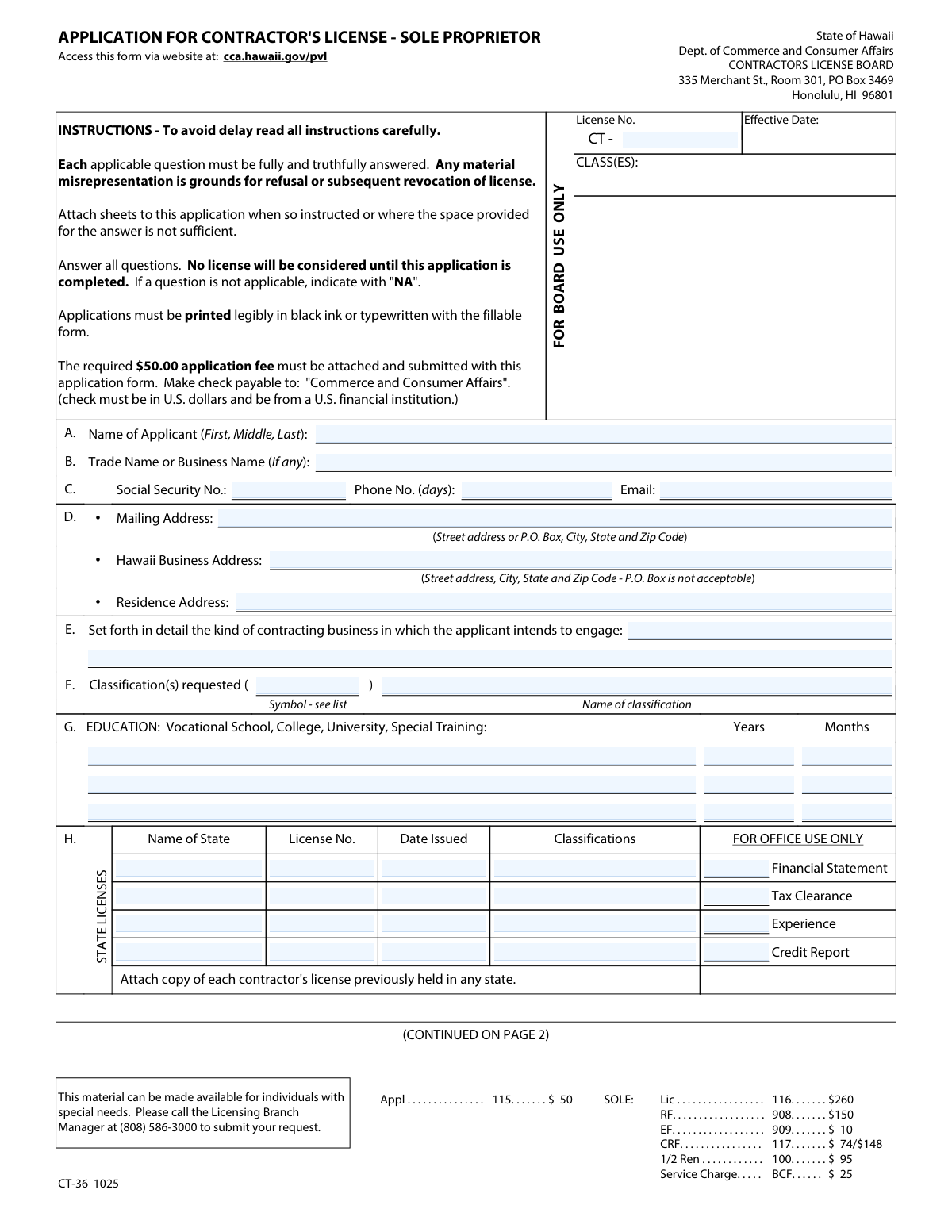
Yes! You can use AI to fill out State of Hawaii Department of Commerce and Consumer Affairs (DCCA) Contractors License Board – Application for Contractor's License (Sole Proprietor) (CT-36) with supporting forms (Experience Certificate CT-03, Contractors Financial Statement CT-02, and Chronological History of Projects/Project List)
This is the State of Hawaii DCCA Contractors License Board application packet for a sole proprietor seeking a contractor’s license, including the main application (CT-36) and required supporting documentation such as notarized experience certificates (CT-03), a CPA-prepared financial statement (CT-02), and a chronological project history (“Project List”). It is important because the Board uses it to verify eligibility (age/work authorization), evaluate supervisory experience and project history, review financial responsibility and credit, and determine whether the applicant may proceed to the licensing examination and final licensing requirements (insurance, place of business, fees). Incomplete or inaccurate submissions can delay review, lead to deficiency, or cause the application to be deemed abandoned under Hawaii law. Today, this form can be filled out quickly and accurately using AI-powered services like Instafill.ai, which can also convert non-fillable PDF versions into interactive fillable forms.
Our AI automatically handles information lookup, data retrieval, formatting, and form filling.
It takes less than a minute to fill out Hawaii DCCA Contractor License (Sole Proprietor) – CT-36 using our AI form filling.
Securely upload your data. Information is encrypted in transit and deleted immediately after the form is filled out.
Form specifications
| Form name: | State of Hawaii Department of Commerce and Consumer Affairs (DCCA) Contractors License Board – Application for Contractor's License (Sole Proprietor) (CT-36) with supporting forms (Experience Certificate CT-03, Contractors Financial Statement CT-02, and Chronological History of Projects/Project List) |
| Number of pages: | 26 |
| Language: | English |
| Categories: | insurance forms |
Instafill Demo: filling out a legal form in seconds
How to Fill Out Hawaii DCCA Contractor License (Sole Proprietor) – CT-36 Online for Free in 2026
Are you looking to fill out a HAWAII DCCA CONTRACTOR LICENSE (SOLE PROPRIETOR) – CT-36 form online quickly and accurately? Instafill.ai offers the #1 AI-powered PDF filling software of 2026, allowing you to complete your HAWAII DCCA CONTRACTOR LICENSE (SOLE PROPRIETOR) – CT-36 form in just 37 seconds or less.
Follow these steps to fill out your HAWAII DCCA CONTRACTOR LICENSE (SOLE PROPRIETOR) – CT-36 form online using Instafill.ai:
- 1 Go to Instafill.ai and upload the CT-36 application packet (or select the Hawaii DCCA Contractors License Board CT-36 form from the form library).
- 2 Let Instafill.ai extract fields and auto-fill your personal and business details (name, SSN, contact info, mailing/business/residence addresses, trade name, and email), then review for accuracy.
- 3 Enter your intended contracting business description and select the contractor license classification(s) requested (symbol and classification name) based on the Hawaii Administrative Rules Chapter 77 list.
- 4 Complete the eligibility and background questions (age, work authorization, prior applications, license discipline, financial/bonding issues, liens/judgments, bankruptcy, criminal history) and attach any required written explanations and supporting documents for any “Yes” answers.
- 5 Use Instafill.ai to complete your experience statement and employment history sections, then prepare and attach the Chronological History of Projects (“Project List”) for each classification requested.
- 6 Upload and attach required supporting documents (application fee confirmation, trade name registration if applicable, credit report, Hawaii tax clearance, CPA-compiled/reviewed/audited financial statement CT-02 with accountant’s report, and at least three notarized Experience Certificates CT-03—one per classification as required).
- 7 Review the final packet for completeness and signatures (including release of information if using a third party), then download/print as needed and submit by mail or in person to the Contractors License Board by the stated deadline.
Our AI-powered system ensures each field is filled out correctly, reducing errors and saving you time.
Why Choose Instafill.ai for Your Fillable Hawaii DCCA Contractor License (Sole Proprietor) – CT-36 Form?
Speed
Complete your Hawaii DCCA Contractor License (Sole Proprietor) – CT-36 in as little as 37 seconds.
Up-to-Date
Always use the latest 2026 Hawaii DCCA Contractor License (Sole Proprietor) – CT-36 form version.
Cost-effective
No need to hire expensive lawyers.
Accuracy
Our AI performs 10 compliance checks to ensure your form is error-free.
Security
Your personal information is protected with bank-level encryption.
Frequently Asked Questions About Form Hawaii DCCA Contractor License (Sole Proprietor) – CT-36
This is the State of Hawaii DCCA Contractors License Board application for a contractor’s license as a Sole Proprietor. It starts the licensing process so the Board can review your qualifications and, if approved, allow you to take the required exam(s).
Use this application if you are applying as an individual owner (not a corporation/LLC/partnership) and want the contractor license issued under you as a sole proprietor. If you are applying under a business entity or as an RME, you generally need a different application type.
You must be at least 18, have a good reputation for honesty and financial integrity, have 4 years of supervisory experience within the past 10 years, pass the appropriate exam, and meet insurance requirements (liability and workers’ compensation).
Your packet must include the $50 non-refundable application fee and supporting documents such as trade name registration (if applicable), experience certificates, a Project List (Chronological History of Projects), a compiled/reviewed/audited financial statement with CPA/PA report, a complete credit report, and a Hawaii tax clearance (if required). The Board will not accept faxed or emailed copies.
Your application, fee, and all supporting documents must be received in the Board’s Honolulu office on or before the first Tuesday of the month prior to the scheduled meeting. Mail to Contractors License Board, DCCA PVL Licensing Branch, P.O. Box 3469, Honolulu, HI 96801, or deliver to 335 Merchant St., Room 301, Honolulu, HI 96813.
The application fee is $50 per application and is non-refundable. Pay by check made payable to “COMMERCE AND CONSUMER AFFAIRS” in U.S. dollars from a U.S. financial institution (dishonored payments may incur a $25 service charge and can invalidate the license).
Your SSN is required by federal and Hawaii laws for identity verification and licensing compliance. If you do not provide it, your application is considered deficient and will not be processed further.
You must list the classification symbol and name that match the work you intend to perform (e.g., “A” General Engineering, “B” General Building, or a specific “C-” specialty). If you are unsure, the Board provides classification descriptions on the contractor webpage to help you select the right one.
You need at least 4 years of on-site supervisory experience within the past 10 years in the classification you’re applying for. The Board emphasizes that supervisory time should reflect actual on-site supervision of your own crew, not design work, ordering materials, or downtime/scheduling.
You must submit at least 3 notarized Experience Certificates supporting your supervisory experience. If you apply for more than one classification, submit at least one certificate for each classification, and no two certificates in the same classification may be from the same person.
The Project List documents your supervisory work history and must be complete in every column, describing in-house work, subcontracted trades, and the means/methods used. Submit a separate Project List for each classification, and make sure the contract amount and supervisory time align with the specific classification work you supervised.
You must submit a current (not more than one year old) compiled, reviewed, or audited financial statement accompanied by an independent accountant’s report. It must be prepared by a licensed PA or CPA with a current permit to practice (bookkeeper or tax preparer statements are not acceptable), and for compiled/reviewed statements you must sign the Board’s Financial Statement Form even if your CPA uses a different format.
You must submit a current and complete credit report (issued within the last 6 months) covering at least the previous 5 years for each required person (for a sole proprietor, this generally means you). The report must include detailed account histories and public records information—reports that only show a score or summary are not considered complete.
A current Hawaii State Tax Clearance (not more than 6 months old) with an original Department of Taxation stamp is required, unless you have resided in Hawaii for less than one year. If you are exempt due to living in Hawaii less than one year, include a letter stating that.
Applications received by the deadline are reviewed at the next month’s Board meeting, and you’ll be notified of approval, disapproval, or deferral. If approved, you register with Prometric, take the exam (typically the following month), and after passing you submit final license requirements (including insurance) before the Board issues the license.
Yes, but both require Board approval. Submit a written out-of-state testing request with your application (you pay any extra costs and locations are limited), and interpreter requests must be approved and include an additional $100 fee through Prometric.
You must provide workers’ compensation coverage (or a Board form if you are a sole proprietor with no employees) and liability/property damage insurance meeting minimum limits of $100,000 per person / $300,000 per occurrence for bodily injury and $50,000 per occurrence for property damage. You must maintain continuous coverage or your license can be automatically forfeited.
If you fail to complete the licensing process within the required timeframe (including taking the exam after becoming eligible) or fail to show continued effort for two consecutive years, your application can be deemed abandoned and destroyed. If that happens, you must reapply, repay fees, and resubmit documents under the rules in effect at the time of reapplication.
Yes, Hawaii requires that the individual performing electrical or plumbing work also hold the appropriate electrician (ES/EJ) or plumber (PM/PJ) license under HRS Chapter 448E. If you don’t hold that license, you must employ a properly licensed electrician or plumber to perform that work, and you may need it to obtain building permits.
Yes—AI form-filling tools can help you organize your information and auto-fill fields to reduce errors and save time. Services like Instafill.ai use AI to map your details into the correct form fields and help you complete the application more efficiently.
Upload the PDF to Instafill.ai, then provide your details (identity/contact info, addresses, classifications, and experience history) and let the AI auto-fill the matching fields. Review each section for accuracy, then download and print the completed form for signature/notarization and mail it with original supporting documents (since faxed/emailed copies are not accepted).
If you have a flat/non-fillable PDF, Instafill.ai can convert it into an interactive fillable form so you can type directly into the fields. After conversion, you can auto-fill, review, and export a clean completed version for printing and submission.
Compliance Hawaii DCCA Contractor License (Sole Proprietor) – CT-36
Validation Checks by Instafill.ai
1
Applicant legal name completeness and format
Validates that the Applicant Name field is present and contains a plausible full legal name (first and last at minimum; middle optional) and is not filled with placeholders such as "NA" or initials only. This is important because the license is issued to the individual and must match supporting documents (financial statement, experience certificates, tax clearance). If validation fails, the submission should be flagged as deficient and routed for correction before processing.
2
Social Security Number required and valid SSN format
Ensures the Social Security Number is provided (the form states the application will not be processed without it) and matches a valid SSN pattern (9 digits, optionally formatted as XXX-XX-XXXX). Also checks for obviously invalid values (all zeros, repeated digits, or 123-45-6789). If validation fails, the application should be rejected as deficient and not advanced to board review.
3
Daytime phone number format and reachability
Validates that the Daytime Phone Number is present and conforms to a valid NANP phone format (10 digits, allowing parentheses/dashes/spaces) and is not an extension-only entry. This matters because the board/testing agency may need to contact the applicant for deficiencies, exam eligibility, or clarifications. If validation fails, the system should require correction or capture an alternate contact method before submission.
4
Email address format (if provided) and consistency
Checks that the Email Address, if entered, matches standard email syntax and does not contain spaces or invalid characters. Email is used for faster communication and status updates, so malformed addresses reduce deliverability and increase processing delays. If validation fails, the system should prompt the applicant to correct the email or leave it blank if optional.
5
Mailing address completeness (including city/state/ZIP)
Ensures the Mailing Address includes street or P.O. Box, city, state, and a valid ZIP/ZIP+4 format. This is important because official notices (approval/deferral/denial, renewal materials) are mailed and missing components can cause non-delivery. If validation fails, the application should be held until a complete mailing address is provided.
6
Hawaii business address must be a physical street address (no P.O. Box)
Validates that the Hawaii Business Address is provided and is not a P.O. Box, per the form requirement that a place of business must be a definite location in the State where service of process can occur. This check should detect common P.O. Box patterns (e.g., "PO Box", "P.O.", "Box") and require a street address. If validation fails, the system should block submission and request a compliant physical address.
7
Application date present and valid date
Checks that the Application Date is provided and is a real calendar date (not future-dated beyond a reasonable threshold, and not an impossible date like 02/30). The date is used to determine timeliness relative to filing deadlines and to evaluate experience recency windows. If validation fails, the application should be returned for correction because downstream deadline and eligibility logic cannot be reliably applied.
8
Age eligibility confirmation (18+ required)
Validates that Question 1 (at least 18 years of age) is answered and that the applicant selected exactly one of Yes/No. Because being 18+ is a statutory requirement, a "No" response should trigger an ineligibility outcome rather than normal processing. If unanswered or both selected, the system should block submission; if "No", the system should stop processing and provide an eligibility message.
9
Work authorization confirmation (citizen/national/authorized to work)
Ensures Question 2 is answered with exactly one selection and, if "No" is selected, flags the application for ineligibility or additional required documentation per agency policy. This is important because the applicant must be authorized to work in the U.S. to lawfully engage in contracting activities. If validation fails (blank or both checked), the submission should be blocked until corrected.
10
Requested classification symbol/name validity and cross-match
Validates that at least one classification is requested and that the symbol entered is one of the allowed values (e.g., A, B, C-13, C-37, etc.) from the provided list. Also checks that the Classification Name corresponds to the selected symbol (e.g., C-13 must map to Electrical contractor) to prevent mismatched or ambiguous requests. If validation fails, the system should require the applicant to select from a controlled list to avoid board processing errors and incorrect exam assignment.
11
Intended contracting business description required and sufficiently detailed
Checks that the Intended Contracting Business Description is not blank and contains a meaningful description (minimum length/word count) rather than generic text like "contracting" or "NA". This matters because the board uses it to understand the scope of work and confirm alignment with the requested classification(s). If validation fails, the system should prompt for additional detail and prevent submission until the description meets the minimum standard.
12
Yes/No question exclusivity and required attachments trigger
Validates that Questions 3 through 11 each have exactly one of Yes/No selected (no blanks and no double-selections). For any question answered "Yes" that requires a detailed statement and/or documents (e.g., license discipline, liens/judgments, bankruptcy, convictions), the system should require an attachment indicator and/or uploaded statement before allowing submission. If validation fails, the application should be marked incomplete and not accepted for filing.
13
Prior Hawaii application month/year required when applicable
If Question 3 (previously applied) is "Yes", validates that the Month/Year Previously Applied field is present and matches an MM/YYYY format with a plausible month (01-12) and non-future year. This is important for record matching and to prevent duplicate or misfiled applications. If validation fails, the system should request the missing/invalid month-year and hold the application from submission.
14
Experience statement time fields are numeric, non-negative, and consistent
Validates that the experience duration entries (years/months for apprentice/journeyman/foreman/supervisor/etc.) are numeric, months are within 0–11, and values are not negative or unrealistically large. This prevents calculation errors when evaluating whether the applicant meets the minimum supervisory experience requirement. If validation fails, the system should prompt correction and prevent submission until the durations are valid.
15
Supervisory experience minimum: 4 years within past 10 years (project list + certificates)
Checks that the submission includes at least 4 full years of supervisory experience within the 10 years immediately preceding the application date, supported by the Project List and experience certificates. The system should compute totals from the Project List “Amount of Supervisory Experience (yrs/months)” and ensure the dates fall within the allowed window, excluding non-supervisory time as instructed. If validation fails, the application should be flagged as not meeting minimum experience and either blocked or routed for board deferral with a deficiency notice.
16
Experience certificates count, notarization, and classification coverage
Validates that at least three experience certificates are provided, each is notarized (notary signature, state, commission expiration, and date present), and that for each requested classification there is at least one certificate. Also enforces the rule that no two certificates in the same classification are from the same person (unique certifier identity per classification). If validation fails, the application should be marked deficient and not scheduled for board review until corrected.
Common Mistakes in Completing Hawaii DCCA Contractor License (Sole Proprietor) – CT-36
Applicants often focus on the application pages and overlook that the Board requires the application, fee, and all supporting documents to be received by the first Tuesday of the month (and the Board does not meet in December). Submitting after the deadline or with missing items (experience certificates, project list, financial statement, credit report, tax clearance, trade name registration if applicable) typically results in deferral and significant processing delays. Avoid this by using a checklist and assembling the entire packet before mailing/delivery, allowing extra time for postal delivery. AI-powered tools like Instafill.ai can help by validating that all required fields and attachments are accounted for before you submit.
A very common mistake is emailing or faxing documents (or sending scans) even though the instructions explicitly state that faxed or emailed copies will not be accepted. This happens when applicants try to meet the deadline quickly or assume a scan is “good enough.” The consequence is an automatic deficiency and delay because the Board will not treat the submission as complete. To avoid it, submit hard copies with original stamps/signatures where required and confirm you are mailing/delivering to the correct address.
Applicants sometimes omit the SSN due to privacy concerns or accidentally transpose digits. The form states the SSN is required for identity verification and legal compliance, and without it the application is deemed deficient and will not be processed further. Double-check the number against an official document and ensure it matches the applicant’s identity exactly. Instafill.ai can reduce typos by securely reusing verified identity data and formatting it consistently.
Many applicants list only a mailing address or P.O. Box for the Hawaii business address, but the form clearly states a P.O. Box is not acceptable as a place of business. This usually happens when the applicant works from home, uses a mailbox service, or assumes the mailing address is sufficient. The consequence is a deficiency because the Board requires a definite physical location in Hawaii where notice/legal process can be served and where the license is displayed. Provide a complete street address for the Hawaii business location and keep it current.
Applicants frequently leave blanks instead of marking “NA,” especially in education/training, prior licenses, or experience sections. The instructions state that every question must be answered and that “NA” should be used when not applicable; blanks are often treated as missing information. This leads to follow-up requests and delays. To avoid it, review every section and explicitly enter “NA” where appropriate; Instafill.ai can automatically flag unanswered required fields and prompt for “NA” when allowed.
Applicants often select a classification name but enter the wrong symbol (or vice versa), especially among similar specialty “C-” categories. This happens because the list is long and some categories are closely related (e.g., C-37 vs. C-37a/b/c). The consequence can be being approved for the wrong exam/classification, needing to amend the application, or delays while the Board clarifies scope. Avoid this by verifying the exact symbol-name pair from the official classification list and submitting a separate Project List for each classification requested.
A frequent issue is providing fewer than three notarized experience certificates, using certifiers who lack DIRECT KNOWLEDGE, or using two certificates in the same classification from the same person (which is not allowed). Applicants also forget that if applying for multiple classifications, at least one certificate is needed for each classification. These mistakes happen because applicants ask convenient references rather than qualified certifiers, or they miss the “no two from the same person” rule. The result is the Board rejecting the experience documentation and deferring the application; avoid it by selecting qualified certifiers, ensuring notarization, and checking the per-classification requirements.
Even when certificates are submitted, the narrative often describes general construction work, estimating, or project management rather than on-site supervision and direction of employees in the specific classification. The Board emphasizes that supervisory experience must be within the past 10 years and should reflect actual on-site supervision of your own crew, not design, ordering materials, scheduling, rain delays, or waiting for deliveries. If the description is vague or off-scope, the Board may find the experience unverified or insufficient. Avoid this by writing detailed, classification-specific descriptions of means/methods and supervision activities, and ensuring the certifier mirrors that detail on the certificate.
Applicants commonly submit a Project List with missing columns (e.g., employer classification, position title/# supervised, detailed description, contract amount, supervisory time) or with dates that don’t reconcile with the claimed supervisory months/years. Another common problem is listing the total project contract amount rather than the portion relevant to the specialty classification, which the form warns against. These errors happen because applicants treat the list like a resume instead of an evidence document. To avoid delays, complete every column, keep dates consistent, and ensure contract amounts and supervisory time are commensurate with the described work; Instafill.ai can help by validating date formats and completeness before submission.
Applicants often submit an internally prepared statement, a tax return, or a bookkeeper-prepared report, but the Board requires a compiled, reviewed, or audited financial statement accompanied by an independent accountant’s report. They also miss that the accountant must be a licensed CPA/PA with a current permit to practice, and if licensed in another state, a copy of the license must be included; additionally, the applicant must sign the Board’s financial statement form for compiled/reviewed statements even if the CPA uses their own format. The consequence is rejection of the financial documentation and application delay. Avoid this by engaging a qualified CPA/PA early and confirming the statement date is current (not more than one year old) and the applicant name matches exactly across documents.
Many applicants submit a credit score, a summary report, or a report that doesn’t show detailed tradelines and public records, even though the form requires a complete credit report covering at least the previous 5 years and issued within the last 6 months. This happens because consumer-facing credit products emphasize scores and summaries, and applicants assume that’s sufficient. The Board may deem the submission incomplete and request a proper report, delaying review. Avoid this by ordering a full, detailed report from a credit reporting agency and confirming it includes account-level details, status, delinquencies, and public records.
Saved over 80 hours a year
“I was never sure if my IRS forms like W-9 were filled correctly. Now, I can complete the forms accurately without any external help.”
Kevin Martin Green
Your data stays secure with advanced protection from Instafill and our subprocessors

Robust compliance program
Transparent business model
You’re not the product. You always know where your data is and what it is processed for.
ISO 27001, HIPAA, and GDPR
Our subprocesses adhere to multiple compliance standards, including but not limited to ISO 27001, HIPAA, and GDPR.
Security & privacy by design
We consider security and privacy from the initial design phase of any new service or functionality. It’s not an afterthought, it’s built-in, including support for two-factor authentication (2FA) to further protect your account.
Fill out Hawaii DCCA Contractor License (Sole Proprietor) – CT-36 with Instafill.ai
Worried about filling PDFs wrong? Instafill securely fills state-of-hawaii-department-of-commerce-and-consumer-affairs-dcca-contractors-license-board-application-for-contractors forms, ensuring each field is accurate.