Fill out contractor forms
with AI.
Contractor forms are essential for maintaining legal compliance, securing professional licenses, and reporting income accurately to the IRS. These documents bridge the gap between skilled labor and regulatory requirements, ensuring that both independent contractors and construction firms operate within state and federal laws. Whether you are managing income reporting forms for tax season or preparing specialized state licensing applications, having the right paperwork is the foundation of a legitimate and successful contracting business.
By continuing, you acknowledge Instafill's Privacy Policy and agree to get occasional product update and promotional emails.
About contractor forms
These forms are typically required by sole proprietors, subcontractors, and established construction companies. You will often encounter them when applying for state-specific certifications, such as a Certified General Contractor license in Florida or a sole proprietor license in Hawaii. Additionally, for those working on public works projects, submitting certified payroll records like Form WH-347 or New Jersey’s MW-562 is a mandatory step to verify that workers are receiving prevailing wages. Keeping up with these requirements is critical during project bidding, annual licensing renewals, and financial audits.
Manually completing these multi-page documents can be time-consuming and prone to errors that delay your business operations. Tools like Instafill.ai use AI to fill these forms in under 30 seconds, handling sensitive data accurately and securely. This allows contractors to spend less time on administrative paperwork and more time focusing on their projects.
Every form on this page can be completed without typing. Instafill is form filling software that reads a PDF and fills it for you — including flat and scanned documents that carry no fillable fields at all.
Forms in This Category
The forms in this category have a median Form Complexity Index of 81/100 (Very Complex), measured across 8 forms by field count, input difficulty, length, conditional logic and structure. See how it is calculated.
- Enterprise-grade security & data encryption
- 99%+ accuracy powered by AI
- 1,000+ forms from all industries
- Complete forms in under 60 seconds
How to Choose the Right Form
Choosing the right contractor form depends on whether you are applying for a professional license or documenting payroll for a government-funded project. This category includes essential documents for state-level certification in Florida and Hawaii, as well as federal and state wage compliance records.
State Licensing and Business Qualification
If you are a contractor looking to establish or license your business entity, your choice depends on your specific state and license type:
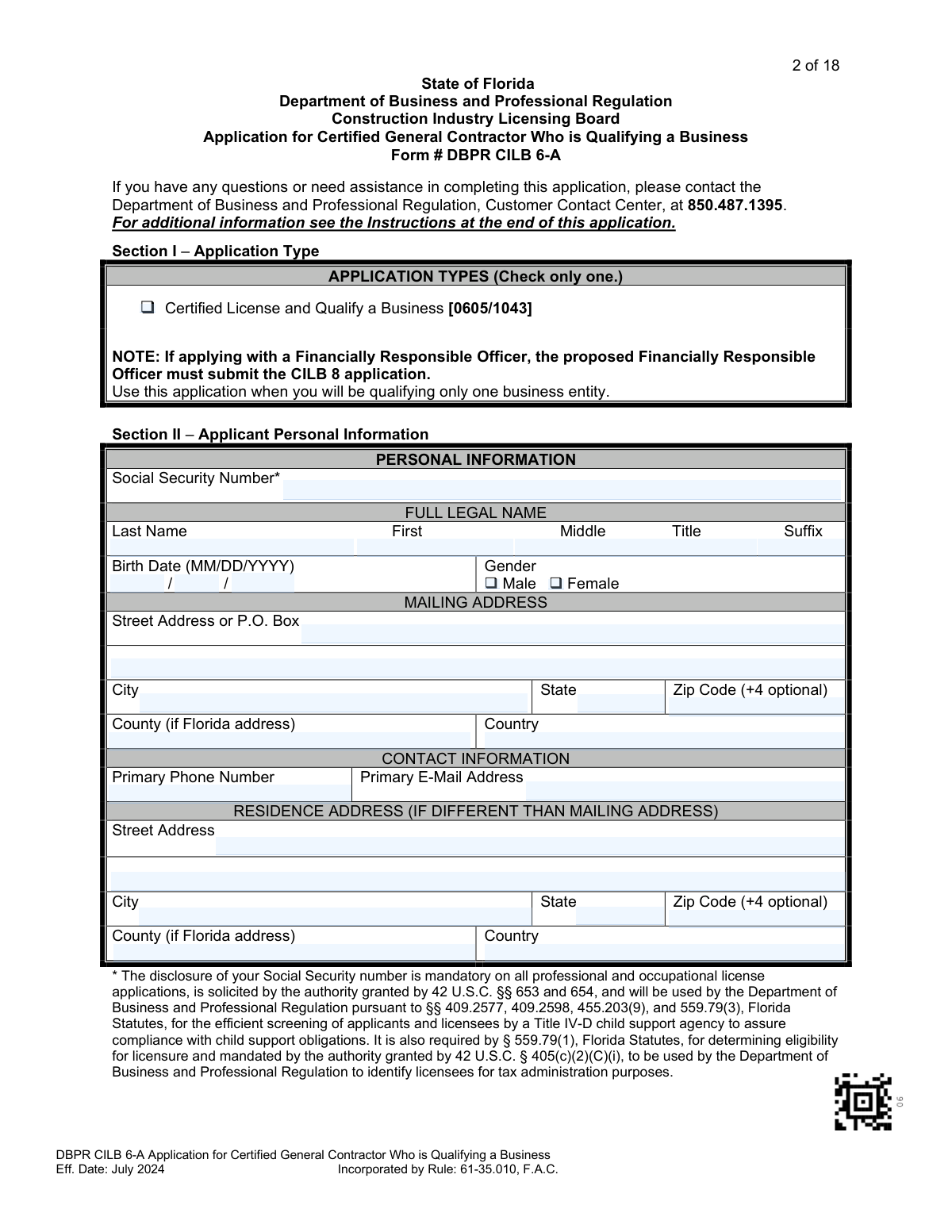
- DBPR CILB 6-A (Certified General Contractor): Choose this form if you are applying for initial certification in Florida as a General Contractor. This form allows you to qualify a business entity for a broad, unrestricted scope of contracting work throughout the state.
- DBPR CILB 6-B (Certified Building Contractor): Use this form if your scope of work in Florida is limited to the construction of commercial or residential buildings (Building Contractor) rather than the unrestricted scope of a General Contractor.
- Hawaii Application for Contractor's License (CT-36): This is the primary application for individuals in Hawaii seeking a sole proprietor license. Ensure you also complete the included supporting documents, such as the Experience Certificate (CT-03) and Contractors Financial Statement (CT-02), to verify your eligibility and project history.
Certified Payroll and Wage Compliance
When working on public works or federally funded projects, you must submit payroll records to prove you are paying mandated prevailing wages.
- Form WH-347 (Payroll for Contractors): This is the standard federal form used for construction contracts financed or assisted by the U.S. government. Use this to report wages and benefits in compliance with the Davis-Bacon Act.
- NJ Form MW-562 (Payroll Certification): If your project is a public works contract in the State of New Jersey, use this form to certify that workers are paid according to the New Jersey Prevailing Wage Act. It is required for both weekly and final certifications.
Whether you are navigating complex Florida licensing or submitting weekly payroll, using Instafill.ai ensures your data is accurately mapped to these official documents, reducing the risk of administrative delays.
Form Comparison
| Form | Purpose | Who Files It | When to Use |
|---|---|---|---|
| Form WH-347, Payroll for Contractors | Report wages paid on federal construction contracts | Contractors and subcontractors on federal projects | Weekly, for each payroll period on federally funded jobs |
| DBPR CILB 6-B, Application for Certified Building Contractor Who is Qualifying a Business | Apply for Florida certified building contractor license | Individuals seeking FL building contractor certification | Initial application to certify and qualify a business entity |
| State of Hawaii Department of Commerce and Consumer Affairs (DCCA) Contractors License Board – Application for Contractor's License (Sole Proprietor) (CT-36) with supporting forms (Experience Certificate CT-03, Contractors Financial Statement CT-02, and Chronological History of Projects/Project List) | Apply for Hawaii contractor's license as sole proprietor | Sole proprietors seeking a Hawaii contractor's license | Initial licensing application with experience and financial docs |
| NJ Department of Labor & Workforce Development Form MW-562, Payroll Certification for Public Works Projects (Contractor and Subcontractor's Weekly and Final Certification) | Certify prevailing wage compliance on NJ public works projects | Contractors and subcontractors on NJ public works jobs | Weekly and upon project completion for wage compliance |
| DBPR CILB 6-A, Application for Certified General Contractor Who is Qualifying a Business | Apply for Florida certified general contractor license | Individuals seeking FL general contractor certification | Initial application for statewide certification and business qualification |
| Form 1099-NEC, Nonemployee Compensation | Report $600+ payments to independent contractors or freelancers | Businesses and individuals paying nonemployees | Annually, by January 31 for prior tax year payments |
Tips for contractor forms
AI-powered tools like Instafill.ai can complete these complex forms in under 30 seconds with high accuracy. The data stays secure during the process, making it a practical time-saver for professionals managing multiple state or federal filings.
Ensure that the labor classifications on payroll forms like WH-347 or MW-562 exactly match the work performed by your employees. Mismatches between reported titles and actual site duties can lead to compliance audits or significant payment delays.
Many licensing applications require a comprehensive list of past projects to verify your experience level. Keeping an updated log of project dates, specific roles, and supervisory tasks will save you hours when filling out experience certificates or project list attachments.
When submitting financial responsibility forms, ensure the data aligns perfectly with your CPA-prepared statements or credit reports. Discrepancies between your self-reported figures and official financial documents are a common cause for application deficiencies and denials.
Several contractor forms, especially state licensing applications, require signatures to be notarized or witnessed by specific officials. Review the entire document for 'Seal' or 'Notary Public' sections before you finish, as missing these signatures can invalidate the entire submission.
Most contractor applications require proof of workers' compensation and general liability insurance. Scan these documents and keep them in a dedicated folder so you can quickly reference policy numbers and expiration dates while filling out your forms.
Frequently Asked Questions
Contractor forms are primarily used for two purposes: professional licensing and labor law compliance. These documents help state and federal agencies verify that a contractor has the necessary experience and financial stability to operate, and that they are paying their employees fair wages on public projects.
Contractors and subcontractors working on federally funded construction projects or state-level public works must submit these forms weekly. They serve as a legal record to ensure that all workers are being paid the prevailing wage and receiving mandated fringe benefits according to the law.
The correct form depends on your specific trade and the state where you intend to work. For example, in Florida, you would choose between General Contractor (6-A) or Building Contractor (6-B) forms based on the scope of your projects, while Hawaii requires specific sole proprietor forms like the CT-36 for individual owners.
Yes, AI tools like Instafill.ai can be used to fill out complex contractor forms and licensing applications accurately. These tools extract data from your source documents and place it into the correct fields, which helps prevent manual entry errors on high-stakes compliance documents.
While manual completion of multi-page licensing or payroll forms can take hours, AI-powered services like Instafill.ai can complete them in under 30 seconds. The technology quickly maps your personal or business data to the specific requirements of the PDF form.
Most state boards require proof of insurance coverage, a financial statement (sometimes prepared by a CPA), and a detailed history of past projects. You may also need to provide electronic fingerprints and a credit report to prove financial responsibility and professional character.
Submission locations vary depending on the document type. Certified payroll forms are generally submitted to the government agency overseeing the construction project, while licensing applications are sent to state-specific boards like the Department of Business and Professional Regulation (DBPR) or the Department of Commerce and Consumer Affairs (DCCA).
Errors or omissions can lead to a 'deficiency' notice, which delays the processing of your license for several weeks or months. In some cases, providing inaccurate information can result in the denial of your application or the revocation of an existing license.
Financial statements are typically required for initial licensing applications to ensure the contractor has sufficient working capital. However, weekly payroll certification forms like the WH-347 do not require financial statements, as they focus specifically on employee hours and wage distributions.
In many states, such as Florida, you must submit a specific application for each business entity you intend to qualify as a contractor. These forms, like the CILB 6-A or 6-B, ensure that both the individual professional and the business entity meet the legal requirements for construction work.
Glossary
- Form Complexity Index
- Instafill’s 0–100 measure of how much effort a form takes to complete, calculated deterministically from the form’s own structure rather than estimated. It combines the number of fillable fields (the largest factor), how difficult those fields are to complete based on their type, the number of pages that contain fields, the amount of conditional “fill-only-if” logic, and how many sections the form is divided into, then adds modifiers for tables and repeating lists, bundled instruction pages, and dense page layouts. A higher score means the form is harder to fill out by hand. The forms in this category have a median Form Complexity Index of 81/100 (Very Complex). See exactly how it is calculated.
- Certified Payroll
- A weekly report submitted by contractors on public works projects that lists every employee, their work classification, wages, and hours worked to ensure legal wage compliance.
- Prevailing Wage
- The hourly wage, usual benefits, and overtime paid to the majority of workers within a specific geographic area, often mandated by law for government-funded construction projects.
- Qualifying Agent
- An individual who meets the experience and examination requirements to obtain a license on behalf of a business entity, allowing that company to legally perform contracting work.
- FEID (Federal Employer Identification Number)
- A unique nine-digit number assigned by the IRS to business entities for identification and tax reporting purposes, similar to a Social Security number for a business.
- Fringe Benefits
- Additional compensation provided to workers beyond their hourly pay, such as health insurance, life insurance, or pension contributions, which must often be reported on payroll certification forms.
- Davis-Bacon Act
- A federal law requiring contractors and subcontractors to pay their laborers and mechanics no less than the locally prevailing wages and fringe benefits on federally funded construction projects.
- 1099-NEC
- The specific IRS form used to report non-employee compensation, which is the income paid to independent contractors and freelancers rather than traditional employees.
- Financial Responsibility
- A licensing requirement where an applicant must prove they have the fiscal stability to operate a business, typically verified through credit reports, FICO scores, and proof of bonding or insurance.