Yes! You can use AI to fill out DBPR CILB 6-A, Application for Certified General Contractor Who is Qualifying a Business
Form DBPR CILB 6-A is an official Florida state application issued by the Construction Industry Licensing Board (CILB) that allows a certified general contractor to apply for initial certification and simultaneously qualify a single business entity to perform contracting work throughout Florida. The form collects detailed personal information, employment history, qualifications, business ownership details, insurance coverage, financial responsibility data, and background disclosures from both the applicant and authorized business representatives. Completing this form correctly is essential for contractors seeking statewide certification, as errors or omissions can result in delays, deficiencies, or denial of licensure. Today, applicants can fill out this complex multi-section form quickly and accurately using AI-powered services like Instafill.ai, which can also convert non-fillable PDF versions into interactive fillable forms.
DBPR CILB 6-A is part of the
DBPR forms, CILB forms, business forms, contractor forms and contract forms categories on Instafill.
Rather not fill this in by hand? Instafill is an online form filler that completes PDF forms automatically — upload the blank form, answer a few questions, and the AI fills every field.
Form specifications
| Form name: | DBPR CILB 6-A, Application for Certified General Contractor Who is Qualifying a Business |
| Number of pages: | 14 |
| Language: | English |
Our AI automatically handles information lookup, data retrieval, formatting, and form filling.
It takes less than a minute to fill out DBPR CILB 6-A using our AI form filling.
Securely upload your data. Information is encrypted in transit and deleted immediately after the form is filled out.
Instafill Demo: How to fill out PDF forms in seconds with AI
How to Fill Out DBPR CILB 6-A Online for Free in 2026
Are you looking to fill out a DBPR CILB 6-A form online quickly and accurately? Instafill.ai offers the #1 AI-powered PDF filling software of 2026, allowing you to complete your DBPR CILB 6-A form in just 37 seconds or less.
Follow these steps to fill out your DBPR CILB 6-A form online using Instafill.ai:
- 1 Navigate to Instafill.ai and upload the DBPR CILB 6-A form or select it from the available form library to begin filling it out online.
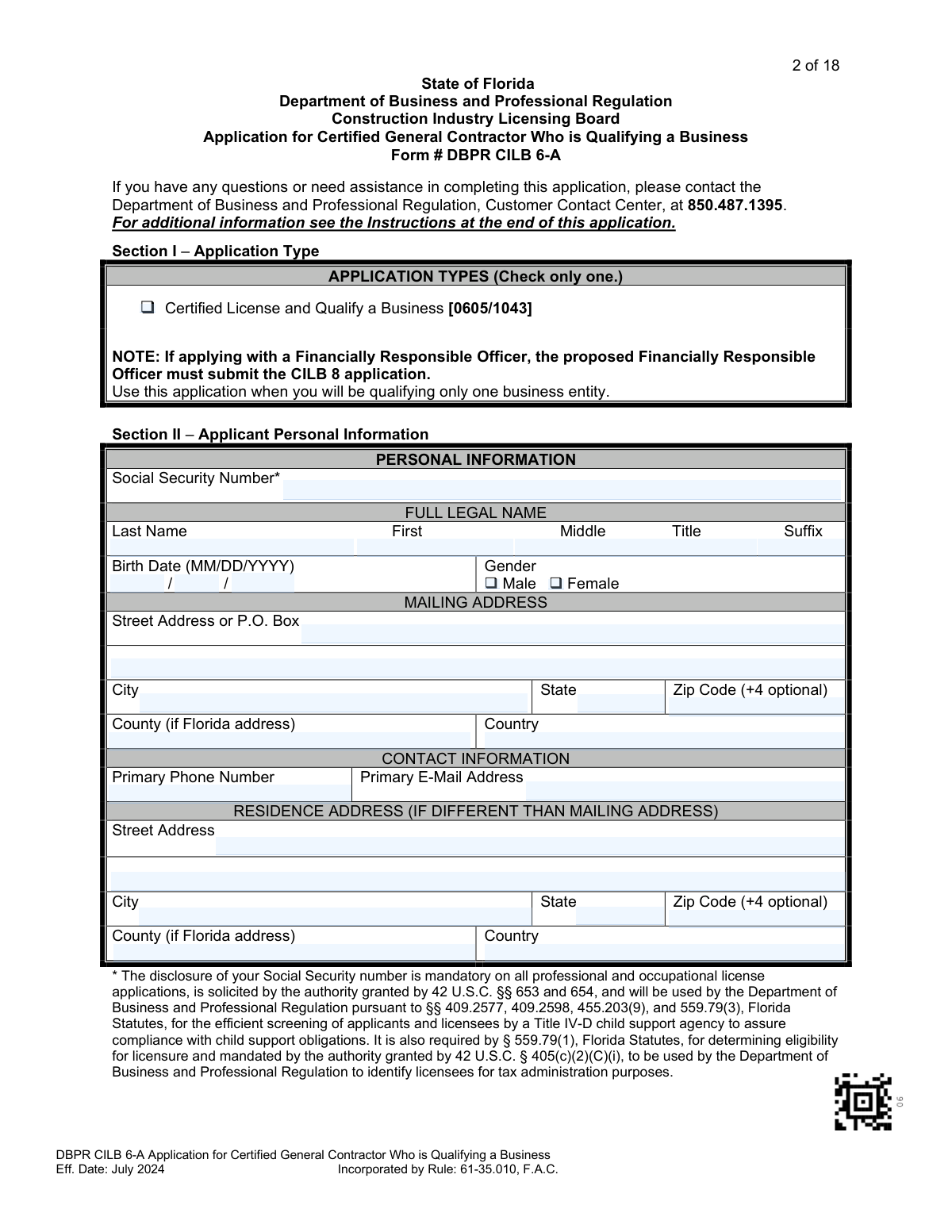
- 2 Complete Section I by selecting the application type (Certified License and Qualify a Business), then fill in Section II with your full legal name, Social Security number, birth date, gender, mailing and residence addresses, and contact information.
- 3 Complete Section III by selecting your method of qualification in Part A and providing detailed employment history in Part B, including employer information, project details, experience areas, and your role (worker or foreman) for each position.
- 4 Fill in Section IV with the business to be qualified information (business name, FEID, business type, existing qualifiers if applicable, and business addresses), then complete Sections V through VII covering primary and secondary qualifier details and full business ownership information.
- 5 Complete Section VIII by confirming insurance coverage for public liability, property damage, and workers' compensation, then fill in Section IX with your credit score status and any financial responsibility course details if your FICO score is below 660.
- 6 Answer all background questions in Section X for yourself and each authorized representative of the business, and provide detailed explanations in Sections XI and XII for any 'Yes' answers, attaching supporting legal documentation as required.
- 7 Review the entire application for accuracy and completeness, then sign and date the Affirmation by Written Declaration in Section XIII, and submit the completed form along with all required documents and the applicable fee to the Florida DBPR.
Our AI-powered system ensures each field is filled out correctly, reducing errors and saving you time.
Why Choose Instafill.ai for Your Fillable DBPR CILB 6-A Form?
Speed
Complete your DBPR CILB 6-A in as little as 37 seconds.
Up-to-Date
Always use the latest 2026 DBPR CILB 6-A form version.
Cost-effective
No need to hire expensive lawyers.
Accuracy
Our AI performs 10 compliance checks to ensure your form is error-free.
Security
Your personal information is protected with bank-level encryption.
Frequently Asked Questions About DBPR CILB 6-A
Form DBPR CILB 6-A is the Application for Certified General Contractor Who is Qualifying a Business, issued by the Florida Department of Business and Professional Regulation (DBPR). It is used by individuals seeking a certified general contractor license in Florida who will also be qualifying a single business entity. You should use this form if you plan to qualify only one business with your contractor license.
The application fee is $245 if you apply between May 1st of an even year and August 31st of an odd year, or $145 if you apply between September 1st of an odd year and April 30th of an even year. Make your check payable to the Florida Department of Business and Professional Regulation and include it with your mailed application.
You must submit the completed application form, the required fee, a credit report with a FICO-derived credit score for both yourself and the business, electronic fingerprints, supporting legal documentation (if applicable), and proof of satisfaction of any liens, judgments, or bankruptcy discharge if shown on your credit report. If your credit score is below 660, you must also provide proof of completing an approved 14-hour financial responsibility course.
Mail your completed application, all required documentation, and the fee to: Department of Business and Professional Regulation, 2601 Blair Stone Road, Tallahassee, FL 32399-0783. If you have questions, you can contact the Customer Contact Center at 850.487.1395.
There are six qualification methods, including combinations of work experience as a worker or foreman and accredited college-level coursework. For example, one method requires four years of experience as a worker or foreman (with at least one year as a foreman), while another requires a four-year construction-related degree plus one year of proven experience. Additionally, Certified General Contractor applicants must have experience in four or more specific experience areas AND at least one year of experience in construction of structures four or more stories in height.
The Upgrade Method allows a certified residential or building contractor who has held an active license in their classification for at least four years to apply for a general contractor license. If you qualify under this method, you are exempt from completing the Employment History section of the application, but you must provide your current license number for verification.
Yes, military veterans have three alternative qualification paths. For example, a veteran with three years of military service and one year of foreman experience may qualify, or a veteran with two years of military service, one year as a foreman, and one year as a worker or foreman. The employment history provided must demonstrate the appropriate time frames for the chosen veteran qualification method.
You must submit a credit report with a FICO-derived credit score from a nationally recognized credit reporting agency. A score of 660 or higher demonstrates financial stability. If your score is below 660, you must complete and provide proof of a 14-hour financial responsibility course approved by the Construction Industry Licensing Board to meet the financial stability requirement.
General and building contractors must carry at least $300,000 in public liability insurance and $50,000 in property damage insurance; all other categories require at least $100,000 public liability and $25,000 property damage. You must also have workers' compensation insurance or file for an exemption, or attest that you will obtain an exemption within 30 days of license issuance.
A Financially Responsible Officer (FRO) is a person appointed to take on financial responsibility for the business, which relieves the primary qualifying agent from financial liability (though the qualifier remains responsible for construction-related matters). Appointing an FRO is optional but recommended if you do not have final approval authority over all business financial matters. If a new FRO is being appointed, that person must also submit a separate CILB 8 application.
Section X contains four background questions covering criminal history, pending bankruptcies or unsatisfied judgments/liens, denied license applications, and disciplinary actions against prior licenses. Both the applicant and all authorized representatives of the business (officers, directors, members, managers, or partners depending on business type) must answer all four questions. Any 'Yes' answer requires a detailed explanation in Section XI or XII.
You are responsible for verifying whether your record has been legally expunged or sealed before answering 'No' to the criminal history question. If you believe records have been expunged or sealed under Florida Statutes §943.0585 or §943.059, you must confirm this prior to answering. Failure to answer accurately may result in denial or revocation of your license.
Electronic fingerprinting is mandatory for all initial license applications. You must have your fingerprints scanned at an approved electronic fingerprinting site, which will electronically submit them to the Florida Department of Law Enforcement and the FBI. For a list of fingerprinting locations, visit http://www.myfloridalicense.com/dbpr/servop/testing/documents/finger_faq.pdf.
Yes, AI-powered services like Instafill.ai can help you accurately auto-fill the many fields in this form, saving you significant time and reducing the risk of errors. Instafill.ai can also convert a flat, non-fillable PDF version of this form into an interactive fillable form if needed. Simply visit Instafill.ai, upload the form, and follow the guided process to complete and review your application.
A primary qualifying agent is jointly and equally responsible for all operations of the business, including all field work, financial matters, and supervision of construction. A secondary qualifying agent is only responsible for supervising fieldwork at sites where their license was used to obtain the building permit and is not responsible for financial matters. If you are applying as a secondary qualifier, you must complete Section VI and provide the primary qualifier's name and license number in Section V.
Compliance DBPR CILB 6-A
Validation Checks by Instafill.ai
1
Social Security Number Format Validation
Validates that the applicant's Social Security Number (SSN) consists of exactly nine numeric digits and conforms to the standard SSN format (XXX-XX-XXXX or nine consecutive digits). The SSN is mandatory under Florida Statutes §§ 409.2577, 409.2598, 455.203(9), and 559.79(3) for child support screening and tax administration purposes. If the SSN is missing, incorrectly formatted, or contains non-numeric characters, the application will be considered deficient and cannot be processed.
2
Birth Date Validity and Logical Age Check
Validates that the Birth Date fields (MM, DD, YYYY) together form a real calendar date and that the resulting age is consistent with a plausible applicant (e.g., at least 18 years old). The month must be between 01 and 12, the day must be valid for the given month and year (accounting for leap years), and the year must be a four-digit value in a reasonable historical range. If the birth date is invalid or results in an implausible age, the application cannot be accurately processed for background screening or licensure eligibility.
3
Full Legal Name Matches Official Documents
Validates that the Full Legal Name fields (Last, First, Middle) are populated with the applicant's complete legal name exactly as it appears on their Social Security card, and that no nicknames, initials only, or abbreviations are used in place of the full name. Per the form instructions, the name must match official documents to ensure accurate identity verification and background checks. If the name does not match supporting documentation, the application will be flagged as deficient, and any aliases or prior names must be disclosed in the Prior Name Information section.
4
Mailing Address Physical Address Requirement
Validates that at least one physical street address (not a P.O. Box alone) is provided across either the Mailing Address or the Residence Address fields, as required by the form instructions. If the mailing address is a P.O. Box, the Residence Address section must be completed with a valid physical street address. Failure to provide a physical address will result in a deficient application, as the Department requires a physical location for correspondence and verification purposes.
5
Florida County Field Conditional Requirement
Validates that the County field is populated when the corresponding State field is 'Florida' (or 'FL') for both the Mailing Address and Residence Address sections, and that it is left blank when the state is not Florida. This conditional requirement ensures accurate geographic identification for Florida-based applicants and is used for administrative routing and audit purposes. If a Florida address is provided without a county, or a non-Florida address includes a county entry, the submission is inconsistent and may cause processing delays.
6
Single Method of Qualification Selection
Validates that exactly one method of qualification is selected in Section III Part A, whether from the standard qualification methods (1–6) or the Military Veterans methods (1–3), and that no more than one box is checked across all qualification options. The form explicitly states 'check only one,' and the employment history in Part B must align with the specific experience requirements of the selected method. If no method is selected, or multiple methods are checked, the application is incomplete and cannot be evaluated for licensure eligibility.
7
Employment History Experience Totals Match Selected Qualification Method
Validates that the total Worker and Foreman experience years entered at the bottom of Section III Part B equal or exceed the minimum experience requirements specified by the qualification method selected in Part A. For example, Method 5 requires four total years with at least one year as a foreman, so the totals must reflect this. If the cumulative experience documented in the employment history entries does not satisfy the selected method's requirements, the application will be deemed deficient and the applicant will not qualify for licensure.
8
Certified General Contractor Four-or-More Experience Areas and High-Rise Requirement
Validates that the employment history entries collectively cover at least four of the six listed experience areas (Foundation/Slabs, Masonry walls, Steel erection, Column erection, Formwork for structural reinforced concrete, Elevated slabs), and that at least one entry indicates experience in the construction of structures four stories or higher. These requirements are mandated by Rule 61G4-15.001(2)(a) and (2)(b), Florida Administrative Code, specifically for Certified General Contractor applicants. If fewer than four experience areas are checked or no high-rise experience is documented, the application will not meet the statutory qualifications.
9
Business Ownership Percentages Sum to 100%
Validates that the percentage of ownership values entered for all listed owners in Section VII sum to exactly 100%. The form instructions explicitly state that the total must equal 100%, and each owner's address and SSN/FEID must also be provided. If the ownership percentages do not total 100%, or if any owner entry is missing required identification information, the business ownership section is incomplete and the application will be considered deficient.
10
Federal Employer Identification Number (FEID) Format Validation
Validates that the Federal Employer Identification Number entered for the business to be qualified consists of exactly nine numeric digits in the standard IRS format (XX-XXXXXXX). The FEID is required for all business entities other than sole proprietors (who may use an SSN) and is used to verify the business's legal registration and tax standing. If the FEID is missing, incorrectly formatted, or does not match the business name on file with the IRS, the application cannot be properly processed.
11
Credit Score Below 660 Requires Financial Responsibility Course Completion
Validates that when the applicant indicates the submitted credit report shows a credit score below 660 (FICO derived), the 'Completed financial responsibility course: Yes' box is checked and all associated course detail fields (School Name, School Provider Number, Course Name, and Date(s) Attended) are fully populated. Per Rule 61G4-15.006, F.A.C., a credit score below 660 requires proof of completion of a Board-approved 14-hour financial responsibility course as an alternative means of demonstrating financial stability. If the course details are missing when the credit score is below 660, the financial stability requirement is unmet and the application will be denied.
12
Background Question Yes Answers Require Corresponding Explanation Sections
Validates that for every 'Yes' answer checked in the Background Questions table (Section X) for any person (applicant or authorized representative), a corresponding explanation entry exists in Section XI (for Questions 1 and 2) or Section XII (for Questions 3 and 4), with all required fields completed (offense, county/state/jurisdiction, date, penalty/disposition, and description). The form instructions state that the number of 'Yes' boxes checked must equal the number of explanation boxes completed. If a 'Yes' answer lacks a corresponding explanation, the application is deficient and may result in denial or administrative action.
13
Financially Responsible Officer Selection Mutual Exclusivity
Validates that exactly one of the three Financially Responsible Officer options in Section V is selected: (1) the business currently has an approved FRO, (2) the business will appoint an FRO, or (3) no FRO will be designated and the primary qualifying agent assumes financial responsibility. Additionally, if option 1 is selected, the FRO's name and license number must be provided; if option 2 is selected, the proposed FRO's name must be provided. Selecting multiple options or leaving the section blank creates an ambiguous financial responsibility assignment that will prevent the application from being processed.
14
Upgrade Method License Number and Classification Validation
Validates that when the 'Upgrade Method' is selected as the qualification method in Section III Part A, a valid license number is entered in the 'If checked, License #' field and exactly one classification (Building or Residential) is checked. The Upgrade Method requires the applicant to hold an active certified residential or building contractor license for a minimum of four years, and the license number is required for DBPR verification. If the license number is missing or neither classification is selected, the upgrade eligibility cannot be confirmed and the application will be considered deficient.
15
Insurance Coverage Affirmation Completeness
Validates that both insurance questions in Section VIII are answered with either 'Yes' or 'No,' and that the applicant has not left either question blank. The form requires confirmation of public liability and property damage insurance meeting minimum thresholds ($300,000 public liability and $50,000 property damage for General and Building Contractors) and workers' compensation insurance or a filed exemption. If either insurance question is unanswered, or if 'No' is selected for public liability insurance without explanation, the application does not meet the mandatory insurance requirements under Section 489.115(5)(a), Florida Statutes.
16
Affirmation by Written Declaration Signature and Date Required
Validates that the Signature, Date, and Print Name fields in Section XIII are all completed before the application is submitted, as the written declaration carries the same legal effect as an oath or affirmation under Section 559.79, Florida Statutes. The date must be a valid calendar date that is not in the future, and the printed name must match the applicant's full legal name provided in Section II. An unsigned or undated declaration renders the entire application legally invalid, and falsification of any material information on the application may result in criminal penalty or administrative action including license revocation.
Common Mistakes in Completing DBPR CILB 6-A
Applicants frequently submit the wrong fee because the amount depends on the specific date range during which they apply — $245 if applying between May 1 of an even year through August 31 of an odd year, and $145 for all other periods. Many people either miscalculate which cycle they fall into or use an outdated fee schedule. Submitting the wrong amount will delay processing or result in rejection. Always verify the current date against the fee schedule before writing your check, and make it payable to the Florida Department of Business and Professional Regulation. AI-powered form tools like Instafill.ai can help flag the correct fee based on the current date.
Applicants often enter a nickname, shortened name, or name that differs from what appears on their Social Security card. The instructions explicitly require the full legal name as it appears on the Social Security card, with no nicknames or initials. A mismatch can cause the application to be flagged as deficient and delay licensure. Always cross-reference your Social Security card before completing the name fields, and list any aliases or prior names (such as maiden names) in the Prior Name Information section.
Many applicants answer 'No' to the prior name question even though they have used a maiden name, nickname, or other alias on professional documents or licenses. If supporting documentation submitted with the application uses a different name than the legal name provided, the application will be considered deficient. Applicants should carefully review all prior licenses, certifications, and legal documents to identify any name variations and list them in the Prior Name Information section. Instafill.ai can prompt users to cross-check name fields and flag potential discrepancies.
Applicants sometimes check a qualification method in Part A that their employment history in Part B does not actually support. For example, selecting Method 1 (four-year degree plus one year experience) without having a qualifying construction-related baccalaureate degree, or selecting Method 5 (four years worker/foreman) without documenting at least one year as a foreman. The board will verify that the employment history matches the selected method, and a mismatch results in denial. Carefully read each method's requirements and ensure your Part B employment history explicitly demonstrates the required years and roles before selecting a method.
Certified General Contractor applicants must demonstrate experience in four or more of the listed experience areas AND provide at least one year of experience in the construction of structures at least four stories in height, per Rule 61G4-15.001. Many applicants overlook this specific requirement and fail to check the 'Yes' box for the four-story question or fail to provide project specifics (number of stories, square footage, materials) that confirm this. Omitting this information results in a deficient application. For every project entry, explicitly state the number of stories and confirm whether it meets the four-story threshold.
Applicants frequently submit a generic credit report that does not include a FICO-derived credit score or a public records statement confirming that records were checked at local, state, and federal levels. The form requires a report from a nationally recognized credit reporting agency that meets both criteria. Submitting an incomplete credit report will cause the application to be returned as deficient. Use only agencies listed on the DBPR's approved credit reporting agencies list and confirm the report explicitly includes a FICO score and a public records statement before submitting.
Applicants with a FICO-derived credit score below 660 are required to complete a 14-hour financial responsibility course approved by the Construction Industry Licensing Board and submit proof of completion. Many applicants either do not realize this requirement applies to them or submit the application without the course documentation, hoping the credit score alone will suffice. This results in automatic denial of the financial stability requirement. If your credit score is below 660, complete an approved course before submitting and include the school name, provider number, course name, and dates attended in Section IX.
Section X requires not only the applicant but also all authorized representatives of the business — including all officers, directors, members, managers, and partners — to answer the four background questions and provide their Social Security numbers. Applicants commonly fill out only their own row and leave the remaining rows blank, which constitutes an incomplete application. The accuracy of authorized representatives can be verified on the Florida Division of Corporations website (sunbiz.org). Before submitting, cross-reference sunbiz.org to identify all required individuals and ensure each one has answered all four questions.
When an applicant or authorized representative answers 'Yes' to any of the four background questions, they must complete Section XI (for questions 1 and 2) or Section XII (for questions 3 and 4) with full details including offense, county, state, date, penalty/disposition, and a narrative description. Many applicants check 'Yes' but leave the explanation sections blank or provide only a brief, vague description. The instructions state that the number of 'Yes' answers must equal the number of completed explanation boxes. Incomplete explanations will result in a deficient application and may raise red flags with reviewers.
Section VII requires listing all business owners with their respective ownership percentages, and the total must equal exactly 100%. Applicants frequently omit minority owners, round percentages incorrectly, or forget to include corporate entities as owners. If the percentages do not add up to 100%, the application is considered incomplete. List every person or entity with any ownership interest, use precise percentages (e.g., 33.33% rather than 33%), and verify the total before submitting. If an owner is a company rather than an individual, provide that company's FEID number instead of an SSN.
The instructions explicitly state that applicants must provide at least one physical street address — a P.O. Box alone is not sufficient. Many applicants use a P.O. Box as both their mailing and residence address, leaving no physical address on file. This causes the application to be flagged as deficient. If your mailing address is a P.O. Box, you must also complete the Residence Address section with a valid physical street address. Instafill.ai can automatically validate address fields and alert users when only a P.O. Box has been provided.
Section XIII requires the applicant's original signature, the date signed, and a printed name. A surprisingly common mistake is submitting the application without a signature, with only initials, or with the date field left blank. Because the signature carries the same legal effect as an oath or affirmation under Florida law, an unsigned application cannot be processed and will be returned. Before mailing, always verify that Section XIII is fully completed with a wet or valid electronic signature, the exact date of signing, and the applicant's full printed name.
Saved over 80 hours a year
“I was never sure if my IRS forms like W-9 were filled correctly. Now, I can complete the forms accurately without any external help.”
Kevin Martin Green
Your data stays secure with advanced protection from Instafill and our subprocessors




Robust compliance program
Transparent business model
You’re not the product. You always know where your data is and what it is processed for.
ISO 27001, HIPAA, and GDPR
Our subprocesses adhere to multiple compliance standards, including but not limited to ISO 27001, HIPAA, and GDPR.
Security & privacy by design
We consider security and privacy from the initial design phase of any new service or functionality. It’s not an afterthought, it’s built-in, including support for two-factor authentication (2FA) to further protect your account.
Fill out DBPR CILB 6-A with Instafill.ai
Worried about filling PDFs wrong? Instafill securely fills dbpr-cilb-6-a-application-for-certified-general-contractor-who-is-qualifying-a-business forms, ensuring each field is accurate.
