Fill out DBPR forms
with AI.
DBPR forms are official documents issued by the Florida Department of Business and Professional Regulation, the state agency responsible for licensing and regulating a wide range of professions and industries across Florida. These forms cover everything from construction contractor certifications to alcoholic beverage license transfers, making them essential for businesses and individuals who need to establish, maintain, or modify their standing with the state. Whether you're a contractor seeking statewide certification or a business owner acquiring a liquor license, submitting the correct DBPR form accurately and on time is a critical step in staying legally compliant.
By continuing, you acknowledge Instafill's Privacy Policy and agree to get occasional product update and promotional emails.
About DBPR forms
The forms in this category are typically used by contractors, business owners, license applicants, and legal representatives navigating Florida's regulatory requirements. For example, a general contractor qualifying a new business entity would need the CILB 6-A, while someone purchasing an existing bar or restaurant would likely need to file the ABT-6002 to transfer the alcoholic beverage license into their name. These forms often require detailed personal disclosures, financial documentation, background information, and supporting attachments — making accuracy especially important, as errors can lead to processing delays or outright denial.
Because many of these forms are lengthy and involve complex multi-section requirements, tools like Instafill.ai use AI to fill them out in under 30 seconds, helping applicants avoid common mistakes and submit complete, accurate paperwork without the usual hassle.
Every form on this page can be completed without typing. Instafill is form filling software that reads a PDF and fills it for you — including flat and scanned documents that carry no fillable fields at all.
Forms in This Category
The forms in this category have a median Form Complexity Index of 87/100 (Very Complex), measured across 7 forms by field count, input difficulty, length, conditional logic and structure. See how it is calculated.
- Enterprise-grade security & data encryption
- 99%+ accuracy powered by AI
- 1,000+ forms from all industries
- Complete forms in under 60 seconds
How to Choose the Right Form
These five DBPR forms fall into two distinct categories — construction contractor licensing and alcoholic beverage license transfers. Here's how to find the right one quickly.
Applying for a Contractor License?
Both of these forms are for individuals seeking initial certification as a contractor in Florida while also qualifying a business entity:
- DBPR CILB 6-A — Choose this if you are applying as a Certified General Contractor. This license allows you to perform a broad range of construction work statewide.
- DBPR CILB 6-B — Choose this if you are applying as a Certified Building Contractor. This covers a more specific scope of construction work compared to the general contractor designation.
Both forms require employment history, project experience, insurance documentation, financial disclosures, and electronic fingerprinting. If you're unsure which contractor classification fits your work, check with the Florida Construction Industry Licensing Board before applying.
Transferring an Alcoholic Beverage License?
All three remaining forms are versions of DBPR ABT-6002, used when transferring ownership of a Florida alcoholic beverage license. They cover the same transaction and collect the same information — including license details, business entity data, owner background disclosures, and required governmental approvals.
- Use any version of DBPR ABT-6002 if you are buying or receiving an existing liquor license, changing the business name, updating officers or stockholders, or relocating a licensed premises.
- This form is also required when adding retail tobacco product options or changing the license series.
Since all three ABT-6002 listings represent the same form, simply select the one that is fillable or most complete for your needs — Instafill.ai can help you complete any version accurately using AI assistance.
Quick Summary
| Need | Form to Use |
|---|---|
| Become a Certified General Contractor | DBPR CILB 6-A |
| Become a Certified Building Contractor | DBPR CILB 6-B |
| Transfer a liquor/beverage license | DBPR ABT-6002 |
Form Comparison
| Form | Purpose | Who Files It | When to Use |
|---|---|---|---|
| DBPR CILB 6-B, Application for Certified Building Contractor Who is Qualifying a Business | Apply for certified building contractor license and qualify a business | Individual seeking certified building contractor certification in Florida | Initial certification application for building contractor statewide licensure |
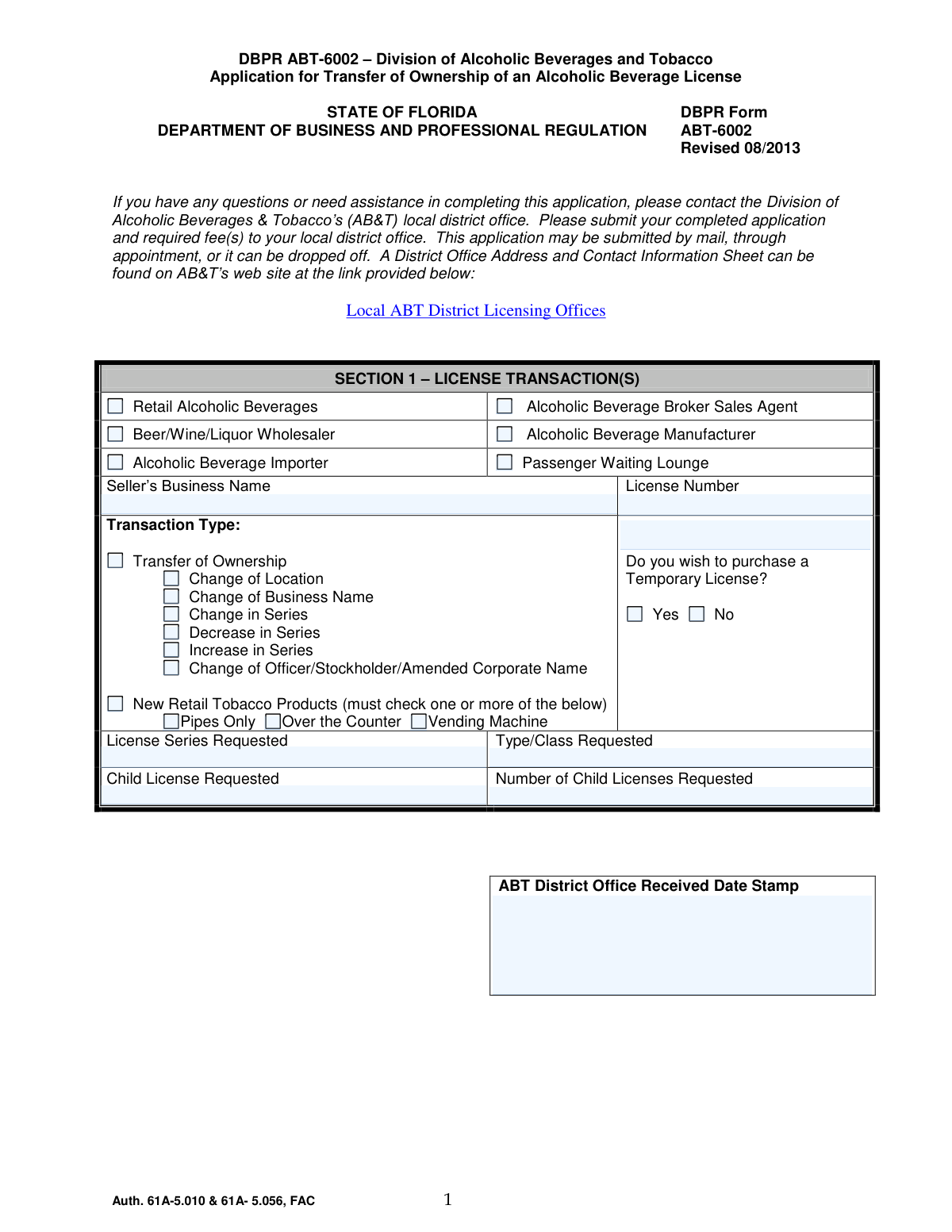
| DBPR ABT-6002 – Application for Transfer of Ownership of an Alcoholic Beverage License | Transfer ownership of an alcoholic beverage license in Florida | New owner acquiring an existing Florida alcoholic beverage license | When buying, selling, or changing ownership of a liquor license |
| DBPR ABT-6002, Division of Alcoholic Beverages and Tobacco Application for Transfer of Ownership of an Alcoholic Beverage License | Transfer or update details of an alcoholic beverage license | Applicants transferring or modifying an existing liquor license | Ownership transfer, location change, or license detail updates |
| DBPR Form ABT-6002, Division of Alcoholic Beverages and Tobacco Application for Transfer of Ownership of an Alcoholic Beverage License | Transfer alcoholic beverage license and update related license details | New owners or businesses acquiring a Florida alcoholic beverage license | License transfer, series change, officer updates, or adding tobacco options |
| DBPR CILB 6-A, Application for Certified General Contractor Who is Qualifying a Business | Apply for certified general contractor license and qualify a business | Individual seeking certified general contractor certification in Florida | Initial certification application for general contractor statewide licensure |
Tips for DBPR forms
DBPR forms often require attachments such as fingerprint cards, proof of insurance, surety bonds, credit reports, arrest dispositions, and entity registration documents. Collecting everything before you start filling out the form prevents incomplete submissions that can trigger deficiency notices and delay approval.
Forms like the ABT-6002 and CILB applications require precise identifiers such as your FEIN, Florida Division of Corporations document number, and existing license numbers. A single transposed digit can cause processing delays or a mismatch in DBPR's records, so verify these against your official documents before submitting.
Both contractor licensing and alcoholic beverage transfer forms require full disclosure of criminal history, prior disciplinary actions, liens, and judgments. Omitting or understating this information — even unintentionally — can result in denial or later revocation, so answer every disclosure question carefully and attach required documentation.
Several DBPR forms, including the ABT-6002, must be signed under oath and notarized before submission. Submitting an unnotarized form is a common mistake that will cause your application to be rejected outright, so confirm notarization requirements before your final review.
AI-powered tools like Instafill.ai can complete complex DBPR forms in under 30 seconds with high accuracy, even converting non-fillable PDFs into interactive forms. Your data stays secure throughout the process, making it a practical time-saver if you're managing both a contractor license application and a business qualification simultaneously.
Alcoholic beverage license transfer applications require confirmation of local zoning compliance, Department of Revenue sales tax registration, and sometimes health department approval. Reaching out to these agencies early in the process prevents last-minute bottlenecks that can stall your DBPR application.
DBPR applications distinguish between sole proprietorships, partnerships, corporations, and LLCs, and the required ownership and qualifier information differs for each. Selecting the wrong entity type or providing mismatched ownership details is a frequent error that leads to deficiency letters, so confirm your current Florida Division of Corporations registration before filling out the form.
Retain copies of your completed DBPR forms, all attachments, and any payment receipts before sending your application. If DBPR requests additional information or there is a dispute about what was submitted, having a complete record on hand allows you to respond quickly and accurately.
Frequently Asked Questions
This category includes Florida Department of Business and Professional Regulation (DBPR) forms covering two main areas: construction industry licensing (CILB 6-A and 6-B for certified general and building contractors) and alcoholic beverages and tobacco licensing (ABT-6002 for transferring ownership of an alcoholic beverage license). Whether you're a contractor seeking statewide certification or a business acquiring an existing liquor license, you'll find the relevant application here.
DBPR forms are required by individuals and businesses operating in Florida in regulated industries, including construction contracting and the sale, manufacture, or distribution of alcoholic beverages. For example, a contractor seeking initial statewide certification must file a CILB application, while anyone purchasing or taking over an existing alcoholic beverage license must submit the ABT-6002 transfer form.
DBPR CILB 6-A is for individuals applying for certification as a Certified General Contractor who also want to qualify a business entity, while CILB 6-B is specifically for those seeking certification as a Certified Building Contractor qualifying a business. The scope of contracting work each license covers differs, so applicants should select the form that matches the type of contracting work they intend to perform.
You need to file DBPR ABT-6002 whenever ownership of an existing Florida alcoholic beverage license is being transferred to a new owner, or when certain license details are changing, such as the business location, business name, license series, or officers and stockholders. The transfer must be approved by DBPR before the new owner has legal authority to sell, manufacture, or distribute alcoholic beverages.
Completed DBPR forms are generally submitted to the Florida Department of Business and Professional Regulation, either through their online portal, by mail, or in person at a regional DBPR office, depending on the specific form and application type. It is recommended to check the DBPR website or the instructions accompanying your specific form for the most current submission address and accepted delivery methods.
Supporting documents vary by form but commonly include proof of identity, electronic fingerprints for background screening, certificates of insurance, financial statements or credit reports, and business entity documentation such as articles of incorporation or FEIN verification. For liquor license transfers, additional items like a surety bond, zoning approval, sales tax registration, and arrest disposition records may be required.
Yes, both the CILB 6-A and CILB 6-B applications require applicants to disclose their background and disciplinary history, including any prior license denials, revocations, or criminal history. DBPR reviews these disclosures as part of determining eligibility, and providing inaccurate or incomplete information can result in delays, denial, or revocation of a license.
Yes, AI-powered tools like Instafill.ai can fill out DBPR forms in under 30 seconds by accurately extracting and placing data from your source documents into the correct fields. This is especially useful for complex multi-section forms like CILB 6-A, CILB 6-B, and ABT-6002, which require detailed personal, business, and background information. Instafill.ai can also convert non-fillable PDF versions of these forms into interactive fillable forms.
Manually completing a DBPR form can take anywhere from 30 minutes to several hours depending on the complexity of the application and how readily available your supporting information is. Using AI-powered services like Instafill.ai, the data entry portion can be completed in under 30 seconds, with the AI accurately extracting and placing information from your documents into the appropriate fields.
Yes, DBPR forms are official state forms issued by the Florida Department of Business and Professional Regulation and apply exclusively to individuals and businesses operating within the state of Florida. Contractor certifications obtained through DBPR are valid statewide in Florida, and alcoholic beverage licenses issued or transferred through DBPR are governed by Florida law.
If a DBPR application is incomplete or contains errors, DBPR may issue a deficiency notice requiring you to provide missing information or correct inaccuracies before the application can be processed. In cases of deliberate misstatements, the application may be denied or, if a license has already been issued, it may be subject to revocation. Ensuring accuracy and completeness before submission is critical to avoiding delays.
Certain DBPR applications, particularly the ABT-6002 for alcoholic beverage license transfers, require a sworn, notarized statement affirming the accuracy of the information provided. Contractor licensing forms may also require notarization or sworn attestations depending on the specific section. Always review the signature and verification requirements on each form before submitting.
Glossary
- Form Complexity Index
- Instafill’s 0–100 measure of how much effort a form takes to complete, calculated deterministically from the form’s own structure rather than estimated. It combines the number of fillable fields (the largest factor), how difficult those fields are to complete based on their type, the number of pages that contain fields, the amount of conditional “fill-only-if” logic, and how many sections the form is divided into, then adds modifiers for tables and repeating lists, bundled instruction pages, and dense page layouts. A higher score means the form is harder to fill out by hand. The forms in this category have a median Form Complexity Index of 87/100 (Very Complex). See exactly how it is calculated.
- DBPR
- The Florida Department of Business and Professional Regulation, the state agency responsible for licensing and regulating businesses and professionals in Florida, including contractors and alcoholic beverage sellers.
- Qualifying Agent
- A licensed individual who takes legal and professional responsibility for a business entity's contracting or regulated activities, ensuring the business meets state licensing requirements.
- CILB
- The Construction Industry Licensing Board, a Florida board under DBPR that oversees the licensing and regulation of contractors, including certified general and building contractors.
- ABT
- The Division of Alcoholic Beverages and Tobacco, the DBPR division that regulates the licensing, sale, manufacture, and distribution of alcoholic beverages and tobacco products in Florida.
- Certified Contractor
- A contractor who holds a state-issued Florida certification allowing them to work in their licensed trade anywhere in the state, as opposed to a registered contractor whose license is limited to specific local jurisdictions.
- FEID (Federal Employer Identification Number)
- A unique tax identification number assigned by the IRS to a business entity, required on DBPR forms to identify the business being licensed or qualified.
- Series (Alcoholic Beverage License)
- A classification code assigned to an alcoholic beverage license that defines what types of alcohol a licensee is permitted to sell and under what conditions (e.g., beer only, beer and wine, or full liquor).
- Surety Bond
- A legally binding agreement involving a third-party bonding company that guarantees a licensee will fulfill their obligations; required for certain alcoholic beverage license transfers in Florida.
- Moral Character Disclosure
- A required background disclosure on DBPR applications where applicants must report prior criminal history, disciplinary actions, or regulatory violations, which DBPR uses to assess eligibility for licensure.
- Right of Occupancy
- Documentation proving that an applicant has legal authority to use a premises (such as a lease or deed), required by DBPR when licensing or transferring a license for a specific business location.