Fill out CILB forms
with AI.
The Construction Industry Licensing Board (CILB) forms are essential documents for professionals seeking to operate within Florida's regulated construction market. These forms facilitate the licensing process for various contractor designations, ensuring that applicants meet the state’s rigorous standards for experience, financial stability, and professional conduct. Whether you are applying for initial certification or seeking to qualify a new business entity, these documents are the legal gateway to performing construction work legally throughout the state.
By continuing, you acknowledge Instafill's Privacy Policy and agree to get occasional product update and promotional emails.
About CILB forms
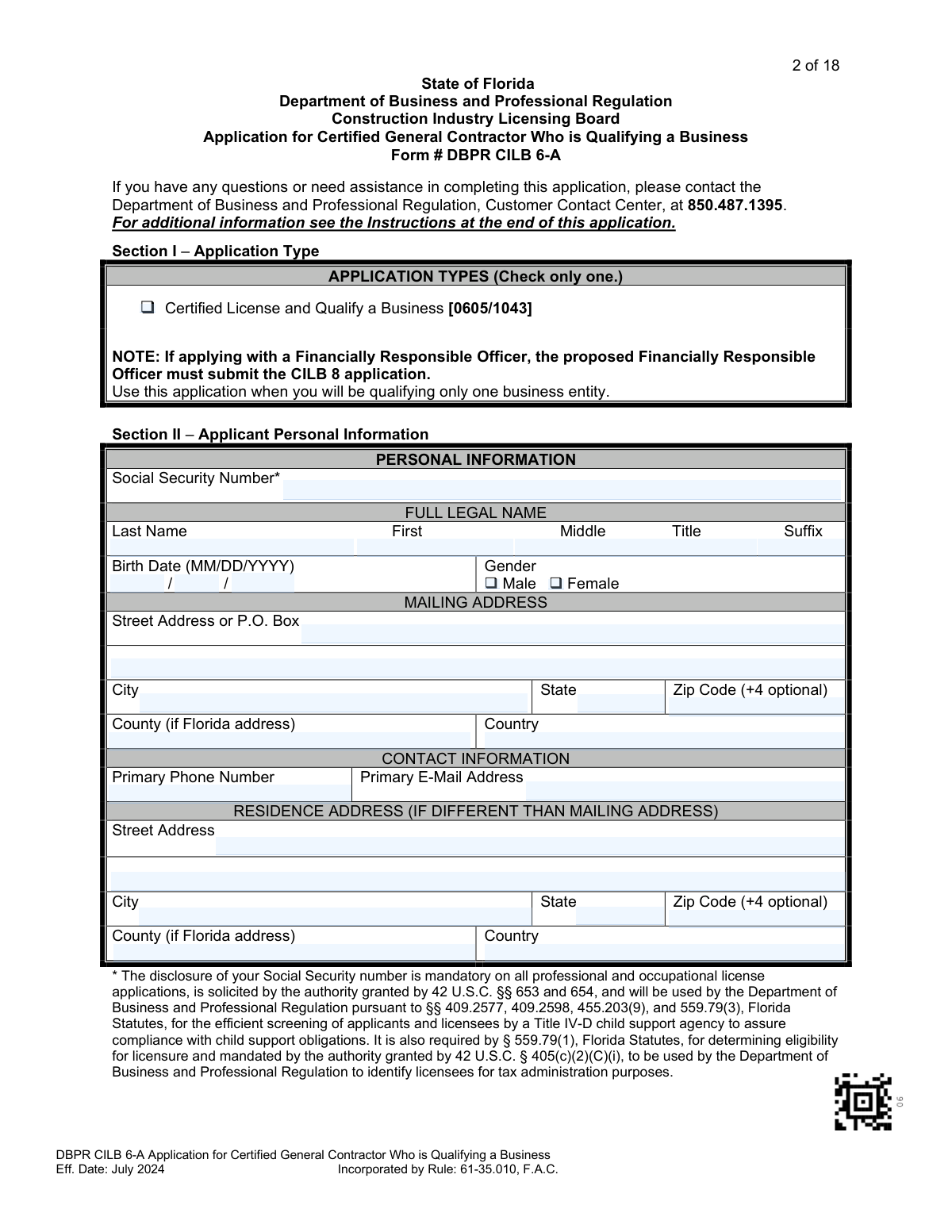
Typically, these forms are used by aspiring General Contractors, Building Contractors, and other specialized tradespeople who need to document their qualifications for the DBPR. For instance, forms like the DBPR CILB 6-A and 6-B are used when an individual wants to qualify a business entity while applying for their certification. The application process requires detailed disclosures regarding employment history, project experience, and financial responsibility, making accuracy paramount to avoid administrative delays or the denial of a license.
Managing the extensive paperwork required by the Florida DBPR can be a time-consuming task for busy professionals. Tools like Instafill.ai use AI to fill these forms in under 30 seconds, ensuring that data is handled accurately and securely while streamlining the submission process. This allows contractors to focus on their projects and business operations rather than getting bogged down in repetitive manual data entry.
Every form on this page can be completed without typing. Instafill is form filling software that reads a PDF and fills it for you — including flat and scanned documents that carry no fillable fields at all.
Forms in This Category
The forms in this category have a median Form Complexity Index of 90/100 (Very Complex), measured across 4 forms by field count, input difficulty, length, conditional logic and structure. See how it is calculated.
- Enterprise-grade security & data encryption
- 99%+ accuracy powered by AI
- 1,000+ forms from all industries
- Complete forms in under 60 seconds
How to Choose the Right Form
Selecting the correct Florida Construction Industry Licensing Board (CILB) form depends entirely on the scope of work your business intends to perform. Both of these applications are designed for individuals seeking initial certification while simultaneously qualifying a business entity.
For Unlimited Construction Scope
If you intend to perform construction on any type of building, regardless of height, size, or structural complexity, you should use DBPR CILB 6-A, Application for Certified General Contractor Who is Qualifying a Business.
- Scope: Unlimited construction services.
- Best for: Contractors working on high-rise buildings, large-scale commercial complexes, and complex infrastructure.
- Experience: You will need to demonstrate experience in four-story or higher construction (or the equivalent required by the board).
For Limited Commercial and Residential Projects
If your professional focus is on commercial or residential buildings that do not exceed three stories in height, choose DBPR CILB 6-B, Application for Certified Building Contractor Who is Qualifying a Business.
- Scope: Limited to buildings of three stories or less.
- Best for: Residential builders, light commercial contractors, and those specializing in remodeling existing structures within this height limit.
- Experience: Your documented project history must show work on the structural components of buildings three stories or less.
Common Requirements for Both Applications
Regardless of which license path you choose, the CILB requires a rigorous documentation process. Both DBPR CILB 6-A and DBPR CILB 6-B require you to verify:
- Financial Responsibility: You must provide credit reports with FICO scores and disclose any history of liens or judgments.
- Insurance Coverage: Proof of public liability, property damage, and workers' compensation insurance is mandatory.
- Background Verification: Applicants must undergo electronic fingerprinting and provide full disclosure of any past disciplinary or criminal history.
- Business Details: You must provide specific details for the entity being qualified, including FEID numbers and ownership percentages.
Form Comparison
| Form | Scope of Work | Licensure Type | Primary Goal |
|---|---|---|---|
| DBPR CILB 6-B, Application for Certified Building Contractor Who is Qualifying a Business | Construction of commercial or residential buildings, typically limited to three stories. | Certified Building Contractor (CBC) | Initial certification and qualifying a business entity for building construction. |
| DBPR CILB 6-A, Application for Certified General Contractor Who is Qualifying a Business | Unlimited scope for construction of any building type or size statewide. | Certified General Contractor (CGC) | Initial certification and qualifying a business entity for general contracting. |
Tips for CILB forms
Ensure your credit reports are current and meet the specific FICO score requirements before starting your application. Gather documentation for any past liens or judgments to avoid delays during the board review process, as financial history is a major component of these filings.
The Florida DBPR requires electronic fingerprinting through an approved vendor before your application can be processed. Keep your transaction receipt as proof of completion, as the board cannot issue your license without these background results on file.
When listing employment history, provide specific details regarding the scope and scale of your previous construction projects. Clear descriptions help the board verify that your experience aligns with the specific contractor classification you are seeking.
Before qualifying a business, ensure the entity is properly registered with the Division of Corporations. The name on your CILB application must match the legal business name and Federal Employer Identification Number (FEID) exactly to prevent administrative rejection.
Using AI-powered tools like Instafill.ai can complete these complex CILB forms in under 30 seconds with high accuracy. Your data stays secure during the process, providing a reliable and efficient way to handle multiple pages of technical information without manual entry errors.
Double-check that your general liability and workers' compensation insurance meet the minimum limits for your specific license type. Providing certificates that explicitly list the Construction Industry Licensing Board as the certificate holder can significantly streamline the approval process.
Ensure all sections requiring signatures from business officers or the primary applicant are dated within the same general timeframe. Discrepancies in dates or missing signatures on multi-page applications are a leading cause of application deficiencies and return-to-sender notices.
Frequently Asked Questions
CILB forms are official documents used by the Florida Construction Industry Licensing Board to regulate the licensing of contractors. These applications allow individuals to apply for initial certification and qualify their business entities to legally perform construction work throughout the state.
The choice depends on your intended scope of work. Use form 6-A if you are applying to be a Certified General Contractor, which permits the construction of any structure, while form 6-B is for Certified Building Contractors, who are generally limited to commercial and residential structures that do not exceed a certain number of stories.
Applicants must typically provide evidence of their work experience or education, proof of financial responsibility through credit reports, and verification of required insurance coverage. Additionally, you must complete electronic fingerprinting and disclose any relevant background or disciplinary history as part of the submission.
Yes, AI tools like Instafill.ai can be used to fill out these complex forms in under 30 seconds. The AI accurately extracts data from your source documents and places it into the correct fields, ensuring that the multi-page application is completed without manual entry errors.
Qualifying a business involves a licensed contractor assuming the legal and financial responsibility for the construction activities of a specific company. By filing these forms, you are linking your personal professional license to the business entity, allowing that company to operate as a licensed contractor.
While manually completing the detailed employment and financial sections can take hours, using automated tools like Instafill.ai allows you to finish the process in less than a minute. This is achieved by mapping data from your existing records directly into the official DBPR PDF.
Once the form is filled and all supporting documents are attached, the application must be submitted to the Florida Department of Business and Professional Regulation (DBPR). It is essential to include the required application fees to ensure the board begins the review process.
Incomplete applications result in 'deficiencies,' which can cause significant delays in your licensing timeline. The DBPR will typically notify you of the missing data, but failing to provide accurate information can eventually lead to a denial of your certification.
Yes, both forms require the applicant to demonstrate financial responsibility. This usually involves providing a credit report with a FICO score for both the individual applicant and the business entity being qualified to ensure there are no outstanding liens or judgments.
Yes, applicants must verify they have obtained the necessary workers' compensation and general liability insurance. The forms include specific sections where insurance details must be documented to prove the business is adequately protected before a license is issued.
Glossary
- Form Complexity Index
- Instafill’s 0–100 measure of how much effort a form takes to complete, calculated deterministically from the form’s own structure rather than estimated. It combines the number of fillable fields (the largest factor), how difficult those fields are to complete based on their type, the number of pages that contain fields, the amount of conditional “fill-only-if” logic, and how many sections the form is divided into, then adds modifiers for tables and repeating lists, bundled instruction pages, and dense page layouts. A higher score means the form is harder to fill out by hand. The forms in this category have a median Form Complexity Index of 90/100 (Very Complex). See exactly how it is calculated.
- CILB (Construction Industry Licensing Board)
- The regulatory body within the Florida DBPR responsible for licensing and regulating the construction industry through examination and disciplinary actions.
- Qualifying a Business
- The legal process where a licensed contractor acts as the primary professional responsible for the construction activities and financial operations of a specific business entity.
- DBPR (Department of Business and Professional Regulation)
- The Florida state agency tasked with licensing and regulating businesses and professionals, including the Construction Industry Licensing Board.
- Certified Contractor
- A contractor who has passed the state examination and is authorized to work in their trade anywhere within the state of Florida.
- Financial Responsibility
- A licensing requirement involving the submission of credit reports and FICO scores to prove the applicant's fiscal stability and lack of outstanding liens.
- FEID (Federal Employer Identification Number)
- A unique nine-digit number assigned by the IRS to business entities, used on CILB forms to identify the company being qualified.
- Qualifying Agent
- The individual licensee who is legally responsible for the supervision of all construction projects and the financial management of the qualified business.
- Electronic Fingerprinting
- A mandatory digital background check process required by the DBPR to verify an applicant's criminal history through state and federal databases.