Fill out Hawaii contractor forms
with AI.
Hawaii contractor forms are the official documents required by the State of Hawaii Department of Commerce and Consumer Affairs (DCCA) Contractors License Board to verify qualifications, review financial standing, and determine eligibility for a contractor's license. These forms are a critical part of the licensing process — the Board uses the information submitted to assess whether an applicant meets Hawaii's legal and professional standards before granting permission to work as a licensed contractor in the state. Submitting incomplete or inaccurate paperwork can result in delays, deficiency notices, or even an application being deemed abandoned under Hawaii law, making accuracy essential from the start.
By continuing, you acknowledge Instafill's Privacy Policy and agree to get occasional product update and promotional emails.
About Hawaii contractor forms
These forms are typically needed by individuals looking to establish themselves as licensed contractors in Hawaii, particularly sole proprietors applying for the first time. The application process involves more than just a single form — it includes supporting documentation such as notarized experience certificates, a CPA-prepared financial statement, and a detailed chronological history of completed projects. Together, these materials give the Board a comprehensive picture of an applicant's experience, financial responsibility, and readiness to proceed to the licensing examination.
Given the complexity and detail involved, tools like Instafill.ai use AI to help applicants fill out these forms accurately in under 30 seconds, and can even convert non-fillable PDF versions into interactive forms — a practical time-saver when you're navigating a multi-document application process.
Every form on this page can be completed without typing. Instafill is form filling software that reads a PDF and fills it for you — including flat and scanned documents that carry no fillable fields at all.
Forms in This Category
The forms in this category have a median Form Complexity Index of 81/100 (Very Complex), measured across 1 forms by field count, input difficulty, length, conditional logic and structure. See how it is calculated.
- Enterprise-grade security & data encryption
- 99%+ accuracy powered by AI
- 1,000+ forms from all industries
- Complete forms in under 60 seconds
How to Choose the Right Form
If you've landed on this page, you're likely a sole proprietor in Hawaii looking to obtain a contractor's license. There is one comprehensive application packet available here — here's what you need to know to use it correctly.
Who This Packet Is For
- Sole proprietors only — individuals applying for a Hawaii contractor's license under their own name as a single-owner business
- Applicants who meet Hawaii's eligibility requirements: minimum age, legal work authorization, and documented supervisory experience in the trade
- Those ready to submit a complete packet to the DCCA Contractors License Board
What's Included in the Packet
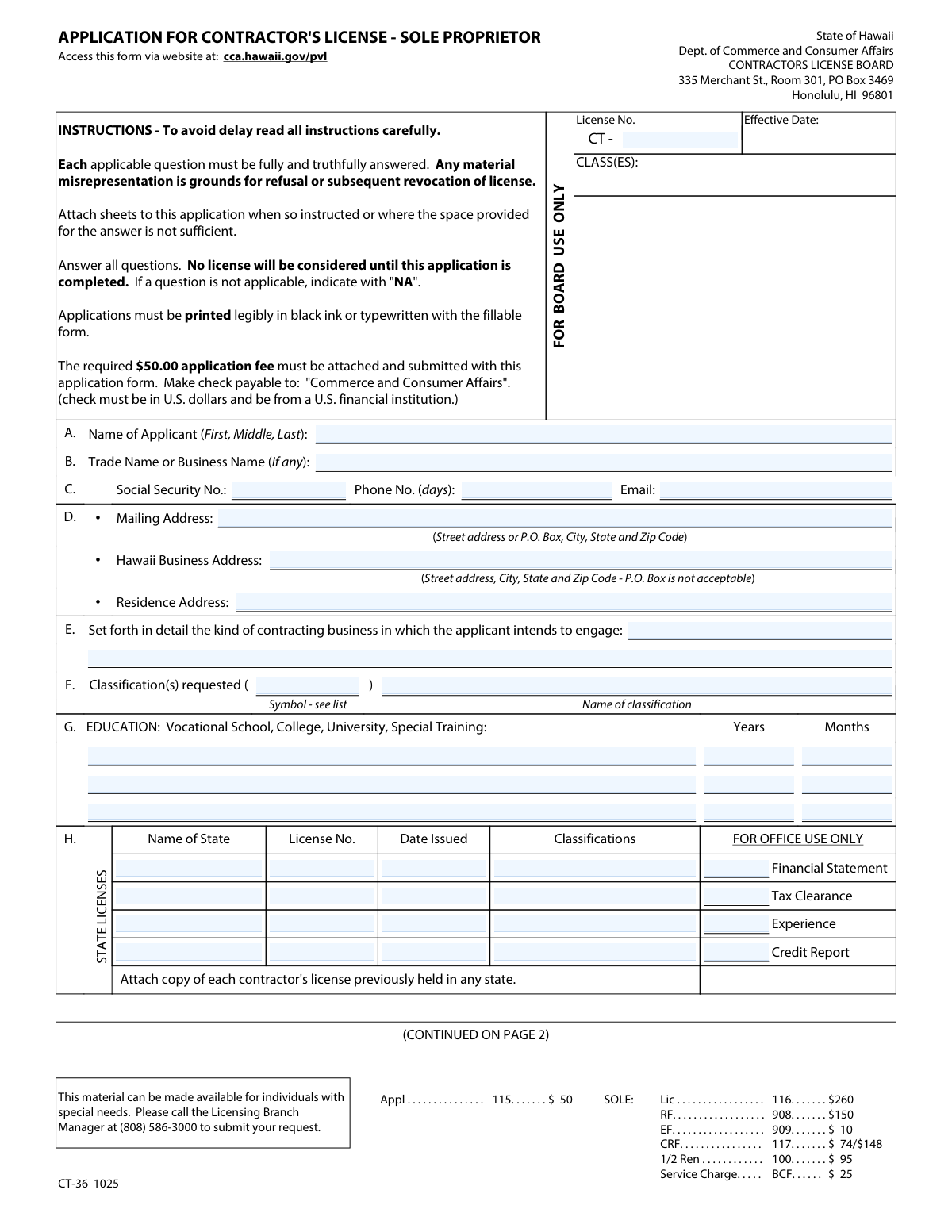
The CT-36 Application for Contractor's License (Sole Proprietor) is the main form, but it must be submitted alongside three required supporting documents:
- CT-03 (Experience Certificate) — A notarized statement verifying your hands-on supervisory experience in your trade
- CT-02 (Contractors Financial Statement) — A financial statement prepared by a licensed CPA demonstrating your financial responsibility
- Project List (Chronological History of Projects) — A detailed log of past projects used by the Board to evaluate your qualifications
When You're Ready to Apply
Before filling out this packet, make sure you can answer yes to all of the following:
- You are applying as a sole proprietor (not a corporation, LLC, or partnership)
- You have sufficient supervisory work experience in your contractor specialty
- You have a CPA available to prepare your CT-02 financial statement
- You can provide a notarized CT-03 from a qualifying reference
A Note on Accuracy
The DCCA Board strictly reviews submissions — incomplete or inaccurate applications can be flagged as deficient or even abandoned under Hawaii law. Using an AI-powered tool like Instafill.ai helps ensure every field is filled correctly, and can convert non-fillable PDF versions into interactive forms for easier completion.
Form Comparison
| Form | Purpose | Who Files It | When to Use |
|---|---|---|---|
| State of Hawaii DCCA Contractors License Board – Application for Contractor's License (Sole Proprietor) (CT-36) | Apply for a Hawaii contractor's license as a sole proprietor | Individual sole proprietors seeking Hawaii contractor licensure | When applying for initial contractor's license in Hawaii |
Tips for Hawaii contractor forms
The Hawaii contractor license application (CT-36) is a multi-part packet that requires notarized experience certificates (CT-03), a CPA-prepared financial statement (CT-02), and a chronological project history. Trying to fill out the main application without these documents on hand often leads to inconsistencies or missing information. Collect everything before you start to avoid having to revise your submission later.
The Board reviews your Project List closely to verify the depth and breadth of your supervisory experience. Each entry should include project name, location, dates, your specific role, and the approximate value of work performed. Vague or incomplete project descriptions are a common reason applications are flagged as deficient.
The Experience Certificate (CT-03) must be notarized — submitting it without a notary signature is one of the most frequent mistakes applicants make. Plan ahead by scheduling a notary appointment before your intended submission date, since finding a notary at the last minute can delay your entire packet.
Your name, business address, license classification, and years of experience must be stated consistently across CT-36, CT-03, CT-02, and the Project List. Discrepancies between forms raise red flags for reviewers and can result in a deficiency notice, which restarts your waiting period.
AI-powered tools like Instafill.ai can complete these forms in under 30 seconds with high accuracy, making it a real time-saver when you're juggling multiple documents in a complex application packet. The platform can also convert non-fillable PDF versions into interactive forms, so you're not stuck typing into a static document. Your data stays secure throughout the process, giving you peace of mind alongside the efficiency.
Under Hawaii law, an application that remains incomplete after a set period can be deemed abandoned, requiring you to start the process over and pay fees again. Respond promptly to any deficiency notices from the DCCA Contractors License Board and track all correspondence dates carefully to avoid this outcome.
The CT-02 financial statement must be prepared by a licensed CPA — self-prepared financials are not accepted and will result in an automatic deficiency. Reach out to your accountant early in the process, as CPA-prepared statements can take several weeks to complete, especially during busy tax seasons.
The Board evaluates age, work authorization, and supervisory experience before allowing an applicant to proceed to the licensing examination. Confirm you meet all eligibility criteria upfront so you don't invest time and money preparing a full packet only to be found ineligible at the review stage.
Frequently Asked Questions
The packet includes the main application form (CT-36), an Experience Certificate (CT-03) that must be notarized, a Contractors Financial Statement (CT-02) prepared by a CPA, and a Chronological History of Projects (Project List). All of these documents must be submitted together to the Hawaii DCCA Contractors License Board for a complete application.
Any individual operating as a sole proprietor who wants to legally perform contracting work in Hawaii must apply for a contractor's license through the DCCA Contractors License Board. This applies to those entering the trade for the first time as well as those who have been working under another license and are now seeking their own.
The Board reviews the applicant's eligibility (including age and work authorization), supervisory experience, project history, and financial responsibility. A satisfactory review may allow the applicant to proceed to the licensing examination and fulfill final requirements such as obtaining insurance, establishing a place of business, and paying applicable fees.
Incomplete or inaccurate submissions can result in processing delays, a deficiency notice requiring additional information, or the application being deemed abandoned under Hawaii law. Taking care to provide thorough and accurate documentation from the start helps avoid these setbacks.
The CT-03 is a notarized document in which a qualified individual verifies the applicant's supervisory experience in the relevant contracting trade. The Board uses it to confirm that the applicant has the hands-on experience necessary to qualify for licensure.
Yes, the Contractors Financial Statement (CT-02) must be prepared by a licensed CPA. This requirement ensures that the Board receives a professionally verified picture of the applicant's financial responsibility and creditworthiness.
Completed applications are submitted to the Hawaii Department of Commerce and Consumer Affairs (DCCA) Contractors License Board. You should check the DCCA's official website or contact their office directly for the most current submission address, accepted submission methods, and any associated filing fees.
Yes, after the Board reviews and approves the application, eligible applicants are typically required to pass a licensing examination before the license is issued. Final licensing also involves meeting additional requirements such as carrying proper insurance and maintaining a place of business in Hawaii.
Yes — AI-powered tools like Instafill.ai can fill out Hawaii contractor forms such as the CT-36, CT-03, and CT-02 in under 30 seconds by accurately extracting and placing data from your source documents. Instafill.ai can also convert non-fillable PDF versions of these forms into interactive fillable forms, making the process faster and reducing the risk of errors.
Manually completing the full packet — including the CT-36 application, CT-03 experience certificate, CT-02 financial statement, and project list — can take considerable time due to the detail required. Using an AI tool like Instafill.ai, the data entry portion can be completed in under 30 seconds, though gathering supporting documents and obtaining notarization and CPA certification will still require additional time.
Once approved, applicants are generally directed to sit for the required licensing examination. After passing the exam, they must fulfill remaining requirements — such as providing proof of insurance, confirming a business address, and paying any outstanding fees — before the license is officially issued.
Yes, the CT-36 form and its supporting documents are specifically designed for sole proprietors. Business entities such as corporations, partnerships, or LLCs seeking a contractor's license in Hawaii would use different application forms designated for those entity types by the DCCA Contractors License Board.
Glossary
- Form Complexity Index
- Instafill’s 0–100 measure of how much effort a form takes to complete, calculated deterministically from the form’s own structure rather than estimated. It combines the number of fillable fields (the largest factor), how difficult those fields are to complete based on their type, the number of pages that contain fields, the amount of conditional “fill-only-if” logic, and how many sections the form is divided into, then adds modifiers for tables and repeating lists, bundled instruction pages, and dense page layouts. A higher score means the form is harder to fill out by hand. The forms in this category have a median Form Complexity Index of 81/100 (Very Complex). See exactly how it is calculated.
- DCCA
- The Hawaii Department of Commerce and Consumer Affairs, the state agency that oversees professional licensing, including the Contractors License Board that reviews and approves contractor license applications.
- Contractors License Board
- The Hawaii board under the DCCA responsible for evaluating contractor license applications, administering licensing examinations, and regulating licensed contractors in the state.
- CT-36
- The main application form number for a Hawaii sole proprietor contractor's license, used to collect personal information, business details, and eligibility declarations for review by the Contractors License Board.
- Experience Certificate (CT-03)
- A notarized supporting document submitted with a Hawaii contractor license application in which a qualified individual verifies the applicant's hands-on supervisory or trade experience in the relevant contracting field.
- Contractors Financial Statement (CT-02)
- A financial disclosure form prepared or reviewed by a Certified Public Accountant (CPA) that demonstrates the applicant's financial responsibility and creditworthiness as required by the Contractors License Board.
- Sole Proprietor
- A business structure in which a single individual owns and operates the contracting business, and is personally liable for all obligations — the specific applicant type addressed by the CT-36 application.
- Chronological Project History (Project List)
- A required supporting document listing the applicant's past construction projects in order of completion, used by the Board to evaluate the depth and relevance of the applicant's supervisory experience.
- Deficiency Notice
- An official notice issued by the Contractors License Board when a submitted application is incomplete or missing required documentation, requiring the applicant to provide corrections before review can proceed.
- Deemed Abandoned
- A status under Hawaii law in which an incomplete or unresponsive application is officially closed by the Board, typically after a deficiency notice goes unaddressed within a specified time period.
- Qualifying Individual
- The person — often the sole proprietor or a designated employee — whose experience, examination results, and qualifications are used to satisfy the technical requirements for a contractor's license in Hawaii.