Fill out contractor license forms
with AI.
Contractor license forms are the essential gateway for professionals looking to establish or expand their construction businesses legally. These documents serve as the formal mechanism through which state boards, such as the Department of Commerce and Consumer Affairs, verify a candidate's technical expertise, financial stability, and professional history. Whether you are applying for a new license or updating your current status, completing these forms accurately is vital to ensure you meet state regulations and maintain the trust of your clients.
By continuing, you acknowledge Instafill's Privacy Policy and agree to get occasional product update and promotional emails.
About contractor license forms
Typically, these forms are required by sole proprietors and business entities during the initial licensing phase or when adding new classifications to their existing credentials. For example, applicants must often provide detailed project histories, notarized experience certificates, and comprehensive financial statements to prove their readiness for the field. Navigating this paperwork can be a significant hurdle, as even minor errors or omissions can lead to lengthy delays or the abandonment of an application.
Tools like Instafill.ai use AI to fill these forms in under 30 seconds, handling complex data accurately and securely to streamline the administrative process. By automating the data entry for detailed packets like the Hawaii CT-36 application, professionals can focus more on their trade and less on the intricacies of government paperwork. This efficiency ensures that your submission is consistent and professional, helping you move through the approval process with greater confidence.
Every form on this page can be completed without typing. Instafill is form filling software that reads a PDF and fills it for you — including flat and scanned documents that carry no fillable fields at all.
Forms in This Category
The forms in this category have a median Form Complexity Index of 81/100 (Very Complex), measured across 1 forms by field count, input difficulty, length, conditional logic and structure. See how it is calculated.
- Enterprise-grade security & data encryption
- 99%+ accuracy powered by AI
- 1,000+ forms from all industries
- Complete forms in under 60 seconds
How to Choose the Right Form
Navigating contractor licensing in Hawaii requires precision. Currently, this category focuses on the primary pathway for individual business owners. To ensure you are choosing the correct documentation, consider the following criteria:
Identifying Your Business Structure
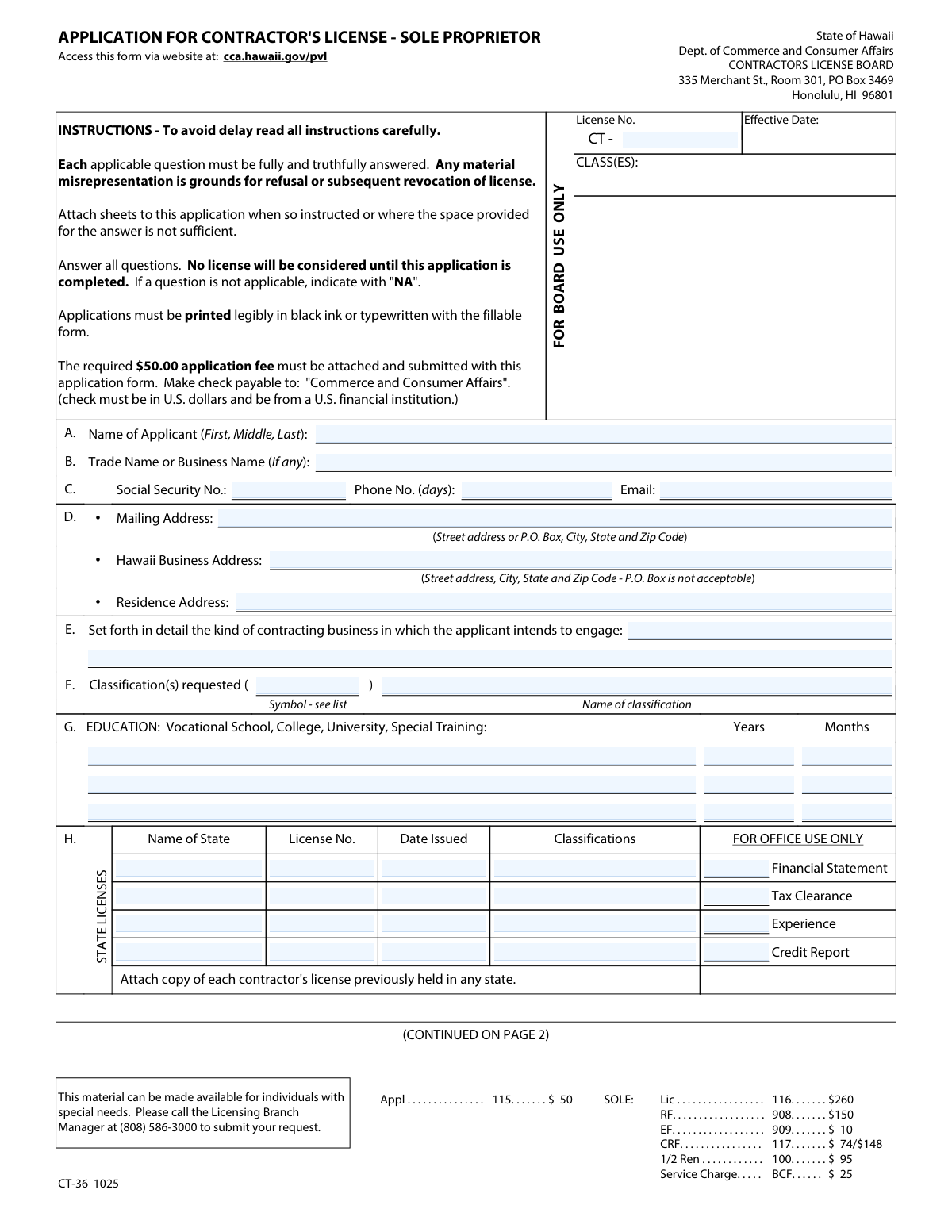
The primary form available here is the Application for Contractor's License (Sole Proprietor) (CT-36). This is specifically designed for individuals operating as sole proprietors. If you are planning to license a Corporation, Partnership, LLC, or LLP, the DCCA requires a different application packet. Using the CT-36 ensures that the background and credit checks are performed on you as an individual rather than a corporate entity.
Components of the CT-36 Packet
When you select the State of Hawaii DCCA Contractors License Board packet, you aren't just getting a single page. You are accessing a comprehensive bundle required for a successful submission. Ensure your use case requires the following components included in this file:
- Form CT-36: The main application used to verify your age, work authorization, and general eligibility.
- Experience Certificate (CT-03): Necessary for documenting your four years of supervisory experience in the specific classification you are seeking.
- Contractors Financial Statement (CT-02): Used to prove financial responsibility; note that this must be accompanied by a report from an independent CPA.
- Chronological History of Projects: A detailed "Project List" that tracks your work history to verify the hands-on experience claimed in your certificates.
Why Accuracy is Critical
Choosing the CT-36 packet is the mandatory first step toward sitting for your licensing examination. The Hawaii Contractors License Board is strict regarding incomplete applications. Using an AI-assisted tool to fill out these complex forms helps prevent the "deficiency" notices that often delay licensing for months or cause applications to be deemed abandoned. If you are an individual contractor in Hawaii, this is the definitive starting point for your legal operation.
Form Comparison
| Form | Primary Purpose | Included Components | Key Eligibility Requirements |
|---|---|---|---|
| State of Hawaii Department of Commerce and Consumer Affairs (DCCA) Contractors License Board – Application for Contractor's License (Sole Proprietor) (CT-36) with supporting forms (Experience Certificate CT-03, Contractors Financial Statement CT-02, and Chronological History of Projects/Project List) | Applying for a Hawaii sole proprietor contractor license to legally perform construction work. | Packet includes application CT-36, experience certificates CT-03, financial statement CT-02, and project history. | Verifies age, work authorization, supervisory experience, financial responsibility, and eligibility for licensing examinations. |
Tips for contractor license forms
Ensure you include all required supporting documents like the CT-02 financial statement and CT-03 experience certificates alongside your main CT-36 application. Missing even one form can lead to the board deeming your application abandoned or causing significant processing delays.
When completing the Project List, provide a clear timeline of your supervisory experience and specific roles held on each job. Accurate dates and detailed project descriptions are vital for the Board to verify that you meet the minimum years of experience required for licensure.
The CT-02 form often requires preparation or review by a Certified Public Accountant to verify your financial responsibility. Plan ahead by sharing these specific form requirements with your accountant early to ensure the data aligns perfectly with the rest of your application packet.
AI-powered tools like Instafill.ai can complete complex contractor license forms in under 30 seconds with high accuracy. Your sensitive professional and financial data stays secure during the process, providing a massive time-saver for busy professionals managing multiple licensing requirements.
Verify that your name, business address, and experience details are identical across the CT-36 application and all supporting certificates. Inconsistencies between your project list and notarized experience certificates are common mistakes that can trigger a manual audit or rejection of your submission.
Several documents in this category, such as the Experience Certificate (CT-03), require a notary seal to be legally valid. Identify these specific sections before you finish the packet to ensure you have all signatures witnessed properly before submission.
Frequently Asked Questions
These forms are specifically designed for individuals applying as sole proprietors to obtain a contractor’s license in the State of Hawaii. If you are starting a construction business alone rather than as a corporation or partnership, this packet contains the necessary documents to initiate your licensure.
A complete packet typically includes the primary application form, such as the CT-36, along with a chronological history of projects and a financial statement. Additionally, you must provide notarized experience certificates to verify your supervisory and technical skills in the construction industry.
While specific requirements can vary by trade, applicants generally need to demonstrate several years of supervisory experience in the specific classification for which they are applying. This experience must be documented clearly in a Project List and verified by qualified references using official experience certificate forms.
The licensing board reviews financial statements to ensure that the applicant has the financial responsibility and stability to operate a contracting business. This usually involves a review of assets, liabilities, and net worth to protect the public from potential business failures or defaults.
Yes, you can fill out these complex contractor license forms using AI-powered tools like Instafill.ai. These tools can accurately extract data from your supporting documents and place it into the required fields in under 30 seconds, significantly reducing the risk of manual entry errors.
Submitting an incomplete or inaccurate application can result in significant delays or a deficiency notice from the Board. Under Hawaii law, if the required information is not provided within a specific timeframe, the application may be deemed abandoned, requiring the applicant to restart the process and pay new fees.
Once the Contractors License Board reviews and approves your application and experience, you will typically be authorized to take the required licensing examinations. These usually include a section on business and law as well as a section specific to the trade classification you are seeking.
Using traditional manual methods, these forms can take hours to complete due to the detailed project history and financial data required. However, AI tools like Instafill.ai can complete the process in under 30 seconds by automatically mapping your existing records onto the PDF application.
For many contractor license applications, specifically the financial statement portion (CT-02), the Board requires the document to be prepared or reviewed by a Certified Public Accountant. It is important to check the specific instructions to see if a CPA-prepared statement is mandatory for your specific license class.
Completed application packets for Hawaii are typically submitted to the Department of Commerce and Consumer Affairs (DCCA) Contractors License Board. You should follow the current filing instructions regarding whether to mail the hard copies or submit them through an official online portal.
No, the sole proprietor forms are specifically for individuals. Corporations, partnerships, and limited liability companies (LLCs) usually have a separate set of application forms that require different entity-level documentation and the designation of a Responsible Managing Employee.
Yes, certain documents within the application packet, such as the Experience Certificate (CT-03), often require a notary public to witness the signature of the person verifying your work history. Ensuring these are properly notarized is essential for the Board to accept the verification as valid.
Glossary
- Form Complexity Index
- Instafill’s 0–100 measure of how much effort a form takes to complete, calculated deterministically from the form’s own structure rather than estimated. It combines the number of fillable fields (the largest factor), how difficult those fields are to complete based on their type, the number of pages that contain fields, the amount of conditional “fill-only-if” logic, and how many sections the form is divided into, then adds modifiers for tables and repeating lists, bundled instruction pages, and dense page layouts. A higher score means the form is harder to fill out by hand. The forms in this category have a median Form Complexity Index of 81/100 (Very Complex). See exactly how it is calculated.
- DCCA
- The Department of Commerce and Consumer Affairs, the Hawaii state agency responsible for overseeing business registrations and the Contractors License Board.
- Sole Proprietor
- An individual who owns and operates their business alone, where there is no legal distinction between the owner and the business entity.
- Experience Certificate (CT-03)
- A required supporting document used to verify that an applicant has at least four years of supervisory experience in the specific trade for which they are seeking a license.
- CPA-Prepared Financial Statement
- A financial report (Form CT-02) that must be audited, reviewed, or compiled by a Certified Public Accountant to prove the applicant meets the state's financial integrity requirements.
- Chronological History of Projects
- A comprehensive list of construction projects an applicant has completed, used by the Board to evaluate the depth and variety of their hands-on work experience.
- License Classification
- The specific category of work a contractor is authorized to perform, such as General Engineering (Class A), General Building (Class B), or Specialty (Class C) trades.
- Responsible Managing Employee (RME)
- A qualified individual designated by a contracting entity to directly supervise and control construction operations to ensure compliance with state regulations.
- Working Capital
- The amount of liquid assets available to a business, calculated as current assets minus current liabilities, used to determine if a contractor is financially responsible enough to be licensed.