Yes! You can use AI to fill out Education Course Costs and Student Details Claim Form

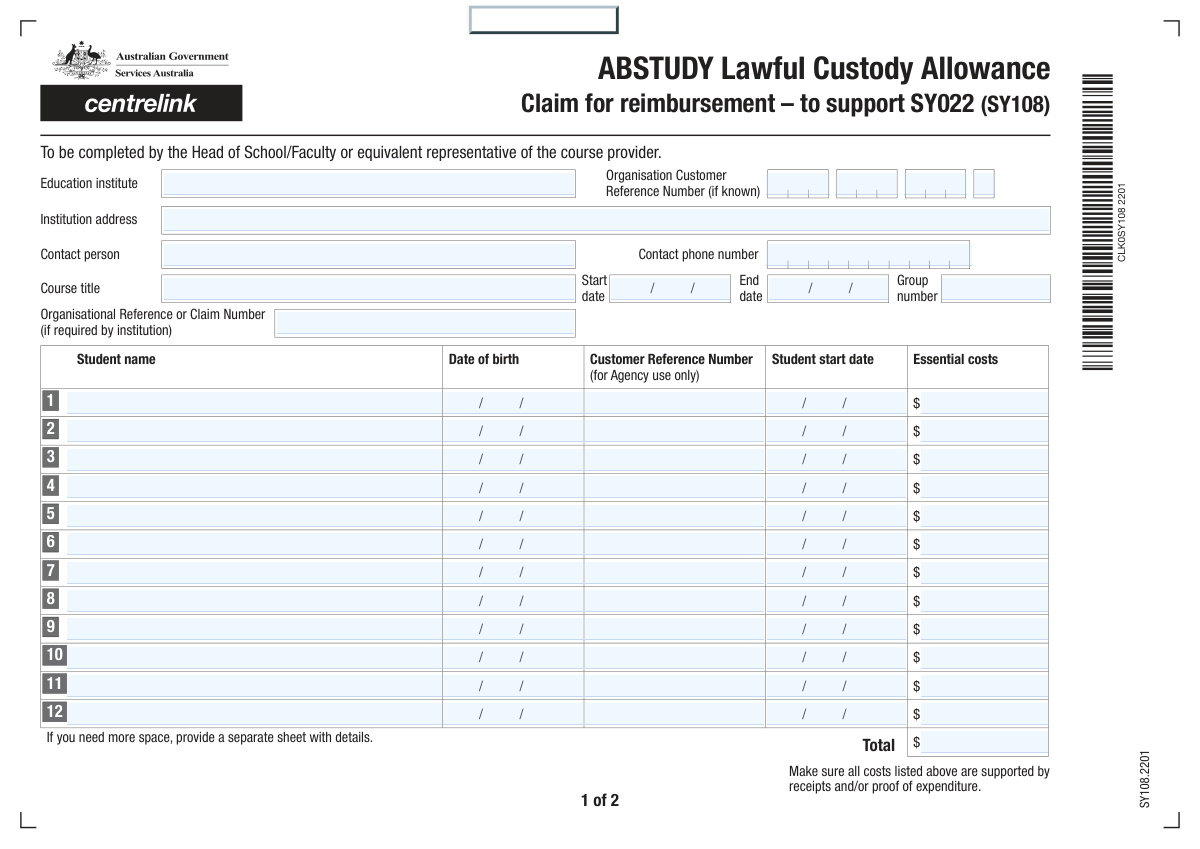
The Education Course Costs and Student Details Claim Form is a comprehensive document used by educational institutions to request reimbursement for essential costs incurred by students. It consolidates claims for multiple students into a single submission, detailing course information, student data, and itemized expenses for an agency's review. This process ensures that providers are properly compensated for approved educational expenditures. Today, this form can be filled out quickly and accurately using AI-powered services like Instafill.ai, which can also convert non-fillable PDF versions into interactive fillable forms.
Student Course Cost Claim is part of the ETA forms, education forms, student forms and VA claim forms categories on Instafill.
Our AI automatically handles information lookup, data retrieval, formatting, and form filling.
It takes less than a minute to fill out Student Course Cost Claim using our AI form filling.
Securely upload your data. Information is encrypted in transit and deleted immediately after the form is filled out.

Form specifications

Form name: Education Course Costs and Student Details Claim Form
Number of fields: 117
Number of pages: 2
Filled form examples: Form Student Course Cost Claim Examples
Language: English
main-image

Instafill Demo: How to fill out PDF forms in seconds with AI

How to Fill Out Student Course Cost Claim Online for Free in 2026

Are you looking to fill out a STUDENT COURSE COST CLAIM form online quickly and accurately? Instafill.ai offers the #1 AI-powered PDF filling software of 2026, allowing you to complete your STUDENT COURSE COST CLAIM form in just 37 seconds or less.
Follow these steps to fill out your STUDENT COURSE COST CLAIM form online using Instafill.ai:
  1. 1 Navigate to Instafill.ai and upload the Education Course Costs and Student Details Claim Form, or select it from their library of templates.
  2. 2 Enter the course provider's information, including the institute's name, address, reference number, and contact person.
  3. 3 Input the specific course details, such as the title, start and end dates, and group number.
  4. 4 For each student being claimed (up to twelve), fill in their full name, date of birth, start date, and the total essential costs.
  5. 5 Itemize any additional costs for stationery, resources, or materials in the provided section, and enter the total cost of all claims.
  6. 6 Provide the claimant's bank account details for reimbursement and have an authorized representative (e.g., Head of School) enter their confirmation details and signature.
  7. 7 Review all entered information for accuracy using Instafill.ai's validation checks, then download, print, or securely submit the completed form as required.

Our AI-powered system ensures each field is filled out correctly, reducing errors and saving you time.

Why Choose Instafill.ai for Your Fillable Student Course Cost Claim Form?

Speed

Complete your Student Course Cost Claim in as little as 37 seconds.

Up-to-Date

Always use the latest 2026 Student Course Cost Claim form version.

Cost-effective

No need to hire expensive lawyers.

Accuracy

Our AI performs 10 compliance checks to ensure your form is error-free.

Security

Your personal information is protected with bank-level encryption.

Frequently Asked Questions About Form Student Course Cost Claim

This form is used by an education provider or other institution to claim reimbursement for essential costs incurred for students participating in a specific course. It allows for detailing costs for up to twelve students and itemizing up to fifteen separate expenses.

An authorized representative from the education institute, correctional facility, or supplier should complete this form. The final confirmation must be signed by a Head of School, Head of Faculty, or an equivalent representative.

The Organisation Customer Reference Number is a unique identifier for your institution. You should provide this number if you know it, as it helps the agency process your claim more efficiently.

No, you should leave the 'Student Customer Reference Number' field blank for each student. This number is for internal use and will be completed by the processing agency.

This form accommodates claims for up to twelve students. If you have more students, you will need to complete and submit a separate form for the additional individuals.

Essential costs are mandatory expenses directly related to the course, such as textbooks, required materials, or specific equipment. You should provide a breakdown of these expenses in the 'Item Details' section.

The 'Essential Costs' field for each student should reflect their share of the total expenses. The 'Item Details' section is where you list all individual items purchased, and the 'Total Cost' should equal the sum of all student costs.

You must provide bank account details if the reimbursement is being paid to the education institution, supplier, or any party other than the student. If the student is the claimant, this section is not required.

The form must be signed by a Head of School, Head of Faculty, or an equivalent senior representative of the institution. This signature confirms that all information provided in the claim is accurate.

After completing the form, use the 'Print' button to create a hard copy. The printed form must be signed and then submitted according to the instructions provided by the agency you are claiming from.

Yes, services like Instafill.ai use AI to help you accurately auto-fill form fields with your saved information. This can significantly reduce the time it takes to complete repetitive forms.

Simply upload the form to the Instafill.ai platform. The AI will make the fields interactive, allowing you to click and fill them with your saved personal, business, and student details for a faster process.

If you have a non-fillable or 'flat' PDF, you can use a service like Instafill.ai. It can convert the static document into an interactive, fillable form online so you can easily type in your information.

The claimant can be the education institution, a correctional facility, a supplier of materials, or the student. The reimbursement will be sent to the bank account of the claimant specified on the form.

Compliance Student Course Cost Claim
Validation Checks by Instafill.ai

1
Course Date Chronology Validation
This check ensures the 'End Date' of the course is on or after the 'Start Date'. It prevents the submission of logically impossible course durations, which would cause processing errors. If the end date precedes the start date, the system will flag an error and require the user to correct the dates before proceeding.
2
Total Cost Calculation Verification
This validation automatically sums all 'Student Essential Costs' and all 'Item Total Cost' fields and compares the result to the value entered in the 'Total Cost' field. This is critical for ensuring the financial accuracy of the claim. If the manually entered total does not match the calculated sum, an error is displayed, forcing a correction to ensure data integrity.
3
Student Start Date within Course Range
This check verifies that each student's individual 'Start Date' falls on or between the overall course 'Start Date' and 'End Date'. This maintains logical consistency and confirms that the student's claim is for participation within the official course timeframe. An error will be flagged for any student whose start date is outside this range.
4
Conditional Student Block Completion
If a 'Student Name' field is populated, this validation ensures that the corresponding 'Date of Birth', 'Start Date', and 'Essential Costs' fields for that student are also filled. This rule enforces the submission of complete records for each individual being claimed. An error message will highlight the missing information for any incomplete student entry.
5
BSB Number Format Validation
This check ensures the 'Branch Number (BSB)' field contains exactly six numeric digits. Correct formatting is essential for successful electronic fund transfers to Australian bank accounts. The system will reject any input that does not meet this specific format, preventing payment processing failures.
6
Conditional Bank Details Requirement
This validation enforces the completion of the bank details section if the 'Reimbursement Claimant' is not the student. When a third party is claiming reimbursement, their 'Bank Name', 'BSB', 'Account Number', and 'Account Holder Name' become mandatory. This ensures the system captures the necessary information to process the payment to the correct entity.
7
Confirmation Date Logic
This check validates that the 'Confirmation Date' is on or after the course 'End Date'. It is illogical to confirm the details of a course before it has concluded. This rule prevents such data entry errors and ensures the confirmation is chronologically sound, flagging an error if the date is invalid.
8
Claimant and Confirmer Presence for Claims
This validation verifies that if any student or item costs are entered, the 'Reimbursement Claimant' and 'Confirmer's Name' fields are not left empty. These fields are critical for identifying who is making the claim and who is authorizing its validity. The form submission will be blocked if costs are present but these key individuals are not identified.
9
Valid Currency Format for All Cost Fields
This validation ensures that all fields related to cost ('Essential Costs', 'Item Total Cost', 'Total Cost') contain only valid positive numeric values. It prevents the entry of text, symbols, or negative numbers that would cause calculation and processing errors. If invalid data is entered, the user will be prompted to enter a valid monetary amount.
10
Item Block Integrity
For each of the fifteen item detail blocks, this check ensures that if an 'Item Description' is provided, the corresponding 'Item Total Cost' field is also filled with a value greater than zero. Conversely, if a cost is entered, a description becomes mandatory. This prevents incomplete or orphaned entries in the itemized cost list, ensuring each claimed item is fully described and costed.
11
At Least One Claim Item Exists
This validation ensures the form is not submitted without any claim data. It checks that at least one student claim (with name and cost) or one itemized claim (with description and cost) has been entered. This prevents the submission of blank or empty forms and ensures there is a valid reimbursement request to process.
12
Student Date of Birth Plausibility
This check verifies that the 'Student Date of Birth' is a realistic date in the past, implying the student is of a reasonable age for post-secondary education (e.g., older than 14). It prevents data entry errors such as future dates or typos that would make the record invalid. A validation failure would prompt the user to review and correct the entered date.
13
Account Holder Name Consistency
This check compares the 'Account Holder Name(s)' with the 'Reimbursement Claimant' name when bank details are provided for a non-student claimant. A mismatch can indicate a potential error and risk of misdirected payment. The system should raise a warning, prompting the user to confirm the details are correct before submission.
14
Confirmer Position Requirement
This validation checks that the 'Confirmer's Position/Title' field is filled if a 'Confirmer's Name' is provided. The form specifies that the confirmer must be a 'Head of School/Faculty or equivalent', so this field is crucial for verifying the authority of the person signing off on the claim. An empty position field would result in an error, requiring the user to specify the confirmer's role.

Common Mistakes in Completing Student Course Cost Claim

Incorrectly Formatting Dates

Users often enter dates in inconsistent or ambiguous formats (e.g., MM-DD-YY vs. DD/MM/YYYY) across the numerous date fields like 'Start Date', 'End Date', and 'Date of Birth'. This ambiguity can lead to incorrect data interpretation and significant processing delays. To avoid this, use a consistent, clear format like YYYY-MM-DD, and double-check all date entries before submission.

Miscalculating Total Costs

The form requires multiple cost calculations, including 'Essential Costs' per student and a final 'Total Cost'. Users frequently make manual arithmetic errors when summing these figures, leading to a mismatch between the itemized costs and the total claimed. This discrepancy can trigger an audit or cause the entire claim to be rejected. Using a calculator or spreadsheet to verify sums is crucial.

Filling 'Agency Use Only' Fields

Several fields, such as the 'Student Customer Reference Number', are explicitly marked 'for agency use only'. Despite this instruction, applicants often attempt to fill them in, sometimes with incorrect or irrelevant information, assuming all fields must be completed. This can interfere with the agency's internal processing and data entry. It is essential to read field descriptions carefully and leave fields designated for internal use blank.

Ignoring Conditional Field Instructions

Many sections, like the bank details and itemized costs, have instructions such as 'Fill only if...' which depend on answers in other parts of the form. Users often overlook these conditions and either provide unnecessary information or omit required details. This leads to confusion and requires follow-up, delaying the reimbursement. Carefully tracing the logic of the form and only filling sections applicable to your specific claim is key.

Using Abbreviations for Institute or Claimant Names

The form requests the 'full name' for entities like the 'Education Institute Name' and 'Claimant Name', but users often use common abbreviations or acronyms (e.g., 'MIT' instead of 'Massachusetts Institute of Technology'). This can cause issues with database lookups and payment processing, as the name may not match official records. Always provide the complete, official legal name as requested to ensure accurate identification.

Entering a Card Number Instead of a Bank Account Number

The 'Account Number' field for reimbursement specifically warns against entering a card number, indicating this is a frequent and critical mistake. A 16-digit debit or credit card number is not the same as a bank account number and will result in a failed payment transaction. To avoid this, locate the correct account number from a check or bank statement, and verify it matches the 'Account Holder Name(s)'.

Data Entry Errors in Repetitive Student Sections

The form includes repetitive sections for up to twelve students, making manual data entry highly susceptible to errors. Users may accidentally copy and paste incorrect information, transpose digits in a date of birth, or mix up the 'Essential Costs' between students. These small errors can invalidate a student's claim. To prevent this, meticulously review each student's entry one by one before submission. AI-powered tools like Instafill.ai can help by auto-populating data from a source file, significantly reducing manual entry errors.

Incorrect Confirmer's Title

The 'Confirmation Details' section requires the 'Confirmer's Position/Title' to be a 'Head of School/Faculty or equivalent representative'. Forms are often signed by individuals who do not meet this authority level, which can invalidate the entire claim. Before seeking a signature, ensure the person holds the required title and authority to approve the claim, preventing rejection on a technicality.

Incomplete or Incorrect 'Org Customer Reference No.'

The 'Org Customer Reference No.' is split into four separate fields, which can be confusing for users who may not have the number or know how it is segmented. Leaving it blank when it's required or entering the segments incorrectly can prevent the processing agency from identifying the correct organization account. If the number is known, double-check its format and segmentation; if unknown, contact the agency to clarify if it's mandatory for your submission.

Mismatch Between Student and Course Dates

The form has a general 'Start Date' and 'End Date' for the course, as well as individual 'Start Date' fields for each student. Users may enter conflicting information, such as a student's start date that is earlier than the overall course start date. This inconsistency creates confusion and may require clarification, delaying the process. Ensure all dates are logical and consistent across the entire form. If the form is a non-fillable PDF, a tool like Instafill.ai can convert it into a fillable version, making data entry and review easier.
Saved over 80 hours a year

“I was never sure if my IRS forms like W-9 were filled correctly. Now, I can complete the forms accurately without any external help.”

Kevin Martin Green

Your data stays secure with advanced protection from Instafill and our subprocessors

Robust compliance program

Transparent business model

You’re not the product. You always know where your data is and what it is processed for.

ISO 27001, HIPAA, and GDPR

Our subprocesses adhere to multiple compliance standards, including but not limited to ISO 27001, HIPAA, and GDPR.

Security & privacy by design

We consider security and privacy from the initial design phase of any new service or functionality. It’s not an afterthought, it’s built-in, including support for two-factor authentication (2FA) to further protect your account.

Fill out Student Course Cost Claim with Instafill.ai

Worried about filling PDFs wrong? Instafill securely fills education-course-costs-and-student-details-claim-form forms, ensuring each field is accurate.