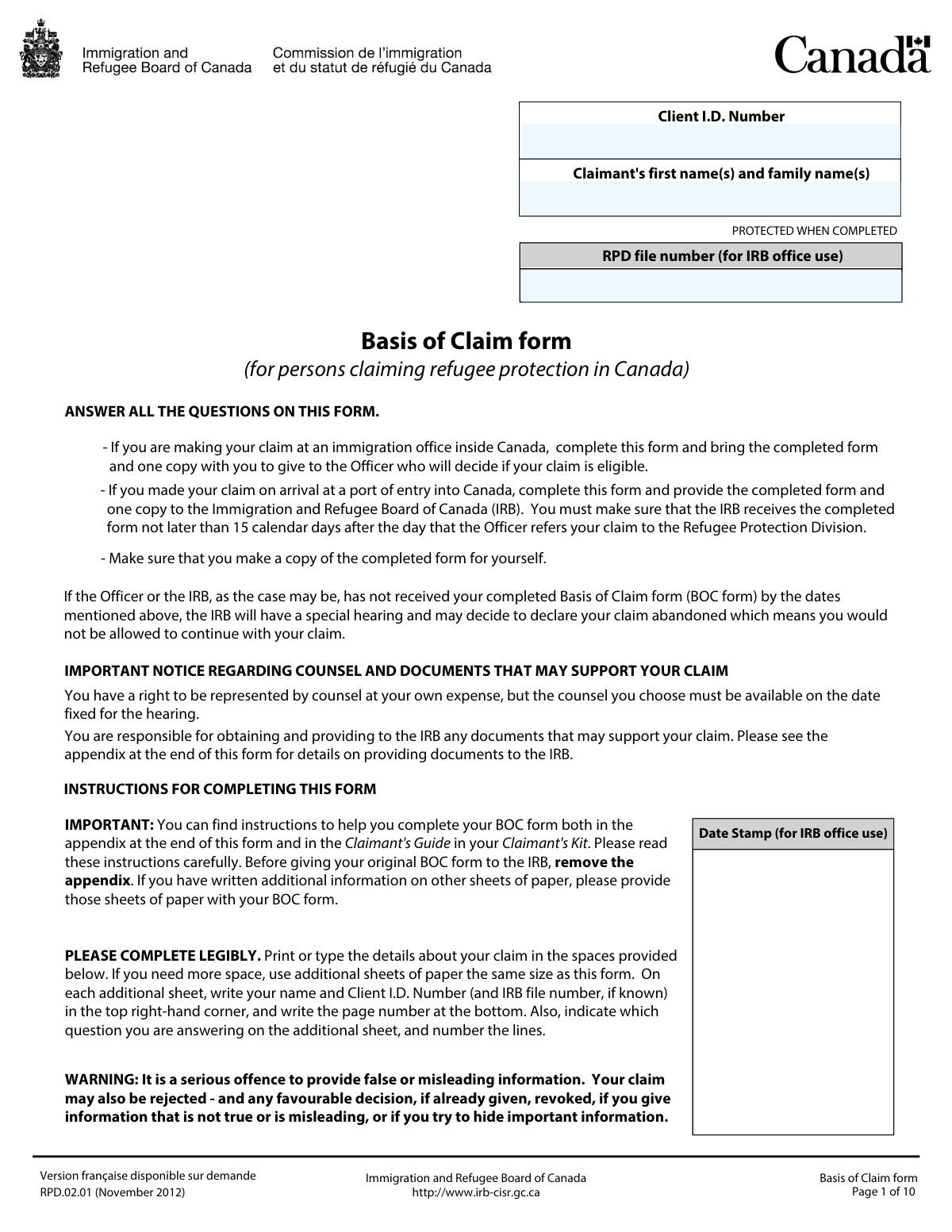
Yes! You can use AI to fill out Immigration and Refugee Board of Canada (IRB) – Refugee Protection Division (RPD) Basis of Claim Form (for persons claiming refugee protection in Canada) (RPD.02.01)

The Basis of Claim (BOC) form is the official written statement a claimant provides to the Refugee Protection Division of the Immigration and Refugee Board of Canada explaining who they are and why they need refugee protection. It captures identity details, countries of risk, family information, prior protection claims, and a detailed narrative of past harm and feared future harm. The BOC is central evidence in the claim and the claimant can be questioned on it at the hearing, so it must be complete, accurate, and consistent with supporting documents. Missing the submission deadline (e.g., 15 calendar days after referral for port-of-entry claims) can lead to an abandonment hearing and the claim being declared abandoned.
Our AI automatically handles information lookup, data retrieval, formatting, and form filling.
It takes less than a minute to fill out BOC (RPD.02.01) using our AI form filling.
Securely upload your data. Information is encrypted in transit and deleted immediately after the form is filled out.

Form specifications

Form name: Immigration and Refugee Board of Canada (IRB) – Refugee Protection Division (RPD) Basis of Claim Form (for persons claiming refugee protection in Canada) (RPD.02.01)
Number of pages: 12
Filled form examples: Form BOC (RPD.02.01) Examples
Language: English
main-image

Instafill Demo: filling out a legal form in seconds

How to Fill Out BOC (RPD.02.01) Online for Free in 2026

Are you looking to fill out a BOC (RPD.02.01) form online quickly and accurately? Instafill.ai offers the #1 AI-powered PDF filling software of 2026, allowing you to complete your BOC (RPD.02.01) form in just 37 seconds or less.
Follow these steps to fill out your BOC (RPD.02.01) form online using Instafill.ai:
  1. 1 Confirm your filing pathway and deadline (inland eligibility interview vs. port of entry referral) and note the required submission method and copy requirements (original plus one copy; additional document copies as instructed).
  2. 2 Complete “Who You Are” with your personal identifiers (names, date of birth, passport sex/gender and self-identification if different, nationality/ethnicity, religion, and languages/dialects) and record your Client ID and any IRB file number.
  3. 3 Draft the “Why You Are Claiming Refugee Protection” section in chronological order, answering each sub-question about past harm, future risk, reasons for persecution/serious harm, attempts to seek protection, internal relocation, departure dates, and any third-country stay.
  4. 4 List all countries where you believe you are at risk of serious harm, and complete citizenship history, family member details, and any previous refugee/asylum claims by you or listed relatives (including outcomes and file/client numbers if known).
  5. 5 Provide Canadian immigration history and logistics: any visa applications to Canada (type, dates, office, result), your current contact address in Canada, and counsel details (if represented), plus your preferred official language and interpreter needs.
  6. 6 Upload/attach supporting documents as required (two copies of identity/travel and other supporting documents; include certified English/French translations for non-official-language documents) and prepare any additional sheets with proper headers (name, Client ID, IRB file number if known, question reference, page numbers).
  7. 7 Review for completeness and consistency, then sign the correct claimant declaration (A if no interpreter was needed; B if an interpreter was needed) and, if applicable, have the interpreter complete and sign the interpreter declaration; submit to the IRB/Officer by the deadline and keep a copy for your records.

Our AI-powered system ensures each field is filled out correctly, reducing errors and saving you time.

Why Choose Instafill.ai for Your Fillable BOC (RPD.02.01) Form?

Speed

Complete your BOC (RPD.02.01) in as little as 37 seconds.

Up-to-Date

Always use the latest 2026 BOC (RPD.02.01) form version.

Cost-effective

No need to hire expensive lawyers.

Accuracy

Our AI performs 10 compliance checks to ensure your form is error-free.

Security

Your personal information is protected with bank-level encryption.

Frequently Asked Questions About Form BOC (RPD.02.01)

The BOC form is the document you use to explain the reasons you are asking for refugee protection in Canada. The Refugee Protection Division (RPD) of the Immigration and Refugee Board of Canada (IRB) uses it as key evidence to decide your claim.

Each person claiming refugee protection must complete their own BOC form, including family members whose claims are being processed together. Information in one person’s BOC can affect decisions for other family members.

If you made your claim at a port of entry, the IRB must receive your completed BOC form no later than 15 calendar days after the officer refers your claim to the RPD. If you made your claim at an immigration office inside Canada, you must bring the completed form and one copy to your eligibility interview.

The IRB will schedule a special hearing and may declare your claim abandoned. If your claim is declared abandoned, you may not be allowed to continue your claim and may be barred from making another refugee claim in the future.

You can deliver it to the IRB office listed on your Notice to Appear, or send it by courier, or fax it (generally only if it is 20 pages or fewer unless the IRB agrees otherwise). If you fax it, you must still provide the original at the beginning of the hearing.

Yes—submit the completed original and one copy as instructed, and make a copy for your own records. The form also requires you to attach two copies of documents you have to support your claim.

Attach two copies of any documents you have now, especially identity and travel documents (including your passport), and other supporting evidence such as medical, psychological, police documents, membership proof, news clippings, and tickets. You must bring originals to the hearing unless they were seized by CIC/CBSA.

Yes—any document not in English or French must include a certified translation in English or French. You are responsible for paying for translations, and the translation must include the translator’s details and a signed accuracy statement.

You must do everything you can to obtain identity documents immediately. If you still cannot get them, you will need to explain why at your hearing and show that you made efforts to obtain them.

Provide a detailed, chronological explanation including what happened (or what you fear will happen), who was responsible, why you were targeted, and whether others in similar situations were harmed. Include dates, names, and places wherever possible.

You must explain in detail why you did not seek protection. If you did seek help, describe who you approached, what steps you took, and what happened as a result.

The IRB wants to know whether you tried to relocate within your country and whether it was possible to live safely elsewhere. If you did not move, explain why; if you did, explain why you left and why you still cannot live safely in another area today.

You must provide details such as the country, when you moved there, how long you stayed, and whether you claimed refugee protection there. If you did not claim protection there, explain why not.

Children 6 years old or younger generally complete only the “Who You Are” section, and a parent or IRB-appointed representative signs. Children aged 7 to 17 must complete the entire form, signed by a parent or IRB-appointed representative.

Yes, you have the right to be represented by counsel at your own expense, and you should provide your counsel’s contact details in the “Your Counsel” section. If you get or change counsel later, you must inform the IRB immediately using the form in your Claimant’s Kit.

Compliance BOC (RPD.02.01)
Validation Checks by Instafill.ai

1
Client I.D. Number presence and format validation
Validates that the Client I.D. Number is provided and matches the expected identifier format used by the intake system (e.g., numeric length, allowed separators, no letters if not permitted). This is critical for linking the BOC form to the correct claimant record and preventing misfiling. If validation fails, the submission should be rejected or routed to manual review with a request for correction.
2
IRB/RPD file number conditional validation (office-use field)
Checks that the RPD file number is either blank (when unknown to the claimant) or matches the official file-number pattern when provided. This prevents claimants from entering incorrect or fabricated file numbers and avoids mis-association with another person’s case. If the value is present but invalid, the system should flag it and require correction or remove it from claimant-entered data.
3
Claimant legal name completeness and character validation
Ensures both given/first name(s) and family/last name(s) are completed and contain only acceptable characters (letters, spaces, hyphens, apostrophes) with reasonable length limits. Names are core identity fields used across IRB communications and matching to identity documents. If missing or containing invalid characters, the form should be considered incomplete and returned for correction.
4
Date of birth format and plausibility validation
Validates that the date of birth is provided in the required format (YYYY/MM/DD) and represents a real calendar date. It also checks plausibility (e.g., not in the future, not unreasonably old) to reduce data entry errors. If invalid, the system should block submission and prompt the claimant to correct the date.
5
Sex on passport selection and self-identified gender consistency
Checks that exactly one option is selected for the sex identified on the passport (Male/Female/Other) and that any self-identified sex/gender field is completed only when applicable (i.e., when the claimant indicates they do not identify with the passport marker). This ensures clarity for identity verification and respectful, accurate hearing logistics. If inconsistent (e.g., self-identification provided without indicating mismatch, or multiple selections), the system should require clarification before acceptance.
6
Nationality/ethnic group/religion/languages required-field completeness
Validates that the claimant provides entries for nationality/ethnic or racial group/tribe, religion/denomination (or explicitly writes N/A), and lists languages/dialects spoken. These fields support risk assessment context and interpreter planning. If left blank without N/A, the submission should be flagged as incomplete and returned for completion.
7
Yes/No questions must have a single explicit response
Ensures every Yes/No question (e.g., harm experienced, risk on return, sought protection, internal relocation, moved to another country, children accompanying, counsel questions, visa application questions) has exactly one selection. This prevents ambiguous answers that can undermine eligibility and scheduling decisions. If missing or both selected, the system should block submission until corrected.
8
Conditional narrative requirement for harm/risk/protection questions
When the claimant answers “YES” to harm experienced or risk on return, the system requires a non-empty narrative that addresses the prompts (what happened/what would happen, who, why, and when/where). When the claimant answers “NO” to seeking authorities’ help or internal relocation, the system requires an explanation of why not. If the required narrative is missing or too short to be meaningful (e.g., below a minimum character threshold), the submission should be rejected as incomplete.
9
Departure date from country format and timeline consistency
Validates that the ‘When did you leave your country’ date is in YYYY/MM/DD format and is not in the future. It should also be logically consistent with the narrative chronology (e.g., harm events should not all occur after the stated departure date unless explained as occurring elsewhere). If the date is invalid or the timeline is contradictory without explanation, the system should flag for correction or manual review.
10
Third-country safety movement details completeness (conditional)
If the claimant indicates they moved to another country (other than Canada) to seek safety, the system requires the country name, move date, duration of stay, and whether protection was claimed there (and if not, why not). This information is essential for assessing flight alternatives and credibility. If any required sub-field is missing, the submission should be marked incomplete and returned for completion.
11
Children accompanying: parent/guardian selection and consent document logic
If children under 18 are claiming with the claimant, validates that one of the parent/guardian scenarios is selected (parent with other parent in Canada, parent with other parent not in Canada, not the parent). It then requires either document details (legal custody/consent) or a written explanation of why documents are not available, depending on the scenario. If the scenario is not selected or the consent/custody information is missing, the system should block submission due to safeguarding and legal-travel requirements.
12
Child age-specific risk narrative requirement (conditional for age ≤ 6)
If a child aged six or younger is included as claiming protection, requires a child-specific risk explanation that is distinct from the adult’s general narrative. This ensures the child’s individualized risk is documented as required by the form instructions. If the child-specific section is blank when applicable, the submission should be flagged as incomplete.
13
Countries of risk list must be populated and valid country names
Validates that at least one country is listed in the ‘Countries where you are at risk of serious harm’ section and that entries are recognizable country names (not cities, regions, or vague terms like “home”). This is central to the protection claim and determines the scope of risk assessment. If no country is listed or entries are invalid, the system should require correction before acceptance.
14
Family members table: required columns and date/age rules
For each listed relative, checks that surname, given name, relationship, and location are provided, and that the date field follows the rule: either a valid birth date (YYYY/MM/DD) or an approximate age when the date is unknown; if marked deceased, a valid date of death is provided. This prevents unusable family composition data and supports cross-referencing related claims. If required columns are missing or date/age rules are violated, the system should flag the row and require correction.
15
Citizenship history table: acquisition date and status completeness
Validates that each citizenship entry includes the country, present status, how citizenship was acquired, and the acquisition date in YYYY/MM/DD format (or a controlled ‘unknown’ mechanism if permitted). Citizenship history is critical for determining country of reference and potential protection alternatives. If any required field is missing or the date is invalid, the system should mark the section incomplete.
16
Visa application section: conditional date and outcome consistency
If the claimant indicates they applied for a Canadian visa, requires the application date and office, and enforces consistency between outcome and follow-up fields: if accepted, visa type and issuance date/duration must be provided; if refused, refusal date and reason must be provided. This prevents contradictory records (e.g., both issued and refused dates) and supports admissibility/credibility review. If inconsistent or missing required sub-fields, the system should block submission until corrected.
17
Canadian contact address and phone format validation
Validates that the Canadian contact address includes street number/name, city, province, and postal code, and that the postal code matches Canadian format (A1A 1A1) while the phone number includes an area code and contains only valid digits and separators. Accurate contact information is essential for notices to appear and procedural fairness. If invalid or incomplete, the system should require correction and warn that processing may be delayed.
18
Counsel section: authorization type and contact details (conditional)
If the claimant indicates they have counsel, requires counsel name and contact details (address, city, province, postal code, phone; and validates email format if provided). It also requires selecting counsel type (lawyer/notary, ICCRC member, family member, other) and, where applicable, a membership identification number and province. If counsel is marked ‘Yes’ but details are missing or membership info is inconsistent with counsel type, the system should flag for correction to prevent unauthorized representation issues.
19
Official language selection and interpreter requirement consistency
Validates that exactly one official language (English or French) is selected for IRB communications. If the claimant indicates they do not understand English or French (or provides a non-official language in interpreter fields), the interpreter language/dialect must be provided; if no interpreter is needed, the field must explicitly be ‘N/A’. If inconsistent (e.g., no official language selected, interpreter left blank), the system should block submission until resolved.
20
Declaration and interpreter declaration signature/date logic
Ensures the claimant completes and signs exactly one of Declaration A or Declaration B, with a valid date in YYYY/MM/DD format. If Declaration B is used (interpreter assistance), the interpreter’s full name, signature, language/dialect, and date must also be completed; if Declaration A is used, the interpreter declaration should be blank or marked not applicable. If signatures/dates are missing or both declarations are signed, the submission should be rejected as not legally attested.

Common Mistakes in Completing BOC (RPD.02.01)

Missing the BOC submission deadline or sending it to the wrong place

People often confuse the process for claims made at a port of entry versus inside Canada, or assume mailing/faxing on the due date is enough. If the IRB does not receive the completed form within the required timeframe (e.g., 15 calendar days after referral for port-of-entry claims), you may be called to a special hearing and your claim can be declared abandoned. Avoid this by confirming which scenario applies to you, using a delivery method with proof of receipt, and ensuring the IRB office listed on your Notice to Appear receives it on time.

Leaving questions blank instead of writing “N/A”

Claimants frequently skip items they think do not apply (e.g., prior visa applications, internal relocation, authorities contacted) and leave them empty. Blank fields can be treated as incomplete, trigger follow-up requests, or create credibility concerns if it looks like you avoided a topic. To avoid this, answer every question and write “N/A” where it truly does not apply, adding a brief clarification when helpful.

Inconsistent identity details (names, DOB, sex/gender) compared to documents

A common error is using different spellings, name order, multiple surnames, or a different date format than what appears on passports/IDs, or misunderstanding the “sex identified on your passport” versus self-identified gender field. Inconsistencies can cause delays, confusion across family members’ files, and credibility issues during the hearing. Use the exact spelling and order from your identity documents, use the required date format (year/month/day), and clearly complete both the passport sex field and the self-identification line if they differ.

Providing a narrative without specific dates, places, and names

Many people describe events generally (e.g., “in 2020,” “in my city,” “they threatened me”) and omit the details the form explicitly requests. Vague timelines make it harder for the IRB to assess risk and can lead to tougher questioning or findings that the account is not sufficiently detailed. Prevent this by writing events in chronological order and including approximate dates if exact ones are unknown, plus locations, organizations, and individuals involved whenever possible.

Not clearly linking harm/risk to the persecutor and the reason for targeting

Claimants often describe what happened but do not clearly state who caused the harm (person/group), why they believe it happened, and how it connects to their particular profile (e.g., political opinion, religion, ethnicity, gender/sexual orientation, family association). Without that link, the claim may appear like generalized violence or a personal dispute rather than refugee protection grounds. Avoid this by explicitly answering each sub-question: who harmed/threatened you, why you were targeted, and why similar people are also at risk.

Weak or contradictory answers about police/authority protection (Question 2(c))

People frequently answer “No” to seeking help but provide little explanation, or answer “Yes” without documenting what steps were taken and what happened. The IRB often examines whether state protection was available, so unclear answers can undermine the claim. To avoid this, describe exactly which authority/organization you approached (or why it was unsafe/impossible), the dates, the response received, and any evidence such as reports, emails, or witness statements if available.

Incomplete internal relocation details (Question 2(d))

A common mistake is answering “No” to moving within the country without explaining why relocation was not possible, or answering “Yes” but not explaining why the new location was still unsafe and why no other area would be safe today. This can lead to a finding that you had a reasonable internal flight alternative. Avoid this by addressing both past attempts and present feasibility: safety, ability to live legally, access to work/housing, reach of the persecutor, and any barriers (ethnic profiling, registration rules, threats, etc.).

Omitting travel history and third-country stays or not explaining why no claim was made there

Claimants sometimes forget to disclose time spent in other countries, transit stops, or longer stays, or they do not explain why they did not seek protection in a country where they lived for a period. Missing or inconsistent travel history can be viewed as concealment and can create major credibility problems. Avoid this by listing each country stayed in (other than Canada), dates of entry/exit, length of stay, status there, and a clear explanation of whether and why you did or did not claim asylum.

Document submission errors: missing two copies, missing certified translations, or late disclosure

People often submit only one copy, forget to include translations for non-English/French documents, or provide informal translations that are not certified. Others submit new supporting documents too close to the hearing, missing the “at least 10 days before” rule (and the requirement to provide copies to the Minister if the Minister is a party). Avoid this by preparing two copies of all supporting documents, obtaining certified translations with the required translator statement, and tracking disclosure deadlines for any documents obtained after filing.

Incorrect handling of additional sheets (missing identifiers, question references, or page numbers)

When claimants add pages, they often forget to put their name and Client I.D. number (and IRB file number if known) on each page, fail to indicate which question they are answering, or do not number pages/lines. This can cause pages to be separated from the file or misunderstood, leading to missing evidence or incomplete answers. Avoid this by following the form’s instructions exactly: same paper size, identifiers in the top right, question number and line numbering, and page numbers at the bottom.

Family and children section mistakes (missing relatives, wrong relationships, missing consent documents)

Applicants frequently list only immediate family in Canada and omit deceased relatives, half-siblings, or children born outside marriage/adopted children, or they provide incomplete citizenship/location details. For children under 18, people often select the wrong custody scenario or fail to provide written consent/legal documents when the other parent is not present, which can delay processing and raise safeguarding concerns. Avoid this by listing relatives exactly as requested (including deceased with date of death/approximate age), and for minors, attach custody/consent documents or provide a detailed explanation if they cannot be obtained.

Signing the wrong declaration or missing interpreter declarations

A frequent error is signing Declaration A even though an interpreter helped complete the form, or forgetting to have the interpreter complete and sign the Interpreter’s Declaration. This can call into question whether the claimant understood the content and can lead to procedural issues or requests to correct and re-submit. Avoid this by choosing Declaration A only if you read and understood English yourself; otherwise complete Declaration B and ensure the interpreter prints their full name, states the language/dialect, and signs and dates the interpreter section.
Saved over 80 hours a year

“I was never sure if my IRS forms like W-9 were filled correctly. Now, I can complete the forms accurately without any external help.”

Kevin Martin Green

Your data stays secure with advanced protection from Instafill and our subprocessors

Robust compliance program

Transparent business model

You’re not the product. You always know where your data is and what it is processed for.

ISO 27001, HIPAA, and GDPR

Our subprocesses adhere to multiple compliance standards, including but not limited to ISO 27001, HIPAA, and GDPR.

Security & privacy by design

We consider security and privacy from the initial design phase of any new service or functionality. It’s not an afterthought, it’s built-in, including support for two-factor authentication (2FA) to further protect your account.

Fill out BOC (RPD.02.01) with Instafill.ai

Worried about filling PDFs wrong? Instafill securely fills immigration-and-refugee-board-of-canada-irb-refuge forms, ensuring each field is accurate.