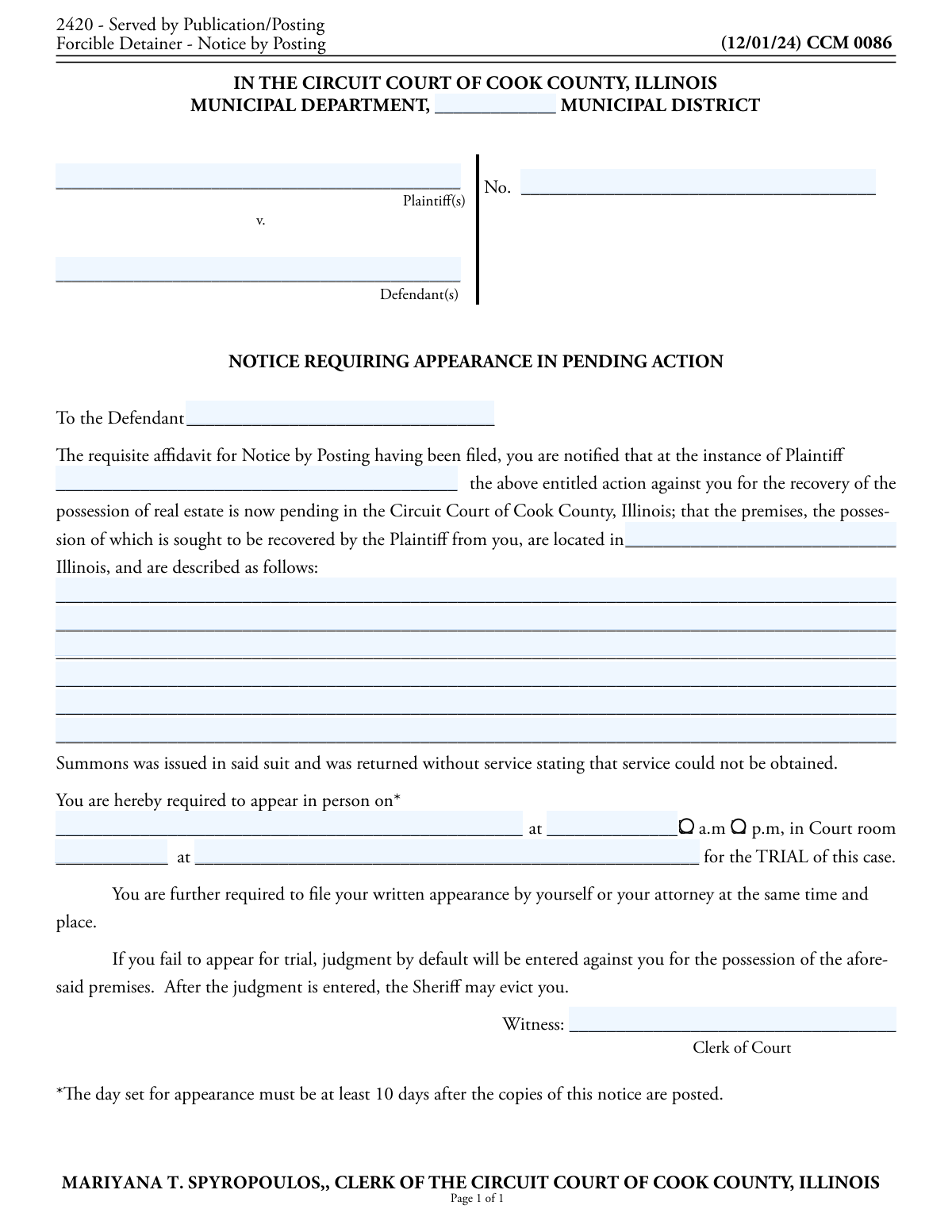
Yes! You can use AI to fill out 2420 - Served by Publication/Posting Forcible Detainer - Notice by Posting (CCM 0086)

This is an official Circuit Court of Cook County, Illinois “Notice by Posting” used in a forcible detainer (eviction/possession) case when the summons was returned without service and the plaintiff proceeds with notice by posting (and/or publication) supported by an affidavit. The form identifies the parties and case number, describes the premises at issue, and states the date, time, and location where the defendant must appear for trial and file a written appearance. It is important because it provides court-authorized notice and warns that failure to appear can result in a default judgment for possession and potential eviction by the Sheriff.
Our AI automatically handles information lookup, data retrieval, formatting, and form filling.
It takes less than a minute to fill out CCM 0086 (2420) using our AI form filling.
Securely upload your data. Information is encrypted in transit and deleted immediately after the form is filled out.

Form specifications

Form name: 2420 - Served by Publication/Posting Forcible Detainer - Notice by Posting (CCM 0086)
Number of pages: 1
Filled form examples: Form CCM 0086 (2420) Examples
Language: English
main-image

Instafill Demo: filling out a legal form in seconds

How to Fill Out CCM 0086 (2420) Online for Free in 2026

Are you looking to fill out a CCM 0086 (2420) form online quickly and accurately? Instafill.ai offers the #1 AI-powered PDF filling software of 2026, allowing you to complete your CCM 0086 (2420) form in just 37 seconds or less.
Follow these steps to fill out your CCM 0086 (2420) form online using Instafill.ai:
  1. 1 Enter the municipal district and complete the case caption: plaintiff(s), defendant(s), and the court case number.
  2. 2 Fill in the defendant’s name in the “To the Defendant” section and the plaintiff’s name where indicated.
  3. 3 Provide the location of the premises (city/town and Illinois) and write the full legal/street description of the property in the description lines.
  4. 4 Confirm the basis for posting/publication (that the required affidavit has been filed and summons was returned without service) and ensure the form matches the case facts.
  5. 5 Enter the required appearance/trial details: date (at least 10 days after posting), time (a.m./p.m.), courtroom number, and courthouse address/location.
  6. 6 Complete the signature/witness area for the Clerk of Court (or as required by local procedure) and generate copies for posting/service.
  7. 7 Review for accuracy and compliance with Cook County filing/service rules, then file/submit as required and arrange for proper posting/publication and proof of service.

Our AI-powered system ensures each field is filled out correctly, reducing errors and saving you time.

Why Choose Instafill.ai for Your Fillable CCM 0086 (2420) Form?

Speed

Complete your CCM 0086 (2420) in as little as 37 seconds.

Up-to-Date

Always use the latest 2026 CCM 0086 (2420) form version.

Cost-effective

No need to hire expensive lawyers.

Accuracy

Our AI performs 10 compliance checks to ensure your form is error-free.

Security

Your personal information is protected with bank-level encryption.

Frequently Asked Questions About Form CCM 0086 (2420)

This notice is used in an eviction (forcible detainer) case to notify a defendant that a lawsuit for possession of real estate is pending and that they must appear for trial. It is typically used when the defendant could not be served personally and the court allows notice by posting/publication.

The plaintiff (or the plaintiff’s attorney) generally prepares the notice and arranges for posting as required by the court rules/order. The Clerk’s office provides the form, but the plaintiff is responsible for completing it accurately and following the posting instructions.

Notice by posting is used after summons was issued and returned without service, meaning the defendant could not be served. The form also states that the required affidavit for notice by posting must be filed first.

It is a sworn statement filed with the court explaining that service could not be obtained and supporting the request to use posting/publication. The notice indicates this affidavit must be filed before the notice by posting is used.

You must complete the municipal district, plaintiff and defendant names, case number, the defendant’s name being notified, the plaintiff’s name, the property location (city in Illinois), the legal or street description of the premises, and the trial date/time/courtroom/address.

List the address and any additional description used in the case to identify the rental unit or property (for example, unit number). The description should match what is in the eviction complaint and court file to avoid confusion.

The trial/appearance date must be set at least 10 days after copies of the notice are posted. This means you cannot choose a date that is fewer than 10 days from the posting date.

The defendant must appear in person at the listed date, time, and courtroom for trial and must file a written appearance (either personally or through an attorney) at the same time and place. Failing to do so can result in a default judgment.

The notice warns that the court may enter a default judgment for possession of the premises. After judgment, the Sheriff may carry out an eviction.

No. This notice means an eviction case is pending and a trial date has been set; eviction can only occur after a court judgment and enforcement by the Sheriff.

These details come from the case assignment and the court’s scheduling information for the eviction case. If you are unsure, check the case docket/notice from the court or contact the Clerk of the Circuit Court of Cook County for the assigned location and courtroom.

It means the Sheriff or process server attempted service but could not serve the defendant, and the summons was returned to the court showing service was not completed. This is one reason the plaintiff may seek permission to use posting/publication.

This form references “Served by Publication/Posting” and “Notice by Posting,” but whether publication is also required depends on the court’s order and applicable rules. Review the judge’s order and local requirements to confirm whether you must post, publish, or both.

The form includes a “Witness: Clerk of Court” line, indicating it is issued under the authority of the Clerk. Follow the court’s instructions for issuance—some courts require the Clerk to sign/seal the notice before it is posted.

Common issues include using a trial date that is not at least 10 days after posting, listing the wrong address/unit, mismatching party names or case number, or failing to follow the court’s required method and proof of posting/publication. Any of these can lead to continuances or the need to re-serve notice.

Compliance CCM 0086 (2420)
Validation Checks by Instafill.ai

1
Municipal District Selection Is Provided and Valid
Validates that the "MUNICIPAL DISTRICT" field is not left blank and matches an allowed Cook County Municipal District value/number. This is important because the district determines the correct venue and courtroom assignment for the case. If missing or invalid, the form should be rejected or flagged for correction because it may be filed in the wrong department or be unprocessable by the clerk.
2
Plaintiff Name(s) Present and Properly Formatted
Checks that the Plaintiff(s) line is completed with at least one plaintiff name and does not contain placeholder underscores or empty content. It should also validate that the entry is a name/entity (not an address-only entry) and is within reasonable length limits. If it fails, the notice cannot clearly identify who is bringing the action, which can invalidate service/notice and cause filing delays.
3
Defendant Name(s) Present and Matches "To the Defendant" Field
Ensures the Defendant(s) line is completed and that the "To the Defendant" addressee field is also completed and consistent (same defendant name(s) or a clearly identified subset when multiple defendants exist). This matters because the notice must be directed to the correct party for due process. If inconsistent or missing, the system should block submission or require confirmation because the notice may be legally defective.
4
Case Number (No.) Required and Conforms to Court Case Number Pattern
Validates that the "No." (case number) field is present and matches the expected Cook County case number format (e.g., year + case type code + sequence, depending on court standards). This is critical for docketing, retrieval, and ensuring the notice is tied to the correct pending action. If invalid or blank, the form should fail validation because it cannot be reliably associated with a case.
5
Affidavit for Notice by Posting Confirmation
Checks that the form indicates the requisite affidavit for notice by posting/publication has been filed (e.g., a required checkbox/attestation or linked filing reference in an electronic workflow). This is important because posting notice typically requires a supporting affidavit as a legal prerequisite. If not confirmed, the system should prevent issuance of the notice or flag it as noncompliant.
6
Premises Location City/County/State Completeness (Located in ___ Illinois)
Validates that the premises location field ("located in ______ Illinois") is completed with a city/township/municipality or other required locality descriptor and is not left as blanks/underscores. This matters because the notice must identify where the property is located to inform the defendant and establish venue relevance. If missing, the notice is ambiguous and should be rejected for completion.
7
Legal Description / Property Address Is Provided and Sufficient
Ensures the property description section contains a usable address or legal description (e.g., street address, unit number, PIN if required by local practice) and is not empty. This is essential because the action concerns possession of specific real estate, and the defendant must be able to identify the premises at issue. If insufficient, the system should require additional detail or mark the submission as invalid.
8
Appearance/Trial Date Is Present and Valid Date Format
Checks that the appearance date field is completed and follows an accepted date format (e.g., MM/DD/YYYY) and represents a real calendar date. This is important because the notice compels appearance on a specific day and errors can deprive a party of proper notice. If invalid, the form should not be accepted because the hearing date cannot be reliably interpreted.
9
Appearance/Trial Time Is Present, Valid, and AM/PM Selection Is Unambiguous
Validates that a time is entered (e.g., HH:MM) and that exactly one of AM or PM is selected (not both, not neither). This matters because an incorrect or ambiguous time can result in missed appearances and improper default judgments. If the time or AM/PM is invalid, the system should block submission and prompt for correction.
10
Courtroom Number Is Provided and Numeric/Alphanumeric Valid
Ensures the courtroom field is completed and matches expected courtroom identifier rules (often numeric, sometimes alphanumeric) and is not placeholder text. This is critical for directing the defendant to the correct location for trial. If missing/invalid, the notice is incomplete and should be rejected or flagged for clerk review.
11
Courthouse/Address Location for Trial Is Provided
Checks that the location line ("at ______") includes the courthouse name and/or street address sufficient to locate the courtroom. This is important because Cook County has multiple courthouse locations, and the defendant must know where to appear. If absent, the system should require completion to avoid defective notice.
12
Minimum 10-Day Posting Rule Compliance
Validates the rule stated on the form: the day set for appearance must be at least 10 days after the copies of the notice are posted. This requires capturing a "posting date" (or linking to a posting event) and computing the difference between posting date and appearance date. If the interval is less than 10 days, the system should fail validation because the notice does not meet the statutory timing requirement.
13
Posting Date Captured When Service Method Is Posting/Publication
Ensures that when this specific notice type (served by publication/posting) is used, the submission includes the posting date(s) and/or posting certification details needed to evaluate timing and compliance. This matters because without a posting date, the system cannot enforce the 10-day rule or document service. If missing, the form should be rejected or routed to an exception workflow.
14
Clerk/Witness Signature or Authorized Issuance Indicator Present
Validates that the "Witness: ____ Clerk of Court" section is completed via an authorized clerk signature, electronic seal, or issuance indicator (depending on the system). This is important because the notice is a court-issued document and typically must be authenticated. If not present, the system should not treat the notice as issued and should prevent finalization/printing.
15
No Placeholder Underscores or Template Artifacts Remain in Required Fields
Scans required fields for unfilled placeholders (e.g., long underscore lines) and template artifacts (e.g., stray characters like "q" near AM/PM) that indicate the form was not properly completed. This matters because placeholders can be mistaken for content and lead to incomplete or confusing notices. If detected in required areas, the system should block submission and highlight the fields needing completion.

Common Mistakes in Completing CCM 0086 (2420)

Leaving the Municipal District blank or selecting the wrong one

People often skip the “_____ Municipal District” line or guess the district without confirming it. This can cause the clerk to reject the filing or result in the notice not matching the case’s assigned court location. Avoid this by verifying the correct Municipal District from the case assignment, filing information, or the court’s district map before completing the form.

Using incomplete or incorrect party names (Plaintiff/Defendant)

A frequent error is listing nicknames, omitting middle initials/suffixes, or failing to include all plaintiffs/defendants exactly as they appear in the case caption. Mismatched names can create service/notice challenges and may lead to delays, amendments, or disputes about whether the notice applies to the correct person. Copy the names precisely from the filed complaint and include all parties in the same order and spelling.

Forgetting to enter the case number (or entering the wrong one)

The “No. ______” field is often left blank or filled with an internal reference number instead of the court case number. Without the correct case number, the notice may not be properly associated with the pending action, which can delay proceedings or require re-posting. Use the exact court-issued case number and double-check every digit and letter.

Not identifying the defendant in the “To the Defendant” line

Some filers leave the “To the Defendant ______” line empty or write a generic phrase like “Occupants” without matching the case caption. This can undermine clarity about who is being notified and may invite challenges to the adequacy of notice. Enter the defendant name(s) exactly as listed in the caption (or follow court rules if using “Unknown Occupants,” if applicable).

Failing to include the plaintiff name after “at the instance of Plaintiff”

Because the plaintiff is already listed in the caption, people sometimes overlook the separate blank that requires the plaintiff’s name in the body of the notice. Leaving it blank can make the notice look incomplete and may prompt rejection or require correction. Repeat the plaintiff’s full legal name exactly as shown in the caption.

Providing an incomplete property location (city missing or wrong state)

The form requires the premises to be located in “_____ Illinois,” but filers sometimes omit the municipality, write only “Cook County,” or accidentally list a different state. An unclear location can create confusion about the premises at issue and may weaken the notice’s effectiveness. Include the correct municipality (e.g., Chicago, Cicero) and confirm it matches the complaint and lease documents.

Insufficient legal description of the premises

Many people enter only a street address and leave the description lines mostly blank, or they omit unit numbers, building identifiers, or other details needed to uniquely identify the premises. This can lead to disputes about what space is being sought (especially in multi-unit buildings) and may require re-issuance of the notice. Include the full address, unit/apartment number, and any additional identifying description consistent with the complaint and lease.

Setting an appearance date that violates the 10-day minimum rule

The form states the appearance day must be at least 10 days after copies of the notice are posted, but filers often count incorrectly or schedule too soon to move the case faster. If the date is not compliant, the notice may be defective and the court may require re-posting and rescheduling, causing delays. Calculate the timeline carefully (including how the court counts days) and choose a date safely beyond the minimum.

Not completing the time field correctly (a.m./p.m. not selected or unclear)

A common mistake is leaving the time blank, checking both a.m. and p.m., or writing a time without clearly indicating a.m. or p.m. This can create ambiguity about when the defendant must appear and may lead to missed appearances or challenges to notice. Enter a specific time and mark only one (a.m. or p.m.) exactly as scheduled by the court.

Leaving the courtroom number or court address blank

People sometimes assume the courtroom and address are “known to the court” and leave these fields empty, especially if they are copying from an older form. Missing courtroom/location details can prevent the defendant from appearing properly and may be viewed as inadequate notice. Confirm the assigned courtroom and the full courthouse address for the Municipal District and enter both clearly.

Missing clerk/witness information or submitting an unsigned/incomplete notice

The “Witness: ______ Clerk of Court” area is sometimes left incomplete, or filers sign in the wrong place or omit required clerk issuance steps depending on local procedure. An improperly issued notice can be rejected or questioned, leading to rework and delays. Follow the court’s process for issuance (who completes the witness/clerk portion) and ensure the final document is complete before posting.
Saved over 80 hours a year

“I was never sure if my IRS forms like W-9 were filled correctly. Now, I can complete the forms accurately without any external help.”

Kevin Martin Green

Your data stays secure with advanced protection from Instafill and our subprocessors

Robust compliance program

Transparent business model

You’re not the product. You always know where your data is and what it is processed for.

ISO 27001, HIPAA, and GDPR

Our subprocesses adhere to multiple compliance standards, including but not limited to ISO 27001, HIPAA, and GDPR.

Security & privacy by design

We consider security and privacy from the initial design phase of any new service or functionality. It’s not an afterthought, it’s built-in, including support for two-factor authentication (2FA) to further protect your account.

Fill out CCM 0086 (2420) with Instafill.ai

Worried about filling PDFs wrong? Instafill securely fills 2420-served-by-publicationposting-forcible-detaine forms, ensuring each field is accurate.