Yes! You can use AI to fill out Student Claim for Essential Equipment Form

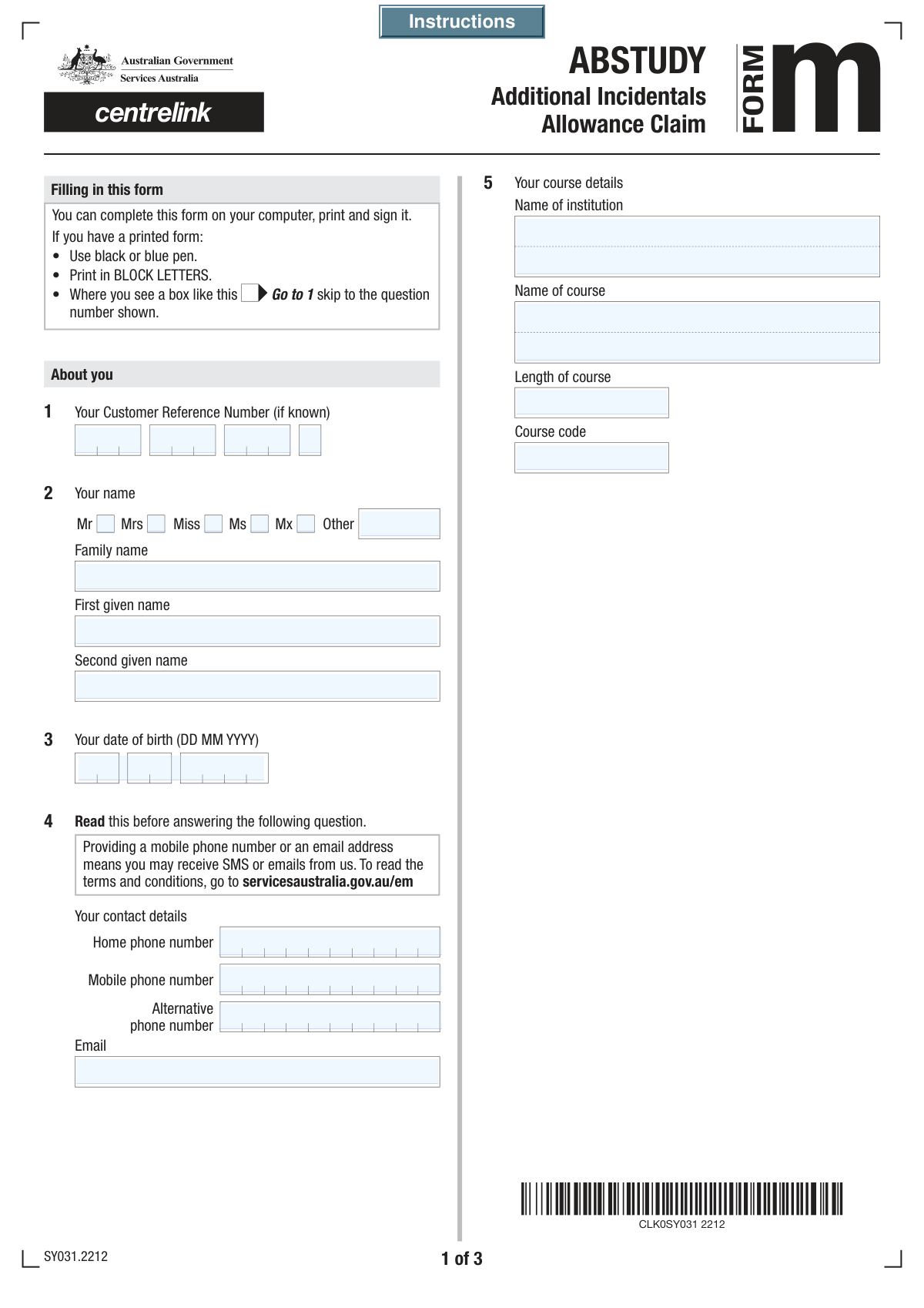
This form is a detailed application for students seeking financial support to cover the costs of essential equipment and materials required for their studies. It requires applicants to itemize both previously purchased items and items they intend to buy, supported by receipts and quotes, and includes a declaration from the educational institution to verify the student's enrollment and the necessity of the items. Today, this form can be filled out quickly and accurately using AI-powered services like Instafill.ai, which can also convert non-fillable PDF versions into interactive fillable forms.
Student Equipment Claim is part of the student forms and VA claim forms categories on Instafill.
Our AI automatically handles information lookup, data retrieval, formatting, and form filling.
It takes less than a minute to fill out Student Equipment Claim using our AI form filling.
Securely upload your data. Information is encrypted in transit and deleted immediately after the form is filled out.

Form specifications

Form name: Student Claim for Essential Equipment Form
Number of fields: 93
Number of pages: 5
Filled form examples: Form Student Equipment Claim Examples
Language: English
main-image

Instafill Demo: How to fill out PDF forms in seconds with AI

How to Fill Out Student Equipment Claim Online for Free in 2026

Are you looking to fill out a STUDENT EQUIPMENT CLAIM form online quickly and accurately? Instafill.ai offers the #1 AI-powered PDF filling software of 2026, allowing you to complete your STUDENT EQUIPMENT CLAIM form in just 37 seconds or less.
Follow these steps to fill out your STUDENT EQUIPMENT CLAIM form online using Instafill.ai:
  1. 1 Navigate to Instafill.ai and upload or select the Student Claim for Essential Equipment Form.
  2. 2 Use the AI assistant to automatically fill in your personal details, including your name, date of birth, and contact information.
  3. 3 Enter your course details, such as the institution name, course name, and course code.
  4. 4 Carefully list all items you have already purchased, providing a description, receipt number, and cost for each.
  5. 5 List all items you still need to purchase, providing a description and cost based on quotes.
  6. 6 Review the automatically calculated subtotals and the total claim amount for accuracy before signing the student declaration.
  7. 7 Download the completed form to obtain the required signature and declaration from your school or faculty official.

Our AI-powered system ensures each field is filled out correctly, reducing errors and saving you time.

Why Choose Instafill.ai for Your Fillable Student Equipment Claim Form?

Speed

Complete your Student Equipment Claim in as little as 37 seconds.

Up-to-Date

Always use the latest 2026 Student Equipment Claim form version.

Cost-effective

No need to hire expensive lawyers.

Accuracy

Our AI performs 10 compliance checks to ensure your form is error-free.

Security

Your personal information is protected with bank-level encryption.

Frequently Asked Questions About Form Student Equipment Claim

This form is used by students to claim reimbursement for educational items they have already purchased and to request funds for items they plan to purchase. It requires a detailed list of expenses supported by receipts and quotes.

This form should be completed by students who are seeking financial reimbursement or funding for course-related materials as part of a scholarship, grant, or financial aid program.

Your Customer Reference Number is a unique identifier assigned to you by our organization. You can typically find it in previous correspondence, your online account portal, or the initial welcome package you received.

Yes, you must provide a receipt number for each item you have already purchased. For items you have not yet purchased, you will need to provide quotes to support the estimated cost.

The form allows for up to fourteen purchased items. If you have more, please attach a separate sheet with the additional items listed in the same format (description, receipt number, cost) and include their total in your subtotal calculation.

This section must be completed and signed by an authorized representative from your school or faculty, such as a course coordinator or head of department. They are verifying your enrollment and the relevance of the claimed items.

The 'Total Claim' is the sum of the 'Items Already Purchased Subtotal' and the 'Items Not Yet Purchased Subtotal'. Ensure you have calculated both subtotals correctly before adding them together for the final amount.

You must submit copies of all receipts for items you have already purchased and copies of quotes for items you plan to buy. Failure to provide these supporting documents may delay your claim.

Processing times can vary depending on the volume of requests. Ensure your form is complete and all supporting documents are attached to avoid delays.

Yes, you can use services like Instafill.ai, which uses AI to accurately auto-fill form fields from your saved profile, helping you complete the form quickly and reduce errors.

You can use a service like Instafill.ai to easily fill out this form online. Simply upload the form, and the platform will make it interactive, allowing you to type in your information and save your progress.

If you have a non-fillable PDF, you can use a tool like Instafill.ai to convert it into an interactive, fillable form. This allows you to easily type your information directly into the fields before printing or submitting it.

Compliance Student Equipment Claim
Validation Checks by Instafill.ai

1
Verifies Total Claim Calculation
This check ensures the value in the 'Total Claim' field is exactly equal to the sum of the 'Items Already Purchased Subtotal' and the 'Items Not Yet Purchased Subtotal'. This is a critical financial validation to prevent manual calculation errors and ensure the claim's final value is accurate. If the total does not match the sum of the subtotals, the submission should be blocked and an error message displayed.
2
Validates Purchased Items Subtotal Calculation
This validation confirms that the value entered in the 'Items Already Purchased Subtotal' field is the correct sum of all individual 'Cost' fields for the purchased items listed. This check is essential for maintaining the financial integrity of the claim data. An incorrect sum would trigger an error, requiring the user to correct either the individual costs or the subtotal amount before proceeding.
3
Enforces Conditional 'Other Title' Entry
This check ensures the 'Other Title' text field is only filled if the 'Title1_MX' (or an equivalent 'Other' radio button) is selected. It prevents users from providing conflicting information, such as selecting 'Mr' while also entering a custom title. If 'Other Title' is filled without the corresponding selection, an error should prompt the user to clear the field or change their title selection.
4
Validates Date of Birth Plausibility
This check confirms that the 'Date of Birth' is a valid date in the past and represents a plausible age for a student (e.g., older than 16 and younger than 100). This prevents obvious data entry errors like future dates or typos and helps flag potentially nonsensical entries. An invalid or implausible date would prevent form submission until corrected.
5
Ensures Valid Email Address Format
This validation inspects the 'Email Address' field to ensure the entry conforms to the standard email format, such as '[email protected]'. This is critical for ensuring that all communications, such as confirmations or requests for more information, can be successfully delivered to the applicant. If the format is invalid, the form should display an error until a valid email is provided.
6
Requires At Least One Contact Method
This validation ensures the user has provided at least one primary method of contact by checking that either the 'Mobile Phone Number' or the 'Email Address' field is filled out. This is important to ensure the organization can reliably contact the applicant regarding their submission. If neither field is filled, the form should not be submittable and should prompt the user to provide at least one.
7
Validates Completeness of Purchased Item Entries
For each purchased item, this rule checks that if the item's name or description field is filled, then the corresponding 'Receipt Number' and 'Cost' fields are also filled. This is based on the form's instructions and ensures that every logged item has complete data for processing. An incomplete entry would trigger an error, highlighting the specific item row with missing information.
8
Enforces Sequential Purchased Item Entry
This validation checks that the purchased item fields are filled in order, without gaps. For example, 'Third Purchased Item' cannot be filled if 'Second Purchased Item Name' is empty. This maintains data integrity and a logical order, simplifying review and processing. If a gap is detected, an error message should indicate which preceding item needs to be filled first.
9
Ensures Customer Reference Number Completeness
This check verifies that all four parts of the 'Customer Reference Number' are filled in. Since the number is split into four separate fields, it is likely a critical identifier that is unusable if any part is missing. This validation prevents submissions with partial reference numbers, which could lead to processing delays or failure to match the form to a customer record.
10
Validates Declaration Date Sequence
This rule ensures logical consistency between the two declaration dates by verifying that the 'Declaration Date' from the 'School/Faculty Declaration' is on or after the 'Date of Declaration' from the 'Student's Declaration'. A school cannot logically sign off on a claim before the student has made their own declaration. A failure would indicate a data entry error that must be corrected.
11
Verifies Cost Field Numerical Format
This validation is applied to all 'Cost' fields across the form, for both purchased and not-yet-purchased items. It ensures that the entered value is a valid, positive number, potentially formatted as currency (e.g., allowing two decimal places). This prevents non-numeric text from being entered, which would break the automated calculations for the subtotals and the total claim.
12
Cross-Validates Course Name Consistency
This check compares the 'Q5.CourseName' field from the 'Course Details' section with the 'Course Name' field in the 'School/Faculty Declaration' section. It ensures the course name is consistent throughout the form, reducing ambiguity and the potential for error. A mismatch could indicate a typo or a more serious discrepancy and should prompt the user to review and correct the entries.
13
Mandatory Name Fields
This check ensures that the 'Family Name' and 'First Given Name' fields are not empty. These fields are fundamental for identifying the applicant. Submitting a form without a name would make the record useless, so this check is a basic requirement for data completeness.
14
Validates Not-Yet-Purchased Subtotal Calculation
This validation confirms that the value in the 'Items Not Yet Purchased Subtotal' field correctly equals the sum of all 'Cost' fields for items not yet purchased. Similar to the purchased items subtotal, this ensures financial accuracy for quoted items. If the calculation is incorrect, an error should prompt the user to fix the discrepancy.

Common Mistakes in Completing Student Equipment Claim

Incorrectly Entering Segmented Customer Reference Number

The form splits the Customer Reference Number into four separate parts. Users often make mistakes by transposing digits, entering the segments in the wrong order, or accidentally omitting one part. This error will almost certainly lead to the system being unable to find their record, causing immediate rejection or significant processing delays. To avoid this, double-check the number against your source document, entering each segment carefully into its corresponding box.

Manual Calculation Errors for Subtotals and Total Claim

The form requires the applicant to manually calculate and enter subtotals for purchased and unpurchased items, as well as a final total claim amount. Manual addition is highly prone to error, especially with a large number of items. An incorrect total will lead to the claim amount being wrong, which could result in underpayment or rejection of the form for correction. Use a calculator to sum the costs carefully and double-check your math before entering the final figures in the subtotal and total fields.

Mismatching Item Descriptions, Receipts, and Costs

The form has a long, repetitive section for itemized expenses, with each item requiring a description, receipt number, and cost. Due to data entry fatigue, users frequently enter a cost or receipt number on the wrong line, mismatching it with the item description. This invalidates the entry and can jeopardize the claim for that item. To prevent this, fill out one complete item row at a time and cross-reference with your receipts before moving to the next.

Ignoring Conditional Field Requirements

Many fields, such as 'Receipt Number' and 'Cost', are conditional and should only be filled if the corresponding item description is provided. People often miss these instructions, either leaving required fields blank (e.g., cost for a listed item) or filling in optional fields unnecessarily. This creates incomplete or confusing data that can halt processing. Carefully read the instructions for each field, often noted as "Fill only if...", to ensure all dependencies are met.

Confusing Student and Faculty Declaration Sections

This form contains two distinct declaration sections: one for the student and one for the school/faculty. Students, in a hurry, may accidentally start filling out the fields intended for the school official, such as 'Position at Institution'. This error will invalidate the declaration and require the form to be re-submitted. Students should only complete the 'Student's Declaration' section, sign it, and then pass the entire form to the appropriate school official to complete their part.

Data Entry Errors Due to Inconsistent Field Labels

The form uses inconsistent labels for the itemized expense list (e.g., 'Purchased Item', 'Second Purchased Item Name', 'Q6.ItemPurchased.7'). This confusing design makes it easy for users to lose their place and enter information into the wrong field, especially when dealing with a long list of items. Such errors can lead to items being missed or incorrectly documented in the claim. To mitigate this, work slowly, matching each receipt to the corresponding numbered item field on the form, regardless of the inconsistent label.

Transposing First Name and Family Name

The form explicitly asks for 'Family Name' and 'First Given Name' in separate fields. It's a very common mistake for applicants to accidentally switch them, especially if they are used to different cultural or regional form conventions. This can cause significant issues with identity verification and record matching, potentially delaying the entire process. Always double-check that your last name is in the 'Family Name' field and your first name is in the 'First Given Name' field.

Incorrect or Incomplete Title Selection

The form provides multiple title options, including a custom 'Other Title' field. A common error is selecting 'Other' (or 'Mx') but failing to specify the title in the 'Other Title' text box, or vice-versa. This creates ambiguity and may require the processor to follow up, delaying the application. Ensure you select only one title and, if choosing 'Other', complete the associated text field.

Missing Signatures or Dates in Declaration

The student and faculty declaration sections both require a signature and a date to be legally valid. These are among the most commonly missed fields on any form, and their absence will automatically invalidate the submission. This forces the applicant to get the form signed and dated again, causing significant delays. Before submitting, perform a final check specifically for the signature and date fields in all required sections.

Illegible Handwriting on Non-Fillable Forms

If this form is a non-fillable PDF, it must be printed and completed by hand. Poor or rushed handwriting can make critical information like names, reference numbers, and item costs unreadable, which is a primary cause of data entry errors and processing delays. If you must fill it by hand, use block capitals and black ink. A better solution is to use a tool like Instafill.ai, which can convert non-fillable PDFs into digital, fillable versions, ensuring all your entries are clean, typed, and legible.
Saved over 80 hours a year

“I was never sure if my IRS forms like W-9 were filled correctly. Now, I can complete the forms accurately without any external help.”

Kevin Martin Green

Your data stays secure with advanced protection from Instafill and our subprocessors

Robust compliance program

Transparent business model

You’re not the product. You always know where your data is and what it is processed for.

ISO 27001, HIPAA, and GDPR

Our subprocesses adhere to multiple compliance standards, including but not limited to ISO 27001, HIPAA, and GDPR.

Security & privacy by design

We consider security and privacy from the initial design phase of any new service or functionality. It’s not an afterthought, it’s built-in, including support for two-factor authentication (2FA) to further protect your account.

Fill out Student Equipment Claim with Instafill.ai

Worried about filling PDFs wrong? Instafill securely fills student-claim-for-essential-equipment-form forms, ensuring each field is accurate.