Yes! You can use AI to fill out Barber & Hairdresser Student/Apprentice Quarterly Report Form (Alaska Board of Barbers and Hairdressers) – Form 08-4315
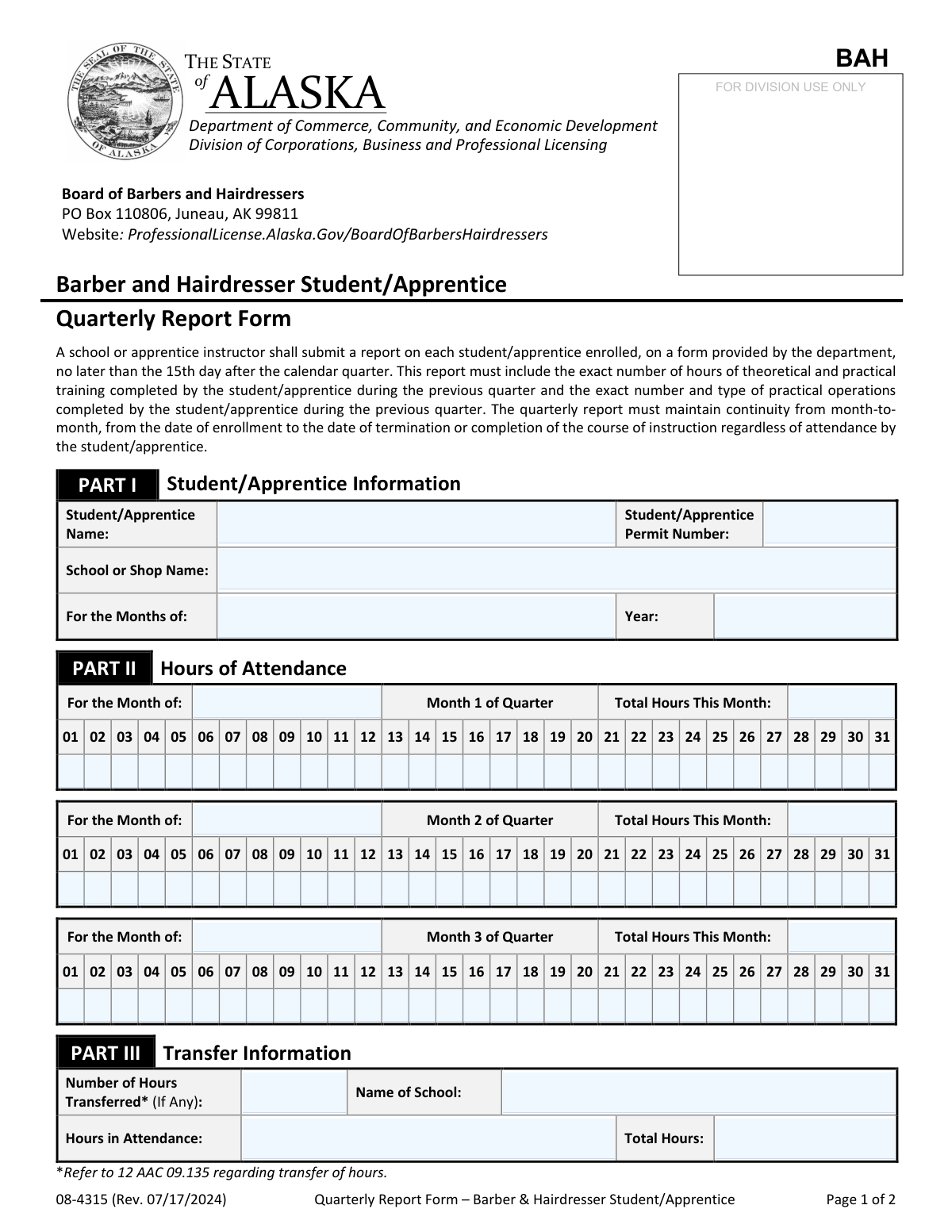
This is an official Alaska Department of Commerce, Community, and Economic Development (Division of Corporations, Business and Professional Licensing) form used by barber/hairdresser schools or apprentice instructors to report each enrolled student/apprenticeâs training progress each calendar quarter. It documents exact hours of theoretical and practical attendance and the number/type of practical operations completed during the quarter, maintaining continuous records from enrollment through completion or termination. The report is due no later than the 15th day after the end of each calendar quarter and may also capture transfer hours per 12 AAC 09.135. Accurate reporting supports compliance with Alaska Board requirements and helps verify eligibility toward licensure training hour and operation minimums.
Our AI automatically handles information lookup, data retrieval, formatting, and form filling.
It takes less than a minute to fill out Alaska 08-4315 using our AI form filling.
Securely upload your data. Information is encrypted in transit and deleted immediately after the form is filled out.
Form specifications
| Form name: | Barber & Hairdresser Student/Apprentice Quarterly Report Form (Alaska Board of Barbers and Hairdressers) – Form 08-4315 |
| Number of pages: | 2 |
| Filled form examples: | Form Alaska 08-4315 Examples |
| Language: | English |
Instafill Demo: filling out a legal form in seconds
How to Fill Out Alaska 08-4315 Online for Free in 2026
Are you looking to fill out a ALASKA 08-4315 form online quickly and accurately? Instafill.ai offers the #1 AI-powered PDF filling software of 2026, allowing you to complete your ALASKA 08-4315 form in just 37 seconds or less.
Follow these steps to fill out your ALASKA 08-4315 form online using Instafill.ai:
- 1 Enter Part I student/apprentice details: full name, permit number, school or shop name, and the quarter months and year being reported.
- 2 Complete Part II hours of attendance for each of the three months in the quarter by entering daily hours (as applicable) and calculating the total hours for each month.
- 3 If applicable, complete Part III transfer information by listing transferred hours, the prior school name, and hours in attendance/total hours (per 12 AAC 09.135).
- 4 Fill Part IV by recording the theory hours completed this quarter and the rules and regulations hours completed this quarter (as required by the Alaska Board).
- 5 Fill Part V practical operations by entering the number of completed operations for each listed subject area (e.g., hair cutting, coloring, permanent waving, beard trimming/shaving) for the quarter, ensuring entries align with the program type (hairdresser vs barber) and required minimums.
- 6 Review the entire form for accuracy and continuity with prior months/quarters, confirming totals and that all required sections are complete.
- 7 Complete Part VI certifications and signatures: student printed name/signature/date and instructor printed name/signature/date, then submit to the Board by the deadline (15th day after the quarter).
Our AI-powered system ensures each field is filled out correctly, reducing errors and saving you time.
Why Choose Instafill.ai for Your Fillable Alaska 08-4315 Form?
Speed
Complete your Alaska 08-4315 in as little as 37 seconds.
Up-to-Date
Always use the latest 2026 Alaska 08-4315 form version.
Cost-effective
No need to hire expensive lawyers.
Accuracy
Our AI performs 10 compliance checks to ensure your form is error-free.
Security
Your personal information is protected with bank-level encryption.
Frequently Asked Questions About Form Alaska 08-4315
This form is used to report a student/apprenticeâs training progress for the prior calendar quarter, including exact theory and practical hours and the exact number and type of practical operations completed.
A school or apprentice instructor must submit a report for each enrolled student/apprentice using the department-provided form.
It must be submitted no later than the 15th day after the end of the calendar quarter.
Yes. The report must maintain continuity month-to-month from enrollment to termination/completion regardless of attendance.
You must provide the student/apprentice name, permit number, the school or shop name, and specify the months and year covered by the report.
For each of the three months in the quarter, record the hours for each day (01â31 as applicable) and then enter the total hours for that month in the âTotal Hours This Monthâ field.
Only enter hours for the days that exist in that month; leave non-applicable days blank and ensure the monthly total matches the actual days/hours attended.
You should report precise totals (not estimates) for theory and practical training hours and list the actual counts completed for each practical operation category during the quarter.
If any hours were transferred, enter the number of hours transferred, the name of the school, and the hours in attendance/total hours as requested, and follow 12 AAC 09.135 for transfer rules.
Part IV lists minimums of 185 hours for Theory and 5 hours for Rules and regulations of the Alaska Board of Barbers and Hairdressers; report the hours completed this quarter for each subject.
No. The minimum columns are reference standards; you should enter the student/apprenticeâs âPractical Operations Completed This Quarterâ for the applicable program (hairdresser or barber).
Some categories explicitly allow mannequin work (for example, wet styling/comb-out, thermal styling, permanent waving, and hair coloring/bleaching as noted). Follow the notes in each operation description.
No. The form states that no credit is given for color rinses.
Both the student and the instructor must print and sign their names and include the date signed to certify the information is true and correct.
The form references the Board of Barbers and Hairdressers, PO Box 110806, Juneau, AK 99811, and the website ProfessionalLicense.Alaska.Gov/BoardOfBarbersHairdressers for additional information.
Compliance Alaska 08-4315
Validation Checks by Instafill.ai
1
Requires Student/Apprentice Name to be present and properly formatted
Validates that the Student/Apprentice Name field is not blank and contains a plausible full name (e.g., at least first and last name, not only initials or a single character). This is important to uniquely identify the trainee and prevent mismatches with permit and school records. If validation fails, the submission should be rejected or routed for correction because the report cannot be reliably attributed to a specific individual.
2
Validates Student/Apprentice Permit Number format and presence
Checks that the permit number is provided and matches the expected permit-number pattern used by the licensing system (e.g., allowed length, alphanumeric rules, no illegal characters). This ensures the report is tied to an active permit record and supports auditing and continuity across quarters. If the permit number is missing or malformed, the system should block submission and prompt the filer to correct the permit number.
3
Requires School or Shop Name and enforces non-placeholder content
Ensures the School or Shop Name is completed and is not a placeholder value (e.g., 'N/A', 'unknown', or only whitespace). This is necessary to identify the reporting entity and to support compliance checks for approved schools/shops. If it fails, the form should be returned for completion because the department cannot determine who is responsible for the training record.
4
Validates Quarter identification: Months-of and Year are complete and consistent
Checks that the 'For the Months of' quarter indicator and the Year are provided, and that the three months listed/selected correspond to a single calendar quarter within the stated year. This prevents mixing months from different quarters or years, which would break continuity and reporting timelines. If inconsistent (e.g., months span two years or are not a valid quarter set), the submission should be rejected and the user asked to correct the quarter.
5
Validates Month 1/2/3 selections are distinct and in chronological order
Ensures the three 'For the Month of' entries represent three different months and are ordered sequentially (e.g., Jan/Feb/Mar, not Jan/Mar/Feb or duplicates). This is important because the form is a quarterly report and must maintain month-to-month continuity. If duplicates or out-of-order months are detected, the system should require correction before acceptance.
6
Validates daily attendance hour entries are numeric and within reasonable bounds
For each day-of-month cell (01â31) in each month section, validates that entries are numeric (allowing decimals only if policy permits) and non-negative. It should also enforce a reasonable maximum per day (e.g., 0â24, or a stricter business rule such as 0â12/16) to prevent impossible attendance. If any day entry violates these rules, the submission should fail validation and highlight the specific day and month.
7
Validates day-of-month applicability (no hours entered for invalid dates)
Checks that hours are not entered for dates that do not exist in the selected month (e.g., Feb 30/31, Apr 31). This prevents inflated totals and ensures accurate month-to-month continuity. If hours are present on an invalid date, the system should block submission and require the user to remove or correct those entries.
8
Reconciles monthly total hours with sum of daily hours for each month
Validates that 'Total Hours This Month' equals the sum of the daily hour entries for that month (within a small tolerance if decimals are allowed). This is critical because the form requires the exact number of hours completed during the quarter, and totals must be auditable. If totals do not match, the system should reject the submission or force recalculation to the computed total.
9
Validates quarterly hours continuity and non-negative totals across Month 1–3
Ensures that each month has a total (even if zero) and that the combined quarter total (computed) is non-negative and plausible for a quarter. This supports the requirement that reporting maintain continuity from month-to-month regardless of attendance. If any month is missing a total or totals are negative/implausible, the submission should be flagged for correction.
10
Transfer hours conditional requirement and numeric validation
If 'Number of Hours Transferred (If Any)' is provided and greater than zero, validates it is numeric, non-negative, and within a reasonable maximum, and requires 'Name of School' and 'Hours in Attendance/Total Hours' fields to be completed. This is important because transferred hours must be traceable to a source school and must not be used to inflate attendance. If transfer hours are entered without the required supporting fields (or with invalid numbers), the submission should be rejected.
11
Validates transfer totals consistency (Hours in Attendance vs Total Hours vs Transferred)
Checks logical consistency among transfer-related fields: transferred hours should not exceed total hours, and totals should reconcile according to the systemâs defined meaning (e.g., Total Hours equals attendance hours plus transferred hours, if that is the intended structure). This prevents double-counting and ensures accurate cumulative training records. If the relationship is inconsistent, the system should flag the discrepancy and require correction before acceptance.
12
Validates Theory hours and Rules/Regulations hours are present and numeric
Ensures the 'Theory (Hours)' and 'Rules and regulations' completed-this-quarter fields are filled in and are numeric, non-negative values. These are required curriculum components and must be tracked precisely for licensing eligibility. If either is missing or invalid, the submission should not be accepted because the quarterâs instructional breakdown is incomplete.
13
Validates practical operations counts are numeric integers and non-negative
For each practical operation line item, validates that the 'Practical Operations Completed This Quarter' entry is an integer (no fractions), non-negative, and not blank when required by the program type. Practical operations are counted as discrete services/tasks, so fractional values indicate data entry errors. If invalid, the system should reject the submission and identify the specific operation row.
14
Enforces program-type applicability for practical operations (Barber vs Hairdresser)
Validates that the submission indicates the traineeâs track (Barber or Hairdresser) or derives it from the permit, and then enforces that only applicable operation categories are required/expected (e.g., beard trimming/shaving typically barber-focused; manicure/makeup typically hairdresser-focused). This prevents requiring irrelevant items and helps detect incorrect reporting on the wrong form/track. If the track is missing or the entered operations conflict with the track rules, the submission should be flagged for review or correction.
15
Validates signature blocks completeness and date formats
Ensures Student Printed Name, Student Signature, Date Signed, Instructor Printed Name, Instructor Signature, and Instructor Date Signed are all present. Dates must be valid calendar dates in an accepted format (e.g., MM/DD/YYYY) and not impossible (e.g., 13/40/2026). If any signature element is missing or dates are invalid, the submission should be rejected because the certification statement is incomplete.
16
Checks signature date logic against reporting period (no pre-period signing)
Validates that the signature dates are not earlier than the end of the reported quarter/months and are not unreasonably far in the future. This supports the requirement that the report reflects completed training during the previous quarter and is certified after the fact. If dates fall outside acceptable bounds, the system should flag the submission for correction or compliance review.
Common Mistakes in Completing Alaska 08-4315
People often leave the Student/Apprentice Name or Permit Number blank, or they enter a nickname, transposed digits, or a permit number that doesnât match the licensing record. This usually happens because the form is completed from memory or copied from an old report without verification. The consequence is delayed processing or the hours being credited to the wrong person or not credited at all. Avoid this by copying the name and permit number exactly as shown in the studentâs permit/licensing record and double-checking digit order before submission.
A common error is selecting months that are not a single calendar quarter (e.g., FebâApr) or forgetting to enter the correct year, especially around year-end. This happens because the form asks for âFor the Months ofâ and then separately lists Month 1/2/3, which can be confusing when back-filling reports. If the months/year are wrong, the report may not maintain continuity and can create gaps or overlaps in the studentâs training record. Avoid this by confirming the exact calendar quarter (JanâMar, AprâJun, JulâSep, OctâDec) and entering all three months and the correct year consistently.
Many reports are submitted late because the deadline is tied to the end of the calendar quarter rather than the end of the schoolâs term or payroll cycle. Late reports can cause compliance issues for the school/shop and may delay recognition of hours toward completion. It can also create a backlog that increases the chance of data entry mistakes when reconstructing hours later. Avoid this by setting a recurring reminder for the 1st week after each quarter ends and preparing the report from daily attendance logs as the quarter closes.
In Part II, people often fail to enter hours for each day (01â31), leave days blank without indicating zero, or miscalculate âTotal Hours This Month.â This happens when attendance is tracked elsewhere and the form is filled out quickly at month-end, leading to missed days or arithmetic errors. Incorrect totals can result in under- or over-reporting hours, which can trigger audits, corrections, or rejected reports. Avoid this by recording hours daily (or transferring from a verified daily log) and re-checking monthly totals with a calculator or spreadsheet before signing.
Because the form lists 01â31 for every month, people sometimes enter hours on dates that donât exist (e.g., April 31, February 30). This typically happens when copying a pattern of attendance across months or when the person filling the form doesnât cross-check the calendar. These entries can make the attendance record appear unreliable and may require resubmission or clarification. Avoid this by referencing the actual calendar for each month and leaving non-existent dates blank (or clearly zero) while ensuring the monthly total matches only valid dates.
The form requires continuity from enrollment to termination/completion regardless of attendance, but people often restart tracking after absences, skip months with low attendance, or overlap dates between quarters. This happens when reports are prepared only for âactiveâ months rather than maintaining a continuous record. Gaps or overlaps can cause the board to question the accuracy of training records and may delay approval of hours toward licensure. Avoid this by reporting every quarter in sequence, ensuring the months follow the prior report, and documenting zero/low attendance periods accurately rather than omitting them.
In Part III, people frequently enter transferred hours without listing the prior school name, confuse âNumber of Hours Transferredâ with âHours in Attendance,â or leave the fields partially blank. This often happens when a student has prior training and the preparer is unsure what is officially transferable under 12 AAC 09.135. Incorrect transfer reporting can lead to hours not being accepted or being double-counted, requiring corrections. Avoid this by confirming the approved transfer hours, entering the prior school name, and clearly separating transferred hours from hours attended in the current quarter.
In Part IV, the form shows minimums (e.g., Theory 185; Rules and regulations 5), and people sometimes copy the minimums instead of reporting the actual hours completed during the quarter. This happens because the layout looks like a requirement checklist rather than a reporting table. Reporting minimums instead of actuals can inflate or distort progress and may be flagged during review. Avoid this by entering the exact theory and rules/regulations hours completed in the previous quarter, supported by class schedules or instructional logs.
In Part V, people sometimes enter numbers under the âMinimum â Hairdressersâ or âMinimum â Barbersâ columns instead of the âPractical Operations Completed This Quarterâ column, or they follow the wrong track (barber vs hairdresser). This occurs because the table includes multiple numeric columns and the âminimumâ values can be mistaken for fields to fill in. The consequence is that the report doesnât show actual completed operations, which can delay crediting progress or require resubmission. Avoid this by confirming the studentâs program (barber or hairdresser) and entering only the actual operations completed this quarter in the correct âcompletedâ column.
People often count services that the form explicitly excludes (e.g., âNo credit given for color rinsesâ) or they record an operation without including required elements like hair analysis, predisposition tests, or safety precautions. This happens when salon service terminology doesnât match the boardâs defined operation requirements. If ineligible or incomplete operations are counted, totals may be disallowed and the student may fall short later when audited. Avoid this by training staff/instructors on the boardâs definitions and only counting operations that meet the listed components and exclusions.
In Part VI, submissions commonly lack the studentâs signature/date, the instructorâs signature/date, or the printed names, and sometimes the wrong person signs (e.g., front desk staff). This happens when the form is completed in batches and signatures are intended to be collected later but are forgotten. Unsigned or undated certifications can invalidate the report and require re-collection and resubmission. Avoid this by collecting signatures at the time the report is finalized, verifying both printed names and dates are present, and ensuring the instructor of record signs in the correct field.
Saved over 80 hours a year
âI was never sure if my IRS forms like W-9 were filled correctly. Now, I can complete the forms accurately without any external help.â
Kevin Martin Green
Your data stays secure with advanced protection from Instafill and our subprocessors

Robust compliance program
Transparent business model
Youâre not the product. You always know where your data is and what it is processed for.
ISO 27001, HIPAA, and GDPR
Our subprocesses adhere to multiple compliance standards, including but not limited to ISO 27001, HIPAA, and GDPR.
Security & privacy by design
We consider security and privacy from the initial design phase of any new service or functionality. Itâs not an afterthought, itâs built-in, including support for two-factor authentication (2FA) to further protect your account.
Fill out Alaska 08-4315 with Instafill.ai
Worried about filling PDFs wrong? Instafill securely fills barber-hairdresser-studentapprentice-quarterly-rep forms, ensuring each field is accurate.



