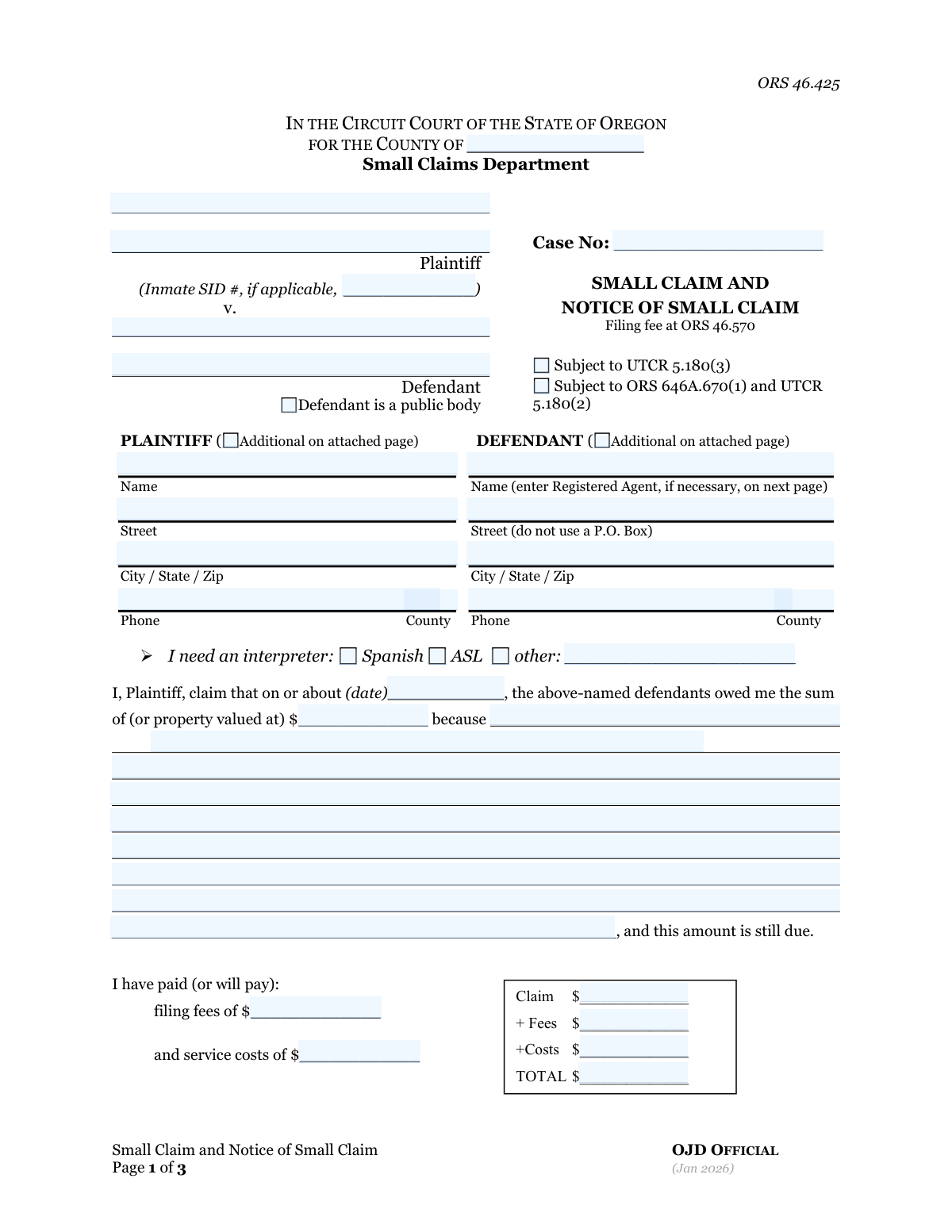
Yes! You can use AI to fill out Small Claim and Notice of Small Claim (ORS 46.425) (OJD Official) (Jan 2026)

This is the Oregon Judicial Department’s official small claims pleading used to file a small claims case in Oregon Circuit Court (Small Claims Department) under ORS 46.425. The plaintiff uses it to identify the parties, state the basis for the debt or property claim, and list the amount sought including filing fees and service costs. It also includes a required declaration of good-faith collection efforts and provides the defendant with formal notice and instructions on how to respond within the stated deadline. Filing it correctly is important because it initiates the case and sets the terms and timeline for the defendant’s response and potential judgment.
Our AI automatically handles information lookup, data retrieval, formatting, and form filling.
It takes less than a minute to fill out ORS 46.425 Small Claim and Notice of Small Claim using our AI form filling.
Securely upload your data. Information is encrypted in transit and deleted immediately after the form is filled out.

Form specifications

Form name: Small Claim and Notice of Small Claim (ORS 46.425) (OJD Official) (Jan 2026)
Number of pages: 3
Filled form examples: Form ORS 46.425 Small Claim and Notice of Small Claim Examples
Language: English
main-image

Instafill Demo: filling out a legal form in seconds

How to Fill Out ORS 46.425 Small Claim and Notice of Small Claim Online for Free in 2026

Are you looking to fill out a ORS 46.425 SMALL CLAIM AND NOTICE OF SMALL CLAIM form online quickly and accurately? Instafill.ai offers the #1 AI-powered PDF filling software of 2026, allowing you to complete your ORS 46.425 SMALL CLAIM AND NOTICE OF SMALL CLAIM form in just 37 seconds or less.
Follow these steps to fill out your ORS 46.425 SMALL CLAIM AND NOTICE OF SMALL CLAIM form online using Instafill.ai:
  1. 1 Select the correct Oregon Circuit Court county and enter the case number if already assigned (or leave blank if the clerk will assign it).
  2. 2 Enter plaintiff information (name, address, phone, county, inmate SID if applicable) and indicate interpreter needs if required.
  3. 3 Enter defendant information (name and address; if the defendant is an entity, add the registered agent details; check boxes if the defendant is a public body or if consumer debt collection rules apply).
  4. 4 Describe the claim: provide the date of the event, explain why the defendant owes the money (or property value), and enter the claim amount.
  5. 5 Calculate totals by entering filing fees and service costs (paid or to be paid) and compute the total amount requested (claim + fees + costs).
  6. 6 Complete the Declaration of Good Faith Effort by describing collection attempts; if applicable, attach the Consumer Debt Collection Disclosure Statement required by UTCR 5.180.
  7. 7 Review for accuracy, sign and date under penalty of perjury, provide email/printed name, and file with the court; arrange service on the defendant and complete the defendant notice section items that the plaintiff must fill in (e.g., defendant filing fee amounts and court contact information if required).

Our AI-powered system ensures each field is filled out correctly, reducing errors and saving you time.

Why Choose Instafill.ai for Your Fillable ORS 46.425 Small Claim and Notice of Small Claim Form?

Speed

Complete your ORS 46.425 Small Claim and Notice of Small Claim in as little as 37 seconds.

Up-to-Date

Always use the latest 2026 ORS 46.425 Small Claim and Notice of Small Claim form version.

Cost-effective

No need to hire expensive lawyers.

Accuracy

Our AI performs 10 compliance checks to ensure your form is error-free.

Security

Your personal information is protected with bank-level encryption.

Frequently Asked Questions About Form ORS 46.425 Small Claim and Notice of Small Claim

This form starts a small claims case in Oregon Circuit Court and serves as the notice that will be delivered to the defendant. It tells the court what you are claiming and informs the defendant how to respond.

The plaintiff (the person filing the claim) completes and files this form with the court. The defendant uses the notice information to decide whether to pay, request a hearing, or request a jury trial (if eligible).

File in the Oregon county where the case is properly located (often where the defendant lives/does business or where the event happened). Enter that county name at the top: “FOR THE COUNTY OF ____” and use that court’s Small Claims Department.

No—typically the clerk assigns the case number after you file. Leave “Case No.” blank unless the court has already given you one.

You must provide names, street addresses (do not use a P.O. Box), city/state/zip, and phone numbers for both sides. If there are additional parties, use the attached page referenced on the form.

Yes, if needed you should list the business and provide the registered agent information in the “DEFENDANT’S REGISTERED AGENT” section. This helps ensure the correct party is served.

No—the form specifically says not to use a P.O. Box for street addresses. Use a physical street address for the parties and for any registered agent.

In the statement that begins “I, Plaintiff, claim that on or about (date) …,” briefly explain the reason the defendant owes you money (or property) and why it is still due. Include key facts like the date, what was agreed, and what was not paid or returned.

Enter the amount you are claiming (or the value of the property), then add the filing fees and service costs you paid or will pay. The “TOTAL” should equal Claim + Fees + Costs.

Filing fees are what you pay the court to file the case, and service costs are what it costs to legally deliver the papers to the defendant. The form allows you to list these amounts separately and include them in the total you seek.

You must state that you tried in good faith to collect from the defendant before filing. Describe what you did (for example, calls, emails, letters, payment requests, or attempts to return/resolve the issue) and when you did it.

If your case falls under ORS 646A.670(1) and UTCR 5.180, you must comply with those rules and attach a completed Consumer Debt Collection Disclosure Statement. The form directs you to www.courts.oregon.gov/debtcollection for details.

Check the box indicating you need an interpreter and specify the language (Spanish, ASL, or “other”). Provide the language needed in the blank if it is not listed.

The defendant has 30 days after receiving the notice to do one of the listed options in writing: pay, demand a hearing (and pay the fee), or demand a jury trial (if eligible). If they do nothing within 30 days, the plaintiff may ask for a judgment by default.

A jury trial option is available only if the amount claimed (including prejudgment interest, fees, and costs) is more than $750. The defendant must also pay the required jury trial fee.

Compliance ORS 46.425 Small Claim and Notice of Small Claim
Validation Checks by Instafill.ai

1
County Selection Required and Matches Court Venue
Validate that the 'FOR THE COUNTY OF' field is completed with a valid Oregon county name and is not left blank. This matters because small claims must be filed in the correct venue, and the court needs the county to route and docket the case properly. If the county is missing or invalid, the submission should be rejected or flagged for clerk review before acceptance.
2
Case Number Format (If Provided) and Uniqueness Handling
If a Case No. is entered, validate it matches the court’s expected case number pattern (e.g., alphanumeric with separators) and does not contain prohibited characters. This is important to prevent misfiling into the wrong case or creating duplicate records. If the format is invalid, the system should block submission or clear the field and require clerk assignment depending on workflow.
3
Plaintiff Identity Completeness (Name, Address, City/State/Zip, Phone)
Ensure the plaintiff section includes a full name and a complete physical mailing address (street, city, state, zip) plus a phone number. This is required so the court and defendant can contact the plaintiff and so service/notice information is reliable. If any required element is missing, the filing should be rejected as incomplete.
4
Inmate SID Number Conditional Validation
If the plaintiff indicates they are an inmate (or provides an Inmate SID #), validate the SID is present and follows the expected numeric/length rules used by the jurisdiction. This helps correctly identify incarcerated filers and avoid identity mismatches. If the SID is partially entered or malformed, the system should require correction or remove the SID entry.
5
Defendant Identity Completeness and Public Body Indicator Consistency
Validate that at least one defendant is provided with a name and complete address information, and that the 'Defendant is a public body' indicator is consistent with the defendant type selected/entered. This matters because service requirements and certain statutory notices can differ for public bodies. If the defendant information is incomplete or the public-body flag conflicts with the defendant details, the submission should be flagged for correction.
6
No P.O. Box in Street Address Fields (Plaintiff/Defendant/Registered Agent)
Check that any field labeled 'Street (do not use a P.O. Box)' does not contain P.O. Box patterns (e.g., 'PO Box', 'P.O. Box', 'Box 123'). This is important because the form explicitly requires a physical street address for service and location verification. If a P.O. Box is detected, the system should block submission and prompt for a physical address.
7
Registered Agent Section Required When Defendant Appears to Be an Entity
If the defendant name suggests a business/entity (e.g., contains 'LLC', 'Inc', 'Corp', 'City of', 'County', 'Department'), validate that the Registered Agent section is completed or that an attached page provides the registered agent details. This is important for proper service and to ensure the correct legal party is named. If missing, the system should require completion or an attachment before allowing filing.
8
Phone Number Format Validation (Plaintiff/Defendant/Registered Agent)
Validate phone numbers are in an acceptable format (e.g., 10 digits with optional separators, and optionally country code if allowed) and do not contain letters or invalid lengths. Reliable phone numbers help the court resolve administrative issues and support service coordination. If invalid, the system should require correction or allow submission only with a clear warning depending on court policy.
9
Interpreter Request Completeness and Single-Selection Logic
If 'I need an interpreter' is selected, validate that at least one option is chosen (Spanish, ASL, or 'other') and that 'other' includes a non-empty language description. This ensures the court can schedule appropriate language access services. If the request is incomplete (e.g., 'other' with blank language), the system should block submission until corrected.
10
Claim Date Presence and Valid Date Format
Validate the 'on or about (date)' field is completed and is a real calendar date in an accepted format (e.g., MM/DD/YYYY) and not an impossible date. The claim date is needed to understand timeliness and for case narrative clarity. If missing or invalid, the submission should be rejected as incomplete.
11
Claim Basis Narrative Required (Because...)
Ensure the narrative explaining why the defendants owe the amount (the 'because' section) is not blank and meets a minimum content threshold (e.g., not just 'N/A' or a few characters). This is important because the defendant must receive adequate notice of the claim’s basis. If insufficient, the system should require additional detail before filing.
12
Monetary Fields Are Numeric, Non-Negative, and Currency-Formatted
Validate that all dollar fields (claim amount, filing fees, service costs, fees/costs totals) contain valid numeric values with at most two decimal places and are not negative. This prevents calculation errors and ensures the court and parties understand the amounts sought. If any field is non-numeric or negative, the system should block submission and highlight the offending field.
13
Total Calculation Consistency (Claim + Fees + Costs = TOTAL)
Recalculate TOTAL as Claim + Fees + Costs and verify it matches the entered TOTAL within a small rounding tolerance (e.g., $0.01). This is important to avoid disputes and clerical errors in judgment amounts and notices. If inconsistent, the system should either auto-correct the TOTAL or require the filer to correct it before submission.
14
Good Faith Effort Declaration: Efforts Description Required
Validate that the 'Describe your efforts' field is completed with a meaningful description (e.g., contact attempts, demand letters, payment requests) and is not left blank. The form requires a declaration of good faith collection efforts prior to filing, and missing content undermines compliance. If absent or clearly insufficient, the system should prevent filing or route to clerk review per local rules.
15
Consumer Debt Collection Disclosure Attachment Required When ORS 646A.670/UTCR 5.180 Applies
If the filer indicates the case is subject to ORS 646A.670(1) / UTCR 5.180 (as referenced on the form), validate that a 'Consumer Debt Collection Disclosure Statement' attachment is included. This is important because the rule requires the disclosure to be attached and incorporated, and missing it can lead to rejection or delay. If the attachment is not present when required, the system should block submission and prompt for the document.
16
Signature, Printed Name, and Date Required on Declaration
Validate that the plaintiff signature is present (e-signature or uploaded signature per system rules), the printed name field is completed, and the declaration date is provided and valid. This matters because the declaration is made under penalty of perjury and must be properly executed to be accepted. If any element is missing, the submission should be rejected as unsigned/undated.

Common Mistakes in Completing ORS 46.425 Small Claim and Notice of Small Claim

Leaving the county or case number blank (or putting the wrong court)

People often forget to fill in the county at the top or assume the clerk will assign everything, and they may file in the wrong county. Filing in the wrong place can delay the case, require refiling, or lead to dismissal for improper venue. Always write the correct Oregon county for the Circuit Court where you are filing, and leave the case number blank only if the court assigns it (follow local instructions). If you already have a case number, copy it exactly as issued.

Using a P.O. Box for a party or registered agent address

This form repeatedly warns “do not use a P.O. Box,” but many filers still list one because it’s their mailing address or the only address they know. A P.O. Box can prevent proper service of process and cause the court to reject the filing or require amendments. Use a physical street address for Plaintiff, Defendant, and any Registered Agent; if you need a separate mailing address, provide it only where the court allows it (or attach an explanation).

Naming the wrong defendant (or not listing the registered agent for a business)

A very common error is suing a trade name, a store location, or an employee instead of the legal entity that actually owes the debt. If the defendant is a corporation/LLC, failing to identify the correct legal name and registered agent can lead to failed service and an unenforceable judgment. Verify the defendant’s exact legal name and registered agent (e.g., via Oregon Secretary of State business registry) and complete the “Defendant’s Registered Agent” section when needed.

Not indicating when the defendant is a public body (or checking it incorrectly)

Filers sometimes overlook the “Defendant is a public body” indicator or misunderstand what counts as a public body (state agencies, counties, cities, school districts, etc.). Public-body claims can have special notice requirements and procedures; mistakes can cause dismissal even if the underlying claim is valid. Confirm whether the defendant is a government entity and follow any additional statutory notice steps before filing, documenting compliance if required.

Missing or vague “on or about” date and claim explanation

People often write a broad story without a clear date, or they leave the date blank because the dispute happened over time. Without a specific date (or date range) and a concise explanation of why money/property is owed, the claim can be unclear, harder to prove, and easier for the defendant to challenge. Provide the best specific date you can (or a clear range) and summarize the basis of the claim in plain facts: what happened, what agreement existed, what was delivered, and what remains unpaid.

Incorrect math in the Claim + Fees + Costs total

It’s common to double-count filing fees, forget to include service costs, or put the total in the wrong line (e.g., putting the total amount in the “Claim” field). Math errors can lead to the wrong amount being requested, confusion at judgment, or the need to amend the filing. Enter the principal claim amount on “Claim,” list filing fees and service costs separately, and re-check that the TOTAL equals Claim + Fees + Costs exactly.

Listing fees/costs as estimates without updating or documenting them

Filers sometimes guess at filing fees or service costs (“will pay”) and never update the numbers, or they include costs that are not actually recoverable. This can create disputes about the amount owed and may reduce what the court awards. Use the current fee schedule for the filing fee, use the actual service quote/receipt when possible, and keep documentation so the amounts match what you truly paid.

Failing to describe the “good faith effort” to collect before filing

Many people write “I tried to collect” without details, or they leave the section blank because they think it’s optional. The court expects a real description (calls, letters, emails, payment demands, dates), and a weak or missing statement can delay processing or undermine credibility. Briefly list what you did, when you did it, who you contacted, and the outcome; attach copies of demand letters or messages if helpful.

Not attaching the required Consumer Debt Collection Disclosure Statement when applicable (UTCR 5.180 / ORS 646A.670)

If the claim is a consumer debt collection case, filers often miss the checkbox language and do not attach the required disclosure statement. Missing required attachments can result in rejection by the clerk, a motion to dismiss, or delays while you correct the filing. Determine whether your claim fits ORS 646A.670(1) and UTCR 5.180, and if it does, attach the completed disclosure statement and ensure it is referenced as incorporated into the pleading.

Forgetting interpreter needs or not specifying “other” language clearly

People frequently skip the interpreter section or check “other” without writing the language/dialect, assuming the court will figure it out later. Late interpreter requests can cause continuances, missed hearings, or communication problems in court. If you need an interpreter, check the correct box (Spanish/ASL) or clearly write the language for “other,” and request it as early as possible so the court can schedule services.

Missing signature/date or using an inconsistent printed name/email

A common technical error is forgetting to sign and date the declaration, or printing a name that doesn’t match the plaintiff name listed on page 1. Unsigned declarations can be rejected, and inconsistent names/emails can cause notice problems and confusion about who is making the sworn statements. Sign and date where indicated, print your name exactly as listed as Plaintiff, and provide a reliable email you check regularly for court communications.
Saved over 80 hours a year

“I was never sure if my IRS forms like W-9 were filled correctly. Now, I can complete the forms accurately without any external help.”

Kevin Martin Green

Your data stays secure with advanced protection from Instafill and our subprocessors

Robust compliance program

Transparent business model

You’re not the product. You always know where your data is and what it is processed for.

ISO 27001, HIPAA, and GDPR

Our subprocesses adhere to multiple compliance standards, including but not limited to ISO 27001, HIPAA, and GDPR.

Security & privacy by design

We consider security and privacy from the initial design phase of any new service or functionality. It’s not an afterthought, it’s built-in, including support for two-factor authentication (2FA) to further protect your account.

Fill out ORS 46.425 Small Claim and Notice of Small Claim with Instafill.ai

Worried about filling PDFs wrong? Instafill securely fills small-claim-and-notice-of-small-claim-ors-46425-oj forms, ensuring each field is accurate.