Yes! You can use AI to fill out Pacific Gastroenterology Associates Referral Form
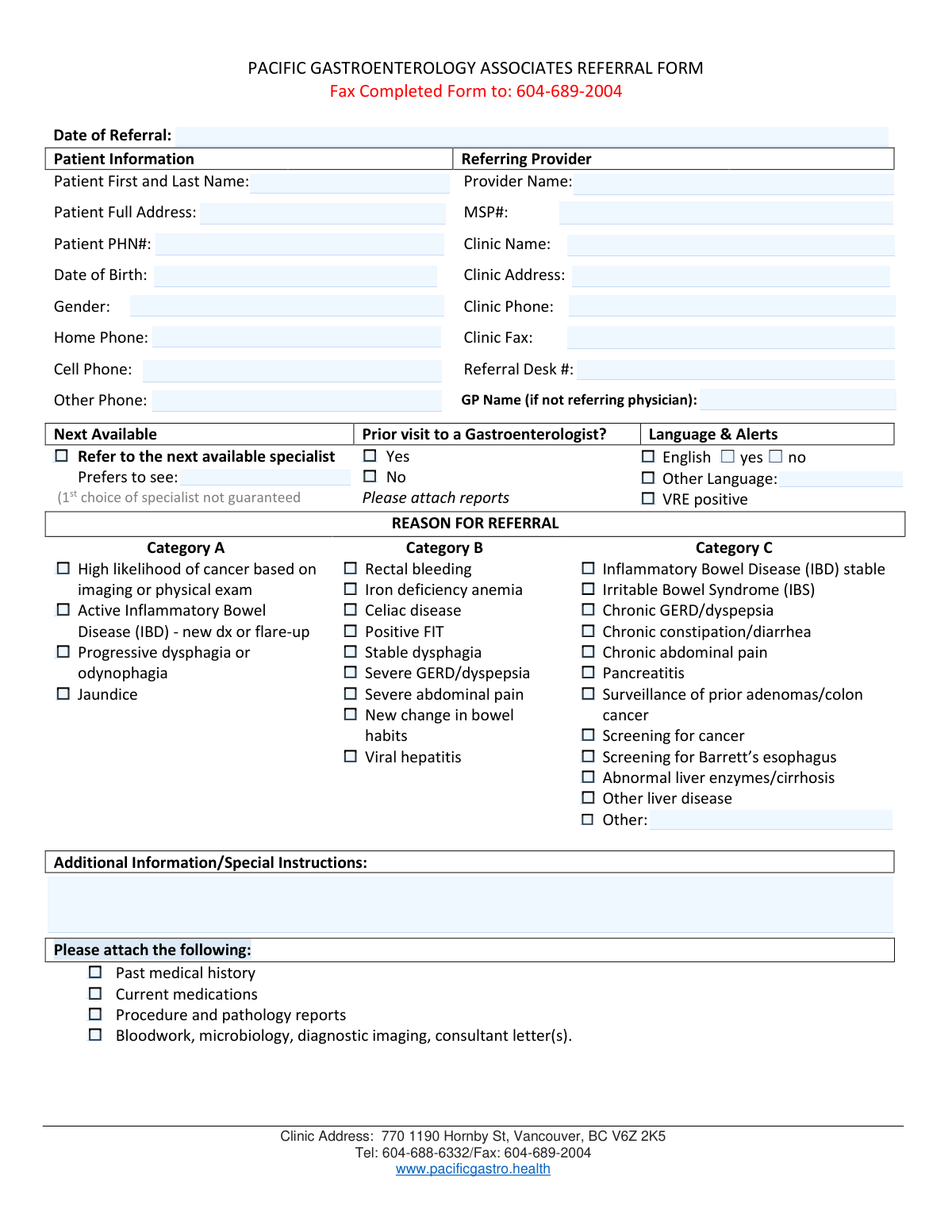
The Pacific Gastroenterology Associates Referral Form is a clinical referral document used to request a gastroenterology consultation for a patient and to communicate key details such as patient identifiers (e.g., PHN), contact information, language/alerts, and the clinical reason for referral (Category A/B/C). It helps the receiving clinic triage the referral appropriately (e.g., suspected cancer, active IBD flare, positive FIT) and ensures the right supporting records (labs, imaging, prior reports) are attached. Accurate completion is important to avoid delays in booking and to support safe, informed care. Today, this form can be filled out quickly and accurately using AI-powered services like Instafill.ai, which can also convert non-fillable PDF versions into interactive fillable forms.
Our AI automatically handles information lookup, data retrieval, formatting, and form filling.
It takes less than a minute to fill out Pacific Gastroenterology Referral Form using our AI form filling.
Securely upload your data. Information is encrypted in transit and deleted immediately after the form is filled out.
Form specifications
| Form name: | Pacific Gastroenterology Associates Referral Form |
| Number of pages: | 1 |
| Filled form examples: | Form Pacific Gastroenterology Referral Form Examples |
| Language: | English |
Instafill Demo: filling out a legal form in seconds
How to Fill Out Pacific Gastroenterology Referral Form Online for Free in 2026
Are you looking to fill out a PACIFIC GASTROENTEROLOGY REFERRAL FORM form online quickly and accurately? Instafill.ai offers the #1 AI-powered PDF filling software of 2026, allowing you to complete your PACIFIC GASTROENTEROLOGY REFERRAL FORM form in just 37 seconds or less.
Follow these steps to fill out your PACIFIC GASTROENTEROLOGY REFERRAL FORM form online using Instafill.ai:
- 1 Go to Instafill.ai and upload the Pacific Gastroenterology Associates Referral Form (PDF/image) or select it from the form library.
- 2 Enter or import the patient’s demographic details (full name, address, PHN, date of birth, gender, and phone numbers).
- 3 Enter the referring provider and clinic details (provider name, MSP#, clinic name/address, phone/fax, referral desk number, and GP name if different).
- 4 Specify scheduling preferences (next available vs. preferred specialist) and indicate whether the patient has previously seen a gastroenterologist; add language preferences and any alerts (e.g., VRE positive).
- 5 Select the appropriate reason(s) for referral by checking the relevant Category A/B/C boxes and add any “Other” reason text if needed.
- 6 Complete the “Additional Information / Special Instructions” section with brief clinical context, precautions, and any scheduling notes.
- 7 Attach or list supporting documentation (past medical history, medications, procedure/pathology reports, bloodwork/imaging/consult letters), then review for accuracy and export/send the completed form (e.g., fax to 604-689-2004).
Our AI-powered system ensures each field is filled out correctly, reducing errors and saving you time.
Why Choose Instafill.ai for Your Fillable Pacific Gastroenterology Referral Form Form?
Speed
Complete your Pacific Gastroenterology Referral Form in as little as 37 seconds.
Up-to-Date
Always use the latest 2026 Pacific Gastroenterology Referral Form form version.
Cost-effective
No need to hire expensive lawyers.
Accuracy
Our AI performs 10 compliance checks to ensure your form is error-free.
Security
Your personal information is protected with bank-level encryption.
Frequently Asked Questions About Form Pacific Gastroenterology Referral Form
This form is used by a healthcare provider to refer a patient to Pacific Gastroenterology Associates for assessment, consultation, or GI-related procedures. It helps the clinic triage the referral based on urgency and the reason for referral.
The referring provider (or their clinic staff) should complete the form and submit it to Pacific Gastroenterology Associates. Patients typically do not submit this form themselves unless their provider instructs them to.
Fax the completed form to 604-689-2004. The clinic phone number is 604-688-6332 if you need to confirm receipt or ask referral-related questions.
You should include the patientâs full name, full address, PHN, date of birth, gender, and at least one reliable phone number (home/cell/other). Providing multiple contact numbers can help prevent scheduling delays.
Enter the provider name and MSP#, plus clinic name, clinic address, clinic phone and fax, and the referral desk number if available. If the patientâs GP is different from the referring physician, include the GP name as well.
Check âRefer to the next available specialistâ if the patient can see any gastroenterologist sooner. If the patient prefers a specific specialist, write the name in the âPrefers to seeâ line, but note the form states the first choice is not guaranteed.
This asks whether the patient has previously seen a gastroenterologist for the condition being referred. If yes, attach any relevant prior reports (e.g., procedure and pathology reports, consultant letters) to help avoid repeat testing and speed up triage.
Indicate whether the patientâs preferred language is English or another language, and specify the other language if applicable. Check âVRE positiveâ only if the patient has a documented VRE-positive result so the clinic can apply appropriate infection-control precautions.
Choose the category that best matches the patientâs current clinical urgency and symptoms, then check the specific reason(s) within that category. Category A generally reflects more urgent concerns (e.g., high likelihood of cancer, progressive dysphagia, jaundice), while Category C is typically routine or stable conditions.
Yesâcheck all boxes that apply to the patientâs presentation (for example, iron deficiency anemia plus positive FIT). Use âAdditional Information/Special Instructionsâ to clarify the main concern and provide key context.
Attach relevant clinical information such as past medical history, current medications, procedure and pathology reports, and any bloodwork, microbiology, diagnostic imaging, or consultant letters. Including these documents helps the clinic triage appropriately and may reduce delays.
Include a brief clinical summary, key findings, symptom duration, red flags, relevant comorbidities, infection-control needs, and any scheduling constraints. This is also the best place to explain anything not captured by the checkboxes.
The form does not list a specific processing time, and timelines can vary based on triage category and clinic capacity. To avoid delays, ensure all required fields are complete and attach supporting reports; you can call the clinic if you need to confirm next steps.
YesâAI form-filling tools can help by extracting details from your records and placing them into the correct fields, reducing manual entry errors. Services like Instafill.ai can auto-fill form fields accurately and save time.
Upload the referral form to Instafill.ai, add the patient/provider details (or upload supporting documents), and let the AI map information into the correct fields before you review and export for faxing. If the PDF is flat/non-fillable, Instafill.ai can convert it into an interactive fillable form so you can complete it digitally.
Compliance Pacific Gastroenterology Referral Form
Validation Checks by Instafill.ai
1
Date of Referral is present and in valid date format
Validates that the Date of Referral field is not blank and is a real calendar date (e.g., YYYY-MM-DD or an accepted local format) and not an impossible value (e.g., 2026-02-30). This is important for triage timing, waitlist ordering, and auditability of the referral. If validation fails, the submission should be rejected or routed back for correction because the clinic cannot reliably prioritize or track the referral.
2
Date of Referral is not in the future and is reasonable relative to submission time
Checks that the Date of Referral is not later than the form submission date/time (allowing a small tolerance if needed for time zones or end-of-day batching). Future-dated referrals can break queue ordering and create compliance issues for documentation. If the date is in the future beyond tolerance, flag the referral for manual review or require correction before acceptance.
3
Patient name completeness and character validation
Ensures Patient First and Last Name contains at least two name components (first and last) and is not placeholder text (e.g., 'N/A', 'Unknown', 'Test'). Also validates allowed characters (letters, spaces, hyphens, apostrophes) and reasonable length to prevent truncation or injection of non-name content. If validation fails, the referral should be returned for correction because patient matching and registration will be unreliable.
4
Patient PHN format and checksum/length validation (BC PHN)
Validates that the Patient PHN is present and matches the expected BC Personal Health Number structure (typically 10 digits) and, if supported, passes any known checksum/validation rules. This prevents misidentification, duplicate charts, and billing/eligibility issues. If the PHN is missing or malformed, the system should block submission or require an alternate verified identifier per policy.
5
Date of Birth is valid and logically consistent with referral date
Checks that Date of Birth is a valid date and that the patient age is within a plausible range (e.g., 0â120 years) and not after the Date of Referral. This is critical for clinical appropriateness, screening eligibility, and correct patient identification. If validation fails, the referral should be flagged as high risk for wrong-patient errors and require correction before scheduling.
6
Patient address completeness (street, city, province, postal code)
Ensures Patient Full Address includes minimum required components: street address, city, province/state (e.g., BC), and a postal/zip code. Complete address data supports patient contact, mailing of prep instructions, and correct jurisdictional handling. If incomplete, the system should prompt for missing components or route to staff for follow-up before booking.
7
Phone number format validation and at least one patient contact number present
Validates Home Phone, Cell Phone, and Other Phone (if provided) against a consistent phone format (e.g., 10 digits for NANP, allowing separators and optional country code). Also enforces that at least one patient phone number is provided so the clinic can contact the patient for scheduling and prep. If all phone fields are blank or invalid, the referral should be rejected or held until a valid contact number is supplied.
8
Referring provider identity completeness (Provider Name + Clinic Name required)
Checks that Provider Name and Clinic Name are both present and not placeholders, ensuring the referral has an accountable source. This is important for clarifications, results routing, and medico-legal traceability. If missing, the referral should be returned because the clinic may be unable to obtain additional information or send reports appropriately.
9
MSP# (provider number) format validation
Validates that the MSP# is present and matches the expected numeric format/length for a provider registration number (as configured for the jurisdiction). Correct provider identifiers are essential for correspondence, billing workflows, and preventing misattribution of referrals. If invalid or missing, the system should block submission or flag for administrative follow-up depending on clinic policy.
10
Clinic contact numbers (phone and fax) format and presence rules
Validates Clinic Phone and Clinic Fax (if provided) for correct phone/fax formatting and ensures at least one reliable outbound contact method exists for the referring clinic. This supports rapid clarification and secure document exchange. If both are missing/invalid, the referral should be flagged for manual review because communication and report delivery may fail.
11
Next Available vs Preferred Specialist mutual exclusivity and dependency
Ensures that 'Refer to the next available specialist' and 'Prefers to see' are not both selected in a conflicting way, and that if 'Prefers to see' is selected, the preferred specialist name is provided. This prevents scheduling ambiguity and misrouting. If the selection is inconsistent or the preferred name is blank, the system should require correction before the referral enters scheduling.
12
Prior gastroenterologist visit Yes/No must be explicitly selected (single choice)
Validates that exactly one of 'Prior visit to a Gastroenterologist? Yes' or 'No' is selected (not both, not neither). This information affects expectations for available prior records and may influence triage and continuity of care. If invalid, the referral should be returned for clarification to avoid missing critical historical information.
13
Language selection consistency (English vs Other Language) and required details
Checks that language fields are internally consistent: if 'Other Language' is indicated, a specific language name must be provided; if English is selected as primary, the other-language field should be empty unless explicitly allowed as bilingual. Accurate language data is important for interpreter booking and informed consent. If inconsistent or missing required language detail, the system should prompt for correction to prevent communication and safety issues.
14
VRE positive flag requires infection-control note or alert handling
If 'VRE positive' is checked, validates that Additional Information/Special Instructions includes relevant infection-control details (e.g., date/source of positive result or required precautions) or that the system captures an equivalent structured alert. This is important for patient and staff safety and appropriate rooming/procedure planning. If the flag is set without supporting details, the referral should be flagged for clinical review before booking.
15
Reason for Referral: at least one clinical indication selected and 'Other' text required when used
Ensures at least one checkbox is selected across Category A/B/C, or that Category C 'Other' is selected with a non-empty specification. A missing reason prevents triage, urgency assignment, and appropriate booking type (consult vs procedure). If no reason is provided or 'Other' is blank, the system should block submission and request completion.
16
Attachment checklist requirements based on prior GI visit and high-risk indications
Validates that when 'Prior visit to a Gastroenterologist' is 'Yes', the attachment checklist includes relevant prior reports (procedure/pathology, consultant letters, etc.) or the submission includes uploaded documents where supported. Additionally, for certain indications (e.g., 'High likelihood of cancer', 'Jaundice', 'Positive FIT', 'Iron deficiency anemia'), the system should require at least one supporting investigation document (imaging/labs/report) or a note explaining unavailability. If required attachments are not indicated/provided, the referral should be flagged as incomplete and held for follow-up to avoid unsafe or delayed triage.
Common Mistakes in Completing Pacific Gastroenterology Referral Form
People often leave the Date of Referral blank or enter an ambiguous format (e.g., 03/04/24) that can be interpreted two ways. This can delay triage because the clinic may not know how long the referral has been waiting or whether it is current. Always use an unambiguous format (YYYY-MM-DD or DD-MMM-YYYY) and ensure it matches the date the referral is actually sent; AI-powered tools like Instafill.ai can auto-format dates consistently and flag missing dates before faxing.
A common error is entering nicknames, missing a last name, or swapping first/last name fields, especially when copying from informal chart notes. If the name does not match the PHN record, the clinic may have trouble locating the patient, creating duplicate charts, or booking correctly. Enter the patientâs full legal first and last name exactly as it appears on their BC Services Card/health card, and include middle name/initial only if it is part of the official record; Instafill.ai can standardize name formatting and reduce transposition errors.
PHNs are frequently mistyped (missing digits, transposed numbers) or entered with extra characters/spaces that donât match the health card. An incorrect PHN can prevent registration, cause billing/eligibility issues, and delay appointment scheduling. Copy the PHN directly from the health card, verify digit count, and avoid adding labels or punctuation; Instafill.ai can validate numeric patterns and highlight likely PHN entry mistakes.
Many referrals include only a street address or omit the postal code, which is common when data is pulled from partial demographics. Missing address details can cause problems with patient identification, mailing prep instructions, and coordinating follow-up. Enter the full residential address including street, city, province (BC), and postal code; Instafill.ai can auto-complete and format addresses consistently to reduce omissions.
People often enter only one phone number, forget the area code, or place the patientâs number in the clinic phone field (or vice versa). If the clinic cannot reach the patient quickly, booking and pre-procedure instructions may be delayed or missed. Provide at least one reliable number (cell preferred), include area codes, and use the âOther Phoneâ field for work/alternate contacts; Instafill.ai can format phone numbers and detect missing digits/area codes.
Referrals commonly arrive without an MSP# or with missing clinic contact details, especially when the form is filled quickly or by someone unfamiliar with the providerâs billing identifiers. Missing provider identifiers and contact numbers can delay clarification requests, result reporting, and booking coordination. Ensure Provider Name, MSP#, Clinic Name/Address, Clinic Phone, Clinic Fax, and Referral Desk # are all completed and current; Instafill.ai can store provider profiles and auto-populate these fields accurately.
A frequent misunderstanding is writing a preferred specialist name but not checking the corresponding option, or checking both ânext availableâ and âprefers to seeâ without clarifying priority. This can lead to scheduling confusion and longer wait times if the clinic holds the referral for a specific provider unintentionally. Choose one pathway: check âRefer to the next available specialistâ for fastest access, or check âPrefers to seeâ and clearly write the provider name; Instafill.ai can prompt for consistency when one option is selected.
People sometimes check âYesâ or âNoâ based on memory without confirming, or they check âYesâ but forget to attach prior consult/procedure/pathology reports. Missing prior GI records can force repeat testing, slow triage, and reduce the specialistâs ability to assess urgency. Confirm prior GI involvement in the chart, check the correct box, and attach relevant reports when âYesâ is selected; Instafill.ai can remind users to include required attachments and generate a checklist cover page.
The language area is easy to misread because it includes checkboxes for English, yes/no, and âOther Language,â leading to contradictory selections (e.g., English checked plus Other Language without specifying). Missing language needs can result in no interpreter being arranged, and missing a VRE-positive flag can create infection-control risks. Clearly indicate the patientâs preferred language (English or specify the other language) and only check VRE positive when documented; Instafill.ai can enforce required âspecifyâ text when âOther Languageâ is selected and reduce contradictory checkbox combinations.
Users sometimes check several boxes across Category A/B/C without clarifying the primary issue, or they select a lower-urgency category for red-flag symptoms (e.g., progressive dysphagia, jaundice). Incorrect categorization can delay urgent care or create back-and-forth clarification requests. Select the single best-matching reason(s), prioritize the most urgent symptom, and use âAdditional Informationâ to explain context and duration; Instafill.ai can help by prompting for key red-flag details and ensuring the selection aligns with the narrative.
A common omission is checking âOtherâ under Category C but leaving the line blank, assuming the clinic will infer the reason from attached notes. This can stall triage because the clinic cannot route the referral appropriately without a clear indication of the clinical question. If âOtherâ is selected, write a concise, specific reason (e.g., âsuspected NAFLD with elevated ALT x 6 monthsâ); Instafill.ai can require a description when âOtherâ is checked and prevent submission with an empty specify field.
Referrals often mention symptoms but omit supporting labs, imaging, FIT results, or prior pathology/procedure reports, or the sender forgets to check the attachment boxes. Missing documentation can lead to triage delays, repeat investigations, and incomplete consults. Attach the most recent relevant bloodwork, microbiology, imaging reports, and any prior endoscopy/pathology, and ensure the checklist reflects what is actually included; Instafill.ai can help track required documents and validate that referenced results (e.g., positive FIT) are attached.
Saved over 80 hours a year
âI was never sure if my IRS forms like W-9 were filled correctly. Now, I can complete the forms accurately without any external help.â
Kevin Martin Green
Your data stays secure with advanced protection from Instafill and our subprocessors

Robust compliance program
Transparent business model
Youâre not the product. You always know where your data is and what it is processed for.
ISO 27001, HIPAA, and GDPR
Our subprocesses adhere to multiple compliance standards, including but not limited to ISO 27001, HIPAA, and GDPR.
Security & privacy by design
We consider security and privacy from the initial design phase of any new service or functionality. Itâs not an afterthought, itâs built-in, including support for two-factor authentication (2FA) to further protect your account.
Fill out Pacific Gastroenterology Referral Form with Instafill.ai
Worried about filling PDFs wrong? Instafill securely fills pacific-gastroenterology-associates-referral-form forms, ensuring each field is accurate.



