
Yes! You can use AI to fill out California Department of Social Services (CDSS) Community Care Licensing Child Care Forms Packet (LIC 9150, LIC 282, LIC 627, LIC 700, LIC 995A, CDPH 286, LIC 9227)
Don't type 136 fields by hand. Tell our AI about yourself, or upload a document you already have, and it fills every field in seconds. You check it, then download, print or sign.
The AI does the filling. You just check it.
No typing into boxes, nothing to install.
What this form asks for
The AI fills all of it, from your answers or your documents.
The AI checks your answers before you download
20 checks built for this form, so a wrong date or a missing answer is caught before anyone else sees it.
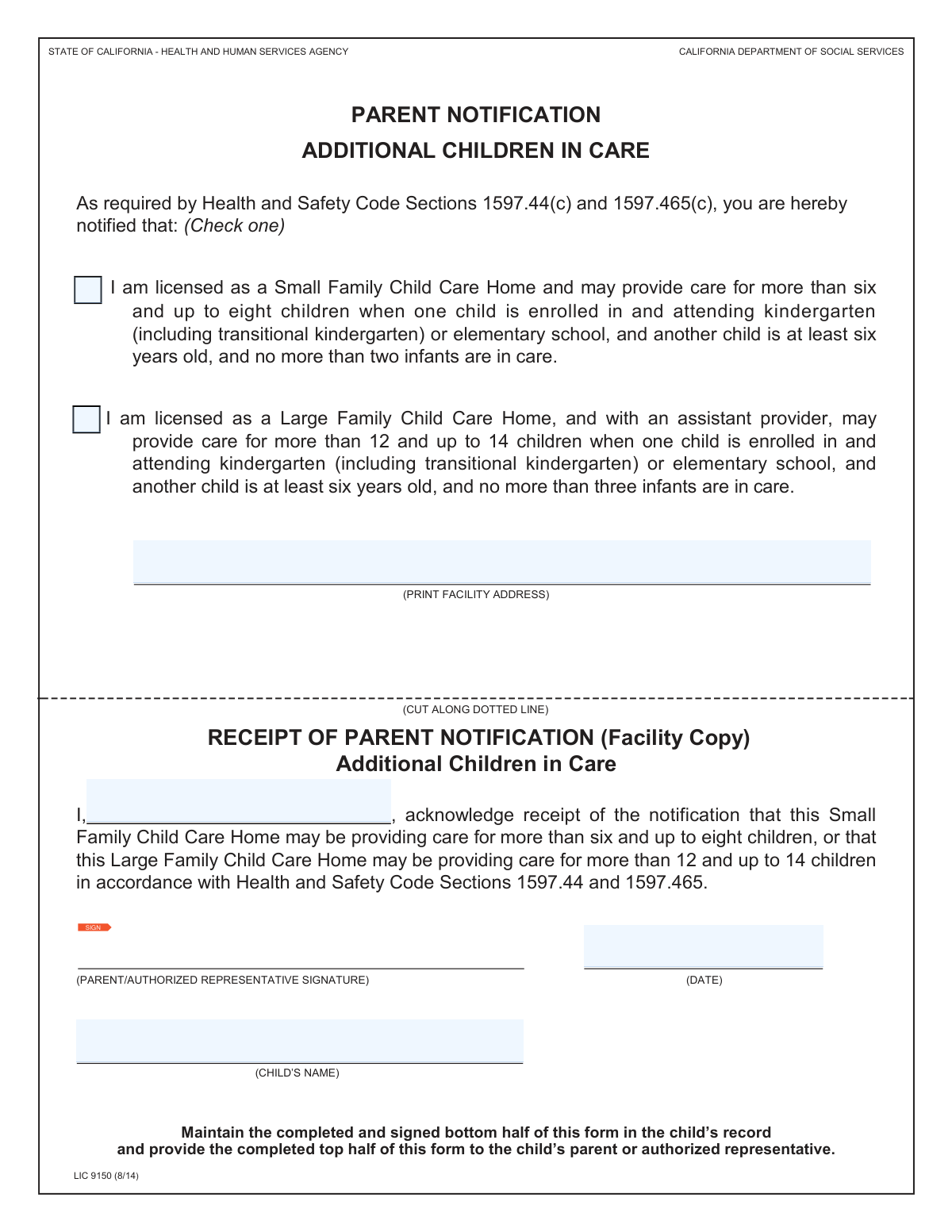
Validate that exactly one of the two options is checked: Small Family Child Care Home or Large Family Child Care Home. This is required to clearly indicate which capacity rule applies and what the parent is being notified about. If neither or both are selected, the notification is ambiguous and should be rejected for correction before filing or distributing.
Ensure the “PRINT FACILITY ADDRESS” field is completed with at least street address, city, state, and ZIP (and not left blank). The facility address is essential to identify which licensed location the notification applies to and to support audits/complaints. If incomplete, the form should fail validation and be returned to the provider to complete the address.
Validate that the receipt section includes the parent/authorized representative printed name (if captured), a signature, a date, and the child’s name. This receipt is the evidence that the parent received the required notification for that specific child. If any of these are missing, the receipt is not legally reliable and should be flagged as incomplete.
For every form that includes a signature line (e.g., LIC 282, LIC 627, LIC 700, LIC 995A acknowledgement, LIC 9227), verify a signature is present and the associated date is a valid calendar date. Dates should not be in the future relative to submission/processing time, because that indicates an entry error or pre-dating. If invalid, the record should be rejected or routed for correction depending on policy.
Validate that Section A includes the child’s name, the licensee’s name, and the family child care home name. These fields identify the parties and the specific facility for which the no-insurance acknowledgement applies. If any are missing, the affidavit cannot be tied to the correct child/facility and should fail validation.
If the submission indicates the licensee does not own the premises or is part of a condominium/HOA (or if Section B is present/selected), require Section B’s child name, licensee name, home name, parent/guardian signature, and date. If the licensee owns the premises and is not in an HOA, Section B should be blank or explicitly marked not applicable to avoid conflicting statements. If Section B is partially completed or contradicts the stated status, flag for review.
And 14 more checks
- Emergency Medical Consent (LIC 627) — Facility name and child name required
- LIC 627 — Home address and phone number format validation
- LIC 627 — Medication allergies field must be explicitly completed (value or 'None')
- Identification & Emergency Information (LIC 700) — Child identity fields complete and consistent
- LIC 700 — Parent/guardian and responsible party information completeness
- LIC 700 — Emergency contacts and authorized pickup entries have minimum required data
- LIC 700 — Physician and dentist information required or explicitly unavailable
- Parents’ Rights Acknowledgement (LIC 995A) — Child name, family child care home name, signature, and date required
- Immunization Record (CDPH 286) — Pupil identification and SSID format (if provided)
- CDPH 286 — Vaccine dose date format and chronological logic
- CDPH 286 — Status of Requirements section mutually exclusive selection and required supporting fields
- Individual Infant Sleeping Plan (LIC 9227) — Infant info and contact phone format validation
- LIC 9227 — Rolling ability dates and signature dependencies
- LIC 9227 — Medical exemption documentation required when exemption is 'Yes'
Let AI fill out your CA Child Care Licensing Forms (LIC/CDPH)
No typing. Every field filled in seconds, checked, ready to sign.
How to Fill Out CA Child Care Licensing Forms (LIC/CDPH) Online for Free in 2026
What the AI walks you through.
- Select the specific form(s) you need from the packet (e.g., LIC 9150, LIC 282, LIC 627, LIC 700, LIC 995A, CDPH 286, LIC 9227) based on the child’s enrollment and the facility’s licensing situation.
- Enter facility and child identifiers where applicable (facility name/address; child’s full name; admission date; parent/authorized representative names and contact details).
- Complete the disclosure/notification sections by checking the correct options (e.g., small vs. large family child care home capacity notice on LIC 9150; insurance/bond disclosure statements on LIC 282; parents’ rights acknowledgement on LIC 995A).
- Provide emergency and medical information (LIC 627 and LIC 700): emergency consent, home/work phones, physician/dentist, medication allergies, and authorized pick-up persons and emergency contacts.
- Record health compliance data if required (CDPH 286): enter vaccine dose dates, mark any permanent/temporary medical exemptions, and complete the status-of-requirements section with staff initials and follow-up dates if conditional.
- If the child is an infant, complete the safe-sleep documentation (LIC 9227): home sleep environment, typical sleep schedule, pacifier use, rolling ability dates/observations, and attach any physician medical exemption documentation if applicable.
- Collect required signatures and dates (parent/authorized representative, provider/licensee, and staff where required), then distribute copies as instructed (give parent copies; retain facility copies in the child’s record/file).
Common Mistakes in Completing CA Child Care Licensing Forms (LIC/CDPH)
The ones the AI is built to catch.
Not checking the correct “Small” vs “Large” Family Child Care Home box (LIC 9150)
Leaving the facility address blank or writing it in the wrong section (LIC 9150 top half)
Parent receipt section missing key identifiers (parent name, child name, date) (LIC 9150 bottom half)
Confusing who keeps which portion of the form (detach/cut instructions ignored)
Liability insurance affidavit completed incorrectly (LIC 282) — using it when insurance exists or leaving blanks
Skipping Section B on LIC 282 when it applies (non-owner/HOA/condo situations)
Emergency medical consent missing the facility name or child name (LIC 627)
Incomplete allergy and contact information on LIC 627 (allergies, home/work phone, address)
Authorized pickup list incomplete or too vague (LIC 627 / LIC 700)
LIC 700 identification fields mixed up (parent/guardian names, responsible person, addresses, dates)
Immunization record errors: wrong date format, missing doses, or not completing status/initials (CDPH 286)
Infant Sleeping Plan not updated when rolling begins or missing required signatures (LIC 9227)
Frequently Asked Questions About CA Child Care Licensing Forms (LIC/CDPH)
Is it really free for 7 days?
Can I fill other forms too?
How do I cancel?
How does the AI fill out CA Child Care Licensing Forms (LIC/CDPH)?
What happens to my information?
How complex is CA Child Care Licensing Forms (LIC/CDPH) to fill out?
What is the purpose of the “Parent Notification – Additional Children in Care” (LIC 9150) form?
Who needs to receive and sign the LIC 9150 notification?
How do I know whether the provider is a Small or Large Family Child Care Home on LIC 9150?
What are the conditions that allow a Small Family Child Care Home to care for up to 8 children?
What are the conditions that allow a Large Family Child Care Home to care for up to 14 children?
What does the parent sign on the LIC 9150 receipt section, and where is it kept?
What is the “Affidavit Regarding Liability Insurance” (LIC 282) used for?
Do providers have to carry liability insurance, and what if they don’t?
When is Section B of LIC 282 required?
What is the “Consent for Emergency Medical Treatment” (LIC 627) and who signs it?
What information is required on the Identification and Emergency Information form (LIC 700)?
What are “Parents’ Rights” (LIC 995A) and what do I sign?
What is the California Pre-Kindergarten and School Immunization Record (CDPH 286) used for?
What does “conditional admission” mean on CDPH 286?
What is the Individual Infant Sleeping Plan (LIC 9227) and when is it required?
Get your CA Child Care Licensing Forms (LIC/CDPH) filled out by AI
$0 today. Cancel before Nov 1 and you pay nothing.
Other forms like this one
CAR forms: Form SSA-44, Medicare Income-Related Monthly Adjustment Amount - Life-Changing Event, Form I-90, Application to Replace Permanent Resident Card, Form 2441, Child and Dependent Care Expenses, Form WH-380-E, Certification of Health Care Provider, Form 4137, Social Security and Medicare Tax on Unreported Tip Income, Form 8959, Additional Medicare Tax, Form 8919, Uncollected Social Security and Medicare Tax, Form CMS-1763, Request for Termination of Medicare Coverage, Form CMS-855O, Medicare Enrollment Application, Form CMS-460, Medicare Participation Agreement, Form CMS-4040, Request for Enrollment in Medicare Part B, Form WH-380-F, Certification of Health Care Provider, Form W-10, Dependent Care Provider’s Identification, Form 1099-K, Payment Card and Third Party Network Transactions, Form CMS-40B, Application for Enrollment in Medicare Part B, Form SS-5-FS, Application for a Social Security Card, Form REG 195, Disabled Person Placard, Form AR-11, Alien's Change of Address Card, Form I-905, Application for Authorization to Issue Certification for Health Care Workers, Form I-131A, Application for Carrier Documentation
CDSS forms: California Department of Social Services (CDSS) Community Care Licensing Division — Administrative Organization (LIC 309), AAP 2, Reassessment Information - Adoption Assistance Program
child care forms: Form 2441, Child and Dependent Care Expenses, State of Illinois Department of Human Services (IDHS) – Bureau of Child Care and Development Child Care Application (Form IL444-3455), State of Illinois Department of Children and Family Services Medical Report on an Adult in a Child Care Facility (CFS 602), Carer Payment and Carer Allowance – Medical Report (SA431) for a child under 16 years, Pennsylvania Application for Subsidized Child Care (CY 868), Form OCFS-6001, Child Care Provider, Staff, Volunteer and Household Member Information, Form T-3, Children with Special Health Care Needs (CSHCN) Services Program Application, Physician's Report for Child Care, Relationship and Child Care Arrangement Details Form, Level of Care (LOC) Assessment for Children in Foster Care, Intact Family Services Child Care Referral Form, Department of Children and Family Services (DCFS) Day Care Service Eligibility Application, Authorization for Background Check for Child Care, JFS 01443, Request for Payment for Special Services for Children in Out-of-Home Care, Form AD 838, Statement of Monies Paid for 24-Hour Care of Children, Superior Court of New Jersey Certification in Support of Request for Excuse from Jury Service: Personal Obligation to Provide Care for Minor Child(ren)
licensing forms: Licensing (Jersey) Law 1974 Self-declaration Form (Dec 2016), New York State Department of State (Division of Licensing Services) Property Condition Disclosure Statement (DOS-1614-f), California Department of Social Services (CDSS) Community Care Licensing Division — Administrative Organization (LIC 309), Letter of Authorization - County of Kauai Department of Finance, Division of Motor Vehicles & Licensing
California DSS forms: California Department of Social Services (CDSS) Community Care Licensing Division — Administrative Organization (LIC 309)
social services forms: Missouri Department of Social Services, Family Support Division — Application for Supplemental Nutrition Assistance Program (SNAP) (MO 886-0460 / FS-1), California Department of Social Services (CDSS) Community Care Licensing Division — Administrative Organization (LIC 309), California Department of Social Services Form RFA 07 (2/18), Resource Family Approval (RFA) Health Questionnaire (Mandatory), California Department of Social Services, Sworn Statement, AAP 2, Reassessment Information - Adoption Assistance Program, Adoption Assistance Program (AAP) - Request for Benefits, Adoption Assistance Program (AAP) Eligibility Certification, Adoption Assistance Program (AAP) Rate Questionnaire, Adoption Assistance Program Nonrecurring Adoption Expense Agreement and Claim, Health & Human Services Agency California Department of Social Services APPLICATION FOR A FAMILY CHILD HOME LICENSE LIC 279
care licensing forms: California Department of Social Services (CDSS) Community Care Licensing Division — Administrative Organization (LIC 309)
community care forms: California Department of Social Services (CDSS) Community Care Licensing Division — Administrative Organization (LIC 309)
L.A. Care forms: Form SSA-44, Medicare Income-Related Monthly Adjustment Amount - Life-Changing Event, Form 2441, Child and Dependent Care Expenses, Form WH-380-E, Certification of Health Care Provider, Form 4137, Social Security and Medicare Tax on Unreported Tip Income, Form 8959, Additional Medicare Tax, Form 8919, Uncollected Social Security and Medicare Tax, Form CMS-1763, Request for Termination of Medicare Coverage, Form CMS-855O, Medicare Enrollment Application, Form CMS-460, Medicare Participation Agreement, Form CMS-4040, Request for Enrollment in Medicare Part B, Form WH-380-F, Certification of Health Care Provider, Form W-10, Dependent Care Provider’s Identification, Form CMS-40B, Application for Enrollment in Medicare Part B, Form I-905, Application for Authorization to Issue Certification for Health Care Workers, DHS-6696-ENG, Minnesota Health Care Programs Application (MNsure/DHS), State of Illinois Department of Human Services (IDHS) – Bureau of Child Care and Development Child Care Application (Form IL444-3455), Form CH-006: PA-BH-Res-PCS, Oregon Behavioral Health Support Program Plan of Care Authorization (Plan of Care Request for Behavioral Health Residential or Personal Care Services), State of Illinois Department of Children and Family Services Medical Report on an Adult in a Child Care Facility (CFS 602), Carer Payment and Carer Allowance – Medical Report (SA431) for a child under 16 years, Pennsylvania Application for Subsidized Child Care (CY 868)
social service forms: Missouri Department of Social Services, Family Support Division — Application for Supplemental Nutrition Assistance Program (SNAP) (MO 886-0460 / FS-1), California Department of Social Services (CDSS) Community Care Licensing Division — Administrative Organization (LIC 309), California Department of Social Services Form RFA 07 (2/18), Resource Family Approval (RFA) Health Questionnaire (Mandatory), California Department of Social Services, Sworn Statement, Health & Human Services Agency California Department of Social Services APPLICATION FOR A FAMILY CHILD HOME LICENSE LIC 279
California social services forms: Form SOC 295, Application for In-Home Supportive Services, California Department of Social Services (CDSS) Community Care Licensing Division — Administrative Organization (LIC 309), California Department of Social Services Form RFA 07 (2/18), Resource Family Approval (RFA) Health Questionnaire (Mandatory), California Department of Social Services, Sworn Statement, Health & Human Services Agency California Department of Social Services APPLICATION FOR A FAMILY CHILD HOME LICENSE LIC 279
SOC forms: Form SOC 295, Application for In-Home Supportive Services, Form 4137, Social Security and Medicare Tax on Unreported Tip Income, Form 8919, Uncollected Social Security and Medicare Tax, Form SS-5-FS, Application for a Social Security Card, Form SSA-4-BK, Application for Social Security Benefits, Form SSA-1042S, Social Security Benefit Statement, Application for Scope of Clinical Practice (SoCP) – Application Form SoCP Only (v1.00 06/2014), Missouri Department of Social Services, Family Support Division — Application for Supplemental Nutrition Assistance Program (SNAP) (MO 886-0460 / FS-1), Form SSA-3369-BK, Work History Report (Social Security Administration), California Department of Social Services (CDSS) Community Care Licensing Division — Administrative Organization (LIC 309), California/National Apartment Association Official Form B-15, Rental Application for Residents and Occupants (May 2015) with Application Agreement, National Apartment Association (NAA) Rental Application for Residents and Occupants (Virginia) and Supplemental Rental Application for Units Under Government Regulated Affordable Housing Programs, California Association of REALTORS® (C.A.R.) Form LR, Residential Lease or Month-to-Month Rental Agreement (Revised 12/19), Pacific Gastroenterology Associates Referral Form, Chicago Residential Lease for Apartments, Condominiums, Single Family Homes, and Townhomes (Chicago Association of REALTORS®) (V13.0 2026), Form 8919, Uncollected Social Security and Medicare Tax on Wages, Liantis / RSVZ – Aanvraagformulier voor vrijstelling van sociale bijdragen als zelfstandige (artikel 17 van het koninklijk besluit nr. 38 van 27 juli 1967), Form SSA-827 (06-2024), Authorization to Disclose Information to the Social Security Administration (SSA), Tesorería General de la Seguridad Social (TGSS) — Mandato / Orden de domiciliación de adeudos directos SEPA para el pago de cuotas de la Seguridad Social (TC 1/15-3, 06-2022), California Department of Social Services Form RFA 07 (2/18), Resource Family Approval (RFA) Health Questionnaire (Mandatory)
Let AI fill out your CA Child Care Licensing Forms (LIC/CDPH)
Your trial starts once a card is added. You pay nothing before Nov 1.
Our AI already knows this form, all 136 fields of it. Skip the typing: tell it about yourself, or upload what you have, and it fills the whole form in seconds.
- AI fills every field on all 9 pages, checkboxes included
- No typing into boxes: answer a few questions, or upload a document you already have, an old copy of this form, a photo of a document
- The AI checks the answers; you review and change anything before you download
- Download the finished PDF, print it, or sign it online
- Encrypted, and never used to train AI
Cancel before Nov 1 and you pay nothing.
A card is needed to start the trial. Cancel in two clicks from your account.
Terms · Privacy