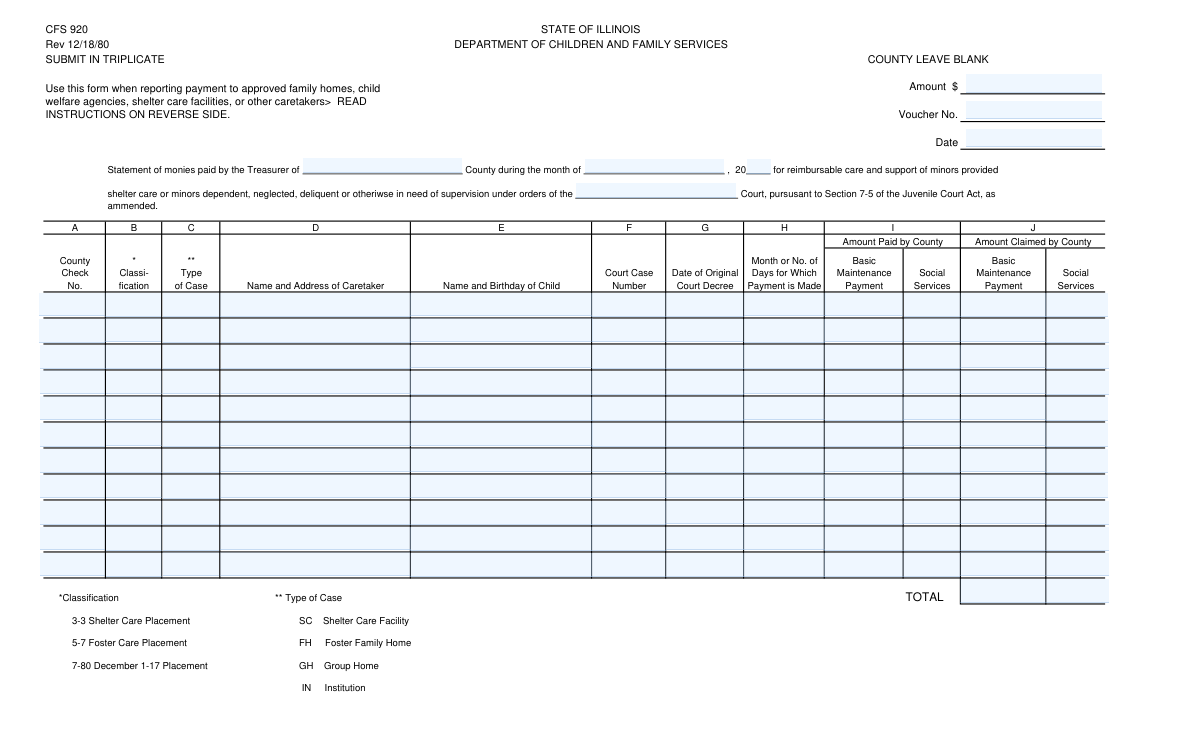
Yes! You can use AI to fill out Form AD 838, Statement of Monies Paid for 24-Hour Care of Children

Form AD 838, Statement of Monies Paid for 24-Hour Care of Children, is a crucial document for California county welfare departments. It serves as the official claim for reimbursement from the state for funds expended on 24-hour out-of-home care for eligible children, covering costs like basic maintenance and social services. Accurate and timely submission of this form is essential for counties to maintain funding for their child welfare programs. Today, this form can be filled out quickly and accurately using AI-powered services like Instafill.ai, which can also convert non-fillable PDF versions into interactive fillable forms.
AD 838 is part of the CAR forms, child care forms, NJ state forms, PA state forms, state ID forms and L.A. Care forms categories on Instafill.
Our AI automatically handles information lookup, data retrieval, formatting, and form filling.
It takes less than a minute to fill out AD 838 using our AI form filling.
Securely upload your data. Information is encrypted in transit and deleted immediately after the form is filled out.

Form specifications

Form name: Form AD 838, Statement of Monies Paid for 24-Hour Care of Children
Number of fields: 143
Number of pages: 2
Filled form examples: Form AD 838 Examples
Language: English
main-image

Instafill Demo: How to fill out PDF forms in seconds with AI

How to Fill Out AD 838 Online for Free in 2026

Are you looking to fill out a AD 838 form online quickly and accurately? Instafill.ai offers the #1 AI-powered PDF filling software of 2026, allowing you to complete your AD 838 form in just 37 seconds or less.
Follow these steps to fill out your AD 838 form online using Instafill.ai:
  1. 1 Navigate to Instafill.ai and upload your AD 838 form, or select it from our library of templates.
  2. 2 Enter the general statement details at the top of the form, including the treasurer's name and the statement month and year.
  3. 3 For each individual payment record, provide the child's information, including their name, birthday, court case number, and caretaker details.
  4. 4 Input the specific financial data for each record, detailing the amounts paid and claimed by the county for both basic maintenance and social services.
  5. 5 Use the AI-assisted tool to automatically calculate and populate the total payment fields at the bottom of the form, ensuring accuracy.
  6. 6 Review all entered information for completeness and correctness. The AI can help flag potential errors or omissions before finalization.
  7. 7 Download, print, or securely share the completed AD 838 form for official submission to the appropriate state department.

Our AI-powered system ensures each field is filled out correctly, reducing errors and saving you time.

Why Choose Instafill.ai for Your Fillable AD 838 Form?

Speed

Complete your AD 838 in as little as 37 seconds.

Up-to-Date

Always use the latest 2026 AD 838 form version.

Cost-effective

No need to hire expensive lawyers.

Accuracy

Our AI performs 10 compliance checks to ensure your form is error-free.

Security

Your personal information is protected with bank-level encryption.

Frequently Asked Questions About Form AD 838

This form is used by county officials to create a detailed statement of monies paid for child services, such as basic maintenance and social services, and to claim reimbursement for those expenses.

The County Treasurer or a designated official in the county's finance or social services department who is responsible for disbursing and tracking payments for child care is typically the one who completes this form.

'Amount Paid' is the total amount the county disbursed for a service. 'Amount Claimed' is the portion of that payment for which the county is seeking reimbursement or officially reporting for state or federal programs.

The form indicates that these codes are typically defined in a legend or reference section at the bottom of the document. You must use the specific codes provided to ensure proper processing.

If you have more payments than the spaces provided, you will need to use a second copy of the form. Ensure the 'Statement Details' section with the Treasurer's name, month, and year is identical on all pages.

No, you must leave this field empty as instructed. It is reserved for internal use by the agency that processes the form.

You can enter either the name of the month the payment covers (e.g., 'June') or the specific number of days. Ensure your method is consistent for all entries on the form.

This is the date on which the court first issued the legal order that authorized the child's placement and the associated payments. This date is crucial for establishing eligibility.

No, each payment record section is designed for a single child. You must use a separate payment record for each child, even if they have the same caretaker and court case.

The total fields are the sum of all the 'Amount Claimed' entries for Basic Maintenance and Social Services, respectively. Do not sum the 'Amount Paid' fields for these totals.

Yes, services like Instafill.ai use AI to accurately auto-fill form fields, which can save significant time and reduce errors, especially on repetitive forms with multiple similar records.

Simply upload the form to the Instafill.ai platform. The AI will make all the fields interactive, allowing you to type your information, save your progress, and store data for future use.

You can use a service like Instafill.ai, which can convert flat, non-fillable PDFs into interactive forms. Just upload your file, and the platform will make it easy to complete on your computer.

Compliance AD 838
Validation Checks by Instafill.ai

1
Total Basic Maintenance Summation
This check verifies that the 'Total Basic Maintenance Payment Paid by County' field is the correct sum of all individual 'Basic Maintenance Payment' fields across all filled payment records. This is crucial for ensuring mathematical accuracy and preventing financial discrepancies in reporting. If the total does not match the sum of its parts, the form submission should be rejected and the user prompted to correct the amounts.
2
Total Social Services Summation
This validation confirms that the 'Total Social Services Payment Paid by County' field accurately equals the sum of all individual 'Social Services Payment' fields from each payment record. Maintaining correct totals is critical for auditing and financial reconciliation. A mismatch will trigger an error, requiring the user to review and fix the individual or total payment amounts before proceeding.
3
Court Decree Date Chronology
This check ensures that for each payment record, the 'Original Court Decree Date' is on or before the date implied by the 'Statement Month' and 'Statement Year'. This logical validation prevents impossible scenarios where a payment is recorded for a period before the legal decree authorizing it was issued. A failure would indicate a data entry error and require correction of one or both dates.
4
Statement Year Two-Digit Format
This validation verifies that the 'Statement Year Last Two Digits' field contains exactly two numeric digits (00-99). This is crucial for correctly constructing the full year for date-based calculations and record-keeping. Submissions with non-numeric characters, or more or less than two digits, will be flagged as invalid to ensure data integrity.
5
Child's Birthday Validity
For each 'Child Name and Birthday' field, this check validates that the birthday portion is a real, parsable date (e.g., MM/DD/YYYY) and that the date is in the past. This prevents the entry of nonsensical dates like 'February 30th' or future birthdays. Ensuring valid birth dates is essential for eligibility verification and accurate record-keeping.
6
Payment Record Integrity Check
This validation ensures that if any field within a specific payment record (e.g., 'First Payment Record') is filled, then all other required fields for that same record (like 'Child Name', 'Court Case Number', and payment amounts) are also filled. This prevents the submission of incomplete or orphaned data for a payment entry. An incomplete record would be flagged, requiring the user to either complete the record or clear it entirely.
7
Monetary Amount Format Validation
This check iterates through all fields representing a monetary value (e.g., 'Basic Maintenance Payment by County', 'Amount (County Leave Blank)') and ensures they contain only valid numeric and currency characters. This is fundamental for preventing calculation errors and ensuring data can be processed by financial systems. Any non-numeric entries would be rejected.
8
Claimed vs. Paid Amount Consistency
For each payment record, this check verifies that the 'Amount Claimed' is less than or equal to the 'Amount Paid' for both Basic Maintenance and Social Services. This is a common business logic to prevent claiming more than was paid out, which would be a financial error. A discrepancy would trigger a warning, prompting the user to confirm the amounts are correct before submission.
9
Court Case Number Format
This validation checks that the 'Court Case Number' field in each payment record conforms to a predefined format or pattern, such as including specific prefixes, year indicators, or a certain number of digits. This helps ensure the case number is valid and can be used to correctly reference legal documents. An invalid format would prevent submission until corrected, reducing lookup failures later.
10
Classification Code Validation
This check validates the 'Classification' code entered in each payment record against a master list of valid codes, as hinted at in the field descriptions. This is critical for correct categorization, reporting, and applying the right business rules to each payment. An invalid code would be rejected, forcing the user to select a valid option.
11
Type of Case Code Validation
Similar to the classification code check, this validation ensures the 'Type of Case' code in each payment record exists in a predefined list of acceptable codes. This ensures data consistency and allows for accurate aggregation and analysis based on case type. If the entered code is not found in the master list, the submission will fail.
12
Statement Month Validity
This check ensures the 'Statement Month' field contains a valid month, whether entered as a name (e.g., 'January'), abbreviation ('Jan'), or a number (1-12). It prevents typos and invalid entries that would make the statement date ambiguous. This is essential for accurate temporal tracking of payments and reports.
13
Payment Period Format
This validation checks the 'Month or Number of Days for Payment' field to ensure it contains either a valid month name or a plausible number of days (e.g., 1-31). This prevents ambiguous or incorrect data entry for the payment period. An invalid entry would be flagged for correction to ensure billing and reporting accuracy.

Common Mistakes in Completing AD 838

Confusing 'Paid' vs. 'Claimed' Amounts

This form has columns for amounts 'Paid by County' and amounts 'Claimed by County' side-by-side for both Basic Maintenance and Social Services. Users often transpose these figures due to the repetitive layout, entering a 'paid' amount in the 'claimed' field or vice-versa. This leads to significant financial discrepancies, incorrect reimbursements, and audit failures. To avoid this, carefully read each column header for every entry and cross-reference the figures with source documentation before inputting them.

Manual Calculation Errors in Total Fields

The 'Total' fields require the user to manually sum up to eleven separate entries for 'Basic Maintenance' and 'Social Services'. This process is highly susceptible to human arithmetic errors, resulting in incorrect financial summaries and form rejection. To prevent this, use a calculator and double-check all additions before entering the final totals. AI-powered tools like Instafill.ai can automate these calculations, eliminating the risk of manual error.

Data Inconsistency Across Repetitive Records

The form requires re-entering the same information (e.g., Child Name, Court Case Number) across multiple payment records. This often leads to inconsistencies like typos, name variations ('John Smith' vs. 'J. Smith'), or different date formats for the same case. Such errors create fragmented data, making it difficult to track a case accurately and can lead to payment delays. Using an intelligent form filler like Instafill.ai can help by auto-populating recurring information consistently across all relevant fields.

Ignoring 'Leave Blank' Instructions

The very first field, 'Amount (County Leave Blank)', explicitly instructs the user not to enter data. However, in a rush to complete the form, people often fill in every available box, ignoring the instruction. Entering data in this field can cause the form to be immediately flagged for correction or rejected by the processing department, leading to unnecessary delays. Always read the label for every field carefully, especially for instructions written in parentheses.

Using Incorrect Year Format

The 'Statement Year Last Two Digits' field specifically asks for a two-digit year (e.g., '23' for 2023). A common mistake is to enter the full four-digit year out of habit, which can cause data validation errors in the receiving system. This simple mistake can halt the automated processing of the entire form. Always adhere to specific formatting rules indicated in the field label to ensure smooth processing.

Incomplete Combined Field Data

Fields like 'Caretaker Name and Address' and 'Child Name and Birthday' require multiple pieces of information in a single entry. Users frequently provide only the name, forgetting to add the address or the birthday. This omission creates an incomplete record that requires a follow-up from the processing agency, delaying the payment. To avoid this, review each part of the field label and ensure all requested information is included before moving on.

Using Descriptions Instead of Codes

The 'Classification' and 'Type of Case' fields require specific numeric or alphanumeric codes, which are likely defined in a legend on the form. A frequent error is for users to write out a description like 'Foster Home' instead of entering the corresponding code 'FH'. This prevents the form from being processed automatically and requires manual intervention and correction. Always locate the code legend and use the exact codes provided.

Inconsistent Date Formatting

Multiple fields, such as 'Original Court Decree Date', require a date but do not specify the format. Users may enter dates in various ways (e.g., MM/DD/YYYY, DD-MM-YY, Month Day, Year), leading to data entry confusion and system errors. This can cause critical dates to be misinterpreted by the system or the reviewer. To prevent this, adopt a standard format like MM/DD/YYYY and use it consistently throughout the form.

Ambiguous Payment Period Entry

The field for the payment period is labeled 'Month or Number of Days for Payment,' which creates ambiguity. Some users might enter 'July' while others enter '31,' even for the same payment type, leading to inconsistent data that is difficult to analyze or audit. This can cause confusion about whether a payment is for a full month or a specific number of days. For clarity, it is best to follow any internal guidelines or, if none exist, to choose one format and use it consistently across all records on the form.

Filling a Non-Fillable PDF Manually

Often, forms like this are distributed as non-fillable PDFs, forcing users to print them and fill them out by hand. This leads to illegible handwriting, smudges, and makes all the other data entry errors more likely. This manual process is slow and inefficient, often requiring the information to be manually re-typed into a system later. Tools like Instafill.ai can convert flat PDFs into fillable forms, allowing for clean, typed entries and enabling features like data validation and auto-calculation to prevent mistakes.
Saved over 80 hours a year

“I was never sure if my IRS forms like W-9 were filled correctly. Now, I can complete the forms accurately without any external help.”

Kevin Martin Green

Your data stays secure with advanced protection from Instafill and our subprocessors

Robust compliance program

Transparent business model

You’re not the product. You always know where your data is and what it is processed for.

ISO 27001, HIPAA, and GDPR

Our subprocesses adhere to multiple compliance standards, including but not limited to ISO 27001, HIPAA, and GDPR.

Security & privacy by design

We consider security and privacy from the initial design phase of any new service or functionality. It’s not an afterthought, it’s built-in, including support for two-factor authentication (2FA) to further protect your account.

Fill out AD 838 with Instafill.ai

Worried about filling PDFs wrong? Instafill securely fills form-ad-838-statement-of-monies-paid-for-24-hour-care-of-children forms, ensuring each field is accurate.