Yes! You can use AI to fill out Iowa Advance Directive: Durable Power of Attorney for Health Care and Declaration (Living Will)
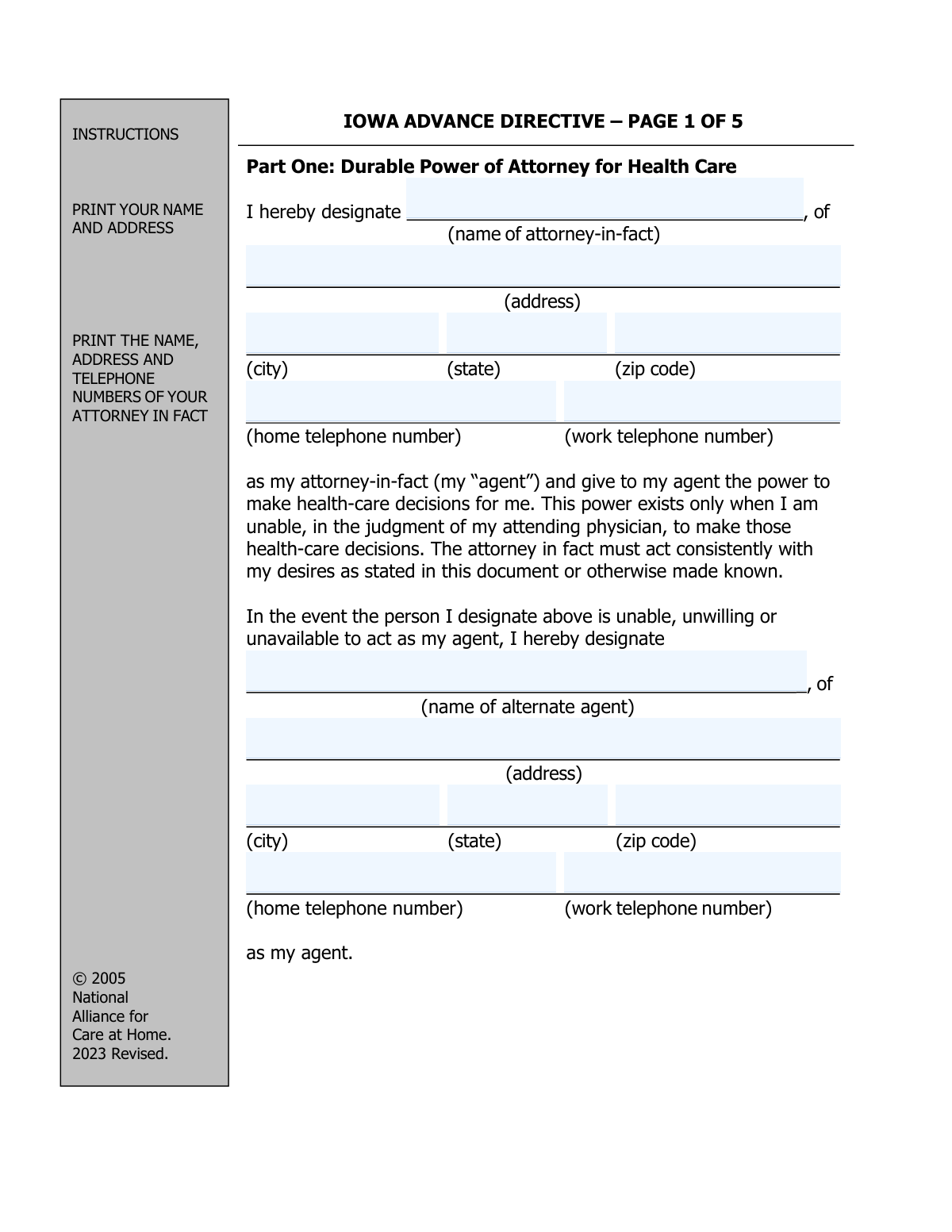
The Iowa Advance Directive is a state-specific legal document that protects an individual's right to accept or refuse medical treatment in the event they become unable to make decisions for themselves. It consists of three parts: Part One (Durable Power of Attorney for Health Care) allows you to name an agent to make healthcare decisions on your behalf; Part Two (Declaration/Living Will) lets you state your wishes regarding life-sustaining procedures if you develop a terminal condition; and Part Three covers the required signature, witness, and notarization provisions. The package also includes an optional Iowa Organ Donation Form. Today, this important document can be filled out quickly and accurately using AI-powered services like Instafill.ai, which can also convert non-fillable PDF versions into interactive fillable forms.
Our AI automatically handles information lookup, data retrieval, formatting, and form filling.
It takes less than a minute to fill out Iowa Advance Directive using our AI form filling.
Securely upload your data. Information is encrypted in transit and deleted immediately after the form is filled out.
Form specifications
| Form name: | Iowa Advance Directive: Durable Power of Attorney for Health Care and Declaration (Living Will) |
| Number of pages: | 10 |
| Language: | English |
Instafill Demo: filling out a legal form in seconds
How to Fill Out Iowa Advance Directive Online for Free in 2026
Are you looking to fill out a IOWA ADVANCE DIRECTIVE form online quickly and accurately? Instafill.ai offers the #1 AI-powered PDF filling software of 2026, allowing you to complete your IOWA ADVANCE DIRECTIVE form in just 37 seconds or less.
Follow these steps to fill out your IOWA ADVANCE DIRECTIVE form online using Instafill.ai:
- 1 Navigate to Instafill.ai, search for the Iowa Advance Directive form, and upload your PDF or select the form from the available library to begin filling it out online.
- 2 Complete Part One by entering the full name, address, and telephone numbers of your primary agent (attorney-in-fact) and, if desired, an alternate agent who will act if your primary agent is unavailable.
- 3 Optionally complete the Final Disposition Declaration by entering the name of your designee under the Iowa Final Disposition Act, and add any optional personal instructions regarding your advance care plans, hospice wishes, or burial preferences.
- 4 Complete Part Two (Declaration/Living Will) if you wish to state your desires regarding life-sustaining procedures in the event of a terminal condition or permanent unconsciousness, including any additional specific directions or limitations.
- 5 Complete the optional Iowa Organ Donation Form by initialing your preferred organ donation option, providing your name and signature, and having the required witnesses sign and provide their addresses.
- 6 Execute Part Three by signing and dating the document, then have it either witnessed by two qualified witnesses (at least one of whom is not related to you within the third degree of consanguinity) or acknowledged by a notary public.
- 7 Review the completed form for accuracy, then download, print, and distribute copies to your designated agent, alternate agent, family members, healthcare providers, and faith leaders, and consider saving a copy in your electronic health record.
Our AI-powered system ensures each field is filled out correctly, reducing errors and saving you time.
Why Choose Instafill.ai for Your Fillable Iowa Advance Directive Form?
Speed
Complete your Iowa Advance Directive in as little as 37 seconds.
Up-to-Date
Always use the latest 2026 Iowa Advance Directive form version.
Cost-effective
No need to hire expensive lawyers.
Accuracy
Our AI performs 10 compliance checks to ensure your form is error-free.
Security
Your personal information is protected with bank-level encryption.
Frequently Asked Questions About Form Iowa Advance Directive
The Iowa Advance Directive is a legal document that protects your right to accept or refuse medical treatment if you become unable to make decisions yourself. Any competent adult who is 18 years of age or older, or an emancipated minor, living in or spending significant time in Iowa should consider completing this form to ensure their healthcare wishes are honored.
Part One is the Durable Power of Attorney for Health Care, which lets you name an agent to make medical decisions on your behalf. Part Two is the Iowa Declaration (living will), which states your wishes about life-sustaining procedures if you have a terminal condition. Part Three contains the signature and witness provisions required to make the document legally effective — you must complete Part Three regardless of which other parts you fill out.
You can appoint any trusted family member or close friend who clearly understands your wishes and is willing to make serious healthcare decisions on your behalf. However, your agent cannot be your doctor, another treating healthcare provider, or an employee of your treating healthcare provider (unless related to you by blood, marriage, or adoption within the third degree of consanguinity).
Yes, it is strongly recommended to name an alternate agent. The alternate agent steps in if your primary agent is unable, unwilling, or unavailable to act on your behalf, ensuring someone you trust is always available to make decisions for you. You will need to provide the alternate agent's full name, address, and telephone numbers on the form.
You must sign and date the document, and then have it witnessed in one of two ways: either have your signature witnessed by a notary public, or sign the document in the presence of two witnesses who meet specific eligibility requirements. At least one witness must not be related to you by blood, marriage, or adoption within the third degree of consanguinity.
Your witnesses cannot be your doctor or other treating healthcare provider, an employee of your treating healthcare provider, the person you appointed as your agent, or anyone under 18 years of age. Additionally, at least one witness must be someone who is not closely related to you by blood, marriage, or adoption (more distantly related than uncles, aunts, nephews, nieces, great-grandparents, or great-grandchildren).
Your Iowa Durable Power of Attorney for Health Care takes effect when your attending physician determines that you are no longer able to make or communicate your healthcare decisions. Your Iowa Declaration (living will) takes effect when your doctor determines you have a terminal condition and can no longer make decisions, or that you are permanently unconscious. You retain full authority over your own healthcare as long as you are able to communicate your wishes.
Yes, you can revoke your Durable Power of Attorney for Health Care or Declaration at any time and in any manner, regardless of your mental or physical condition — the revocation becomes effective when you or someone else communicates it to your attending physician. Note that if you appointed your spouse as your agent and your marriage ends, their authority is automatically revoked. However, if you designated someone to handle the final disposition of your remains, that power can only be revoked in a signed writing.
The Final Disposition Declaration is an optional section in Part One that lets you designate a specific person to make decisions about the final disposition of your remains and any related ceremonies after your death. It is not required, but completing it ensures your chosen person has sole legal authority over these decisions rather than leaving it to family members or others.
Your advance directive will not be fully effective in a medical emergency — emergency personnel are required to provide CPR unless you have a separate physician's order such as a Do Not Resuscitate (DNR) order or a POLST (Portable Orders for Life Sustaining Treatment) form. Both a POLST and a DNR must be signed by a healthcare provider and presented to emergency responders when they arrive.
The Iowa Organ Donation Form is an optional document included with the advance directive that allows you to specify your wishes regarding organ and tissue donation. You can choose to donate any needed organs, specific organs only, decline donation entirely, or indicate that you have already made arrangements with a specific institution — you must sign, date, and have the form witnessed by two people, at least one of whom must be a disinterested party.
The Iowa Advance Directive does not expressly address mental illness, but you can include your mental health wishes in the optional instructions section and grant your agent authority over mental health decisions. For more detailed psychiatric advance care planning, visit the National Resource Center on Psychiatric Advance Directives at nrc-pad.org, or consult your physician and an attorney about a tailored durable power of attorney.
Yes — services like Instafill.ai use AI to accurately auto-fill form fields, saving you time and reducing errors when completing your Iowa Advance Directive. If you have a flat, non-fillable PDF version of this form, Instafill.ai can also convert it into an interactive fillable form so you can complete it digitally.
To fill out this form online, visit Instafill.ai and upload your Iowa Advance Directive PDF. The AI will guide you through each field — including agent information, optional instructions, and signature sections — and auto-fill the form accurately based on your inputs. Once complete, you can download, print, and sign the document before distributing copies to your agent, family, and healthcare providers.
After signing and witnessing your completed form, make photocopies or digital scans and distribute them to your appointed agent, family members, friends, healthcare providers, and faith leaders so it is accessible in an emergency. You should also consider saving a copy in your electronic health record or an online personal health records application, and carry a card in your wallet indicating that you have an advance directive and where it can be found.
Compliance Iowa Advance Directive
Validation Checks by Instafill.ai
1
Ensures the Primary Agent Name is Provided and Contains a Full Legal Name
This check verifies that the Primary Agent Name (Attorney-in-Fact) field is not left blank and contains what appears to be a full legal name (first and last name at minimum). The primary agent designation is the core purpose of Part One of the Iowa Advance Directive, and an incomplete or missing name renders the Durable Power of Attorney for Health Care legally ineffective. If this field is empty or contains only a single word or initials, the form should be flagged as incomplete.
2
Ensures the Primary Agent is Not the Declarant's Treating Physician or Healthcare Provider Employee
This check verifies that the name entered as the Primary Agent does not match any known treating healthcare provider or their employee, as Iowa law explicitly prohibits these individuals from serving as an agent unless related to the declarant by blood, marriage, or adoption within the third degree of consanguinity. Appointing a disqualified individual as agent would make the power of attorney legally invalid. A warning should be displayed prompting the declarant to confirm the agent is not their treating physician or an employee of their treating healthcare provider.
3
Validates Primary Agent Telephone Number Format
This check ensures that both the Primary Agent Home Telephone Number and Work Telephone Number fields, when provided, conform to a valid U.S. telephone number format including a 10-digit number with area code (e.g., (XXX) XXX-XXXX or XXX-XXX-XXXX). At least one telephone number for the primary agent should be present so that the agent can be reached in an emergency. If neither telephone number is provided, the form should generate a warning, and any entered number that does not match a valid format should trigger a format error.
4
Validates Primary Agent ZIP Code Format
This check confirms that the Primary Agent ZIP Code field contains a valid 5-digit U.S. ZIP code or an extended ZIP+4 format (XXXXX or XXXXX-XXXX). An incorrectly formatted or missing ZIP code could make it difficult to locate or contact the agent in an emergency situation. If the field is blank or contains non-numeric characters or an incorrect digit count, the submission should be flagged for correction.
5
Ensures Alternate Agent Information is Complete When Alternate Agent Name is Provided
This check verifies that if an Alternate Agent Name is entered, all associated address fields (street address, city, state, ZIP code) and at least one telephone number are also completed. Providing a name without contact information makes the alternate agent designation practically unenforceable, as healthcare providers would have no way to reach the alternate agent. If the Alternate Agent Name is filled but any required address sub-field is missing, the form should flag the incomplete alternate agent section.
6
Validates Alternate Agent State Field Contains a Valid U.S. State Abbreviation or Name
This check ensures that the Alternate Agent State field, when provided, contains a recognized U.S. state name or valid two-letter postal abbreviation (e.g., 'IA' or 'Iowa'). An invalid or misspelled state entry could cause mail or legal correspondence to be undeliverable and may raise questions about the document's validity. If the field contains an unrecognized value, the form should prompt the user to correct it to a valid state identifier.
7
Ensures the Execution Date Fields Are Fully and Correctly Completed
This check verifies that the day, month, and year fields in Part Three (Execution) are all populated and form a valid calendar date that is not in the future. Iowa law requires the declarant to sign and date the advance directive for it to be legally binding, and an incomplete or invalid date could render the entire document unenforceable. If any date component is missing, non-numeric where required, or the combined date is logically invalid (e.g., February 30), the form should be flagged.
8
Ensures Either Witness Signatures or Notary Public Section is Completed, But Not Both Left Blank
This check confirms that at least one of the two witnessing alternatives in Part Three has been completed: either both witness fields (Witness 1 and Witness 2 with addresses) are filled, or the Notary Public acknowledgment section (date, declarant name, notary signature, and notary date) is completed. Iowa law requires the advance directive to be witnessed by one of these two methods for it to be legally valid. If both sections are entirely blank, the form must be flagged as legally insufficient.
9
Ensures Two Witnesses Are Provided When the Witness Option is Selected
This check verifies that when Alternative No. 1 (Witnesses) is used, both Witness 1 and Witness 2 fields are completed with names and addresses, and that the required non-relative attestation signature is also present. Iowa law requires two witnesses for this alternative, and having only one witness or missing the non-relative declaration signature makes the document legally defective. If either witness entry is incomplete or the non-relative attestation is unsigned, the form should be flagged.
10
Ensures the Notary Public Section Contains All Required Fields When Notary Option is Selected
This check verifies that when Alternative No. 2 (Notary Public) is selected, all required fields are completed: the date before the notary, the declarant's name as it appears before the notary, the notary's sworn date (day, month, and year), and the notary's signature line. An incomplete notary section fails to satisfy Iowa's legal witnessing requirements and would render the advance directive unenforceable. Any missing field within the notary section should trigger a specific error identifying which element is absent.
11
Ensures Organ Donation Section Has Exactly One Option Initialed
This check verifies that on the Iowa Organ Donation Form, no more than one of the mutually exclusive options has been initialed (decline donation, existing donor card, or donate pursuant to Iowa law). Initialing multiple conflicting options creates ambiguity about the declarant's true wishes and could lead to disputes or unintended outcomes at the time of death. If more than one primary option is initialed, the form should warn the declarant to select only one option.
12
Ensures Organ Donation Sub-Options Are Completed When 'Pursuant to Iowa Law' Option is Selected
This check verifies that when the declarant initials the 'Pursuant to Iowa law, I hereby give, effective on my death' option, at least one sub-option is also initialed for scope of donation ('Any needed organ or parts' or 'The following part or organs listed below') and at least one purpose option ('Any legally authorized purpose' or 'Transplant or therapeutic purposes only'). Leaving these sub-options blank creates an incomplete and potentially unenforceable organ donation declaration. If the primary donation option is initialed but sub-options are missing, the form should flag the incomplete selection.
13
Ensures Specific Organ or Parts Are Listed When 'The Following Part or Organs Listed Below' is Selected
This check verifies that if the declarant initials the option to donate 'The following part or organs listed below,' the corresponding text field for specifying those organs or parts is not left blank. An initialed selection without the accompanying specification is ambiguous and may be legally insufficient to carry out the declarant's intent. If this option is initialed and the specification field is empty, the form should prompt the declarant to list the intended organs or tissues.
14
Ensures Organ Donation Form Declarant Name and Signature Fields Are Completed
This check verifies that the Declarant Name and Declarant Signature fields on the Iowa Organ Donation Form are both populated, and that the associated Date field contains a valid date. The declarant's name and signature are required to authenticate the organ donation declaration and confirm it reflects the declarant's voluntary wishes. If either the name or signature field is blank, or the date is missing or invalid, the organ donation form should be flagged as incomplete.
15
Ensures at Least One Organ Donation Witness is a Disinterested Party
This check verifies that the organ donation form includes at least one witness who has signed the disinterested party attestation statement, confirming they have no personal interest in the declarant's donation or estate. Iowa's organ donation form explicitly requires at least one disinterested witness, and failure to include this attestation could invalidate the donation declaration. If the disinterested party witness section is left blank while the declarant has initialed a donation option, the form should be flagged.
16
Ensures Final Disposition Designee Name is a Full Legal Name When Provided
This check verifies that if the Final Disposition Designee field is completed, it contains what appears to be a full legal name (at minimum a first and last name) rather than a nickname, title, or partial name. Under the Iowa Final Disposition Act, the designee must be clearly identifiable, and an ambiguous or incomplete name could create legal disputes about who holds authority over final disposition decisions. If the field contains only a single word, initials, or a generic title, the form should prompt the declarant to enter the designee's full legal name.
Common Mistakes in Completing Iowa Advance Directive
Many people name their doctor, a treating healthcare provider, or an employee of their healthcare provider as their agent or witness, not realizing these individuals are legally prohibited from serving in those roles. Similarly, people sometimes ask a family member who is related within the third degree of consanguinity (such as an aunt, uncle, niece, nephew, great-grandparent, or great-grandchild) to serve as the sole witness, which invalidates the document. At least one witness must be unrelated by blood, marriage, or adoption beyond the third degree. Carefully review the eligibility requirements before selecting your agent and witnesses, and confirm their eligibility before signing.
People frequently omit the work telephone number, ZIP code, or full street address for their designated agent or alternate agent, assuming partial information is sufficient. Incomplete contact information can make it difficult or impossible for healthcare providers to reach the agent quickly during a medical emergency. Always provide the full name, complete mailing address (street, city, state, ZIP), home telephone number, and work telephone number for both the primary and alternate agents. Tools like Instafill.ai can help ensure all required fields are populated before submission.
Many people designate only a primary agent and leave the alternate agent section blank, not realizing that if the primary agent is unavailable, unwilling, or unable to act, there will be no one legally authorized to make healthcare decisions on their behalf. This gap can cause significant delays or disputes during a medical crisis. It is strongly recommended to name a trusted alternate agent with complete contact information so there is always a backup decision-maker in place.
A common mistake is signing the advance directive without completing either the two-witness option or the notary public option, rendering the document legally ineffective in Iowa. Some people sign in front of only one witness, or have the document witnessed by someone who is under 18 years of age, which also invalidates it. You must choose one of the two legally valid execution methods: two qualified adult witnesses (at least one unrelated within the third degree) or acknowledgment by a notary public. Ensure all signatures, dates, and addresses in Part Three are fully completed.
People often leave the day, month, or year fields blank, or write the date in the wrong format (e.g., entering the full date in the 'day' field instead of separating it into day, month, and year). An undated advance directive may be considered invalid or create confusion about which version is most current if multiple documents exist. Carefully fill in each date component separately — day, month, and year — in the designated fields on the execution page.
Some individuals fill out Part Two (the Iowa Declaration/living will) without fully understanding that it specifically directs physicians to withhold or withdraw life-sustaining procedures in the event of a terminal condition or permanent unconsciousness. People who want all possible life-sustaining treatment should not complete Part Two, as doing so could result in treatment being withheld against their actual wishes. Read the instructions carefully: Part Two is optional and should only be completed if you genuinely wish to have life-sustaining procedures withheld or withdrawn under those circumstances.
Many people believe that completing an advance directive is sufficient to prevent unwanted CPR or emergency interventions, not realizing that the document is not effective during a medical emergency except to identify the agent. Emergency responders are required to provide CPR unless a separate physician-signed DNR or POLST order is present and shown to them at the scene. If you wish to have a do-not-resuscitate order or POLST, you must obtain those separately from your physician and ensure they are accessible to emergency responders.
A completed advance directive is useless if it cannot be located during an emergency. People often sign the document and store it in a safe or filing cabinet without providing copies to their agent, alternate agent, physicians, family members, or healthcare facilities. Iowa law and best practices require that your agent, healthcare providers, and trusted family members or friends all have access to a copy. Consider saving a digital copy in an electronic health record or personal health records application so it is accessible when needed.
When completing the optional instructions sections in Parts One and Two, people sometimes write instructions that are either too vague to be actionable or so restrictive (using words like 'always' or 'never') that they inadvertently limit their agent's ability to respond to unforeseen medical situations. Overly broad or contradictory instructions can create confusion or legal disputes among healthcare providers and family members. Be specific but flexible, describe your values and quality-of-life preferences, and discuss your written instructions with your agent to ensure they understand your intent.
On the Iowa Organ Donation Form, people sometimes initial more than one option (e.g., initialing both 'I do not want to make an organ donation' and 'I hereby give any needed organ or parts'), creating a direct contradiction that could render the donation section invalid or unenforceable. Each option is mutually exclusive, and only one should be initialed. Read each statement carefully before initialing, and if you have already signed a donor card or registry agreement, note the relevant institution in the designated field rather than re-initialing a conflicting option.
People frequently complete the declarant section of the Organ Donation Form but forget to have it signed and dated by two witnesses, or they fail to ensure that at least one witness qualifies as a 'disinterested party' with no interest in the declarant's donation or estate. Without proper witnessing, the organ donation form may not be legally valid. Both witnesses must sign, provide their date, and include their address, and at least one must attest to being a disinterested party by signing the specific statement provided on the form.
Many people complete an advance directive once and never revisit it, even after significant life events such as divorce, the death of a named agent, a serious new diagnosis, or a change in personal values regarding end-of-life care. In Iowa, if you appoint your spouse as your agent and the marriage ends, the agent's power is automatically revoked — but the rest of the document remains in effect without a named agent. Review your advance directive periodically and after any major life change, and update it as needed to ensure it accurately reflects your current wishes and designates available, willing agents.
Saved over 80 hours a year
“I was never sure if my IRS forms like W-9 were filled correctly. Now, I can complete the forms accurately without any external help.”
Kevin Martin Green
Your data stays secure with advanced protection from Instafill and our subprocessors

Robust compliance program
Transparent business model
You’re not the product. You always know where your data is and what it is processed for.
ISO 27001, HIPAA, and GDPR
Our subprocesses adhere to multiple compliance standards, including but not limited to ISO 27001, HIPAA, and GDPR.
Security & privacy by design
We consider security and privacy from the initial design phase of any new service or functionality. It’s not an afterthought, it’s built-in, including support for two-factor authentication (2FA) to further protect your account.
Fill out Iowa Advance Directive with Instafill.ai
Worried about filling PDFs wrong? Instafill securely fills iowa-advance-directive-durable-power-of-attorney-for-health-care-and-declaration-living-will forms, ensuring each field is accurate.