Fill out living will forms
with AI.
Living will forms and advance directive documents are among the most important legal papers a person can prepare. They ensure that your healthcare wishes are clearly documented and legally recognized in situations where you may be unable to speak for yourself — such as during a medical emergency, serious illness, or end-of-life care. These documents typically cover decisions about life-sustaining treatment, the appointment of a trusted person to make medical decisions on your behalf, and in some cases, organ donation preferences. Because requirements vary by state, it's essential to use the correct forms for where you live.
By continuing, you acknowledge Instafill's Privacy Policy and agree to get occasional product update and promotional emails.
About living will forms
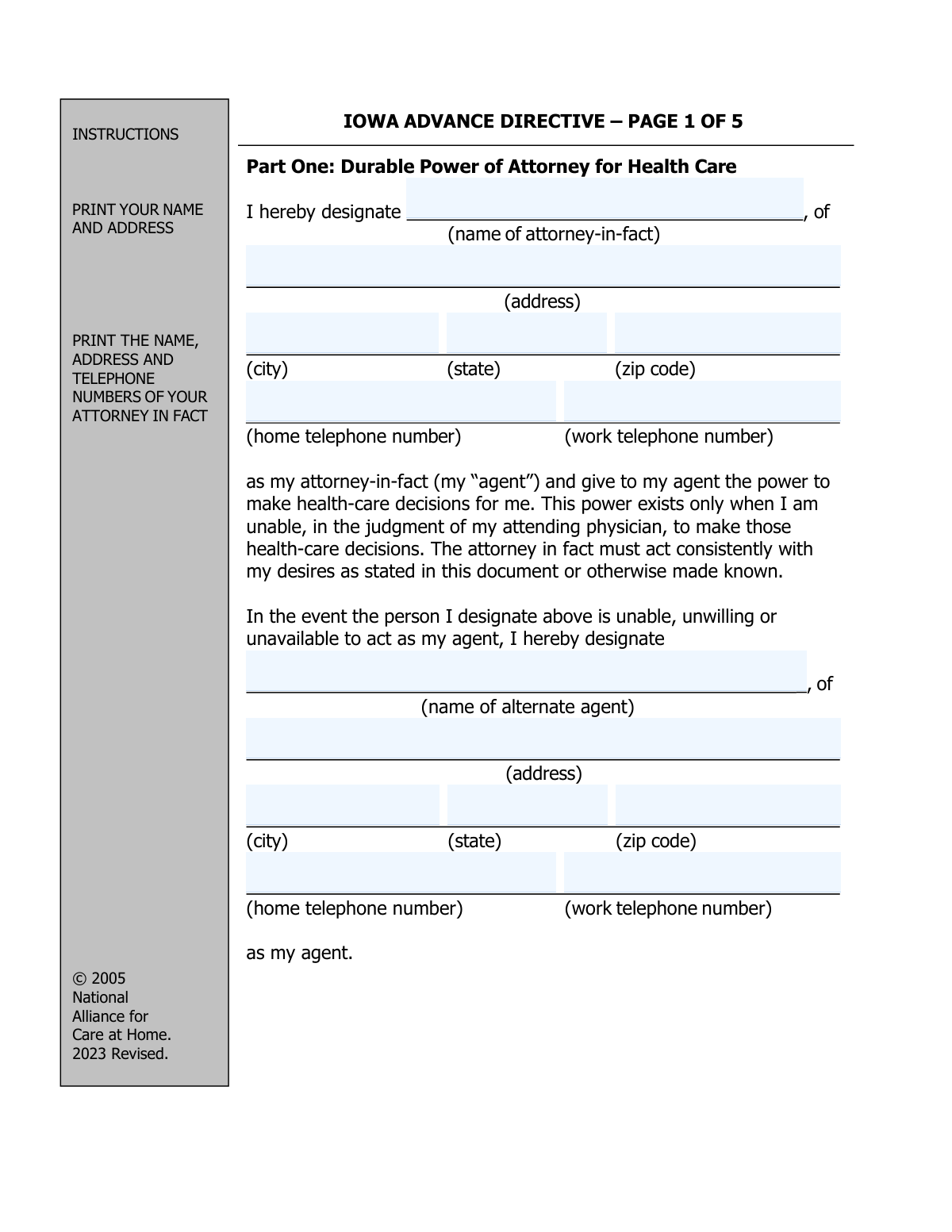
Anyone over the age of 18 can — and arguably should — have these documents in place, but they're especially important for older adults, individuals managing chronic or serious health conditions, and anyone undergoing surgery or long-term medical treatment. Family members and estate planning attorneys often prompt loved ones to complete these forms as part of a broader plan that may also include wills, trusts, and healthcare power of attorney designations. The Iowa Advance Directive, for example, combines a Durable Power of Attorney for Health Care and a Living Will Declaration into a single state-compliant package.
Because these forms involve precise legal language and personal details, accuracy matters. Tools like Instafill.ai use AI to help you fill out these forms in under 30 seconds, reducing the risk of errors and making the process far less time-consuming than working through complex legal paperwork manually.
Every form on this page can be completed without typing. Instafill is form filling software that reads a PDF and fills it for you — including flat and scanned documents that carry no fillable fields at all.
Forms in This Category
The forms in this category have a median Form Complexity Index of 62/100 (Moderate), measured across 1 forms by field count, input difficulty, length, conditional logic and structure. See how it is calculated.
| Form Name | Pages | FCI | |
|---|---|---|---|
| 1. | Iowa Advance Directive: Durable Power of Attorney for Health Care and Declaration (Living Will) | 10 | Moderate 62 |
- Enterprise-grade security & data encryption
- 99%+ accuracy powered by AI
- 1,000+ forms from all industries
- Complete forms in under 60 seconds
How to Choose the Right Form
If you landed on this page looking for a living will or advance directive form for Iowa, you're in the right place. With one comprehensive document available, the decision is straightforward — but it helps to understand what's included so you know it covers your needs.
Who This Form Is For
- Iowa residents who want to document their healthcare wishes in advance
- Anyone who wants to appoint a trusted person to make medical decisions on their behalf
- Individuals planning their estate who need a legally valid advance directive recognized by Iowa healthcare providers
What the Iowa Advance Directive Covers
The Iowa Advance Directive: Durable Power of Attorney for Health Care and Declaration (Living Will) is an all-in-one document with three key components:
- Part One – Durable Power of Attorney for Health Care: Use this if you want to name an agent (family member, friend, or trusted individual) to make healthcare decisions for you if you become incapacitated.
- Part Two – Declaration (Living Will): Use this to specify your wishes about life-sustaining treatment if you are diagnosed with a terminal condition and cannot communicate.
- Part Three – Signatures & Notarization: Required to make the document legally binding in Iowa.
The package also includes an optional Iowa Organ Donation Form, which you can complete at the same time.
When This Form Is the Right Choice
- You live in Iowa and want state-compliant documentation
- You want both a healthcare proxy designation and a living will in a single filing
- You're completing broader estate planning and need this as part of your legal document set
> Note: If you reside outside Iowa, you'll need your state's specific advance directive form, as these documents must comply with individual state laws.
Form Comparison
| Form | Purpose | Who Files It | When to Use |
|---|---|---|---|
| Iowa Advance Directive: Durable Power of Attorney for Health Care and Declaration (Living Will) | Appoint healthcare agent and document end-of-life medical wishes | Iowa residents planning for future medical incapacity | Before a medical emergency or terminal condition occurs |
Tips for living will forms
When completing the Durable Power of Attorney for Health Care section, always designate an alternate or successor agent in case your primary agent is unavailable, unwilling, or unable to act. Life circumstances change, and having a backup ensures your healthcare decisions are never left in limbo during a medical crisis.
Vague language in the Declaration (Living Will) section can create confusion for doctors and family members during stressful situations. Clearly state your preferences regarding specific procedures such as mechanical ventilation, artificial nutrition, and resuscitation so there is no room for misinterpretation.
Iowa's advance directive requires both witnesses and notarization to be legally valid — skipping or incorrectly completing Part Three is one of the most common reasons these documents are rejected. Make sure your witnesses meet Iowa's eligibility requirements, as certain individuals such as your healthcare agent or direct care providers may be disqualified from serving as witnesses.
AI-powered tools like Instafill.ai can complete the Iowa Advance Directive in under 30 seconds with high accuracy, reducing the risk of errors or missed fields. Your data stays secure throughout the process, making it a practical time-saver — especially if you're coordinating multiple estate planning documents at once.
Simply naming a healthcare agent isn't enough — have a detailed conversation with them about your values, medical preferences, and end-of-life wishes before the document is signed. An agent who understands your intentions can advocate effectively on your behalf even in situations your written directive doesn't explicitly cover.
After signing and notarizing your advance directive, provide copies to your healthcare agent, primary care physician, any specialists you see regularly, and your local hospital. Keep the original in an accessible location — not locked in a safe deposit box — so it can be retrieved quickly in an emergency.
Iowa's advance directive package includes an optional Organ Donation Form, and completing it at the same time as your living will ensures your donation wishes are clearly documented alongside your other healthcare directives. Handling both documents together saves time and prevents your donation preferences from being overlooked.
Your health status, personal values, and family circumstances can change over time, so it's good practice to review your advance directive every few years or after a major life event such as a serious diagnosis or the death of your named agent. An outdated document may no longer reflect your true wishes or list an agent who is no longer available.
Frequently Asked Questions
A living will is a written statement of your wishes regarding medical treatment if you become unable to communicate those wishes yourself. An advance directive is a broader term that typically includes both a living will and a durable power of attorney for health care, covering both your stated wishes and the designation of someone to make decisions on your behalf.
Any adult who wants to ensure their healthcare wishes are honored in the event of incapacity should consider completing these forms. They are especially important for individuals with chronic illnesses, those undergoing surgery, seniors, or anyone who simply wants to plan ahead and reduce the burden on family members during difficult times.
The Iowa Advance Directive is a comprehensive document that combines a Durable Power of Attorney for Health Care and a Declaration (Living Will) into one package. It allows you to name a trusted agent to make healthcare decisions for you and to specify your wishes about life-sustaining treatment if you develop a terminal condition, and it also includes an optional organ donation form.
Iowa law does not require you to use an attorney to complete an advance directive or living will form, though consulting one is always an option if your situation is complex. The key legal requirements typically involve proper signing, witnessing, and notarization as outlined in the form itself.
You can name any trusted adult — such as a family member, close friend, or other individual — as your healthcare agent, as long as they are willing and able to carry out that role. It is generally advisable to choose someone who understands your values and wishes and can make difficult decisions under pressure.
You should keep the original in a safe but accessible place, and provide copies to your healthcare agent, primary care physician, and any hospitals or healthcare facilities where you receive regular treatment. Some states also offer advance directive registries where you can file a copy for easy retrieval by medical providers.
Yes, the Iowa Advance Directive requires specific signature, witness, and notarization provisions to be legally valid, as outlined in Part Three of the document. Failing to meet these requirements could render the document unenforceable, so it is important to follow the instructions carefully.
Yes, you can revoke or update your advance directive or living will at any time as long as you are mentally competent to do so. It is a good practice to review your documents periodically — especially after major life events such as a serious diagnosis, marriage, divorce, or the death of a named agent — and to notify your healthcare providers of any changes.
Many states honor advance directives executed in other states, but this is not universally guaranteed, as laws vary by jurisdiction. If you spend significant time in multiple states, it may be worth consulting an attorney or completing advance directive forms for each state where you regularly reside or receive care.
Yes, AI-powered tools like Instafill.ai can fill out Iowa advance directive and living will forms in under 30 seconds by accurately extracting and placing your information from source documents. This can also convert non-fillable PDF versions into interactive forms, making the process faster and reducing the risk of errors.
Using AI tools like Instafill.ai, the data entry portion of a living will or advance directive form can be completed in under 30 seconds. After filling out the form, you will still need to arrange for proper signing, witnessing, and notarization as required by Iowa law before the document is legally valid.
Yes, the Iowa Advance Directive package includes an optional Iowa Organ Donation Form, allowing you to document your organ donation wishes alongside your other healthcare directives. Completing this section is entirely optional but can be a meaningful way to ensure your end-of-life wishes are fully documented in one place.
Glossary
- Form Complexity Index
- Instafill’s 0–100 measure of how much effort a form takes to complete, calculated deterministically from the form’s own structure rather than estimated. It combines the number of fillable fields (the largest factor), how difficult those fields are to complete based on their type, the number of pages that contain fields, the amount of conditional “fill-only-if” logic, and how many sections the form is divided into, then adds modifiers for tables and repeating lists, bundled instruction pages, and dense page layouts. A higher score means the form is harder to fill out by hand. The forms in this category have a median Form Complexity Index of 62/100 (Moderate). See exactly how it is calculated.
- Advance Directive
- A legal document that records your wishes about medical treatment in advance, to be followed if you become unable to communicate or make decisions for yourself. It is an umbrella term that can include both a Living Will and a Durable Power of Attorney for Health Care.
- Living Will
- A written statement specifying what types of life-sustaining medical treatments you do or do not want if you are diagnosed with a terminal condition and can no longer speak for yourself. It is not related to the distribution of property and should not be confused with a last will and testament.
- Durable Power of Attorney for Health Care (DPOA-HC)
- A legal document that authorizes a person you choose (your agent) to make healthcare decisions on your behalf if you become incapacitated. The word 'durable' means the authority remains in effect even after you lose decision-making capacity.
- Healthcare Agent
- The person you designate in a Durable Power of Attorney for Health Care to make medical decisions on your behalf. This individual is sometimes called a healthcare proxy or healthcare representative.
- Terminal Condition
- A medical diagnosis, confirmed by a physician, indicating an incurable and irreversible illness or injury from which death is expected within a relatively short period of time. This status typically triggers the instructions recorded in a Living Will.
- Life-Sustaining Procedures
- Medical treatments or interventions—such as mechanical ventilation, artificial nutrition, or resuscitation—that artificially prolong life when the body can no longer sustain itself. Your Living Will lets you specify whether you want these measures used.
- Incapacitated / Incapacity
- A legal determination that a person is unable to understand information, make informed decisions, or communicate those decisions due to a medical condition. Incapacity is the triggering condition that puts an advance directive into effect.
- Notarization
- The process by which a licensed Notary Public verifies the identity of the person signing a document and witnesses the signature, then applies an official seal. Iowa's advance directive requires notarization to be legally valid.
- Iowa Organ Donation Form
- An optional document included with Iowa's Advance Directive package that allows you to record your consent to donate organs, tissues, or your entire body upon death. It is separate from the Living Will and DPOA-HC but is often completed at the same time.