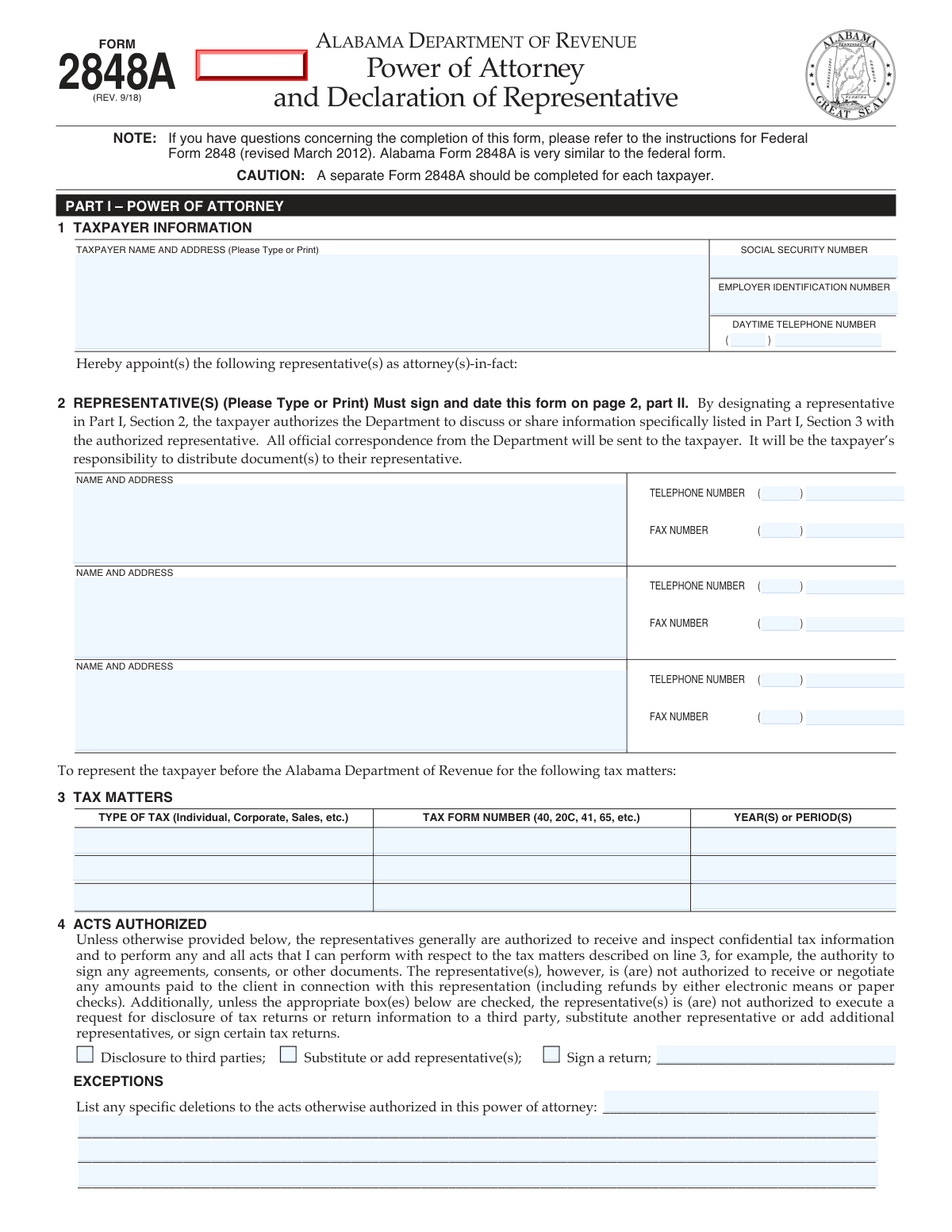
Yes! You can use AI to fill out Alabama Form 2848A, Power of Attorney and Declaration of Representative
Alabama Form 2848A is a legal document that allows a taxpayer to authorize a representative, such as an attorney or CPA, to act on their behalf in tax matters with the Alabama Department of Revenue. It's crucial for granting the representative access to confidential tax information and the authority to sign agreements or other documents. Today this form can be filled out quickly and accurately using AI-powered services like Instafill.ai, which can also convert non-fillable PDF versions into interactive fillable forms.
Form 2848A is part of the
ABA forms, power of attorney forms and representative forms categories on Instafill.
Our AI automatically handles information lookup, data retrieval, formatting, and form filling.
It takes less than a minute to fill out Form 2848A using our AI form filling.
Securely upload your data. Information is encrypted in transit and deleted immediately after the form is filled out.
Form specifications
| Form name: | Alabama Form 2848A, Power of Attorney and Declaration of Representative |
| Number of fields: | 52 |
| Number of pages: | 2 |
| Language: | English |
More forms in ABA forms
Instafill Demo: How to fill out PDF forms in seconds with AI
How to Fill Out Form 2848A Online for Free in 2026
Are you looking to fill out a FORM 2848A form online quickly and accurately? Instafill.ai offers the #1 AI-powered PDF filling software of 2026, allowing you to complete your FORM 2848A form in just 37 seconds or less.
Follow these steps to fill out your FORM 2848A form online using Instafill.ai:
- 1 Navigate to Instafill.ai and upload your Form 2848A or select it from the platform's library of official documents.
- 2 Use the AI assistant to accurately fill in Part I with the taxpayer's information, including name, address, SSN or EIN, and contact details.
- 3 Enter the full name and contact information for each representative you are appointing in the designated section.
- 4 Specify the tax matters your representative can handle by detailing the type of tax, form number, and the specific years or periods.
- 5 In the 'Acts Authorized' section, check the boxes to grant any additional authorities, such as signing returns, and list any specific powers you wish to withhold.
- 6 The taxpayer must electronically sign and date the form in Part I. Each representative must then complete their declaration, sign, and date Part II.
- 7 Review the completed form for accuracy, then download, print, or submit it directly to the Alabama Department of Revenue as required.
Our AI-powered system ensures each field is filled out correctly, reducing errors and saving you time.
Why Choose Instafill.ai for Your Fillable Form 2848A Form?
Speed
Complete your Form 2848A in as little as 37 seconds.
Up-to-Date
Always use the latest 2026 Form 2848A form version.
Cost-effective
No need to hire expensive lawyers.
Accuracy
Our AI performs 10 compliance checks to ensure your form is error-free.
Security
Your personal information is protected with bank-level encryption.
Frequently Asked Questions About Form Form 2848A
Form 2848A, Power of Attorney, allows you to authorize an individual, such as a CPA or attorney, to represent you before the Alabama Department of Revenue. This grants them permission to receive your confidential tax information and act on your behalf for specific tax matters.
Any taxpayer (individual or business) who wants to appoint a representative to handle their tax affairs with the Alabama Department of Revenue must file this form. Both the taxpayer and the representative must sign it.
No, if the tax matter concerns a joint return, both spouses must file a separate Form 2848A. This is required even if you are appointing the same person to represent both of you.
In Part I, Section 3 (Tax Matters), you must list the specific type of tax (e.g., Individual Income), the tax form number (e.g., 40), and the years or periods your representative is authorized for. Be specific to limit or define the scope of their authority.
Yes, filing a new Form 2848A automatically revokes all prior powers of attorney for the same tax matters and periods. To keep a previous POA active, you must check the box in Section 5 and attach a copy of the one you want to remain in effect.
Only if you give them specific permission. To authorize your representative to sign a return, you must check the 'Sign a return' box in Section 4 and specify which tax returns and periods they are authorized to sign.
All official correspondence will continue to be sent to you, the taxpayer. It is your responsibility to provide copies of any documents to your representative.
If the form is not properly signed and dated by both the taxpayer in Part I and the representative in Part II, it will be considered invalid and returned.
This section is where your chosen representative must declare they are qualified to represent you. They must select their designation (e.g., Attorney, CPA), provide their license or enrollment information, and sign the declaration under penalties of perjury.
Yes, services like Instafill.ai use AI to help you accurately auto-fill form fields with your saved information, which saves time and helps prevent errors.
You can upload the Form 2848A PDF to the Instafill.ai platform. The service will make the form fillable online, allowing you to type in your information, save your progress, and then download the completed form for printing and signing.
You can use a service like Instafill.ai, which can convert flat, non-fillable PDFs into interactive forms. Simply upload your file, and the platform will make it possible to fill out the fields electronically.
You will need your personal information (name, address, SSN or EIN), your representative's contact details, and the specific tax matters (tax type, form number, and years) you need assistance with.
Compliance Form 2848A
Validation Checks by Instafill.ai
1
SSN or EIN Exclusivity and Presence
Validates that either a Social Security Number (SSN) or an Employer Identification Number (EIN) is provided for the taxpayer, but not both. This is critical for correctly identifying the taxpayer as an individual or an entity. If both are filled or both are empty, the form submission should be flagged for correction as it creates ambiguity in taxpayer identity.
2
SSN Format Validation
Checks if the provided Social Security Number adheres to the nine-digit XXX-XX-XXXX format. This ensures data integrity and compatibility with government systems that require a correctly formatted SSN for taxpayer lookup. An incorrectly formatted number will cause processing to fail.
3
EIN Format Validation
Ensures the Employer Identification Number, if entered, follows the specific XX-XXXXXXX format. Correct formatting is essential for the Department of Revenue's automated systems to recognize and process the number for business entities. A validation failure would prevent the form from being linked to the correct business account.
4
Taxpayer Signature and Date Requirement
Verifies that the taxpayer's signature and signature date fields in Part I, Section 6 are both completed. The form explicitly states it will be returned if not signed and dated, making this a critical check for legal validity. An incomplete signature block renders the Power of Attorney invalid.
5
Representative Presence and Declaration
Confirms that at least one representative is listed in Part I, Section 2, and that a corresponding, fully completed declaration exists for them in Part II. A Power of Attorney is meaningless without an appointed representative, and the declaration is a legal requirement for that representative. The form should be rejected if a representative is named but their declaration is missing or incomplete.
6
Tax Matter Row Integrity
For each row in the 'Tax Matters' section, this check ensures that if any one field (Type of Tax, Tax Form Number, or Year(s)/Period(s)) is filled, the other two fields in that same row are also filled. This prevents incomplete or ambiguous authorizations. An incomplete row would require manual clarification, delaying the processing of the POA.
7
Conditional 'Sign a Return' Authorization
Validates that the 'Authorized Returns to Sign' text field is populated if, and only if, the 'Sign a return' checkbox is checked. This prevents ambiguity regarding the representative's authority. If the box is checked but the field is empty, the authorization is unclear; if the field is filled but the box is not checked, it's a contradictory instruction.
8
Business Taxpayer Title Requirement
Checks that the 'Title (If Applicable)' field in the taxpayer signature block is filled if an EIN was provided. The presence of an EIN indicates a business or other entity, which requires the signatory to state their authority (e.g., President, Partner, Trustee) to act on its behalf. Failure to provide a title calls the signatory's authority into question and may invalidate the form.
9
Representative Designation Code Validity
Ensures the 'Designation' code entered for each representative in Part II is a single, valid letter from 'a' through 'k'. This code defines the representative's legal qualification to practice before the Department of Revenue. An invalid code makes it impossible to verify the representative's standing and will result in rejection.
10
Jurisdiction/Enrollment Field Logic
Verifies that the 'Jurisdiction (State) or Enrollment Card No.' field is filled out correctly based on the 'Designation' code selected. For example, it should be a two-letter state code for an attorney (a) or CPA (b), a numeric ID for an Enrolled Agent (c), or a title/relationship for a family member (f). This check confirms the representative's credentials are provided in the expected format.
11
Tax Period Format Validation
Scans the 'Year(s) or Period(s)' field in the Tax Matters section to ensure the entry matches an accepted format, such as a four-digit year (YYYY), a range of years (YYYY-YYYY), or a specific period (MM/DD/YYYY–MM/DD/YYYY). This maintains data consistency and prevents errors when defining the scope of the POA. An invalid format could lead to the POA being applied to the wrong tax periods.
12
Prior POA Revocation Attachment Check
If the 'Do not want to revoke a prior power of attorney' box is checked, this validation generates a prominent warning or requires confirmation that a copy of the prior POA is being attached. The form instructions mandate this attachment to keep a prior POA active. This check prevents accidental revocation of existing authorizations due to user oversight.
Common Mistakes in Completing Form 2848A
Taxpayers who filed a joint tax return often mistakenly believe one Power of Attorney form will cover both spouses. The instructions in Section 6 clearly state that each spouse must file a separate Form 2848A, even if they are appointing the same representative. Submitting a single form will render the power of attorney invalid for the non-signing spouse, causing processing delays and preventing the representative from acting on their behalf. To avoid this, each spouse must complete and sign their own individual form.
This error occurs when filers provide ambiguous information in Section 3, such as writing "All Years" or leaving the "Type of Tax" or "Tax Form Number" columns blank. The Department of Revenue requires specific details to grant authority, and an incomplete entry can lead to the form being rejected or the representative's authority being severely limited. To prevent this, always provide the specific Type of Tax (e.g., Individual Income), the exact Tax Form Number (e.g., 40), and the precise Year(s) or Period(s) for each matter.
By default, filing this form automatically revokes all previous Powers of Attorney for the same tax matters. Taxpayers who wish to keep a prior POA active often check the box in Section 5 but forget the crucial second step: attaching a copy of the POA they want to remain in effect. This oversight leads to the unintended revocation of the older POA, potentially removing a key representative. To prevent this, if you check the box in Section 5, you must physically attach a copy of the prior POA to your submission.
The form explicitly warns that it will be returned if the taxpayer's signature and date in Part I (Section 6) or the representative's signature and date in Part II are missing. This is one of the most common reasons for rejection, yet it is easily avoidable and happens due to haste or overlooking the signature lines on page 2. A rejected form must be corrected and resubmitted, delaying the entire process. Always double-check that both the taxpayer and all listed representatives have signed and dated the form in the correct sections before submission.
When an officer, partner, or trustee signs on behalf of a business or other entity, they must include their official title (e.g., "President," "Partner," "Executor") in Section 6. People often sign their name but forget to specify the capacity in which they are signing, which is required to prove they have the authority to bind the entity. The absence of a title can render the Power of Attorney invalid for the business, leading to its rejection. Always ensure the "TITLE (If Applicable)" field is completed when signing for any entity other than yourself as an individual.
In Part II, each representative must declare their qualification by selecting a designation letter (a-k) and providing corresponding jurisdiction or enrollment information. Common mistakes include entering the wrong letter or providing incorrect details in the "Jurisdiction" column, such as an attorney writing their bar number instead of the state abbreviation. This can cause the representative's credentials to be questioned or rejected. Representatives must carefully match their designation code with the required information as specified in the instructions for Part II.
In Section 4, a taxpayer can grant a representative the authority to sign tax returns by checking the "Sign a return" box. However, many people check the box but fail to complete the adjacent line where they must list the specific tax forms and periods the representative is authorized to sign. This omission makes the authorization invalid, as the scope is undefined. If you check this box, you must explicitly list the authorized returns (e.g., "Form 40 for 2023") to grant this powerful authority.
The form requires either a Social Security Number (SSN) for individuals or an Employer Identification Number (EIN) for businesses. Taxpayers, especially sole proprietors, sometimes get confused and enter the wrong type of ID or enter both. This creates ambiguity and can lead to the form being misfiled or rejected because it cannot be matched to the correct taxpayer account. Ensure you enter the SSN for an individual tax matter and the EIN for a business tax matter, but not both.
The form's layout for phone and fax numbers is confusing, with separate fields for the area code and the remaining seven digits. Users often enter the full 10-digit number in one field or misplace the area code, leading to data entry errors and difficulty in contacting the taxpayer or representative. To avoid this, carefully enter the three-digit area code inside the provided parentheses and the seven-digit number in the subsequent field. AI-powered form filling tools like Instafill.ai can automatically parse and format phone numbers correctly, preventing this common error.
Taxpayers often download government forms as non-interactive, "flat" PDFs that cannot be typed into directly. This forces them to print the form and fill it out by hand, which increases the risk of illegible handwriting, smudges, and data entry mistakes that can lead to rejection. A handwritten form is more likely to contain errors and be processed more slowly. To avoid this, use a tool like Instafill.ai, which can convert any non-fillable PDF into an interactive, fillable version, allowing for clean, typed entries and reducing the chance of errors.
Saved over 80 hours a year
“I was never sure if my IRS forms like W-9 were filled correctly. Now, I can complete the forms accurately without any external help.”
Kevin Martin Green
Your data stays secure with advanced protection from Instafill and our subprocessors

Robust compliance program
Transparent business model
You’re not the product. You always know where your data is and what it is processed for.
ISO 27001, HIPAA, and GDPR
Our subprocesses adhere to multiple compliance standards, including but not limited to ISO 27001, HIPAA, and GDPR.
Security & privacy by design
We consider security and privacy from the initial design phase of any new service or functionality. It’s not an afterthought, it’s built-in, including support for two-factor authentication (2FA) to further protect your account.
Fill out Form 2848A with Instafill.ai
Worried about filling PDFs wrong? Instafill securely fills alabama-form-2848a-power-of-attorney-and-declaration-of-representative forms, ensuring each field is accurate.