Fill out ABA forms
with AI.
ABA forms are a broad set of clinical and administrative documents used primarily in the context of Applied Behavior Analysis therapy — a structured, evidence-based treatment most commonly prescribed for individuals diagnosed with Autism Spectrum Disorder (ASD). The majority of forms in this category are prior authorization and treatment request documents submitted to insurance payers, Medicaid programs, and managed care organizations to establish medical necessity and secure approval before ABA services can begin or continue. These forms typically require detailed clinical information, including diagnostic evaluations, treatment goals, service codes, provider credentials, and supporting documentation such as functional behavior assessments and individualized treatment plans.
By continuing, you acknowledge Instafill's Privacy Policy and agree to get occasional product update and promotional emails.
About ABA forms
These forms are most commonly completed by Board Certified Behavior Analysts (BCBAs), supervising providers, and behavioral health agencies working with patients who have ASD or related conditions. Depending on the payer, providers may need to submit plan-specific forms — such as those from Aetna, Blue Shield of California, Evernorth, Medi-Cal, or state Medicaid programs like Alabama or Arkansas — each with their own formatting requirements and required attachments. Families and caregivers may also encounter some of these documents when coordinating care for a dependent. Beyond therapy authorization, this category also includes clinical planning tools like the Biopsychosocial Assessment and ABA Treatment Plan, as well as a small number of unrelated forms that share the ABA acronym.
Given how detailed and time-sensitive these forms can be, tools like Instafill.ai use AI to help providers fill them out accurately in under 30 seconds, reducing the risk of delays or denials caused by incomplete submissions.
Every form on this page can be completed without typing. Instafill is form filling software that reads a PDF and fills it for you — including flat and scanned documents that carry no fillable fields at all.
Forms in This Category
The forms in this category have a median Form Complexity Index of 54/100 (Moderate), measured across 34 forms by field count, input difficulty, length, conditional logic and structure. See how it is calculated.
- Enterprise-grade security & data encryption
- 99%+ accuracy powered by AI
- 1,000+ forms from all industries
- Complete forms in under 60 seconds
How to Choose the Right Form
With 25 forms in this category, finding the right one depends on your role, payer, and where you are in the treatment process. Here's how to narrow it down quickly.
Prior Authorization Requests by Payer
Most forms here are payer-specific authorization requests. Match your health plan to the correct form:
- Aetna / Innovation Health / Banner | Aetna → Use Outpatient Behavioral Health – ABA Treatment Request (GR-69017-4) (effective Jan 1, 2026) or the older Form BHVH
- Blue Cross Blue Shield of Illinois (BCBSIL) → Use the ABA Initial Assessment Request for assessment-only requests, or the ABA Initial Assessment and Clinical Service Request Form for full treatment authorization
- Blue Shield of California → Use the Blue Shield of California Prior Authorization Request Form for ABA – Commercial Products
- Health Net / Medi-Cal (California) → Use the Health Net ABA Recommendation and Referral Form (24-989) for physician referrals, or the ABA Authorization Request (Medi-Cal) for service-level authorization
- Evernorth / Cigna → Use the Evernorth ABA Prior Authorization Form (928213d)
- MetroPlusHealth → Use the MetroPlusHealth Universal ABA Request Form
- Highmark Health Options → Use the Highmark Health Options ABA Prior Authorization Request Form
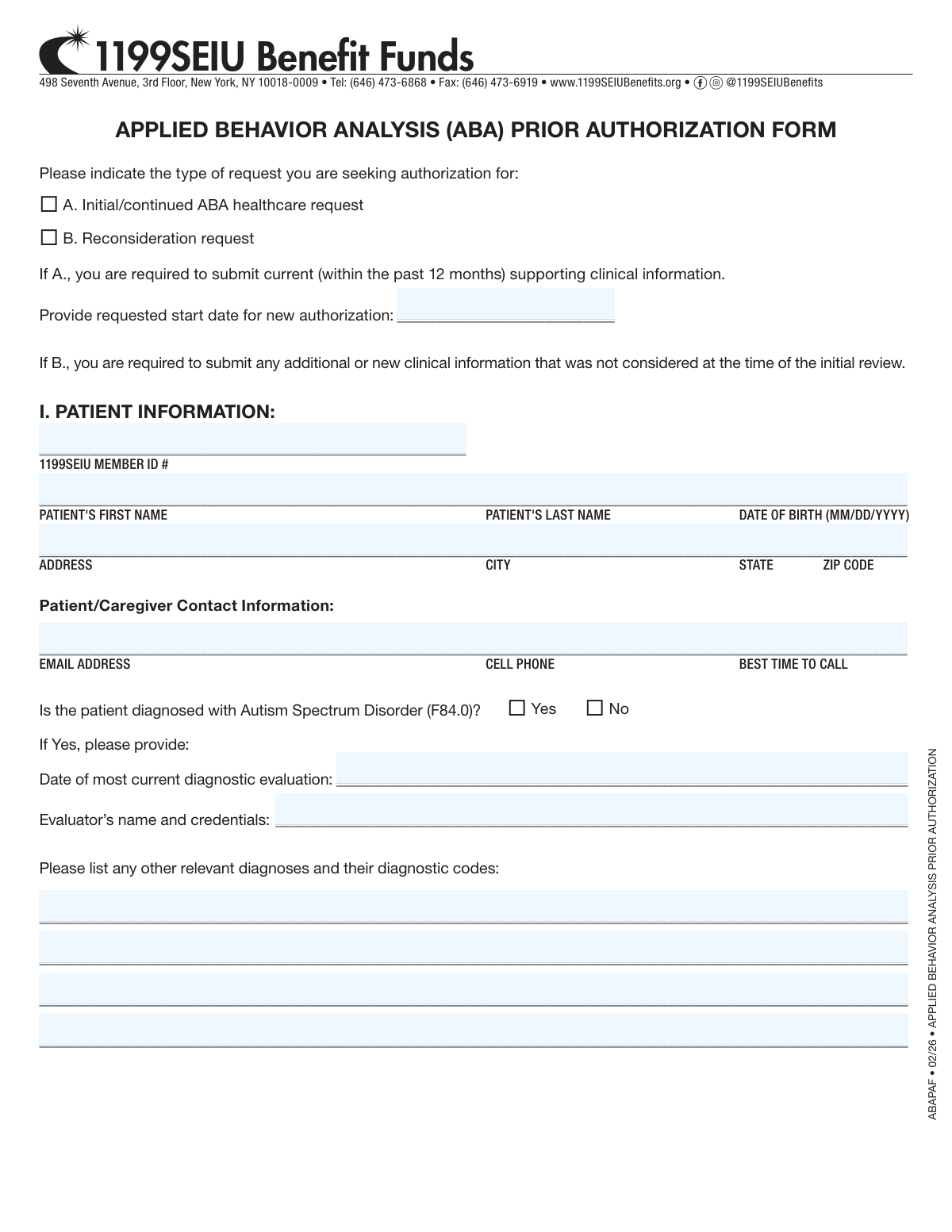
- 1199SEIU Benefit Funds → Use the 1199SEIU ABA Prior Authorization Form (ABAPAF)
- Coordinated Care → Use the Coordinated Care ABA Prior Authorization Request Form
State Medicaid Programs
If you're billing through a state Medicaid plan, use the state-specific form:
- Alabama Medicaid → Alabama Medicaid Agency ABA Therapy Assessment Form (CPT 97151)
- Arkansas Medicaid / Summit Community Care → Arkansas Medicaid ABA Authorization Request (ARSMT-CD-095155-25)
- Louisiana Health Connect → ABA Authorization Form (BRO-DP-ABA FORM-0822)
- New Hampshire → ABA Prior Authorization Form (New Hampshire)
- CareSource PASSE (Arkansas) → CareSource PASSE ABA Prior Authorization Request Form
Clinical Documentation Forms
If you're a BCBA preparing internal treatment records rather than submitting to a payer:
- Use the Biopsychosocial Assessment and ABA Treatment Plan to document client history, treatment goals, and justify service hours
- Use Form 5385BSP (Bridgespan Health) for initial ABA requests requiring comprehensive clinical justification
Not an ABA Therapy Form?
A few forms in this list are unrelated to behavioral health:
- ABA Retirement Funds Program Distribution Request Form — for retirement fund participants, not therapy providers
- Alabama Driver License Renewal (Form DL-100), Contrato de Trabajo Indefinido, and Contrato de Trabajo en Prácticas — these are unrelated to ABA therapy and can be ignored if you're seeking behavioral health forms
Form Comparison
| Form | Purpose | Who Files It | When to Use |
|---|---|---|---|
| Form BHVH, Outpatient Behavioral Health – ABA Treatment Request | Request precertification for ABA treatment under Aetna plans | Attending provider or ABA agency | Before starting ABA therapy services with Aetna |
| ABA Authorization Request (Medi-Cal) – Initial and Concurrent Requests | Request Medi-Cal authorization for ABA assessments and therapy | ABA providers and BCBAs | Initial or concurrent ABA service requests under Medi-Cal |
| MetroPlusHealth Applied Behavior Analysis (ABA) Universal ABA Request Form | Submit ABA service authorization request to MetroPlusHealth | Providers and ABA agencies | Initial, concurrent, or continuity of care ABA requests |
| Alabama Medicaid Agency ABA Therapy Assessment Form (6/20/19) | Request authorization for ABA behavior assessment under Medicaid | BCBA or approved Alabama Medicaid provider | When requesting CPT 97151 assessment authorization in Alabama |
| Applied Behavioral Analysis (ABA) Prior Authorization Request Form (Health Net Behavioral Health Autism Center) | Request utilization review approval for ABA services | Providers and case supervisors under Health Net | Before rendering ABA services to Health Net members |
| Applied Behavior Analysis (ABA) Initial Assessment Request | Request approval for initial ABA assessment period from BCBSIL | Qualified healthcare providers under BCBSIL | At least two weeks before ABA assessment start date |
| Applied Behavioral Analysis (ABA) Prior Authorization Request Form (Coordinated Care) | Obtain prior authorization for ABA services from Coordinated Care | Providers billing Coordinated Care/Medicaid | Before initiating or continuing ABA treatment |
| Applied Behavioral Analysis (ABA) Prior Authorization Form (New Hampshire) | Request payer approval for initial or continued ABA services | BCBAs and ABA providers in New Hampshire | Initial evaluation or ongoing ABA service authorization |
| Health Net Applied Behavioral Analysis (ABA) Recommendation and Referral Form (24-989) | Establish medical necessity and refer member for ABA therapy | Licensed physician or psychologist | When initiating ABA services for Medi-Cal members via Health Net |
| Applied Behavioral Analysis (ABA) Authorization Form, Louisiana Health Connect (BRO-DP-ABA FORM-0822) | Obtain prior authorization for ABA therapy under Louisiana Medicaid | ABA providers serving Louisiana Medicaid members | Before delivering ABA services; valid up to 180 days |
| Applied Behavior Analysis (ABA) Therapy Request Form | Request prior authorization for ABA therapy from SmartHealth | Providers treating SmartHealth members with ASD | Before rendering any ABA therapy services to members |
| Blue Shield of California Prior Authorization Request Form for Applied Behavioral Analysis (ABA) – Commercial Products | Request ABA therapy approval for Blue Shield commercial members | QAS providers under Blue Shield of California | Before starting ABA assessments or treatment services |
| Form 5385BSP, Behavioral Health Utilization Management Applied Behavioral Analysis (ABA) Initial Request Form | Request initial ABA therapy authorization from Bridgespan Health | BCBAs and ABA agencies serving Bridgespan members | Initial 6-month ABA authorization for ASD members |
| Evernorth Applied Behavior Analysis (ABA) Prior Authorization Form | Request ABA treatment authorization from Evernorth | Supervising ABA providers under Evernorth plans | When seeking coverage for ABA services for ASD diagnosis |
| Outpatient Behavioral Health (BH) – ABA Treatment Request: Required Information for Precertification (GR-69017-4) | Request ABA precertification from Aetna and affiliated plans | Attending provider for Aetna/Banner/Allina members | Effective Jan 1, 2026, for all ABA precertification requests |
| Arkansas Medicaid Applied Behavioral Analysis (ABA) Authorization Request | Request ABA prior authorization from Summit Community Care | BCBAs and behavioral health providers in Arkansas | Before rendering ABA services to Arkansas Medicaid members |
| Highmark Health Options Applied Behavioral Analysis (ABA) Prior Authorization Request Form | Request ABA therapy authorization from Highmark Health Options | Providers serving Highmark Health Options members | Before initiating or continuing ABA therapy services |
| CareSource PASSE Applied Behavior Analysis (ABA) Prior Authorization Request Form | Request pre-approval for ABA services under CareSource PASSE | ABA providers serving CareSource PASSE members | Before delivering ABA therapy to members with ASD diagnosis |
| Applied Behavior Analysis (ABA) Initial Assessment Request and Clinical Service Request Form – Blue Cross and Blue Shield of Illinois (BCBSIL) | Obtain authorization for full ABA therapy services under BCBSIL | Qualified healthcare providers under BCBSIL plans | Initial assessment and ongoing ABA treatment authorization |
| 1199SEIU Benefit Funds Applied Behavior Analysis (ABA) Prior Authorization Form | Authorize ABA therapy for 1199SEIU Benefit Fund members | Providers treating 1199SEIU members with ASD | When requesting ABA service approval from 1199SEIU funds |
| Biopsychosocial Assessment and ABA Treatment Plan | Document client history and create individualized ABA treatment plan | Board Certified Behavior Analysts (BCBAs) | During initial client intake and treatment planning process |
| ABA Retirement Funds Program Distribution Request Form | Request distribution of retirement savings from ABA fund | Retirement plan participants | Upon termination, disability, or plan termination |
Tips for ABA forms
Different insurers and Medicaid programs accept different ABA service codes (e.g., 97151, 97153, H2019). Always verify which specific CPT or HCPCS codes a payer accepts before completing your request form, as submitting unsupported codes is a common cause of denials. Check each payer's current fee schedule or provider manual before filling out the form.
Most ABA authorization forms require supporting documents such as a functional behavior assessment, individualized treatment plan, standardized assessment scores, and diagnostic evaluation. Submitting the form without these attachments is one of the top reasons for delays or returned requests. Gather all required documentation before you begin filling out the form to avoid incomplete submissions.
ABA authorization forms typically require the supervising BCBA's license number, NPI, and TIN — and some forms also require the rendering provider's credentials separately. Errors or mismatches in these fields can trigger denials even when the clinical information is complete. Keep a reference sheet with your agency's credentialing details handy to ensure consistency across all submissions.
ABA prior authorization forms are often multi-page and highly detailed, making manual completion time-consuming and error-prone. AI-powered tools like Instafill.ai can complete these forms in under 30 seconds with high accuracy, and your data stays secure throughout the process. This is especially valuable for practices managing authorizations across multiple payers simultaneously.
Most ABA authorizations are limited to specific periods — commonly 90 to 180 days — and services cannot continue without a renewed authorization. Set calendar reminders well in advance of expiration dates to prepare and submit concurrent/recertification requests on time. Late submissions can result in gaps in coverage that interrupt a client's care.
Payers and Medicaid reviewers look for individualized, measurable goals with baseline data rather than generic language. Vague or templated goal descriptions are a frequent reason for medical necessity denials on ABA treatment plan forms. Include specific baseline rates, target behaviors, and measurable criteria for mastery to strengthen every authorization request.
For school-age clients, reviewers often scrutinize whether requested ABA services overlap with IEP-based school services. Clearly document how the requested medical ABA services are distinct from and complementary to any educational programming the client receives. Including IEP status and school service details — as required on many forms — helps prevent denials based on duplication of services.
Each payer — whether Aetna, Medi-Cal, Blue Shield, or a state Medicaid plan — has its own required form, attachments, and submission method (fax, portal, or mail). Creating a one-page checklist for each payer your practice works with can dramatically reduce errors and save time when preparing submissions. Update your checklists whenever payers announce form revisions or policy changes.
Frequently Asked Questions
ABA forms are documents used to request authorization, assessment, or treatment planning for Applied Behavior Analysis therapy services. They are most commonly submitted by providers, BCBAs, and agencies to insurance plans or Medicaid programs to establish medical necessity and obtain approval before ABA services begin. This category also includes related behavioral health documents such as treatment plans and retirement fund forms associated with ABA organizations.
ABA prior authorization forms are generally completed by licensed providers, Board Certified Behavior Analysts (BCBAs), or authorized agency staff on behalf of a patient or member. The forms require clinical credentials, provider NPI and TIN numbers, and detailed diagnostic and treatment information, so they are not typically completed by patients or families directly. In some cases, a referring physician or psychologist may also need to sign or co-complete portions of the form.
This category includes ABA authorization and treatment request forms from a wide range of payers, including Aetna, Blue Cross Blue Shield of Illinois, Blue Shield of California, Health Net, MetroPlusHealth, Evernorth, Highmark Health Options, CareSource PASSE, 1199SEIU Benefit Funds, and Bridgespan Health. It also includes Medicaid-specific forms for states such as Alabama, Arkansas, Louisiana, and California (Medi-Cal), as well as forms for Coordinated Care and New Hampshire payers.
The correct form depends on the member's insurance plan or Medicaid program and the type of service being requested (e.g., initial assessment, continued treatment, or concurrent review). Check the member's insurance card or eligibility information to identify the payer, then select the corresponding form from this category. When in doubt, contact the payer's provider services line to confirm which form and submission method they require.
Most ABA authorization forms require member demographics and insurance ID, provider credentials (NPI, TIN, BCBA certification), ICD-10 or DSM-5 diagnosis codes, requested CPT or HCPCS service codes with units or hours, and supporting clinical documentation such as a treatment plan, functional behavior assessment, or standardized evaluation scores. Some forms also ask for medication lists, school or IEP status, care coordination details, and measurable treatment goals.
Submitting an incomplete or inaccurate ABA authorization form can result in processing delays, returned requests, or outright denials of coverage. Most payers require all fields to be legible and complete, along with any required attachments, before they will begin the medical necessity review. It is important to double-check all sections and include supporting documentation before submitting.
Submission timelines vary by payer, but it is generally recommended to submit ABA authorization requests well before the intended start date of services to allow adequate processing time. For example, some plans specify submission at least two weeks before the requested start date. Always review the specific payer's requirements on the form or in their provider guidelines to avoid gaps in authorization.
Yes, AI-powered tools like Instafill.ai can fill out ABA forms in under 30 seconds by accurately extracting and placing data from source documents such as treatment plans, diagnostic reports, and provider records. This significantly reduces manual data entry time and helps minimize errors on complex multi-page forms. Instafill.ai can also convert non-fillable PDF versions of ABA forms into interactive fillable forms.
Manually completing a multi-page ABA authorization form can take anywhere from 20 minutes to over an hour, depending on the complexity of the form and the amount of clinical documentation required. Using an AI-powered service like Instafill.ai, providers can fill out these forms in under 30 seconds by automatically extracting and populating data from existing clinical documents, making the process much faster and more efficient.
While the majority of ABA therapy forms in this category are specifically designed for members diagnosed with Autism Spectrum Disorder (ASD), some payers may allow ABA services for other qualifying behavioral or developmental conditions. Always refer to the specific payer's coverage policy and the form instructions to confirm which diagnoses are eligible for ABA authorization under that plan.
An initial ABA request is submitted when a member is beginning ABA services for the first time and typically requires a qualifying diagnostic evaluation and full assessment documentation. A concurrent or continued-stay request is submitted when an existing authorization period is ending and the provider is requesting approval to continue services, usually requiring updated progress data, revised treatment goals, and clinical justification for ongoing care. Some forms handle both request types, while others are form-specific.
Submission methods vary by payer but commonly include fax, a secure online provider portal, or mail. Most forms include submission instructions or a designated fax number on the document itself. Always confirm the correct submission address or portal with the payer's provider services team, as submitting to the wrong destination can delay processing.
Glossary
- Form Complexity Index
- Instafill’s 0–100 measure of how much effort a form takes to complete, calculated deterministically from the form’s own structure rather than estimated. It combines the number of fillable fields (the largest factor), how difficult those fields are to complete based on their type, the number of pages that contain fields, the amount of conditional “fill-only-if” logic, and how many sections the form is divided into, then adds modifiers for tables and repeating lists, bundled instruction pages, and dense page layouts. A higher score means the form is harder to fill out by hand. The forms in this category have a median Form Complexity Index of 54/100 (Moderate). See exactly how it is calculated.
- ABA (Applied Behavior Analysis)
- A therapy approach based on the science of learning and behavior, most commonly used to treat Autism Spectrum Disorder (ASD). It focuses on improving specific behaviors such as communication, social skills, and daily living skills through structured techniques.
- Prior Authorization (PA)
- A requirement by health insurers or Medicaid that providers obtain approval before delivering certain services, such as ABA therapy, to confirm medical necessity. Without prior authorization, claims may be denied and services may not be covered.
- BCBA (Board Certified Behavior Analyst)
- A licensed professional who holds national certification in behavior analysis and is qualified to design, supervise, and oversee ABA therapy programs. Most ABA authorization forms require the supervising BCBA's credentials, license number, and NPI.
- Medical Necessity
- A payer's standard for determining whether a requested service is clinically appropriate, evidence-based, and required for the diagnosis or treatment of a condition. ABA authorization forms require clinical documentation to establish medical necessity before services are approved.
- NPI (National Provider Identifier)
- A unique 10-digit identification number assigned to healthcare providers and organizations in the United States, required on most insurance and Medicaid forms. ABA forms typically request both the individual BCBA's NPI and the billing agency's NPI.
- CPT/HCPCS Codes
- Standardized numeric codes used to identify specific medical and behavioral health services for billing and authorization purposes. Common ABA-related codes include 97151 (behavior identification assessment), 97153 (direct therapy), and 97155 (protocol modification/supervision).
- Functional Behavior Assessment (FBA)
- A clinical evaluation process used to identify the causes and triggers of a client's challenging behaviors in order to develop an effective treatment plan. Many ABA authorization forms require an FBA to be submitted as supporting documentation.
- Utilization Management (UM)
- A process used by insurance plans and Medicaid to review and manage the use of healthcare services, including ABA therapy, to ensure they are medically necessary and cost-effective. ABA prior authorization forms are a core part of the utilization management process.
- Concurrent/Continued Stay Review
- An ongoing authorization review conducted by a payer to determine whether ABA services should continue beyond the initial approved period, based on updated clinical progress and treatment goals. Providers must resubmit updated documentation and forms to maintain uninterrupted coverage.
- ICD-10 / DSM-5 Diagnosis Codes
- Standardized coding systems used to classify and document a patient's diagnosis on insurance and Medicaid forms. ABA forms commonly require an ASD diagnosis code such as F84.0 (Autism Spectrum Disorder) from the ICD-10 system, which aligns with DSM-5 diagnostic criteria.