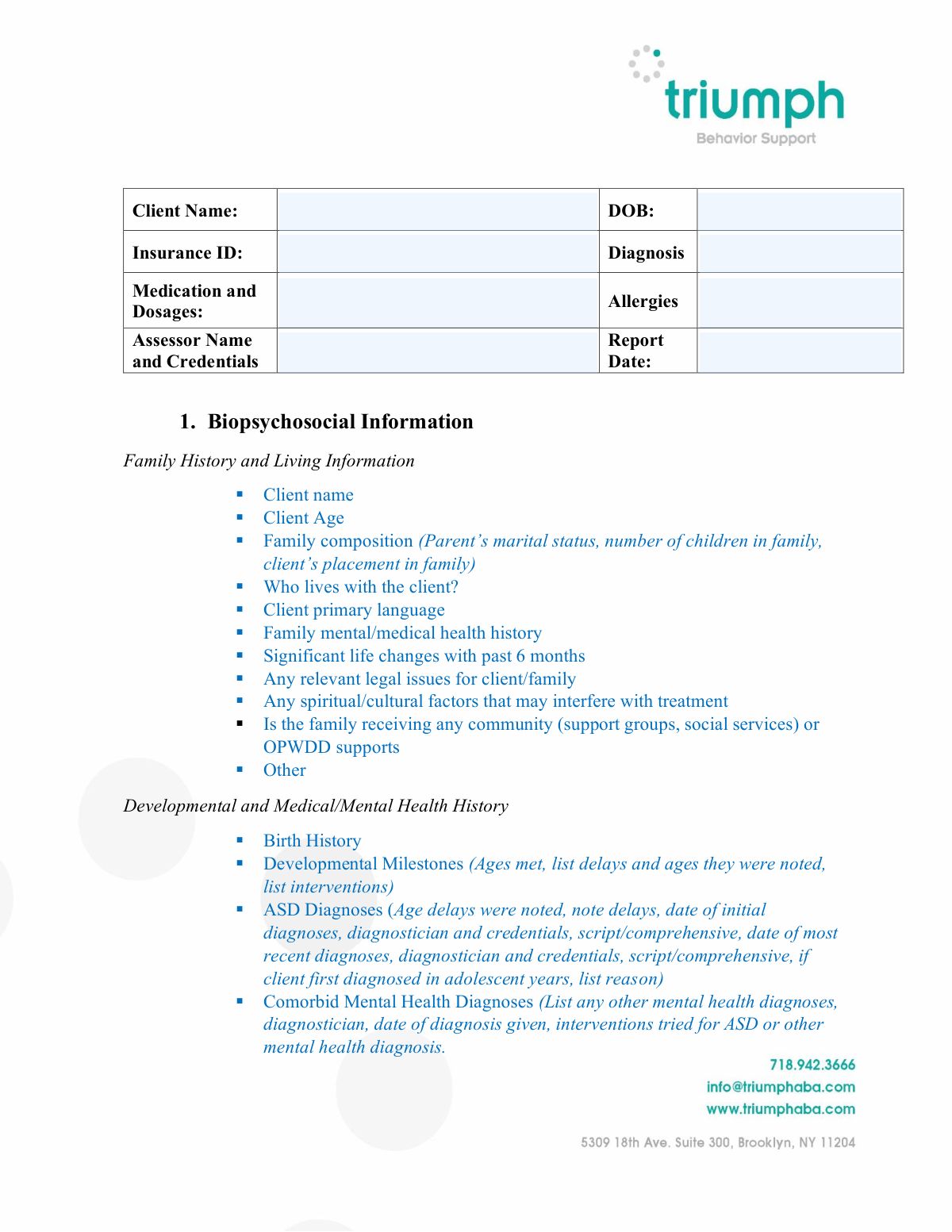
Yes! You can use AI to fill out Biopsychosocial Assessment and ABA Treatment Plan
A Biopsychosocial Assessment and ABA Treatment Plan is a critical clinical document used by Board Certified Behavior Analysts (BCBAs) to gather comprehensive client information, including family, medical, and developmental history. This detailed evaluation is essential for creating an effective, individualized treatment plan, justifying service hours to insurance, and systematically tracking a client's progress against established goals. Today, this form can be filled out quickly and accurately using AI-powered services like Instafill.ai, which can also convert non-fillable PDF versions into interactive fillable forms.
Our AI automatically handles information lookup, data retrieval, formatting, and form filling.
It takes less than a minute to fill out ABA Treatment Plan using our AI form filling.
Securely upload your data. Information is encrypted in transit and deleted immediately after the form is filled out.
Form specifications
| Form name: | Biopsychosocial Assessment and ABA Treatment Plan |
| Number of pages: | 15 |
| Language: | English |
| Categories: | ABA forms, treatment plan forms, ABA treatment forms |
Instafill Demo: How to fill out PDF forms in seconds with AI
How to Fill Out ABA Treatment Plan Online for Free in 2026
Are you looking to fill out a ABA TREATMENT PLAN form online quickly and accurately? Instafill.ai offers the #1 AI-powered PDF filling software of 2026, allowing you to complete your ABA TREATMENT PLAN form in just 37 seconds or less.
Follow these steps to fill out your ABA TREATMENT PLAN form online using Instafill.ai:
- 1 Navigate to Instafill.ai and upload the Biopsychosocial Assessment and ABA Treatment Plan template or select it from the platform's library.
- 2 Use the AI assistant to populate client identification details, such as name, date of birth, and insurance ID, from existing records or by providing the information.
- 3 Complete the historical information sections, including family, developmental, medical, and service history, by entering the relevant details into the designated fields.
- 4 Document the assessment of current functioning by specifying the formal assessments used, summarizing results, and describing the client's severity levels in communication, social skills, and behavior.
- 5 Define specific, measurable goals for increasing skills and decreasing maladaptive behaviors by filling out the corresponding tables with baselines, mastery criteria, and target dates.
- 6 Outline the Behavior Intervention Plan (BIP), parent training goals, coordination of care, and the transition and discharge plans, ensuring all clinical justifications are included.
- 7 Review the entire completed report for accuracy, then have the supervising BCBA provide their name, credentials, signature, and date to finalize the document.
Our AI-powered system ensures each field is filled out correctly, reducing errors and saving you time.
Why Choose Instafill.ai for Your Fillable ABA Treatment Plan Form?
Speed
Complete your ABA Treatment Plan in as little as 37 seconds.
Up-to-Date
Always use the latest 2026 ABA Treatment Plan form version.
Cost-effective
No need to hire expensive lawyers.
Accuracy
Our AI performs 10 compliance checks to ensure your form is error-free.
Security
Your personal information is protected with bank-level encryption.
Frequently Asked Questions About Form ABA Treatment Plan
This form is a comprehensive assessment and treatment plan designed to document a client's history, current functioning, and proposed ABA therapy goals. It is primarily used to request authorization for ABA services from an insurance provider or funding source.
A Board Certified Behavior Analyst (BCBA) or another qualified healthcare professional (QHP) is responsible for completing this form. It requires clinical assessment, goal setting, and the professional's signature to be valid.
You should gather the client's complete history, including family, developmental, and medical records. It is also essential to have copies of any previous psychological evaluations, the client's Individualized Education Program (IEP), and reports from other providers.
These are standard CPT (Current Procedural Terminology) codes used for billing ABA services. For example, 97153 typically represents direct one-on-one therapy, while 97155 is for the supervision and direction of the technician by the BCBA.
The severity levels ('Requiring support,' 'Requiring substantial support,' etc.) are based on DSM criteria. You must use your clinical judgment based on formal assessments and observations to select the level that best reflects the client's need for support in each domain.
The Transition Plan outlines criteria for gradually reducing the intensity of services as the client makes progress toward their goals. The Discharge Plan specifies the long-term goals that, once met, would indicate the client no longer requires the service.
A BIP is required for specific, significant problem behaviors that are being targeted for reduction. Each behavior listed in the 'Behavior Targets for Decrease' table should have a corresponding, detailed Behavior Intervention Plan.
This section is for outlining specific, measurable goals for the parents or caregivers to learn and implement. These goals focus on helping them manage behaviors and generalize the client's learned skills to the home and community settings.
The form notes that the schedule is subject to change. Document the most accurate proposed schedule and communicate any significant, long-term changes to the insurance provider as required by their policies.
Yes, services like Instafill.ai use AI to accurately auto-fill form fields from existing client records. This can save significant time and help reduce manual data entry errors on complex documents like this.
If your PDF is not fillable, you can use a service like Instafill.ai to convert it into an interactive, fillable form. This allows you to easily type information directly into the fields online instead of printing and handwriting.
You would upload the form to the Instafill.ai platform, which uses AI to identify all the fields. You can then fill it out online or connect it to your client data source to auto-populate the information instantly.
This section is used to list all other professionals involved in the client's care, such as their doctor, psychiatrist, or school psychologist. It demonstrates that the BCBA will collaborate with the entire care team, which is often a requirement for service authorization.
In the rationale column, you must provide a clinical justification for the number of hours requested for each service code. This justification should be directly linked to the client's assessment results, the severity of their deficits, and the intensity of intervention needed to meet their goals.
Compliance ABA Treatment Plan
Validation Checks by Instafill.ai
Common Mistakes in Completing ABA Treatment Plan
Clinicians often enter their name in the 'Assessor Name and Credentials' field but omit their professional credentials (e.g., BCBA, LBA). This happens due to oversight or assuming their name is sufficient. This omission can lead to processing delays or rejection by insurance payors, as the reviewer cannot verify that a qualified professional completed the assessment. Always include your full name followed by all relevant licenses and certifications to ensure compliance.
In the 'Hours Requesting' table, the 'Rationale' field is frequently filled with generic phrases like 'medically necessary' or 'to address goals.' This lacks the specific, clinical justification that payors require to approve services, often resulting in denials or requests for more information. To avoid this, each rationale should explicitly link the requested hours for a specific service code to the client's deficits as identified in the formal assessment section of the report.
A frequent error is a mismatch between the total hours listed in the 'Hours Requesting' table and the sum of hours detailed in the weekly 'School and Proposed ABA Schedule' grid. This discrepancy usually occurs from manual calculation errors when populating the schedule. It raises red flags for reviewers, suggesting a lack of attention to detail and causing delays while clarification is sought. Using an AI-powered tool like Instafill.ai can prevent this by automatically calculating totals and flagging inconsistencies between sections.
When filling out the 'Formal Assessment' section, users may name the assessment tool (e.g., Vineland, ABLLS-R) but fail to include the actual scores, percentile ranks, or a clinical summary of the results. This leaves the reviewer without the objective data needed to understand the client's level of functioning and justify the proposed treatment intensity. Always attach the full report or copy and paste the summary of scores and interpretation directly into the form.
In the various goal tables ('Targets for Increase,' 'Parent Training Goals'), a common mistake is writing subjective goals like 'Improve communication' or 'Reduce tantrums.' These are not measurable and do not meet clinical standards. Goals must be defined with objective, measurable criteria (e.g., 'Client will independently request a preferred item in 80% of opportunities across 3 consecutive sessions'). This ensures progress can be tracked effectively.
The form requires that behaviors targeted for reduction in the 'Behavior Intervention Plan' (BIP) section also appear in the 'Behavior Targets for Decrease' table. Clinicians sometimes describe a behavior and intervention strategy in the BIP narrative but forget to create a corresponding, measurable goal in the table. This creates an inconsistent and incomplete plan, making it difficult to track data and demonstrate progress on behavior reduction.
The 'Transition Plan' and 'Discharge Plan' sections are often completed with vague statements like 'When goals are met' or 'When client no longer requires services.' Insurance providers require specific, data-driven criteria for stepping down or discontinuing services, such as achieving a certain score on a standardized assessment. Failing to provide this can lead to the entire treatment plan being rejected for not having a clear path toward client independence.
Users often provide partial information in the medical history sections. For example, they might list a medication without the dosage and prescribing doctor, or mention a diagnosis without the date and diagnostician. This incomplete data provides a fragmented clinical picture and can compromise care coordination. It is crucial to gather and enter all details for every medication and diagnosis to ensure a comprehensive and accurate client history.
The 'Coordination of Care' section asks the BCBA to list specific providers, but it is often left blank or filled with a generic entry like 'School and pediatrician.' This does not meet the requirement to specify the individuals and their relationship to the client. To ensure proper care coordination, the BCBA should list the names, roles, and clinics of other providers (e.g., 'Dr. Smith, Pediatrician, Main Street Pediatrics' or 'Ms. Jones, Speech-Language Pathologist, Lincoln Elementary').
In the goal tables, the 'Baseline' column requires a quantitative starting point for a specific skill or behavior (e.g., 'Occurs an average of 5 times per hour,' or '10% accuracy with verbal prompts'). A common mistake is to use a qualitative description like 'Client has difficulty with this' or 'Rarely occurs.' This makes it impossible to objectively measure progress from the start of the intervention. AI-powered form fillers like Instafill.ai can help by validating that data entered into baseline fields is in a numerical or percentage format, preventing this error. If the form is a non-fillable PDF, Instafill.ai can also convert it to a smart, fillable version.
Saved over 80 hours a year
“I was never sure if my IRS forms like W-9 were filled correctly. Now, I can complete the forms accurately without any external help.”
Kevin Martin Green
Your data stays secure with advanced protection from Instafill and our subprocessors

Robust compliance program
Transparent business model
You’re not the product. You always know where your data is and what it is processed for.
ISO 27001, HIPAA, and GDPR
Our subprocesses adhere to multiple compliance standards, including but not limited to ISO 27001, HIPAA, and GDPR.
Security & privacy by design
We consider security and privacy from the initial design phase of any new service or functionality. It’s not an afterthought, it’s built-in, including support for two-factor authentication (2FA) to further protect your account.
Fill out ABA Treatment Plan with Instafill.ai
Worried about filling PDFs wrong? Instafill securely fills biopsychosocial-assessment-and-aba-treatment-plan forms, ensuring each field is accurate.