Fill out behavioral health forms
with AI.
Behavioral health forms are essential documents used to facilitate and manage mental health services, specialized therapies, and clinical assessments. This category primarily focuses on documentation required for Applied Behavior Analysis (ABA) and other behavioral interventions, which are critical for patients with developmental or behavioral conditions. These forms ensure that care is documented accurately, medical necessity is established, and services are coordinated effectively between patients, providers, and insurance carriers.
By continuing, you acknowledge Instafill's Privacy Policy and agree to get occasional product update and promotional emails.
About behavioral health forms
Typically, these forms are utilized by licensed clinicians, psychologists, and specialized therapy providers such as Board Certified Behavior Analysts (BCBAs). They are most often used during the intake process, for prior authorization requests, or when renewing treatment plans for ongoing care. For instance, providers frequently need to submit ABA Treatment Request forms or Professional Services Questionnaires to health plans like Aetna or Geisinger to secure coverage and ensure their practice information is current. Completing these documents accurately is vital to avoid delays in patient care and to maintain compliance with state and insurance regulations.
Managing the heavy administrative load of behavioral health documentation can be time-consuming for busy clinical practices. Tools like Instafill.ai use AI to fill these behavioral health forms in under 30 seconds, ensuring that data is handled accurately and securely while freeing up more time for direct patient care.
Every form on this page can be completed without typing. Instafill is form filling software that reads a PDF and fills it for you — including flat and scanned documents that carry no fillable fields at all.
Forms in This Category
The forms in this category have a median Form Complexity Index of 53/100 (Moderate), measured across 16 forms by field count, input difficulty, length, conditional logic and structure. See how it is calculated.
- Enterprise-grade security & data encryption
- 99%+ accuracy powered by AI
- 1,000+ forms from all industries
- Complete forms in under 60 seconds
How to Choose the Right Form
Navigating behavioral health documentation often depends on the specific insurance carrier and the type of clinical service being requested. Most forms in this category are designed for providers to secure prior authorization for Applied Behavioral Analysis (ABA) therapy for patients with Autism Spectrum Disorder (ASD).
ABA Prior Authorization Requests
If you are a provider seeking approval for ongoing or initial ABA services, select the form associated with your patient’s health plan to ensure clinical necessity is properly documented:
- Aetna & Affiliates: Use Form BHVH or the updated Outpatient Behavioral Health (BH) – ABA Treatment Request (GR-69017-4) for precertification. Note that the GR-69017-4 is the standard for plans like Innovation Health and Banner | Aetna.
- Health Net: Use the Applied Behavioral Analysis (ABA) Prior Authorization Request Form for standard utilization reviews.
- L.A. Care: Choose the L.A. Care Behavioral Health Treatment ABA Authorization Request Form specifically for Medi-Cal members.
- Evernorth: Use the Evernorth Behavioral Health ABA Prior Authorization Form (PCOMM-2025-224) for initial requests, reconsiderations, or network exceptions.
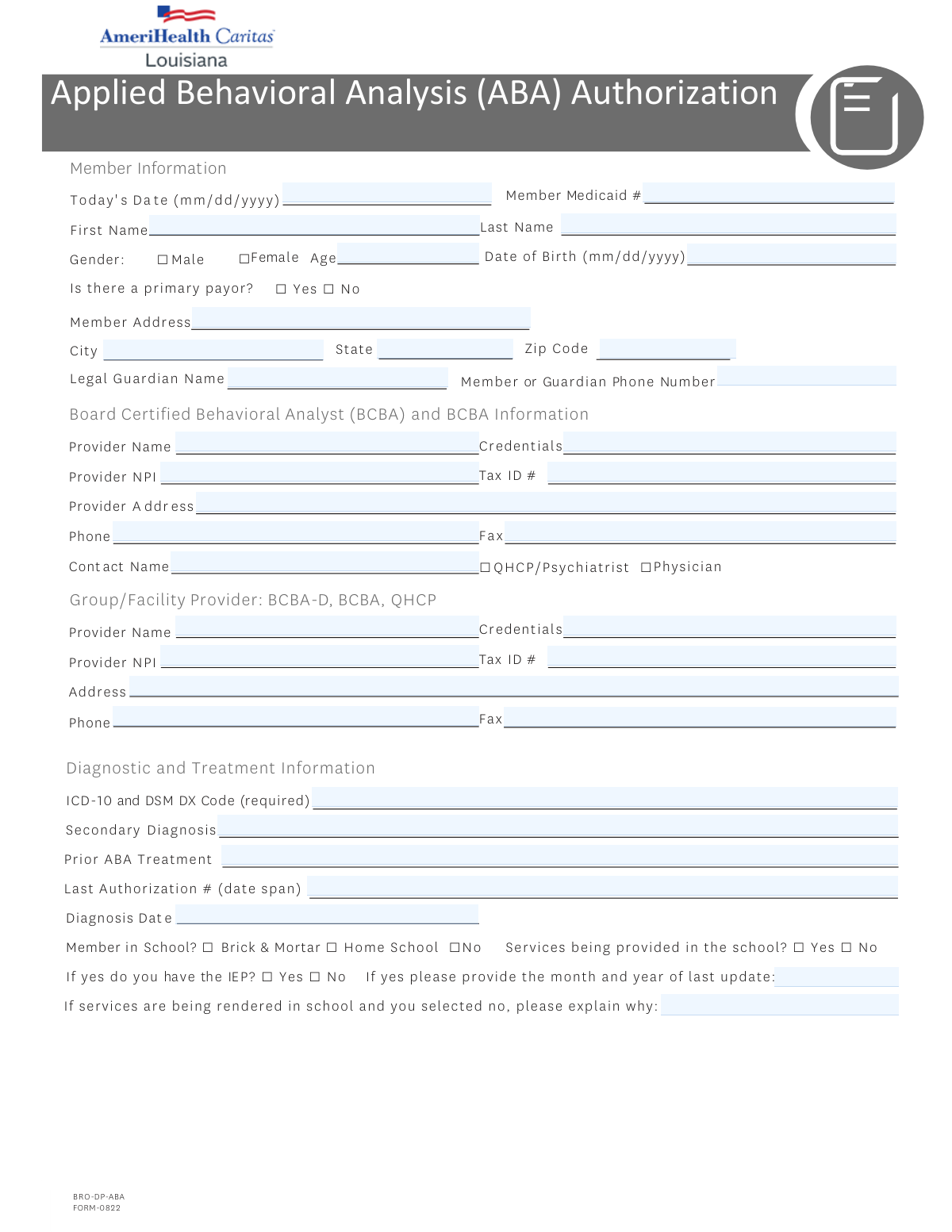
- Louisiana Health Connect: Select the ABA Authorization Form (BRO-DP-ABA FORM-0822) for Medicaid members in Louisiana.
- Bridgespan: Use Form 5385BSP for initial 6-month authorization requests.
- Highmark Health Options: Use their specific ABA Prior Authorization Request Form to document treatment plans and discharge planning for member care.
Initial Referrals and Medical Necessity
Before treatment begins, some plans require a formal recommendation from a physician to establish medical necessity. For Health Net Medi-Cal members, use the Health Net Applied Behavioral Analysis (ABA) Recommendation and Referral Form (24-989). This must be completed by a licensed physician or psychologist before services can be initiated.
Residential Care and Provider Management
For specialized services or administrative updates:
- Oregon Residential Services: Use Form CH-006: PA-BH-Res-PCS to request plan-of-care authorization for behavioral health residential or personal care services (1915(i) services).
- Geisinger Health Plan Providers: Complete the Behavioral Health Professional Services Questionnaire to update your practitioner demographics, specialties, and accepted age groups to ensure accurate member referrals.
Form Comparison
| Form | Primary Purpose | Health Plan / Entity | Service Type |
|---|---|---|---|
| Form BHVH, Outpatient Behavioral Health – ABA Treatment Request | Requesting precertification for ABA treatment services | Aetna and associated plans | Outpatient Applied Behavioral Analysis |
| Geisinger Health Plan Behavioral Health Professional Services Questionnaire | Documenting provider demographics and clinical specialties | Geisinger Health Plan | Professional behavioral health services |
| Form CH-006: PA-BH-Res-PCS, Oregon Behavioral Health Support Program Plan of Care Authorization | Authorizing 1915(i) residential or personal care services | Oregon Behavioral Health Support Program | Residential and personal care services |
| Applied Behavioral Analysis (ABA) Prior Authorization Request Form (Health Net Behavioral Health Autism Center) | Requesting utilization review and session hour approval | Health Net Behavioral Health | Applied Behavioral Analysis (ABA) |
| L.A. Care Behavioral Health Treatment Applied Behavioral Analysis Authorization Request Form | Obtaining prior authorization for Medi-Cal ABA services | L.A. Care (Medi-Cal) | ABA, assessments, and parent training |
| Health Net Applied Behavioral Analysis (ABA) Recommendation and Referral Form (24-989) | Establishing medical necessity for state compliance | Health Net (DHCS/Medi-Cal) | Physician/psychologist ABA referrals |
| Evernorth Behavioral Health Applied Behavior Analysis Prior Authorization Form (PCOMM-2025-224) | Securing coverage for initial or continued therapy | Evernorth Behavioral Health | ABA therapy and network exceptions |
| Applied Behavioral Analysis (ABA) Authorization Form, Louisiana Health Connect (BRO-DP-ABA FORM-0822) | Requesting Medicaid authorization for up to 180 days | Louisiana Health Connect | Medicaid-covered ABA therapy |
| Form 5385BSP, Behavioral Health Utilization Management Applied Behavioral Analysis (ABA) Initial Request Form | Initiating 6-month authorization for ASD treatment | Bridgespan Health | Initial ABA therapy requests |
| Outpatient Behavioral Health (BH) – ABA Treatment Request: Required Information for Precertification (GR-69017-4) | Providing updated clinical data for 2026 precertification | Aetna and Innovation Health | Outpatient ABA therapy |
| Highmark Health Options Applied Behavioral Analysis (ABA) Prior Authorization Request Form | Evaluating medical necessity and discharge planning | Highmark Health Options | ABA therapy and treatment plans |
Tips for behavioral health forms
AI-powered tools like Instafill.ai can complete these behavioral health forms in under 30 seconds with high accuracy. Your data stays secure during the process, providing a practical way to manage large volumes of authorization paperwork without manual data entry.
Many behavioral health forms require specific HCPCS or CPT codes alongside the number of sessions or hours requested. Ensure these match your clinical treatment plan exactly to avoid delays or partial denials during the utilization review process.
Most authorization requests, such as ABA treatment forms, require supporting diagnostic reports or functional assessments. Submitting these documents alongside the form is essential for demonstrating medical necessity and ensuring a faster adjudication process.
Pay close attention to provider and case supervisor identifiers, including National Provider Identifiers (NPI) and Tax Identification Numbers (TIN). Incorrect or missing provider credentials can cause the form to be rejected or result in directory inaccuracies.
Behavioral health authorizations are often limited to specific periods, such as 180 days or six months. Keep a log of these expiration dates so you can submit reauthorization requests well in advance of the current window closing.
Incomplete or illegible forms are a leading cause of processing delays and can interrupt a patient's access to therapy. Use fillable digital formats whenever possible to ensure every required field is clear and no sections are accidentally skipped.
Frequently Asked Questions
These forms are primarily used by healthcare providers to request prior authorization for specialized treatments like Applied Behavior Analysis (ABA). They ensure that the proposed treatment is medically necessary and covered under a patient's specific health insurance plan before services begin.
In most cases, the treating clinician, psychologist, or Board Certified Behavior Analyst (BCBA) is responsible for completing these forms. While patients provide the necessary personal insurance information, the provider must supply the clinical justification, diagnosis codes, and specific treatment units required by the insurer.
The correct form depends entirely on the patient's insurance provider and their specific health plan coverage. You should check the member’s insurance ID card to identify the carrier, such as Aetna, Health Net, or Highmark, and then select the corresponding authorization or referral form for that specific organization.
Most forms require the patient’s official diagnosis, the provider's NPI and Tax ID, and the specific CPT codes for the services being requested. Additionally, you will likely need to provide the requested number of hours per week for both direct therapy and supervision to justify the treatment plan.
Yes, AI tools like Instafill.ai can be used to fill out complex behavioral health and ABA forms by extracting data from your existing clinical source documents. These tools can accurately place information into the correct fields, helping to reduce manual entry errors and ensure that all required sections are completed.
Using traditional manual methods, these multi-page forms can take 15 to 30 minutes to complete accurately. However, AI-powered tools like Instafill.ai can fill these forms in under 30 seconds by automatically mapping data from clinical notes or previous authorizations into the new document.
These questionnaires help insurance plans maintain accurate provider directories by documenting a clinician's specialties, accepted age groups, and the specific therapies they offer. This information ensures that plan members are referred to clinicians who are best suited to meet their specific clinical needs and service preferences.
If there is a significant change in condition or a need for a different level of care, providers typically must submit a change-in-condition assessment or a new authorization request. This updated form provides the clinical rationale for modifying the existing treatment plan or increasing the requested service units.
Submitting an incomplete form often leads to delays in the adjudication process or an administrative denial of the request. Because services usually cannot be scheduled or reimbursed until approval is granted, ensuring all fields—especially provider identifiers and diagnosis codes—are accurate is critical for maintaining continuity of care.
These forms are used for both initial treatment requests and for continued stay or reauthorization requests. Most insurance plans require a new form to be submitted every six months or at the end of a 180-day period to re-evaluate the medical necessity of ongoing treatment.
Glossary
- Form Complexity Index
- Instafill’s 0–100 measure of how much effort a form takes to complete, calculated deterministically from the form’s own structure rather than estimated. It combines the number of fillable fields (the largest factor), how difficult those fields are to complete based on their type, the number of pages that contain fields, the amount of conditional “fill-only-if” logic, and how many sections the form is divided into, then adds modifiers for tables and repeating lists, bundled instruction pages, and dense page layouts. A higher score means the form is harder to fill out by hand. The forms in this category have a median Form Complexity Index of 53/100 (Moderate). See exactly how it is calculated.
- Applied Behavioral Analysis (ABA)
- A therapeutic approach focused on improving specific behaviors, such as social skills and communication, frequently used for individuals with Autism Spectrum Disorder.
- Prior Authorization (Precertification)
- A process where a healthcare provider must obtain approval from an insurance company before delivering a treatment to ensure the service is covered under the patient's plan.
- Medical Necessity
- The clinical standard used by health plans to determine if a requested service is appropriate, reasonable, and required for the treatment of a specific diagnosis.
- BCBA (Board Certified Behavior Analyst)
- A graduate-level professional who is certified to design and oversee behavioral treatment plans and supervise the technicians providing direct care.
- CPT Codes (Current Procedural Terminology)
- A standardized set of numerical codes used by providers to bill insurance for specific medical and behavioral health services, such as assessments or therapy sessions.
- Utilization Management (UM)
- A review process conducted by health insurance companies to evaluate the efficiency and appropriateness of medical services and treatment plans.
- ICD-10 / DSM-V
- Standardized classification systems (International Classification of Diseases and Diagnostic and Statistical Manual of Mental Disorders) used by clinicians to code and diagnose behavioral health conditions.
- PHP / IOP
- Levels of care standing for Partial Hospitalization Program and Intensive Outpatient Program, which provide structured mental health treatment more intensive than standard outpatient therapy.
- NPI (National Provider Identifier)
- A unique 10-digit identification number assigned to healthcare providers in the United States to ensure standard identification during administrative and financial transactions.