Fill out ABA therapy forms
with AI.
Applied Behavior Analysis (ABA) therapy forms are essential documents used by healthcare providers to secure authorization, track patient progress, and establish medical necessity for autism treatment services. These forms play a critical role in the clinical workflow, ensuring that patients receive the appropriate level of care while meeting the rigorous documentation standards required by insurance payers and state agencies. Whether you are conducting an initial behavior assessment or submitting a request for ongoing treatment, accurate and detailed documentation is the key to preventing administrative delays in service delivery.
By continuing, you acknowledge Instafill's Privacy Policy and agree to get occasional product update and promotional emails.
About ABA therapy forms
Typically, these forms are completed by Board-Certified Behavior Analysts (BCBAs), clinical providers, and healthcare administrators during the intake or re-authorization phases. For example, providers may need to submit documents like the Alabama Medicaid ABA Therapy Assessment Form to request treatment units or use specific ABA Therapy Request Forms for private health plans to justify clinical hours. Because these documents require the integration of complex clinical data—including DSM-5 criteria, baseline assessments, and measurable patient goals—they can be incredibly time-consuming to complete manually, especially when managing a large caseload of patients.
Managing this volume of paperwork can be simplified by modern technology. Tools like Instafill.ai use AI to fill these forms in under 30 seconds, ensuring that patient data is handled accurately and securely. This allows clinical teams to focus more on patient outcomes and less on the administrative burden of repetitive manual data entry.
Every form on this page can be completed without typing. Instafill is form filling software that reads a PDF and fills it for you — including flat and scanned documents that carry no fillable fields at all.
Forms in This Category
The forms in this category have a median Form Complexity Index of 53/100 (Moderate), measured across 3 forms by field count, input difficulty, length, conditional logic and structure. See how it is calculated.
| Form Name | Pages | FCI | |
|---|---|---|---|
| 1. | Alabama Medicaid Agency ABA Therapy Assessment Form (6/20/19) — Behavior Assessment and Treatment Request (CPT 97151) for Applied Behavioral Analysis for Autism Spectrum Disorder | 5 | Moderate 53 |
| 2. | Applied Behavior Analysis (ABA) Therapy Request Form | 2 | Moderate 52 |
| 3. | Biopsychosocial Assessment and ABA Treatment Plan | 15 | Very Complex 83 |
- Enterprise-grade security & data encryption
- 99%+ accuracy powered by AI
- 1,000+ forms from all industries
- Complete forms in under 60 seconds
How to Choose the Right Form
Selecting the correct Applied Behavior Analysis (ABA) therapy form is essential for ensuring medical necessity is established and that authorization for services is granted without delay. When navigating this category, your choice will primarily depend on the specific insurance carrier and the type of clinical request you are making.
Forms for Alabama Medicaid Providers
If you are a Board-Certified Behavior Analyst (BCBA) or an approved provider working with patients covered by Alabama Medicaid, you must use the specific state-mandated documentation.
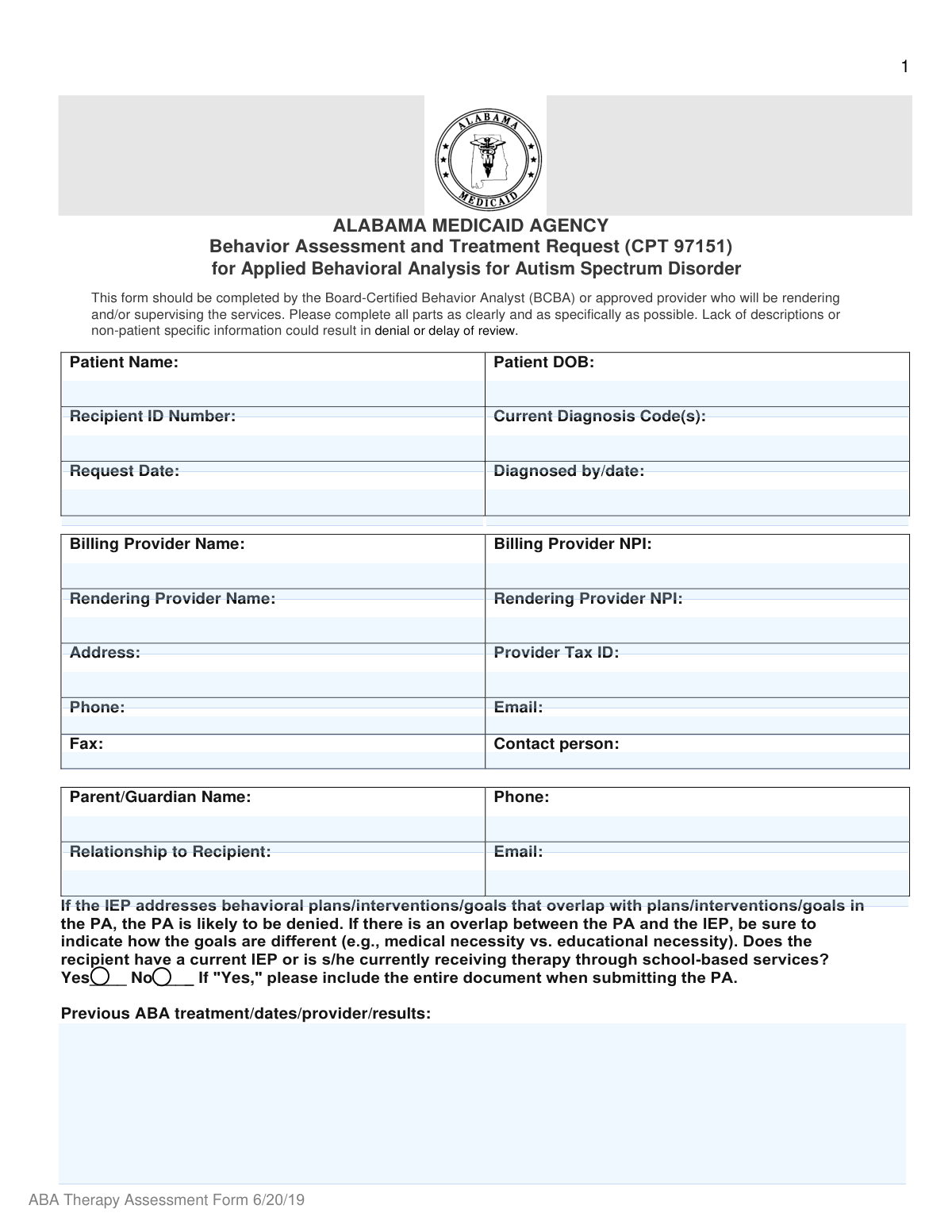
- Alabama Medicaid Agency ABA Therapy Assessment Form (6/20/19): Choose this form specifically for CPT code 97151 (Behavior Assessment and Treatment Request). This document is required to support the medical necessity of initial assessments and treatment planning. It requires detailed clinical history, DSM-5 criteria, and specific baselines for targeted behaviors. Use this when you need to justify the hours required for a new or updated treatment plan for a Medicaid recipient.
Forms for SmartHealth Network Providers
For providers treating patients within the SmartHealth network, the documentation requirements differ in both format and the scope of information requested.
- Applied Behavior Analysis (ABA) Therapy Request Form: This is the standard prior authorization document for SmartHealth members diagnosed with Autism Spectrum Disorder (ICD-10: F84.0). Unlike the Medicaid assessment form, this serves as a broader request for services to be rendered. You should select this form when you need to submit a comprehensive request that includes unit counts, requested service codes, and functional behavior assessments (FBA) for SmartHealth's clinical review team.
Key Considerations for Selection
- Insurance Carrier: Always identify the payer first. Alabama Medicaid and SmartHealth have non-interchangeable forms.
- Service Phase: Use the Alabama Medicaid Agency ABA Therapy Assessment Form specifically for the assessment and planning phase (CPT 97151), whereas the Applied Behavior Analysis (ABA) Therapy Request Form is used to authorize the ongoing therapy services themselves.
Form Comparison
| Form | Primary Purpose | Target Payer | Required Documentation |
|---|---|---|---|
| Alabama Medicaid Agency ABA Therapy Assessment Form (6/20/19) | Authorization for ABA behavior assessment and treatment planning services. | Alabama Medicaid Agency for members diagnosed with Autism Spectrum Disorder. | Clinical history, DSM-5 criteria, test scores, and measurable behavior goals. |
| Applied Behavior Analysis (ABA) Therapy Request Form | Prior authorization for ABA therapy services for members with Autism. | SmartHealth insurance network for members requiring behavioral health services. | Standardized assessment, individualized treatment plan, and functional behavior assessment. |
Tips for ABA therapy forms
Avoid using boilerplate language for behavioral goals. Medicaid and private insurers look for individualized treatment plans with clear baselines and measurable objectives to justify the medical necessity of the requested service hours.
Forms often ask about IEP status or school-based services. Clearly explain how the requested clinical ABA therapy complements rather than duplicates services provided by the school district to avoid denials based on duplication of effort.
Double-check that the diagnosis codes and service codes, such as CPT 97151, are current and consistent across all pages of the document. Discrepancies between the provider's request and the diagnostic report can lead to immediate administrative rejection.
Managing multiple ABA authorization forms is time-consuming for busy providers. AI-powered tools like Instafill.ai can complete these forms in under 30 seconds with high accuracy, and the data stays secure during the process, making it a reliable time-saver for clinical teams.
Most ABA requests require a functional behavior assessment and standardized diagnostic results to be attached. Having these digital files ready before you start filling out the request form ensures a smoother submission and prevents session timeouts during the filing process.
Simple errors in NPI numbers, Medicaid IDs, or member numbers are leading causes of processing delays. Always verify that the provider information matches the credentials on file with the specific insurance carrier or state agency before final submission.
Frequently Asked Questions
ABA therapy forms are used to establish medical necessity and request authorization for Applied Behavior Analysis services for individuals with Autism Spectrum Disorder. These documents provide insurance carriers or state agencies with clinical data, such as diagnosis information and treatment goals, to ensure the proposed therapy is appropriate for the patient.
In most cases, these forms must be completed by a Board-Certified Behavior Analyst (BCBA) or an approved healthcare provider. While parents or guardians provide patient identifiers, the clinical assessments, behavioral baselines, and treatment unit requests must be documented by the professional overseeing the therapy.
Yes, you can use AI-powered tools like Instafill.ai to complete these documents efficiently. These tools can accurately extract data from your clinical notes or source documents and populate the necessary fields in under 30 seconds, helping providers save time on administrative tasks.
Most agencies require a comprehensive clinical package alongside the main request form, including a standardized assessment (like the VB-MAPP or AFLS) and an individualized treatment plan. You may also need to provide a recent diagnostic evaluation and a functional behavior assessment to support the requested number of therapy hours.
The correct form is determined by the patient's insurance provider and the specific service code being requested, such as CPT 97151 for assessments. For example, patients covered by Alabama Medicaid must use the specific agency clinical request form, while those under private plans like SmartHealth must use that company's proprietary authorization document.
Filling out detailed clinical forms manually can take significant time, but using AI services like Instafill.ai allows you to complete them in less than 30 seconds. The AI can also convert static, non-fillable PDF scans into interactive forms, making the entire process much faster and more accurate.
Incomplete or non-patient-specific documentation is one of the leading causes of authorization delays or denials. If clinical history, DSM-5 criteria, or measurable goals are missing, the reviewer may determine that medical necessity has not been proven, potentially pausing the patient's access to care.
Submission methods vary by organization but generally involve faxing the documents to a designated clinical review number or uploading them through a secure provider portal. Always check the instructions on the specific form to ensure you are sending the data to the correct department for processing.
Insurance providers and Medicaid agencies typically only cover services that are medically necessary and distinct from those provided by the school system. Forms often require details about a student's IEP or school-based services to ensure there is no duplication of efforts and that the requested ABA therapy is clinically justified.
Yes, most ABA authorizations are time-limited and require a re-authorization request to continue services. This usually involves submitting an updated form that shows the patient's progress against previous goals and justifies the need for continued or adjusted therapy hours for the next period.
Glossary
- Form Complexity Index
- Instafill’s 0–100 measure of how much effort a form takes to complete, calculated deterministically from the form’s own structure rather than estimated. It combines the number of fillable fields (the largest factor), how difficult those fields are to complete based on their type, the number of pages that contain fields, the amount of conditional “fill-only-if” logic, and how many sections the form is divided into, then adds modifiers for tables and repeating lists, bundled instruction pages, and dense page layouts. A higher score means the form is harder to fill out by hand. The forms in this category have a median Form Complexity Index of 53/100 (Moderate). See exactly how it is calculated.
- Applied Behavior Analysis (ABA)
- A therapy based on the science of learning and behavior, focused on improving specific behaviors and social skills in individuals with autism.
- Board-Certified Behavior Analyst (BCBA)
- A graduate-level healthcare professional who is certified to provide and oversee ABA therapy services and complete clinical assessment forms.
- Prior Authorization
- A requirement from an insurance provider or Medicaid that a service must be reviewed and approved before treatment can begin.
- Medical Necessity
- The clinical standard used by reviewers to determine if a requested therapy is appropriate, reasonable, and necessary for a patient's diagnosis.
- Functional Behavior Assessment (FBA)
- An evaluation process used to identify the underlying reasons for specific behaviors, which is required to develop a targeted treatment plan.
- CPT Code 97151
- A specific medical billing code used for the initial behavior identification assessment and treatment planning performed by a BCBA.
- Baseline
- The initial measurement of a behavior before therapy starts, used as a reference point to track a patient's progress over time.
- ICD-10 Code
- A standardized system of alphanumeric codes used on medical forms to classify specific diagnoses, such as F84.0 for Autism Spectrum Disorder.