Fill out treatment plan forms
with AI.
Treatment plan forms serve as the essential roadmap for clinical care, particularly within the fields of mental health and behavioral health. These documents outline a patient's diagnostic history, current medications, and measurable objectives, ensuring that every member of a care team is aligned on the path forward. By documenting specific goals for behavior reduction or skill acquisition, these forms provide a structured way to track progress over time and justify the medical necessity of ongoing interventions to insurance providers.
By continuing, you acknowledge Instafill's Privacy Policy and agree to get occasional product update and promotional emails.
About treatment plan forms
Clinicians such as Board Certified Behavior Analysts (BCBAs), social workers, and addiction specialists rely on these forms daily to manage complex cases. For instance, the ASAM Criteria Treatment Planning Template is a standard for addiction recovery, while the MMFRM-18 and various Biopsychosocial Assessments are critical for authorizing and reassessing ABA services for individuals with autism. Accurate documentation is not only a clinical requirement but also a vital part of securing the authorizations needed to continue providing life-changing therapy.
Completing these multi-page documents can be an administrative burden for busy providers who would rather focus on patient care. Tools like Instafill.ai use AI to fill these behavioral health forms in under 30 seconds, handling sensitive clinical data accurately and securely to streamline the documentation process.
Every form on this page can be completed without typing. Instafill is form filling software that reads a PDF and fills it for you — including flat and scanned documents that carry no fillable fields at all.
Forms in This Category
The forms in this category have a median Form Complexity Index of 72/100 (Complex), measured across 5 forms by field count, input difficulty, length, conditional logic and structure. See how it is calculated.
| Form Name | Pages | FCI | |
|---|---|---|---|
| 1. | Applied Behavior Analysis for Autism Initial Assessment and Goals and Six Month Reassessment of Goals and Treatment Plan (MMFRM-18) | 8 | Complex 72 |
| 2. | Biopsychosocial Assessment and ABA Treatment Plan | 15 | Very Complex 83 |
| 3. | Blue Shield of California Promise Health Plan Long Term Care Treatment Authorization Request Form | 2 | Moderate 54 |
| 4. | IBC/ CBC ABA Treatment Plan/Concurrent Review Template | 7 | Very Complex 85 |
| 5. | Treatment Plan Request Form for Autism Spectrum Disorders | 3 | Moderate 59 |
- Enterprise-grade security & data encryption
- 99%+ accuracy powered by AI
- 1,000+ forms from all industries
- Complete forms in under 60 seconds
How to Choose the Right Form
Choosing the right treatment plan form is essential for ensuring medical necessity and securing insurance authorization. Depending on your clinical specialty—whether it is Applied Behavior Analysis (ABA) or addiction medicine—your documentation needs will vary significantly.
Applied Behavior Analysis (ABA) Services
If you are a Board Certified Behavior Analyst (BCBA) working with clients on the autism spectrum, you will likely need one of the following clinical documents:
- Biopsychosocial Assessment and ABA Treatment Plan: Select this form when you need to conduct a comprehensive initial evaluation. It covers family, medical, and developmental history, providing the foundational data needed to justify requested service hours to insurance payers.
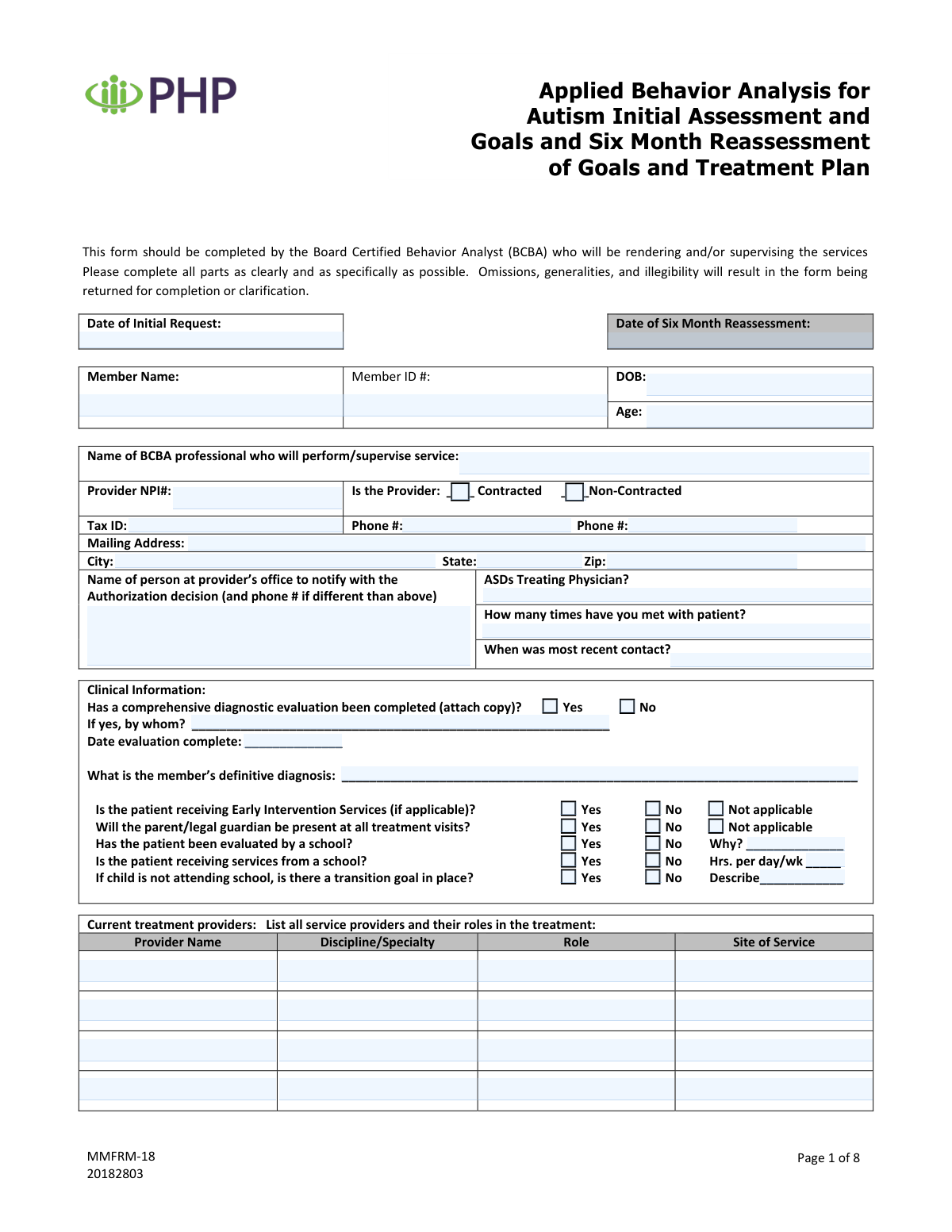
- Applied Behavior Analysis for Autism Initial Assessment and Goals and Six Month Reassessment of Goals and Treatment Plan (MMFRM-18): This is a standardized 8-page clinical authorization form. It is the primary choice for both initial assessments and the mandatory six-month reassessments required by many health plans. It is specifically designed to track progress on behavioral goals and facilitate formal service code requests.
Addiction and Behavioral Health
For professionals working in substance use disorder (SUD) treatment, documentation must align with specific industry standards to ensure high-quality care and compliance:
- ASAM Criteria® Treatment Planning Template: Use this template if you are following the American Society of Addiction Medicine guidelines. It helps clinicians assess patient risks across multiple dimensions, define problem areas, and set measurable goals for service transitions. It is the gold standard for creating structured, individualized addiction treatment plans.
Key Selection Factors
When deciding which form to use, consider the following:
1. Payer Requirements: Some insurance carriers mandate the MMFRM-18 for all ABA authorizations, while others may accept a more general Biopsychosocial Assessment.
2. Clinical Scope: If your focus is behavior reduction and skill acquisition for autism, use the ABA-specific forms. For broader addiction and behavioral health services, the ASAM Criteria template is the most appropriate choice.
Form Comparison
| Form | Primary Purpose | Target Condition | Key Components |
|---|---|---|---|
| Applied Behavior Analysis for Autism Initial Assessment and Goals and Six Month Reassessment of Goals and Treatment Plan (MMFRM-18) | Secures insurance authorization and evaluates clinical progress for ABA services. | Autism Spectrum Disorder (ASD). | Behavioral goals, service hour requests, and provider coordination details. |
| ASAM Criteria® Treatment Planning Template | Guides standardized addiction treatment planning and care transition strategies. | Substance use and addictive disorders. | Risk assessment, problem identification, and individualized clinical goals. |
| Biopsychosocial Assessment and ABA Treatment Plan | Documents comprehensive history to justify medical necessity for therapy hours. | Behavioral health and developmental conditions. | Family history, medical background, and developmental milestone tracking. |
Tips for treatment plan forms
When defining goals for ABA or ASAM plans, ensure every objective is measurable and time-bound. Instead of using vague descriptions of improvement, use specific percentages or frequency counts to help insurance reviewers see clear, objective progress.
To ensure treatment authorization, your documentation must bridge the gap between assessment findings and the requested hours of service. Use the biopsychosocial data to explain exactly why a specific level of care is required for the patient's current clinical status.
Completing complex multi-page documents like the MMFRM-18 or ASAM templates can be time-consuming. AI-powered tools like Instafill.ai can complete these forms in under 30 seconds with high accuracy, and the data stays secure during the process, making it a real time-saver for busy clinicians.
Many behavioral health forms require details on how you are communicating with primary care doctors or school staff. Keep a log of these interactions ready so you can quickly populate the 'Coordination of Care' sections without searching through separate physical files.
For long-term ABA plans, insurers look for comparisons between the initial assessment and current progress. Maintaining consistent goal-tracking sheets throughout the treatment period makes it much easier to fill out the reassessment sections of the MMFRM-18 accurately.
A robust biopsychosocial assessment relies on detailed history that may require interviewing family members. Gathering this information before you start the form ensures you do not have to pause mid-way to track down missing developmental or medical milestones.
Frequently Asked Questions
Treatment plan forms serve as a roadmap for clinical care, outlining a patient's diagnosis, specific measurable goals, and the interventions planned to achieve them. They ensure that all members of a care team are aligned and provide a benchmark for measuring a patient's progress throughout the duration of their therapy.
Most of these forms, particularly for ABA therapy or addiction medicine, must be completed by licensed professionals such as Board Certified Behavior Analysts (BCBAs), clinical psychologists, or certified addiction counselors. These documents require professional clinical judgment to set appropriate goals and justify the medical necessity of the services provided.
The MMFRM-18 is a specific clinical and authorization support form often required by particular insurance payers for autism services, typically at the initial assessment and every six months thereafter. In contrast, a Biopsychosocial Assessment is a broader evaluation tool used during the initial intake process to gather comprehensive family, medical, and developmental history.
While the specific frequency depends on the provider and the insurance payer, many behavioral health plans require a formal reassessment every six months. This regular update ensures that the treatment remains effective and that the clinical goals are adjusted based on the patient's current progress and evolving needs.
Insurance companies use these detailed forms to evaluate the medical necessity of requested services and to determine if the proposed level of care is appropriate for the patient. Without a completed treatment plan that demonstrates clear goals and progress, payers may not authorize the hours or services required for treatment.
The ASAM Criteria template is specifically designed for addiction medicine and substance use disorder treatment. It is used by clinicians to assess patient risks across six dimensions of multidimensional assessment, helping to determine the most appropriate level of care and transition planning for a patient in recovery.
Completed forms are usually submitted directly to the patient's health insurance provider or a third-party behavioral health manager for clinical review. Additionally, these forms are maintained within the patient's electronic health record (EHR) to ensure compliance with healthcare regulations and internal auditing requirements.
Yes, complex clinical treatment plans can be completed using AI tools. Platforms like Instafill.ai can accurately extract data from clinical notes or source documents and place it into the correct fields, ensuring that the necessary clinical details are captured precisely and efficiently.
Manually filling out multi-page clinical forms can take a significant amount of time, often leading to administrative fatigue. By using AI-powered services like Instafill.ai, these forms can be filled in under 30 seconds, significantly speeding up the documentation process for busy clinicians.
In addition to the treatment plan itself, providers often need to include diagnostic evaluations, current medication lists, and coordination notes from other specialists. These documents provide a holistic view of the patient’s needs and support the clinical justification for the proposed treatment hours and methods.
Glossary
- Form Complexity Index
- Instafill’s 0–100 measure of how much effort a form takes to complete, calculated deterministically from the form’s own structure rather than estimated. It combines the number of fillable fields (the largest factor), how difficult those fields are to complete based on their type, the number of pages that contain fields, the amount of conditional “fill-only-if” logic, and how many sections the form is divided into, then adds modifiers for tables and repeating lists, bundled instruction pages, and dense page layouts. A higher score means the form is harder to fill out by hand. The forms in this category have a median Form Complexity Index of 72/100 (Complex). See exactly how it is calculated.
- ABA (Applied Behavior Analysis)
- A type of therapy based on the science of learning and behavior used to improve specific behaviors, such as social skills, communication, and reading, particularly in individuals with autism.
- BCBA (Board Certified Behavior Analyst)
- A healthcare professional with a graduate-level certification in behavior analysis who is responsible for designing, supervising, and signing off on ABA treatment plans.
- Medical Necessity
- The clinical standard used by insurance companies to determine if a treatment or service is essential and appropriate for a patient's specific diagnosis.
- ASAM Criteria
- A set of national guidelines used by clinicians to assess patients with addiction and determine the most appropriate level of care and treatment planning.
- Biopsychosocial Assessment
- A holistic evaluation that examines a patient's biological, psychological, and social factors to help clinicians understand their overall health and develop a comprehensive treatment plan.
- Service Codes
- Specific alphanumeric codes used on forms to identify the exact behavioral health services or procedures being requested for insurance authorization and billing.
- Prior Authorization
- A requirement by health plans for providers to obtain approval before certain services are rendered to ensure the treatment is covered under the patient's plan.
- Transition of Care
- The documented plan for moving a patient from one level of treatment or facility to another, ensuring continuity and safety during the change.