Yes! You can use AI to fill out ASAM Criteria® Treatment Planning Template
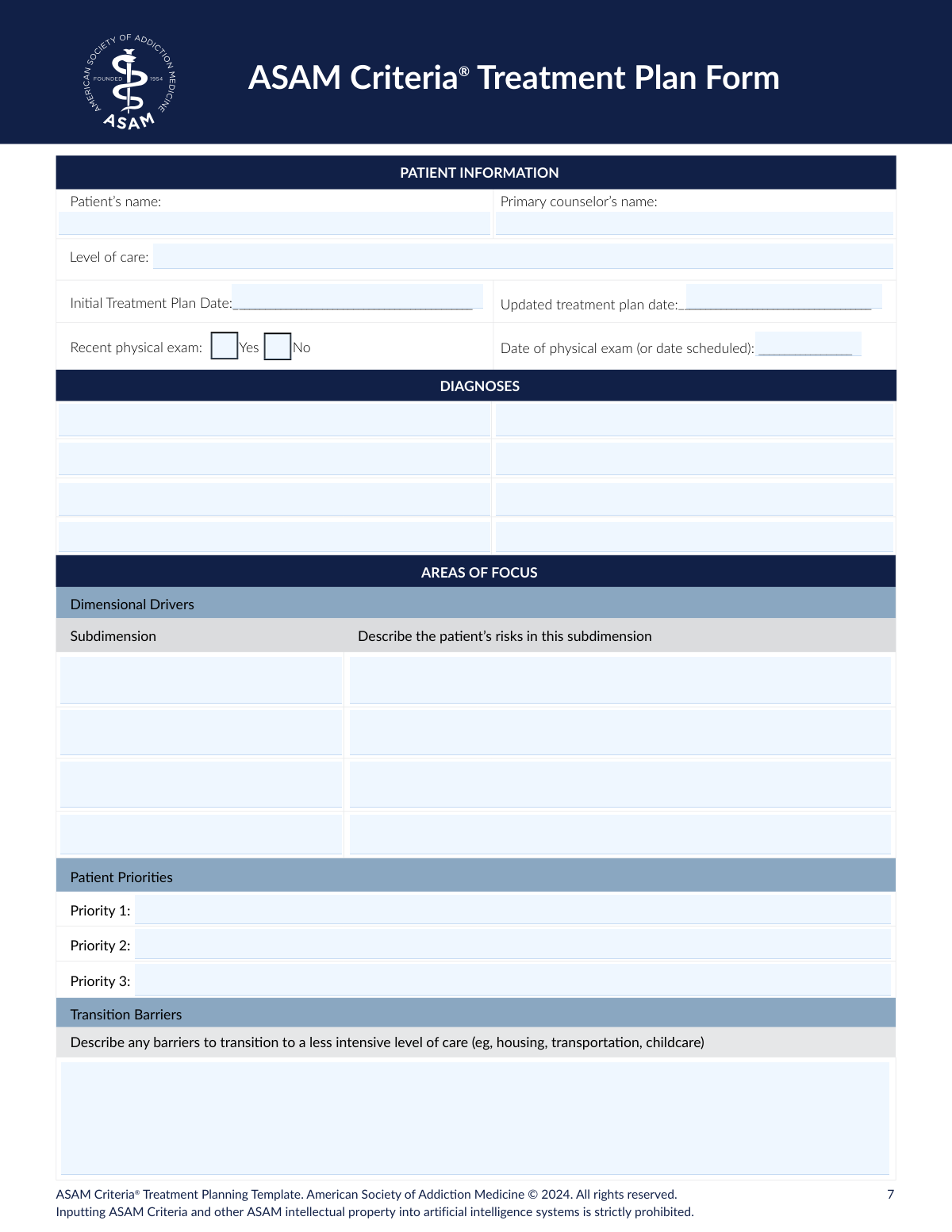
The ASAM Criteria® Treatment Planning Template is a structured document from the American Society of Addiction Medicine used to develop, document, and update a patient's individualized addiction treatment plan. It guides clinicians through assessing patient risks, setting priorities, defining problems with goals and objectives, and planning for services and transition of care. Today, this form can be filled out quickly and accurately using AI-powered services like Instafill.ai, which can also convert non-fillable PDF versions into interactive fillable forms.
Our AI automatically handles information lookup, data retrieval, formatting, and form filling.
It takes less than a minute to fill out ASAM Treatment Plan using our AI form filling.
Securely upload your data. Information is encrypted in transit and deleted immediately after the form is filled out.
Form specifications
| Form name: | ASAM Criteria® Treatment Planning Template |
| Number of fields: | 259 |
| Number of pages: | 9 |
| Field instructions: | ASAM Treatment Plan Instructions |
| Language: | English |
Instafill Demo: How to fill out PDF forms in seconds with AI
How to Fill Out ASAM Treatment Plan Online for Free in 2026
Are you looking to fill out a ASAM TREATMENT PLAN form online quickly and accurately? Instafill.ai offers the #1 AI-powered PDF filling software of 2026, allowing you to complete your ASAM TREATMENT PLAN form in just 37 seconds or less.
Follow these steps to fill out your ASAM TREATMENT PLAN form online using Instafill.ai:
- 1 Navigate to Instafill.ai and upload or select the ASAM Criteria® Treatment Planning Template.
- 2 Use the AI assistant to automatically populate patient identification details, counselor information, and relevant dates.
- 3 Enter the patient's diagnoses, describe dimensional drivers, and list the patient's top priorities for treatment.
- 4 For each identified problem, clearly define the problem statement, goal, objectives, and corresponding action steps.
- 5 Complete the 'Summary of Services' and 'Transition Plan' sections by detailing required medical services, support needs, and plans for future care.
- 6 If applicable, fill out the Safety Plan by identifying risks, support contacts, and preventative strategies.
- 7 Review all entered information for accuracy before obtaining the required digital or physical signatures from the patient, clinician, and supervisor.
Our AI-powered system ensures each field is filled out correctly, reducing errors and saving you time.
Why Choose Instafill.ai for Your Fillable ASAM Treatment Plan Form?
Speed
Complete your ASAM Treatment Plan in as little as 37 seconds.
Up-to-Date
Always use the latest 2026 ASAM Treatment Plan form version.
Cost-effective
No need to hire expensive lawyers.
Accuracy
Our AI performs 10 compliance checks to ensure your form is error-free.
Security
Your personal information is protected with bank-level encryption.
Frequently Asked Questions About Form ASAM Treatment Plan
This form is used by clinicians to create a structured and comprehensive treatment plan for patients with addiction. It helps outline the patient's specific problems, goals, and the services they will receive based on the ASAM Criteria®.
A primary counselor or clinician completes this form in collaboration with the patient. The plan requires signatures from the clinician, the patient (or their guardian), and a clinical supervisor if applicable to be considered complete.
Dimensional Drivers are the specific underlying risks or issues within the ASAM dimensions that are causing or contributing to the patient's main problems. Identifying them helps focus the treatment on the root causes of the patient's challenges.
For each problem, you must write a clear problem statement and a corresponding goal. Then, break that goal down into smaller, measurable objectives and list the specific action steps the patient will take to achieve them.
The Transition Plan outlines the patient's anticipated needs after they complete their current level of care. It helps prepare for a smooth transition by identifying future needs like housing, ongoing therapy, medication, and recovery support services.
If the patient cannot sign the form for any reason, you must provide a clear explanation in the designated space near the signature lines. This ensures there is a formal record of why the signature is missing.
The Safety Plan should be completed whenever a patient is identified as being at risk for returning to use, engaging in risky behavior, or self-harm. It is a collaborative plan that outlines triggers, coping strategies, and emergency contacts to help the patient stay safe.
An objective is a specific, measurable outcome that helps achieve the main goal (e.g., 'Patient will attend two support meetings per week'). Action steps are the smaller, concrete tasks the patient will do to meet that objective (e.g., 'a. Research local meeting times,' 'b. Arrange transportation').
The treatment plan is a living document that should be reviewed and updated regularly to reflect the patient's progress or changing needs. Use the 'Updated treatment plan date' field to document each revision.
While the form prohibits inputting ASAM intellectual property into AI for clinical decision-making, you can use AI-powered services like Instafill.ai to auto-fill patient demographic data and other basic fields. This saves time on data entry, but all clinical content must be developed by the clinician.
You can use a service like Instafill.ai to upload the form and complete it digitally from any device. The platform allows you to easily type information into the fields, add electronic signatures, and securely save or share the finished document.
If you have a flat or non-fillable PDF, you can upload it to a service like Instafill.ai. The tool can automatically convert it into an interactive, fillable form, allowing you to type directly into the fields instead of printing it.
Compliance ASAM Treatment Plan
Validation Checks by Instafill.ai
1
Ensures Patient and Counselor Names are Provided
This check verifies that the 'Patient's name' and 'Primary counselor's name' fields are not empty. These fields are essential for identifying the individual receiving care and the clinician responsible for the plan. A failure to provide this information would make the entire document invalid as it cannot be correctly filed or attributed.
2
Validates Initial Treatment Plan Date
This validation ensures the 'Initial Treatment Plan Date' field is populated with a valid, correctly formatted date (e.g., MM/DD/YYYY). This date serves as the baseline for the entire treatment episode and is critical for clinical tracking, billing, and regulatory compliance. An invalid or missing date prevents the establishment of a clear treatment timeline.
3
Ensures Updated Date is Not Before Initial Date
This check compares the 'Updated treatment plan date' with the 'Initial Treatment Plan Date' to ensure the updated date is on or after the initial date. This maintains a logical and chronological history of the treatment plan's evolution. A validation failure indicates a data entry error that compromises the integrity of the patient's record.
4
Conditional Requirement for Physical Exam Date
This validation rule ensures that if 'Recent physical exam' is marked 'Yes', the 'Date of physical exam' field must be filled with a valid date. This is important to substantiate the claim that an exam was performed and to provide a concrete timeline for medical assessment. If the date is missing, the 'Yes' selection is incomplete and unverifiable.
5
Requires at least one Problem Statement
This check verifies that at least one 'Problem Statement' field is completed within the form. A treatment plan's primary purpose is to address specific clinical problems, so a plan without any defined problems is incomplete and lacks clinical justification. If this validation fails, the form cannot be considered a valid or actionable treatment plan.
6
Validates Action Step Dependency on Objective
This rule ensures that if an 'Action Step' field is filled, its corresponding parent 'Objective' field must also be populated. Action steps are the specific tasks to achieve a broader objective and are meaningless without that context. This validation prevents orphaned data and ensures the plan's hierarchical structure is logical and complete.
7
Verifies Completion Date is Not Before Target Date
For each problem, this check ensures the 'Completion date' is not earlier than the 'Target date'. This logic is essential for accurately tracking progress against goals, as an objective cannot be completed before its planned target date. A failure indicates a chronological impossibility and a significant data entry error.
8
Validates Signature Date Chronology
This check confirms that all signature dates (Patient, Clinician, etc.) are on or after the 'Initial Treatment Plan Date'. A signature cannot legally or logically predate the creation of the document it is attesting to. This is critical for the legal validity of the plan, and a failure would invalidate the signatures.
9
Requires Explanation for Missing Patient Signature
This validation ensures that if the 'Patient signature' field is left blank, the 'If patient is unable to sign...' explanation field must be completed. This is crucial for documenting consent or the reasons for its absence (e.g., patient incapacity). A missing signature without an explanation creates a significant gap in the legal and ethical documentation of the treatment process.
10
Conditional Requirement for Accommodations Description
This check verifies that if 'accommodations needed' is marked 'Yes', the corresponding text field describing the accommodations is not empty. This ensures that the plan to support the patient's participation is clearly documented and actionable. Simply indicating a need without specifying the accommodation is insufficient for implementation and compliance.
11
Validates Numeric Input for Service Frequencies
This validation ensures that fields indicating service frequency, such as 'Individual counseling _____x per week', contain a valid number. This data is essential for defining the intensity of care, scheduling resources, and ensuring accurate billing. Non-numeric input would make it impossible to quantify the services being provided.
12
Ensures Clinician Signature and Credentials are Provided
This check confirms that the 'Clinician signature/credentials' field is completed. The signature of the responsible clinician is required to authorize the treatment plan and take professional responsibility for its content. A missing clinician signature renders the plan an unofficial draft that is invalid for clinical or legal purposes.
Common Mistakes in Completing ASAM Treatment Plan
Clinicians often write goals and objectives that are too broad, such as 'Improve coping skills' or 'Manage emotions.' This happens due to time constraints or a lack of training in SMART (Specific, Measurable, Achievable, Relevant, Time-bound) goal setting. Vague goals make it impossible to track concrete progress, leading to ineffective treatment and difficulty justifying the level of care to payers. To avoid this, ensure every objective is a clear, measurable action, like 'Patient will identify and use 3 grounding techniques during moments of high anxiety per week.'
A frequent error is failing to link a patient's 'Problem Statement' back to the specific ASAM Dimension(s), Subdimension(s), and risk ratings from the initial assessment. This breaks the 'golden thread' of clinical documentation, making it difficult to demonstrate that the treatment plan directly addresses the assessed needs. To prevent this, always review the dimensional assessment when defining a problem and explicitly list the corresponding dimension number and risk rating in the designated fields, ensuring the plan is data-driven.
The 'Patient Priorities' and 'Safety Plan' sections are often filled out using clinical jargon or from the provider's perspective, rather than capturing the patient's own words. This undermines the collaborative, patient-centered nature of the ASAM Criteria and reduces patient buy-in. To avoid this, use direct quotes from the patient whenever possible and collaboratively develop the safety plan, ensuring it is practical and meaningful to them. This makes the plan a useful tool for the patient, not just a document for the chart.
Clinicians frequently leave blanks where service frequencies or appointment dates are required, such as in the 'Summary of Services' section (e.g., 'Group counseling ___ x per week'). This oversight often occurs during a rush to complete paperwork and results in an incomplete and unauditable plan that can be rejected by insurance providers. Always double-check that every service listed has a specified frequency and that all relevant appointment dates are filled in, ensuring the plan clearly outlines the intensity of treatment.
A common mistake is writing 'Action Steps' that describe tasks for the counselor (e.g., 'Therapist will teach CBT skills') instead of specific actions for the patient. The plan is for the patient, so the steps should reflect what they will do to achieve their objective. This leads to a passive plan that lacks patient accountability. To correct this, phrase every action step from the patient's perspective, such as 'I will complete the thought record worksheet after each therapy session.'
This section is often left blank or filled with generic phrases like 'motivated for treatment,' which offers little value. This is a missed opportunity to build a strengths-based plan that leverages the patient's existing recovery capital. A weak 'Strengths' section can lead to a deficit-focused plan that feels discouraging to the patient. To avoid this, take time to collaboratively identify specific personal skills, supportive relationships, and community resources that can be actively used to achieve the stated goal.
Misjudging a patient's stage of change (e.g., labeling a pre-contemplative patient as being in 'Action') is a critical error that leads to mismatched and ineffective interventions. This often happens when a clinician's desire for progress overrides an objective assessment of the patient's readiness. This can cause patient resistance and treatment dropout. To prevent this, carefully assess the patient's language and behavior to accurately determine their stage of change and tailor the problem, goals, and objectives accordingly.
The 'Care Coordination' and 'Transition Plan' sections are frequently filled with vague statements like 'Coordinate with PCP' or 'Refer to housing.' This lack of specificity makes the plan difficult to execute and demonstrates poor planning. These sections require concrete details to be effective. Always specify the responsible staff member, the external provider's name, the specific service being coordinated, and concrete steps for transition, such as 'Case manager will submit application to Sober Living House by [date].'
Users often enter dates in inconsistent formats (e.g., MM/DD/YY vs. Month D, YYYY) or forget to fill in crucial dates like the 'Updated treatment plan date' or 'Completion date.' This creates confusion and can cause compliance issues during audits, as it obscures the timeline of treatment and review. To avoid this, establish a standard date format (e.g., MM/DD/YYYY) and perform a final check to ensure all date fields are completed accurately. AI-powered form filling tools like Instafill.ai can help by automatically standardizing date formats and flagging empty required fields.
When a patient is unable to sign the treatment plan, the form provides a field to explain why, but this is frequently left blank. This omission can raise legal and ethical questions about the patient's involvement and consent in their own treatment planning. This could be a significant issue in legal proceedings or audits. To avoid this, always provide a clear, concise, and objective reason if the patient's signature is missing, such as 'Patient refused to sign, stating disagreement with Goal #2.' If the form is a non-fillable PDF, a tool like Instafill.ai can convert it into a fillable version, making it easier to complete all necessary fields digitally.
Saved over 80 hours a year
“I was never sure if my IRS forms like W-9 were filled correctly. Now, I can complete the forms accurately without any external help.”
Kevin Martin Green
Your data stays secure with advanced protection from Instafill and our subprocessors




Robust compliance program
Transparent business model
You’re not the product. You always know where your data is and what it is processed for.
ISO 27001, HIPAA, and GDPR
Our subprocesses adhere to multiple compliance standards, including but not limited to ISO 27001, HIPAA, and GDPR.
Security & privacy by design
We consider security and privacy from the initial design phase of any new service or functionality. It’s not an afterthought, it’s built-in, including support for two-factor authentication (2FA) to further protect your account.
Fill out ASAM Treatment Plan with Instafill.ai
Worried about filling PDFs wrong? Instafill securely fills asam-criteria-treatment-planning-template forms, ensuring each field is accurate.
