Fill out ASAM forms
with AI.
ASAM forms are foundational tools in the field of addiction medicine, designed to standardize the assessment and treatment planning process for individuals struggling with substance use disorders. These medical assessment forms are based on the American Society of Addiction Medicine (ASAM) Criteria, which provide a comprehensive framework for determining the appropriate level of care and developing personalized treatment strategies. By using these structured documents, healthcare providers can ensure that patient evaluations are thorough, multidimensional, and aligned with evidence-based practices.
By continuing, you acknowledge Instafill's Privacy Policy and agree to get occasional product update and promotional emails.
About ASAM forms
Clinical professionals, including addiction counselors, social workers, and medical doctors, typically rely on these substance abuse forms during initial intake, ongoing treatment reviews, and transition planning. Whether establishing a new treatment plan or updating a patient's progress, these documents are essential for maintaining accurate medical records and coordinating care across different service levels. Because these assessments require detailed input regarding patient risks, goals, and service needs, they are a critical component of professional clinical documentation and insurance compliance.
Managing this paperwork manually can be a time-consuming task for busy clinicians. Tools like Instafill.ai use AI to fill these forms in under 30 seconds, handling sensitive data accurately and securely to streamline the administrative process. This allows practitioners to spend less time on documentation and more time focusing on patient care and recovery outcomes.
Forms in This Category
| Form Name | Pages | |
|---|---|---|
| 1. | ASAM Criteria® Treatment Planning Template | 9 |
- Enterprise-grade security & data encryption
- 99%+ accuracy powered by AI
- 1,000+ forms from all industries
- Complete forms in under 60 seconds
How to Choose the Right Form
The American Society of Addiction Medicine (ASAM) provides the gold standard for placement, continued stay, and transfer/discharge criteria for patients with addiction and co-occurring conditions. When navigating ASAM forms for substance abuse treatment, choosing the right documentation is critical for ensuring clinical compliance and improving patient outcomes.
The Primary Treatment Planning Tool
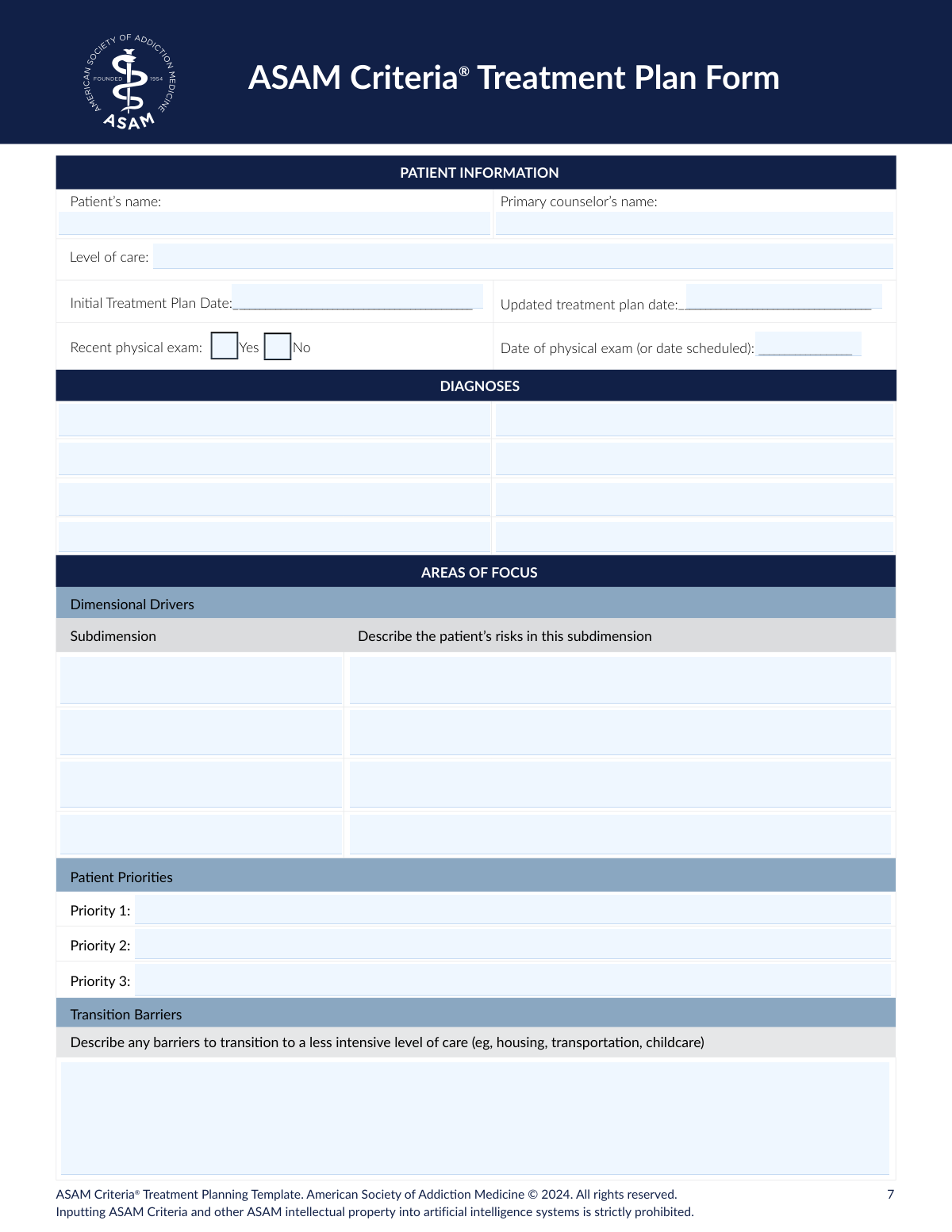
If your goal is to create a comprehensive roadmap for patient recovery, the ASAM Criteria® Treatment Planning Template is the essential document in this category. This form is designed for clinicians, counselors, and intake specialists who need a structured way to manage the complexities of addiction recovery. Use this template to:
- Assess Patient Risks: Systematically evaluate the severity of the patient's condition across the six ASAM dimensions, including intoxication/withdrawal, biomedical conditions, and recovery environment.
- Define Clear Objectives: Establish specific, measurable goals and interventions tailored to the individual's unique needs.
- Plan Transitions: Document the necessary steps for a patient’s transition of care, ensuring continuity as they move between different levels of support.
When to Use This Form
This template is versatile and should be utilized during several key stages of the recovery process:
- Initial Intake: Setting the baseline for treatment and determining the appropriate level of care based on medical necessity.
- Treatment Plan Reviews: Regularly updating goals and priorities as the patient progresses or faces new challenges during their recovery journey.
- Clinical Supervision: Providing a clear, standardized format for supervisors to review a clinician's approach to a specific case and ensure adherence to ASAM standards.
Why Standardize with ASAM?
Using the ASAM Criteria® Treatment Planning Template ensures that your clinical documentation aligns with national standards for addiction medicine. By following this structured format, healthcare providers can ensure they are addressing the full biopsychosocial spectrum of a patient’s needs.
At Instafill.ai, we make it easy to manage these detailed medical assessment forms. Our AI-powered platform helps you fill out the ASAM Criteria® Treatment Planning Template accurately and efficiently, or convert non-fillable versions into interactive forms that save your team valuable time.
Form Comparison
| Form | Primary Purpose | Targeted Users | Key Components |
|---|---|---|---|
| ASAM Criteria® Treatment Planning Template | Develop and document individualized addiction treatment plans based on multidimensional patient risk assessment. | Addiction medicine clinicians, counselors, and multidisciplinary treatment teams in recovery settings. | Risk priorities, patient-centered goals, measurable objectives, and transition of care planning. |
Tips for ASAM forms
Ensure you provide detailed observations for each of the six dimensions, ranging from acute intoxication to recovery environment. Skipping a dimension can result in an incomplete clinical picture and may lead to inaccurate level-of-care recommendations or insurance claim denials.
AI-powered tools like Instafill.ai can complete these complex ASAM forms in under 30 seconds with high accuracy. This technology serves as a major time-saver for clinicians, and your data stays secure throughout the entire process.
When defining objectives within the treatment plan, use SMART goals that incorporate the patient's own words and motivations. Specific, measurable goals make it easier to track progress during follow-up assessments and justify continued care.
The interventions you document should directly correlate to the risk levels identified in the assessment phase. For example, if a patient shows high risk in Dimension 3, the treatment plan must prioritize immediate mental health stabilization and specific behavioral interventions.
Always include a clinical rationale for why a specific level of care is recommended over another. Thorough documentation of medical necessity is critical for passing utilization reviews and ensuring the patient receives the appropriate intensity of services.
Verify that the information entered into the ASAM template matches your progress notes and intake assessments. Discrepancies between different medical records can cause confusion during transitions of care and may raise red flags during external audits.
Frequently Asked Questions
ASAM forms are standardized tools used by healthcare professionals to assess patients with substance use disorders and co-occurring conditions. They help determine the appropriate level of care and guide the development of comprehensive, individualized treatment plans based on clinical evidence.
These forms are typically completed by licensed clinicians, counselors, or social workers specializing in addiction medicine and behavioral health. They use the forms to document clinical findings and ensure that patient care aligns with the American Society of Addiction Medicine's established criteria.
ASAM assessments evaluate six distinct dimensions: acute intoxication/withdrawal potential, biomedical conditions, emotional/behavioral conditions, readiness to change, relapse potential, and recovery environment. This holistic approach ensures that all factors affecting a patient's recovery are considered during treatment planning.
A treatment plan should be updated whenever there is a significant change in the patient's status, such as a transition to a different level of care or the achievement of a major goal. Regular reviews are also often required by insurance providers and accreditation bodies to ensure the treatment remains relevant.
Yes, the ASAM Criteria provides specific frameworks for both adults and adolescents, though the specific considerations and developmental milestones differ. Clinicians use these forms to tailor interventions to the age-appropriate needs of the individual seeking treatment.
Using standardized forms like the ASAM Criteria helps ensure consistency across different treatment facilities and providers. It provides a common language for clinicians and helps insurance companies understand the clinical necessity for specific levels of care, which can streamline the authorization process.
Yes, AI tools like Instafill.ai can be used to fill out ASAM forms by accurately extracting data from clinical notes or source documents and placing it into the correct fields. This technology can complete complex medical forms in under 30 seconds, significantly reducing the administrative burden on healthcare providers.
While manual entry can be time-consuming, using an AI-powered service like Instafill.ai allows users to generate completed forms almost instantly. The AI can process and map data to the treatment planning template in less than 30 seconds, ensuring high accuracy and consistency throughout the document.
Many private insurance companies and state Medicaid programs require documentation based on ASAM Criteria to justify the level of care provided. Using the official treatment planning template helps ensure that all necessary clinical justifications are present to support reimbursement claims.
Completing these forms requires detailed information regarding the patient's medical history, current substance use patterns, psychological status, and social support systems. Clinicians also gather data on the patient's motivation for change and any environmental factors that might impact their recovery journey.
Completed ASAM forms are usually kept in the patient's permanent medical record and may be submitted to insurance companies for utilization review. They are also shared with other members of the patient's multi-disciplinary treatment team to ensure coordinated care across different services.
Glossary
- ASAM Criteria
- The national standard for multidimensional assessment and treatment planning used by clinicians to determine the most appropriate level of care for patients with addiction.
- Six Dimensions
- The assessment framework used to evaluate a patient's risks and strengths across six areas: withdrawal potential, health history, emotional/behavioral health, readiness to change, relapse potential, and recovery environment.
- Level of Care (LOC)
- A designation representing the intensity of treatment services required, ranging from Level 0.5 (early intervention) to Level 4 (medically managed intensive inpatient services).
- Medical Necessity
- The clinical justification used to demonstrate that a specific treatment or level of care is required to address the patient's diagnosed substance use disorder.
- Continuum of Care
- A system of treatment levels that allows patients to move seamlessly between more or less intensive services as their clinical needs change during recovery.
- Withdrawal Management
- A set of medical interventions, formerly known as detoxification, used to safely manage the physical symptoms of stopping substance use.
- Co-occurring Disorders
- The simultaneous presence of both a substance use disorder and a mental health disorder, which requires specialized integrated treatment planning.
- Bio-Psychosocial Assessment
- A holistic evaluation of a patient's biological, psychological, and social history used to inform the goals and objectives within an ASAM treatment plan.