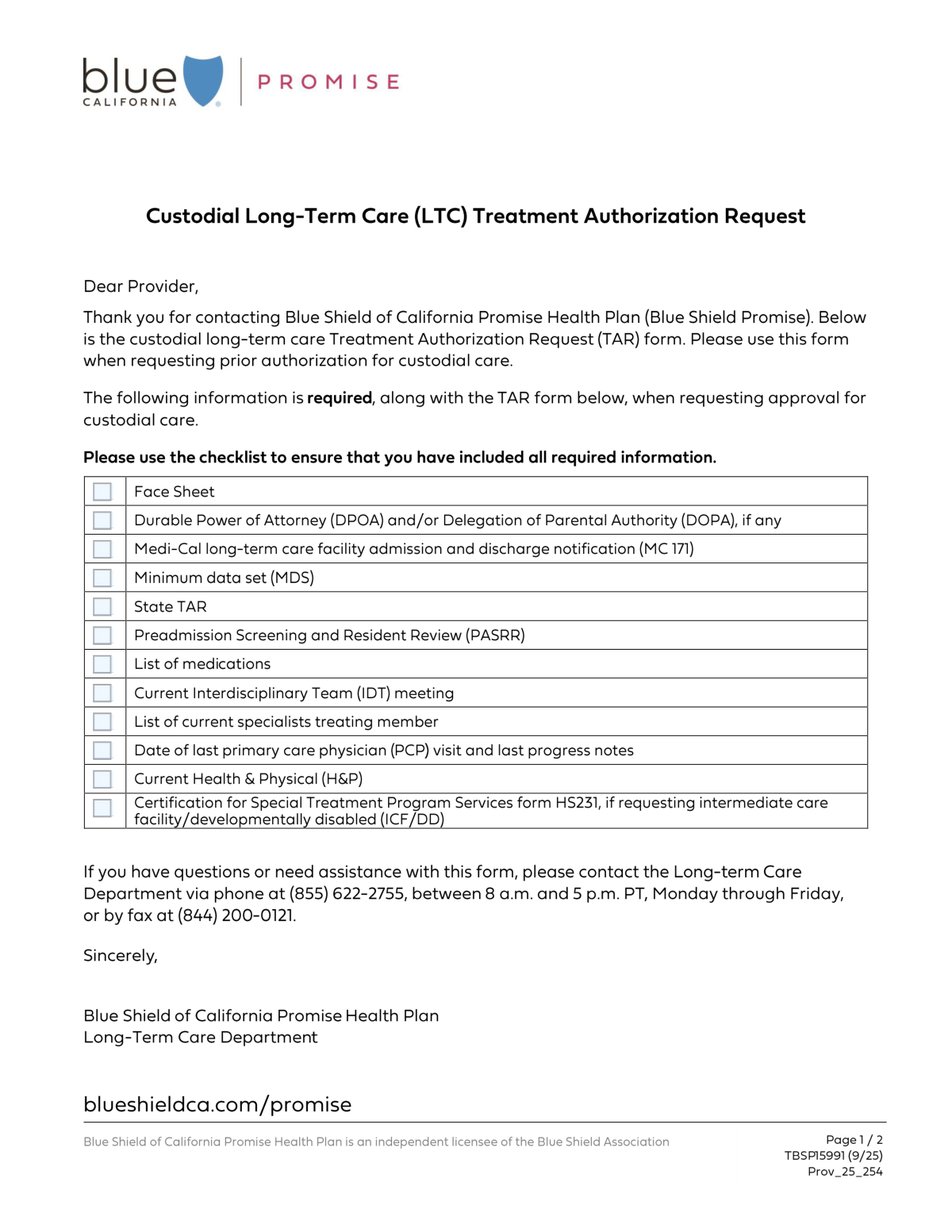
Yes! You can use AI to fill out Blue Shield of California Promise Health Plan Long Term Care Treatment Authorization Request Form
The Blue Shield of California Promise Health Plan Long Term Care Treatment Authorization Request is a formal document used by healthcare providers to seek pre-approval for a patient's admission or continued stay in a long-term care facility. Submitting this form is a critical step to confirm that the services are medically necessary and covered by the member's plan, ensuring proper reimbursement and continuity of care. Today, this form can be filled out quickly and accurately using AI-powered services like Instafill.ai, which can also convert non-fillable PDF versions into interactive fillable forms.
Our AI automatically handles information lookup, data retrieval, formatting, and form filling.
It takes less than a minute to fill out Blue Shield Promise LTC TAR Form using our AI form filling.
Securely upload your data. Information is encrypted in transit and deleted immediately after the form is filled out.
Form specifications
| Form name: | Blue Shield of California Promise Health Plan Long Term Care Treatment Authorization Request Form |
| Number of fields: | 83 |
| Number of pages: | 2 |
| Language: | English |
| Categories: | authorization forms, Blue Shield of California forms, CAR forms, health care forms, health forms, health treatment forms, L.A. Care forms, treatment plan forms |
Instafill Demo: How to fill out PDF forms in seconds with AI
How to Fill Out Blue Shield Promise LTC TAR Form Online for Free in 2026
Are you looking to fill out a BLUE SHIELD PROMISE LTC TAR FORM form online quickly and accurately? Instafill.ai offers the #1 AI-powered PDF filling software of 2026, allowing you to complete your BLUE SHIELD PROMISE LTC TAR FORM form in just 37 seconds or less.
Follow these steps to fill out your BLUE SHIELD PROMISE LTC TAR FORM form online using Instafill.ai:
- 1 Navigate to Instafill.ai and upload the Long Term Care TAR form or select it from the template library.
- 2 Use the AI assistant to automatically fill in patient information, including name, address, and identification numbers (CIN, Patient ID).
- 3 Enter the patient's diagnosis, medical status, and details regarding Medicare or Medi-Cal eligibility.
- 4 Provide the complete information for the requesting physician and the long-term care facility, including names, addresses, NPI, and Tax ID numbers.
- 5 Specify the type of request (e.g., Initial, Reauthorization) and the requested level of care (e.g., Skilled Nursing Facility, Intermediate Care Facility).
- 6 Use the checklist on the form to indicate all supporting documents being submitted with the request, such as the MDS, PASRR, and physician progress notes.
- 7 Review all entered data for accuracy, then securely e-sign and submit the completed authorization request.
Our AI-powered system ensures each field is filled out correctly, reducing errors and saving you time.
Why Choose Instafill.ai for Your Fillable Blue Shield Promise LTC TAR Form Form?
Speed
Complete your Blue Shield Promise LTC TAR Form in as little as 37 seconds.
Up-to-Date
Always use the latest 2026 Blue Shield Promise LTC TAR Form form version.
Cost-effective
No need to hire expensive lawyers.
Accuracy
Our AI performs 10 compliance checks to ensure your form is error-free.
Security
Your personal information is protected with bank-level encryption.
Frequently Asked Questions About Form Blue Shield Promise LTC TAR Form
This form is used to request authorization for long-term care services, such as placement in a skilled nursing facility (SNF), sub-acute care, or an intermediate care facility (ICF). It gathers the necessary patient, physician, and facility information to review the medical necessity of the request.
Typically, a healthcare provider, such as the physician's office or staff at the long-term care facility, completes this form on behalf of the patient. It requires detailed medical and provider information that the patient may not have readily available.
You must include several supporting documents, such as the Face Sheet, a current list of medications, recent physician progress notes, and the Minimum Data Set (MDS). Use the checklist at the top of the form to ensure all required paperwork is attached to avoid delays.
The Patient Identification Number is a general ID assigned by the health plan or facility, while the Client Identification Number (CIN) is a specific ID assigned to Medi-Cal beneficiaries. Be sure to enter both numbers accurately if the patient has them.
You only need to complete the facility information section if you are requesting placement in a specific type of facility, such as a Skilled Nursing Facility (SNF) or Intermediate Care Facility (ICF). This section can be left blank if the request is for other services like home health.
This date is required only if the patient is eligible for Medicare. It helps determine the coordination of benefits and confirms when Medi-Cal or another payer may become the primary source for payment for the requested services.
Select 'Initial' for a brand new request for services. Choose 'Reauthorization' to extend an already approved service period, and use 'Bed Hold / LOA' to reserve the patient's spot at a facility during a temporary leave of absence, like a hospital stay.
If you are requesting services at an ICF/DD, you must also include the 'Certification for Special Treatment Program Services form HS231'. You should also check the 'Developmental Disability (DD)' box in the patient's medical information section.
The National Provider Identifier (NPI) and Tax Identification Number (TIN) are unique IDs for healthcare providers and facilities. This information should be available from the physician's or facility's administrative office.
Processing times can vary depending on the urgency of the request and the completeness of the submitted information. Submitting the form with all required supporting documents will help avoid delays in the review process.
Yes, services like Instafill.ai use AI to accurately auto-fill form fields from your saved information, which can save significant time and reduce errors. This is especially helpful for providers who fill out these forms frequently.
You can use a service like Instafill.ai to upload the form and fill it out directly on your computer. The platform allows you to type information, check boxes, and save your progress digitally before printing or submitting.
If you have a non-fillable PDF, you can use a tool like Instafill.ai to convert it into an interactive, fillable form. This allows you to easily type your answers into the fields instead of having to print and fill it out by hand.
Use the 'Additional Comments' section to provide any extra context or information that is relevant to the request but doesn't fit elsewhere on the form. This could include details about the patient's social situation, specific care needs, or justification for the request.
Compliance Blue Shield Promise LTC TAR Form
Validation Checks by Instafill.ai
1
Conditional Medicare Exhaustion Date Requirement
This check ensures that the 'Medicare Benefits Exhaustion Date' field is populated with a valid date if the 'Yes (Eligible for Medicare)' checkbox is selected. It is important for verifying secondary payer status and coordinating benefits. If the patient is marked as Medicare eligible but the exhaustion date is missing, the form submission should be blocked until the date is provided.
2
Exclusive Request Type Selection
Validates that only one of the request type checkboxes ('Initial', 'Reauthorization', 'Bed Hold / LOA', 'Discharge Notice') is selected. A single submission can only represent one type of request for clarity and correct processing workflow. If more than one option is selected, an error message should prompt the user to select only one.
3
National Provider Identifier (NPI) Format
This check verifies that both the Physician and Facility 'National Provider Identifier (NPI)' fields contain exactly 10 digits. The NPI is a standard, unique identifier for health care providers, and an incorrect format can lead to claim rejections and identification errors. Submissions with invalid NPI formats should be rejected until corrected.
4
Tax Identification Number (TIN) Format
Ensures that the 'Tax Identification Number (TIN)' for both the physician and the facility is a 9-digit number. This is a standard format required for financial and regulatory reporting. An invalid TIN can cause significant processing and payment delays, so the form should not be accepted until the format is correct.
5
Date of Birth and Age Consistency
This validation compares the patient's 'Date of Birth' with the entered 'Age' to ensure they are consistent. This cross-reference helps catch data entry errors in either field, which is critical for accurate patient identification and eligibility verification. If the age does not correctly correspond to the date of birth, the user should be prompted to review and correct the information.
6
Conditional Facility Information Completeness
This check ensures that if any facility type ('Sub-acute', 'SNF', 'ICF', etc.) is selected, then all related facility information fields (Name, Contact, TIN, NPI, Phone, Address) must be filled out. This is crucial because facility selection implies that care is being provided or requested at that location, making its details essential for authorization and communication. A failure would prevent submission until all required facility details are provided.
7
ICF Request and HS231 Form Consistency
Validates that if 'Intermediate care facility (ICF)' is selected as the requested facility type, the 'Certification for Special Treatment Program Services form HS231' checkbox must also be checked. This enforces a procedural dependency, ensuring that requests for specialized ICF services are accompanied by the required certification documentation. If the form is not checked, an alert should inform the user of the requirement.
8
Patient Identifier Requirement
This check ensures that at least one of the patient's primary identifiers, either the 'Patient Identification Number' or the 'Client Identification Number (CIN)', is provided. A unique identifier is fundamental for accurately locating the patient's record and preventing misidentification. The form submission should fail if neither identifier is present.
9
Exclusive Gender Selection
Verifies that only one gender option ('Male', 'Female', 'Non-binary') is selected for the patient. Selecting multiple options is a logical impossibility and indicates a data entry error. The system should enforce a radio button-like behavior, and if a data import allows multiple selections, it should be flagged as an error requiring correction.
10
Standard Phone and Fax Number Format
This validation checks that all phone and fax number fields ('Patient Phone Number', 'Office Phone Number', 'Office Fax Number', etc.) adhere to a standard 10-digit format (e.g., XXX-XXX-XXXX). Correctly formatted numbers are essential for successful communication with the patient, physician, and facility. An invalid format should trigger an error message requesting the user to correct the entry.
11
Request Date and Time Validity
This check ensures the 'Request Date' is not a future date and the 'Time of Request' is in a valid time format. This is important for maintaining an accurate and logical audit trail of the request submission. A request dated in the future is invalid and should be corrected before the form can be submitted.
12
Developmental Disability and HS231 Form Link
This validation ensures that the 'Developmental Disability (DD)' checkbox can only be selected if the 'Certification for Special Treatment Program Services form HS231' checkbox is also selected. This rule links a specific diagnosis type to its required supporting documentation, ensuring compliance with submission protocols. If 'DD' is checked without the HS231 form being checked, the user should be notified of the missing documentation requirement.
Common Mistakes in Completing Blue Shield Promise LTC TAR Form
Users often focus on filling out text fields and overlook the initial checklist for supporting documentation like the 'Face Sheet' or 'List of medications'. This leads reviewers to assume the submission is incomplete, causing processing delays or rejection while they request the 'missing' items. To prevent this, use the checklist to confirm every required document is accounted for before submission.
The form requires facility details like NPI and TIN only when specific facility types (e.g., 'Skilled nursing facility (SNF)') are selected. A common error is selecting one of these facility types but then failing to provide the corresponding facility information. This omission makes it impossible to process the request for that facility, leading to rejection and requiring a corrected resubmission.
When a patient is marked as 'Eligible for Medicare', the 'Medicare Benefits Exhaustion Date' becomes a mandatory field for determining payer responsibility. Applicants frequently check 'Yes' for Medicare but forget to enter this date, especially if it's not readily available. This incomplete data halts the authorization process, as the reviewing entity cannot verify coverage.
Fields like the physician's NPI, facility's TIN, and patient's CIN require precise, error-free entry. Simple data entry mistakes, such as transposing digits, are very common with these long numeric identifiers. An incorrect number can lead to failed verification, claim rejections, and significant delays as it prevents the system from correctly identifying the parties involved.
Users are required to enter both the patient's 'Date of Birth' and their current 'Age'. A frequent mistake is a mismatch between these two fields, often due to a manual calculation error or using an outdated record for the age. This discrepancy raises data integrity flags and can require clarification, slowing down the review process.
The form requires the user to specify the request's purpose by selecting one option: 'Initial', 'Reauthorization', 'Bed Hold / LOA', or 'Discharge Notice'. A common error is either selecting multiple conflicting options or failing to select any at all. This ambiguity forces the reviewer to guess the request's intent or return the form for clarification, causing unnecessary delays.
The form states that 'form HS231' is required when requesting an 'Intermediate care facility (ICF)'. A critical error is selecting 'ICF' as the facility type but failing to check the box indicating the HS231 form is included. This automatically renders the submission incomplete for an ICF request, leading to immediate rejection and delaying care for a vulnerable population.
A serious error is checking boxes in the document checklist (e.g., 'MDS', 'Preadmission Screening') but then failing to actually attach the corresponding documents to the submission. This creates a misleading and incomplete packet that is always rejected upon review. It is crucial to use the checklist as a final verification step to ensure every indicated document is physically or digitally included.
The medical 'Diagnosis' provided must logically justify the requested services and patient status (e.g., 'Bedridden'). An error occurs when the stated diagnosis does not align with a request for a high level of care, raising red flags for medical necessity. This often triggers a more intensive review, a request for more detailed clinical notes, or denial of the request.
Contact information like the 'Patient Phone Number' and 'Office Phone Number' is essential for follow-up questions. People often enter phone numbers without area codes, include unnecessary characters, or use an incorrect format, which can cause communication breakdowns. Using an AI-powered tool like Instafill.ai can help prevent this by automatically formatting phone numbers and other data correctly, ensuring reviewers can easily make contact.
Saved over 80 hours a year
“I was never sure if my IRS forms like W-9 were filled correctly. Now, I can complete the forms accurately without any external help.”
Kevin Martin Green
Your data stays secure with advanced protection from Instafill and our subprocessors

Robust compliance program
Transparent business model
You’re not the product. You always know where your data is and what it is processed for.
ISO 27001, HIPAA, and GDPR
Our subprocesses adhere to multiple compliance standards, including but not limited to ISO 27001, HIPAA, and GDPR.
Security & privacy by design
We consider security and privacy from the initial design phase of any new service or functionality. It’s not an afterthought, it’s built-in, including support for two-factor authentication (2FA) to further protect your account.
Fill out Blue Shield Promise LTC TAR Form with Instafill.ai
Worried about filling PDFs wrong? Instafill securely fills blue-shield-of-california-promise-health-plan-long-term-care-treatment-authorization-request-form forms, ensuring each field is accurate.