Yes! You can use AI to fill out IBC/ CBC ABA Treatment Plan/Concurrent Review Template

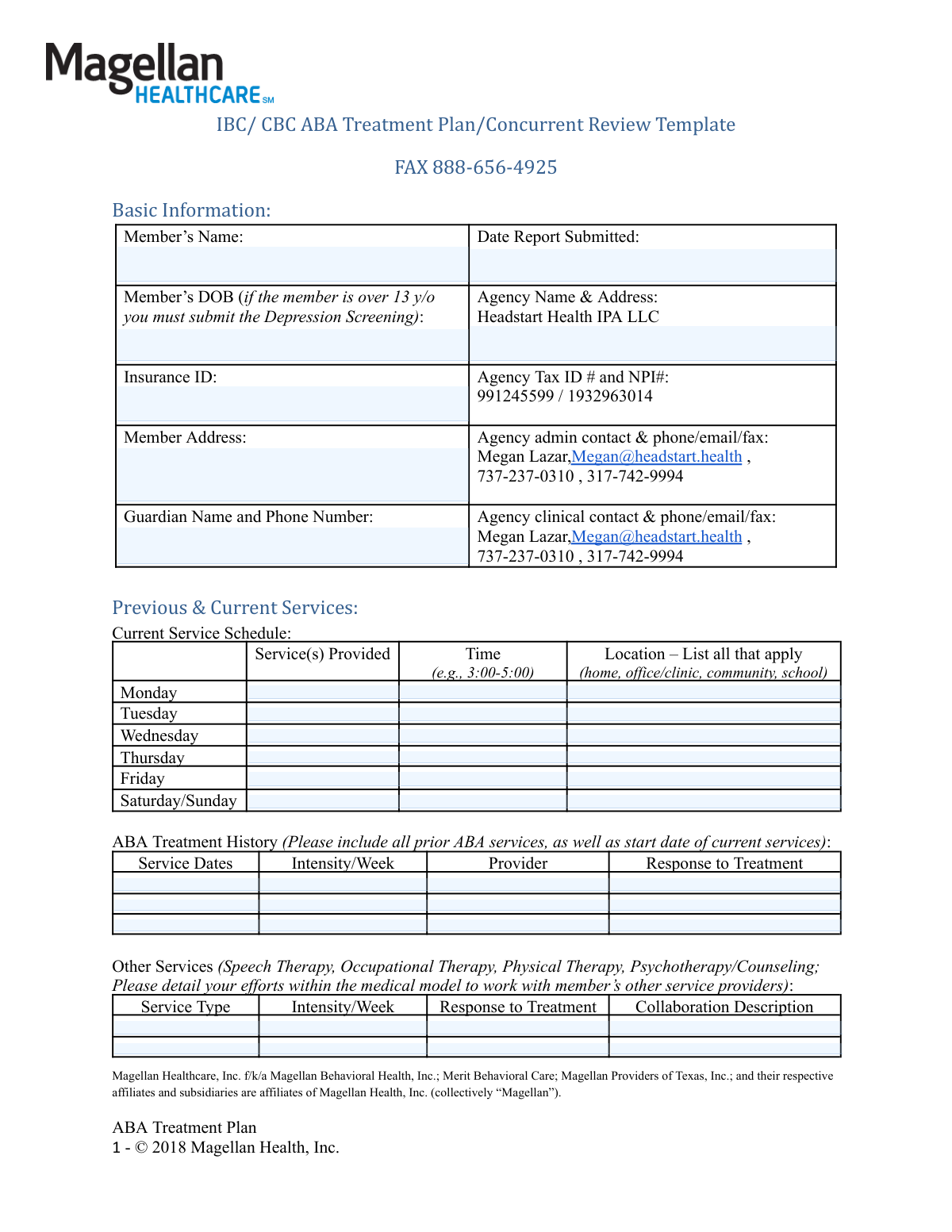
This form is a detailed template for creating and reviewing an Applied Behavior Analysis (ABA) treatment plan for members covered by IBC (Independence Blue Cross) or CBC (Capital Blue Cross). It is used by providers to document a member's history, diagnoses, current service schedule, behavioral and skill acquisition goals, and progress to justify the medical necessity of services for insurance authorization. Today, this form can be filled out quickly and accurately using AI-powered services like Instafill.ai, which can also convert non-fillable PDF versions into interactive fillable forms.
IBC/CBC ABA Treatment Plan is part of the ABA treatment forms, plan review forms and treatment plan forms categories on Instafill.
Our AI automatically handles information lookup, data retrieval, formatting, and form filling.
It takes less than a minute to fill out IBC/CBC ABA Treatment Plan using our AI form filling.
Securely upload your data. Information is encrypted in transit and deleted immediately after the form is filled out.

Form specifications

Form name: IBC/ CBC ABA Treatment Plan/Concurrent Review Template
Number of fields: 304
Number of pages: 7
Language: English
main-image

Instafill Demo: How to fill out PDF forms in seconds with AI

How to Fill Out IBC/CBC ABA Treatment Plan Online for Free in 2026

Are you looking to fill out a IBC/CBC ABA TREATMENT PLAN form online quickly and accurately? Instafill.ai offers the #1 AI-powered PDF filling software of 2026, allowing you to complete your IBC/CBC ABA TREATMENT PLAN form in just 37 seconds or less.
Follow these steps to fill out your IBC/CBC ABA TREATMENT PLAN form online using Instafill.ai:
  1. 1 Navigate to Instafill.ai and upload or select the IBC/CBC ABA Treatment Plan template.
  2. 2 Use the AI assistant to automatically populate basic information, including the member's name, DOB, insurance ID, and agency details.
  3. 3 Enter the member's treatment history, current service schedule, and information about other therapies, collaborating with the AI to ensure all fields are complete.
  4. 4 Input detailed clinical data, such as diagnoses, medications, and scores from developmental assessments like the ABAS-3 or Vineland-3.
  5. 5 Define specific behavior reduction, skill acquisition, and caregiver training goals, including baseline data, mastery criteria, and progress summaries.
  6. 6 Outline the plan for generalization, maintenance, and discharge, and specify the recommended services with CPT codes and hours.
  7. 7 Review all AI-populated and manually entered information for accuracy, then e-sign and submit the completed treatment plan.

Our AI-powered system ensures each field is filled out correctly, reducing errors and saving you time.

Why Choose Instafill.ai for Your Fillable IBC/CBC ABA Treatment Plan Form?

Speed

Complete your IBC/CBC ABA Treatment Plan in as little as 37 seconds.

Up-to-Date

Always use the latest 2026 IBC/CBC ABA Treatment Plan form version.

Cost-effective

No need to hire expensive lawyers.

Accuracy

Our AI performs 10 compliance checks to ensure your form is error-free.

Security

Your personal information is protected with bank-level encryption.

Frequently Asked Questions About Form IBC/CBC ABA Treatment Plan

This form is used by ABA providers to submit a detailed treatment plan or a concurrent review to Magellan Healthcare. It is used to request authorization for ABA services for a member covered by IBC (Independence Blue Cross) or CBC (Capital Blue Cross).

A qualified clinical professional, such as a Board Certified Behavior Analyst (BCBA) or another licensed clinician overseeing the member's ABA treatment, is responsible for completing and submitting this form.

The completed form, along with all required attachments like graphs and assessments, must be faxed to 888-656-4925. Ensure the provider's signature with degree and licensure is included.

Yes, a completed ABAS-3 or Vineland-3 assessment is required. The form specifies that an updated assessment must be included every 6 months and should be completed by a consistent rater.

For each maladaptive behavior, you must provide a clear definition, its function, baseline data, and strategies. A behavior reduction graph showing baseline data and progress over time is mandatory for each of these goals.

If the member is 13 or older, you are required to complete the Depression Screening section. You must ask the member or their guardian the two questions provided and indicate their 'YES' or 'NO' response.

If the member is not enrolled in school with an IEP, you must provide a rationale explaining why. You also need to describe the family's plan to have the member enrolled in school or obtain an IEP.

Yes, the form requires you to include and track at least two caregiver goals. These goals must be measurable and focus on the caregiver's behavior, not just passive activities like watching videos.

You must detail each requested service with its CPT code, modifier, requested hours per week, location, and number of days per week. Note that a 20% supervision-to-direct-hours ratio is standard, and any deviation requires clinical rationale.

This section requires measurable discharge goals that clearly state the criteria for reducing care or graduating from ABA services. The plan should be realistic and based on the member's assessments, progress, and age.

Yes, services like Instafill.ai use AI to auto-fill form fields accurately and save time. This can be especially helpful for repetitive information like agency details, member demographics, and service codes.

Simply upload the ABA Treatment Plan PDF to the Instafill.ai platform. The AI will make all the fields interactive, allowing you to type in your information, save progress, and download the completed document securely.

If you have a non-fillable or 'flat' PDF, you can use a service like Instafill.ai to convert it into an interactive, fillable form. Just upload the document, and the platform will automatically detect the fields for you to complete online.

Compliance IBC/CBC ABA Treatment Plan
Validation Checks by Instafill.ai

Common Mistakes in Completing IBC/CBC ABA Treatment Plan

Incomplete or Invalid Caregiver Training Goals

The form requires at least two caregiver goals that specifically measure the caregiver's behavior, not just their attendance or passive participation. A common mistake is writing goals like 'Caregiver will attend training' instead of 'Caregiver will implement the 3-step prompting procedure with 90% accuracy.' This error occurs due to a misunderstanding of the requirement and can lead to requests for clarification or denial of services, as caregiver involvement is critical for treatment success. To avoid this, ensure goals are active, measurable, and focus on the caregiver's application of learned skills.

Vague or Non-Measurable Discharge Criteria

Providers often enter generic statements like 'Member will be ready for a less restrictive environment' in the Discharge Criteria section. The form explicitly asks for measurable, terminal goals based on assessments and progress. This mistake happens because predicting an exact discharge date is difficult, but it results in a plan that appears incomplete and lacks a clear endpoint, potentially delaying authorization. To prevent this, create specific criteria tied to assessment scores (e.g., 'Achieve a standard score of 85 in the Vineland Socialization domain') or sustained low rates of maladaptive behaviors.

Incorrect Formatting in 'Recommended Services' Table

The 'Recommended Services' table has specific formatting rules that are frequently missed, such as separating service locations like 'school' and 'daycare' from 'home' and 'community'. Another common error is requesting a supervision ratio above the 20% standard without providing the required clinical rationale in the designated space. These mistakes can lead to incorrect service authorizations, payment delays, or the need for resubmission. Carefully reading all instructions for this critical section is essential for avoiding these issues.

Omitting Required Collaboration Details

The form contains multiple sections asking for descriptions of collaboration with other providers, such as speech therapists, OTs, and prescribing physicians. Many users leave these fields blank or provide minimal detail. This omission can be interpreted by reviewers as a lack of a coordinated, 'medical model' approach to care, which may weaken the justification for services. To avoid this, document all attempts at communication and coordination, even if they are pending, to demonstrate a comprehensive treatment approach.

Missing Mandatory Conditional Information

The form includes fields that are required only under certain conditions, which are often overlooked. For example, if a member is over 13, the depression screening is mandatory, and if the member is not in school with an IEP, a rationale is required. Failing to complete these conditional fields leads to an incomplete submission and guaranteed delays as the reviewer must request the missing information. The best way to avoid this is to review the form for conditional logic before submission, ensuring all required follow-up questions are answered.

Improper Behavior Reduction Graphing

Submitting a treatment plan without the required behavior reduction graph, or with a poorly formatted one, is a frequent error. The instructions specify that graphs must include the initial baseline, have equal-interval units on the X-axis, and use phase change lines to denote intervention changes. These mistakes happen due to technical difficulty or rushing, but they prevent reviewers from visually assessing progress, which is a key component of the review. Using charting software that enforces these formatting rules can help ensure compliance.

Altering Static Baseline Assessment Data

In the 'Adaptive Developmental Assessment' section for the ABAS or Vineland, the form explicitly states 'Baseline information should never change.' However, on concurrent review forms, providers sometimes mistakenly overwrite the original baseline scores with current data. This error destroys the point of comparison and makes it impossible to track progress over time, often leading to rejection of the report. To avoid this, always copy the original baseline data exactly as it was on the initial report and enter new scores only in the 'Current' columns.

Inconsistent Member Identification Information

Entering a member's name, date of birth, or insurance ID with typos, using a nickname instead of a legal name, or using an incorrect date format is a very common data entry error. This happens due to simple human error but has significant consequences, as it can cause the submission to be rejected by automated systems or fail to be matched with the correct member file. This leads to billing issues and delays in care authorization. Using an AI-powered form-filling tool like Instafill.ai can prevent this by saving and auto-filling validated information, ensuring consistency across all documents.

Missing Signature Credentials

The signature line explicitly requires the provider's signature to be accompanied by their degree and/or licensure (e.g., 'BCBA, LBA'). It is a common oversight to provide only the signature without the required credentials. This seemingly small mistake can invalidate the entire legal and clinical attestation of the document, forcing a resubmission and delaying the review process. Always double-check that your full, correct credentials are listed next to your signature as required.

Failing to Complete All Fields in Data-Intensive Tables

The form includes numerous tables with multiple columns, such as the 'ABA Treatment History' and 'Diagnosis' sections. Users often leave columns blank, for example, omitting the 'Provider' in the treatment history or the 'Severity Level' for a diagnosis. This happens when the information is not readily available, but it results in an incomplete clinical picture for the reviewer. Since this form is a non-fillable PDF, manually filling every box is tedious and error-prone. A tool like Instafill.ai can convert the PDF into a fillable version and guide the user through all required fields to ensure no data points are missed.
Saved over 80 hours a year

“I was never sure if my IRS forms like W-9 were filled correctly. Now, I can complete the forms accurately without any external help.”

Kevin Martin Green

Your data stays secure with advanced protection from Instafill and our subprocessors

Robust compliance program

Transparent business model

You’re not the product. You always know where your data is and what it is processed for.

ISO 27001, HIPAA, and GDPR

Our subprocesses adhere to multiple compliance standards, including but not limited to ISO 27001, HIPAA, and GDPR.

Security & privacy by design

We consider security and privacy from the initial design phase of any new service or functionality. It’s not an afterthought, it’s built-in, including support for two-factor authentication (2FA) to further protect your account.

Fill out IBC/CBC ABA Treatment Plan with Instafill.ai

Worried about filling PDFs wrong? Instafill securely fills ibc-cbc-aba-treatment-planconcurrent-review-template forms, ensuring each field is accurate.