Fill out ABA treatment forms
with AI.
Applied Behavior Analysis (ABA) treatment forms are essential components of the clinical and administrative workflow for managing Autism Spectrum Disorder (ASD) therapy. These documents facilitate the communication between healthcare providers, insurance carriers, and state agencies to ensure that patients receive necessary interventions. They cover a range of critical functions, from initial biopsychosocial assessments and treatment planning to specific precertification requests required by major insurers like Aetna or state programs like Alabama Medicaid. Accurate documentation is vital for establishing medical necessity, tracking patient progress against measurable goals, and securing the authorization needed to begin or continue life-changing therapy sessions.
By continuing, you acknowledge Instafill's Privacy Policy and agree to get occasional product update and promotional emails.
About ABA treatment forms
These forms are primarily utilized by Board-Certified Behavior Analysts (BCBAs), clinical supervisors, and administrative staff within behavioral health clinics. They are typically required during the intake process, during periodic re-evaluations, or when submitting treatment requests for insurance adjudication. For instance, forms like the Outpatient Behavioral Health ABA Treatment Request or a comprehensive Biopsychosocial Assessment must capture detailed diagnostic data, CPT codes, and specific treatment hours to satisfy rigorous clinical review standards. Navigating these requirements can be time-consuming for providers who would rather focus on patient care than complex paperwork.
Managing this volume of documentation often involves handling non-fillable PDFs and repetitive data entry. Tools like Instafill.ai use AI to fill these forms in under 30 seconds, ensuring that data is handled accurately and securely while significantly reducing administrative overhead. This allows clinicians to maintain high standards of documentation without the traditional manual burden.
Every form on this page can be completed without typing. Instafill is form filling software that reads a PDF and fills it for you — including flat and scanned documents that carry no fillable fields at all.
Forms in This Category
The forms in this category have a median Form Complexity Index of 58/100 (Moderate), measured across 6 forms by field count, input difficulty, length, conditional logic and structure. See how it is calculated.
- Enterprise-grade security & data encryption
- 99%+ accuracy powered by AI
- 1,000+ forms from all industries
- Complete forms in under 60 seconds
How to Choose the Right Form
Selecting the right Applied Behavior Analysis (ABA) form depends primarily on your patient's insurance provider and whether you are performing an initial assessment or requesting ongoing treatment authorization.
Insurance-Specific Precertification
If you are a provider seeking authorization for services under specific health plans, you must use the carrier's designated document to avoid claim denials:
- Aetna and Associated Plans: For the most current requirements (including Innovation Health and Banner | Aetna), use the Outpatient Behavioral Health (BH) – ABA Treatment Request (GR-69017-4). This is the updated standard for medical necessity reviews. Alternatively, some plans may still reference Form BHVH, Outpatient Behavioral Health – ABA Treatment Request for standard precertification.
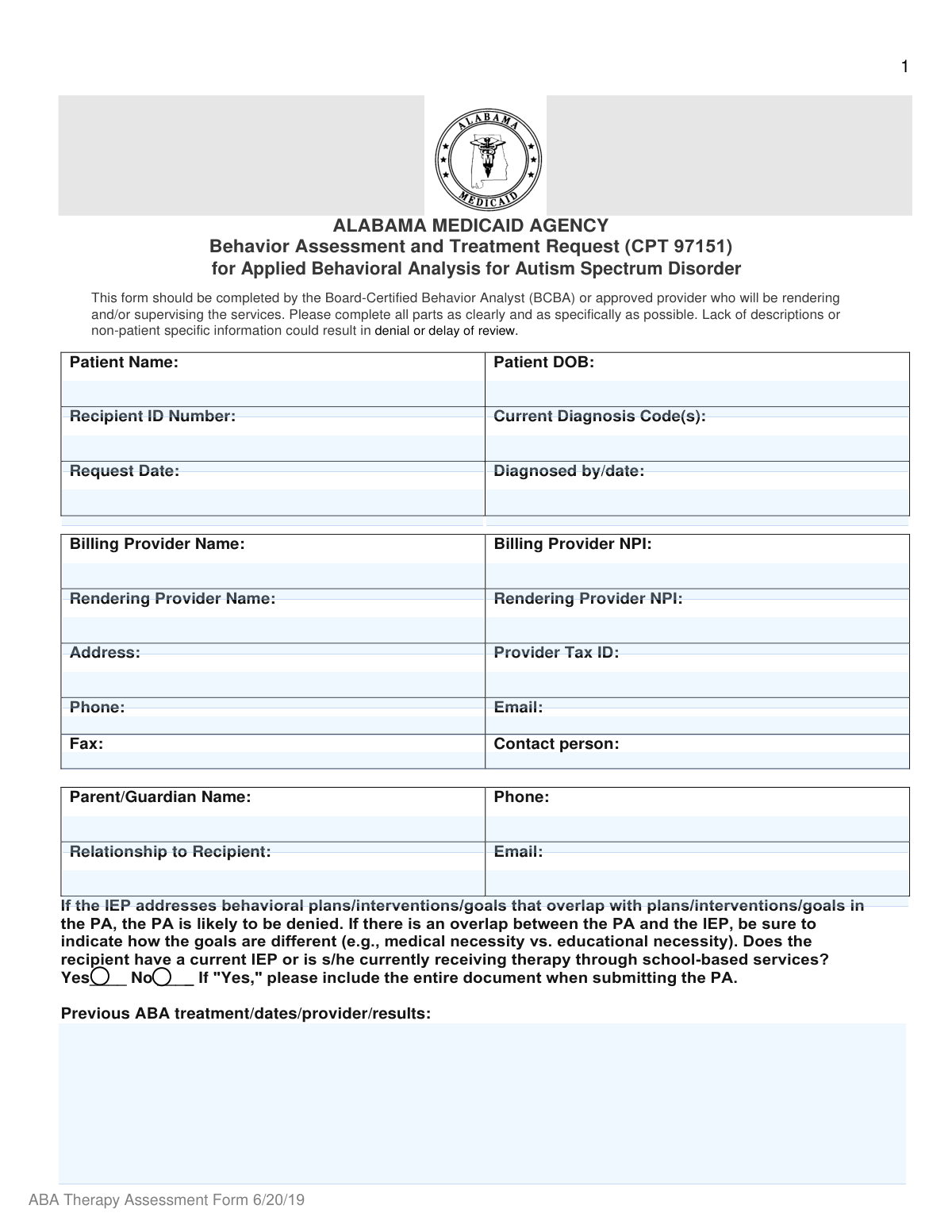
- Alabama Medicaid: If your patient is covered under Alabama Medicaid, you must use the Alabama Medicaid Agency ABA Therapy Assessment Form (6/20/19). This form is specifically tailored for CPT code 97151 and requires detailed information regarding the patient's IEP status and DSM-5 criteria to distinguish clinical therapy from educational services.
Clinical Assessment and Treatment Planning
If you are in the initial diagnostic or intake phase and need a comprehensive template that isn't tied to a single specific private insurer, choose the Biopsychosocial Assessment and ABA Treatment Plan.
This document is essential for:
- Gathering detailed family, medical, and developmental histories.
- Establishing baselines for targeted behaviors.
- Creating the individualized treatment goals that will eventually be used to justify service hours on the insurance-specific request forms mentioned above.
Quick Selection Tips
- For Aetna: Prioritize form GR-69017-4 for all new requests to ensure compliance with upcoming 2026 standards.
- For Medicaid (AL): Ensure the Alabama Medicaid Agency ABA Therapy Assessment Form is completed by a BCBA, as incomplete clinical history is a primary cause for authorization delays.
- For Internal Records: Use the Biopsychosocial Assessment to build the clinical foundation of your case before transferring data to precertification forms.
Form Comparison
| Form | Purpose | Who Files It | When to Use |
|---|---|---|---|
| Form BHVH, Outpatient Behavioral Health – ABA Treatment Request | Request precertification for ABA therapy under Aetna plans | Attending provider or treating clinician | Before starting ABA treatment requiring Aetna authorization |
| Alabama Medicaid Agency ABA Therapy Assessment Form (6/20/19) | Request Medicaid authorization for ABA behavior assessment (CPT 97151) | Board-Certified Behavior Analyst (BCBA) or approved provider | When seeking Alabama Medicaid approval for ABA assessment services |
| Outpatient Behavioral Health (BH) – ABA Treatment Request: Required Information for Precertification (GR-69017-4) | Precertification of outpatient ABA therapy for Aetna-affiliated plans | Patient's attending provider with clinical credentials | Effective January 1, 2026, replaces all prior Aetna ABA precert forms |
| Biopsychosocial Assessment and ABA Treatment Plan | Comprehensive clinical assessment and individualized ABA treatment planning | Board Certified Behavior Analyst (BCBA) | At intake or treatment planning to justify services and track progress |
Tips for ABA treatment forms
When filling out ABA treatment requests, always include specific DSM-5 diagnostic criteria and standardized test scores to demonstrate medical necessity. Insurance providers require this level of detail to justify the requested treatment hours and prevent adjudication delays.
It is vital to specify how ABA therapy differs from services provided through a school’s Individualized Education Program (IEP). Clearly stating that these clinical services are distinct and not duplicative of school-based support helps reviewers approve the request more efficiently.
For every targeted behavior in the treatment plan, provide a clear baseline and a measurable, time-bound goal. This data allows providers to track progress effectively and proves to payers that the intervention is yielding clinical results over time.
Completing complex multi-section ABA forms can be time-consuming for busy BCBAs and administrative staff. AI-powered tools like Instafill.ai can complete these forms in under 30 seconds with high accuracy while ensuring your sensitive data stays secure throughout the process.
A frequent cause for denial is missing or incorrect provider information, such as NPI numbers or Board-Certified Behavior Analyst (BCBA) credentials. Double-check that all supervising provider details are current and match the billing information on file with the health plan.
Do not overlook the importance of family, medical, and developmental history in the biopsychosocial assessment section. A holistic view of the client’s environment provides the necessary context for personalized care and helps justify the intensity of the proposed treatment plan.
Ensure that the CPT codes used align perfectly with the number of units or hours being requested for authorization. Discrepancies between the requested hours and the listed procedure codes are a common mistake that can lead to administrative rejections.
Frequently Asked Questions
ABA treatment forms are essential documents used by healthcare providers to request authorization for Applied Behavior Analysis services for individuals with Autism Spectrum Disorder. They provide insurance companies and state agencies with clinical evidence of medical necessity, treatment goals, and progress tracking. Completing these accurately ensures that patients receive the appropriate level of care and that providers are reimbursed for their services.
Generally, these forms are completed by a Board-Certified Behavior Analyst (BCBA) or the attending healthcare provider who is overseeing the patient's treatment. While parents or guardians may provide some demographic information, the clinical sections require professional evaluation and diagnostic data. The supervising provider must sign off on the treatment plan and the specific hours being requested.
The form you need depends primarily on the patient's insurance provider and the specific state's requirements. For example, Aetna members require specific precertification forms like the BHVH or the GR-69017-4, while Alabama Medicaid patients must use the state-specific assessment form. Always check with the insurance carrier or the state Medicaid agency to ensure you are using the most current version required for their plan.
Precertification is a process where the insurance company reviews the proposed ABA treatment plan before services begin to determine if they are medically necessary and covered under the member's plan. Submitting forms like the Aetna BHVH helps prevent claim denials later by securing approval upfront. This process typically requires detailed information about the patient's diagnosis and the specific CPT codes being billed.
Yes, you can use AI tools to streamline the process of completing ABA treatment forms. Services like Instafill.ai can accurately extract data from source documents, such as clinical notes or diagnostic reports, and place it directly into the required PDF fields. This reduces manual entry errors and ensures that all technical clinical data is transferred correctly from your records to the official form.
A biopsychosocial assessment provides a holistic view of the patient, including their medical history, family dynamics, and developmental milestones. This comprehensive background is crucial for BCBAs to develop an individualized treatment plan that addresses the root causes of specific behaviors. Insurance companies often require this assessment to justify the intensity and duration of the requested ABA hours.
Filling out complex ABA forms manually can take hours, but using AI-powered tools like Instafill.ai can reduce that time to under 30 seconds. The AI quickly parses your clinical documentation and populates the form fields, allowing providers to focus more on patient care rather than paperwork. This efficiency is particularly helpful for multi-page requests that require repetitive data entry.
Before starting the form, you should have the patient's diagnostic evaluation, current Individualized Education Program (IEP) if applicable, and recent baseline data for targeted behaviors. You will also need the provider's credentials, NPI numbers, and the specific CPT codes for the services being requested. Having these documents organized allows for a smoother and more accurate filing process.
Yes, Medicaid programs often have their own specific ABA therapy assessment forms to ensure that services meet state-mandated clinical criteria. Forms like the Alabama Medicaid Agency ABA Therapy Assessment are used specifically to authorize behavior assessments and treatment planning. These forms help state reviewers distinguish between medically necessary therapy and services that should be provided through the school system.
Submitting an incomplete or non-patient-specific form can lead to immediate denials or significant delays in the authorization process. Insurance reviewers look for specific measurable goals and clinical evidence; if these are missing, they may request additional documentation or deny the request entirely. Using standardized forms and ensuring all sections are filled helps facilitate a quicker adjudication process.
Glossary
- Form Complexity Index
- Instafill’s 0–100 measure of how much effort a form takes to complete, calculated deterministically from the form’s own structure rather than estimated. It combines the number of fillable fields (the largest factor), how difficult those fields are to complete based on their type, the number of pages that contain fields, the amount of conditional “fill-only-if” logic, and how many sections the form is divided into, then adds modifiers for tables and repeating lists, bundled instruction pages, and dense page layouts. A higher score means the form is harder to fill out by hand. The forms in this category have a median Form Complexity Index of 58/100 (Moderate). See exactly how it is calculated.
- Applied Behavior Analysis (ABA)
- A type of therapy that focuses on improving specific behaviors, such as social skills, communication, and reading, through the use of behavioral principles and reinforcement.
- Board-Certified Behavior Analyst (BCBA)
- A graduate-level professional who is certified to design, implement, and oversee ABA treatment plans and supervise behavior technicians.
- Precertification
- A mandatory review process where an insurance company evaluates a treatment request in advance to determine if the service is medically necessary and covered by the member's plan.
- CPT Code 97151
- A specific medical billing code used for the behavior identification assessment and treatment planning performed by a BCBA or other qualified professional.
- Medical Necessity
- The clinical standard used by insurers to determine if a requested service is essential and appropriate for the diagnosis or treatment of a patient's condition.
- Biopsychosocial Assessment
- A holistic evaluation that considers biological, psychological, and social factors to understand a client's history and current needs for treatment planning.
- DSM-5
- The fifth edition of the Diagnostic and Statistical Manual of Mental Disorders, which provides the standardized criteria used by clinicians to diagnose Autism Spectrum Disorder.
- IEP (Individualized Education Program)
- A legal document for school-aged children with disabilities that outlines their educational goals and services provided within the public school system.