Fill out plan review forms
with AI.
Plan review forms are essential documents used by local governments and building departments to evaluate proposed construction projects before any physical work begins. These forms serve as the primary communication tool between applicants and planning departments, ensuring that new developments, renovations, or demolitions comply with safety standards, local zoning laws, and specific building codes. By thoroughly reviewing these plans in advance, municipalities can prevent structural issues, ensure proper land use, and maintain the overall safety and aesthetic integrity of the community.
By continuing, you acknowledge Instafill's Privacy Policy and agree to get occasional product update and promotional emails.
About plan review forms
Typically, these forms are required by property owners, general contractors, and developers who are initiating significant changes to a property. Whether you are applying for a building permit for a new residential home, an addition to a commercial space, or a complex structural renovation, the plan review process is a critical legal step. These applications require detailed project specifications, estimated costs, and identification of the licensed professionals involved, such as architects or engineers. Navigating this paperwork accurately is vital to avoiding delays in project timelines or potential legal complications with local authorities.
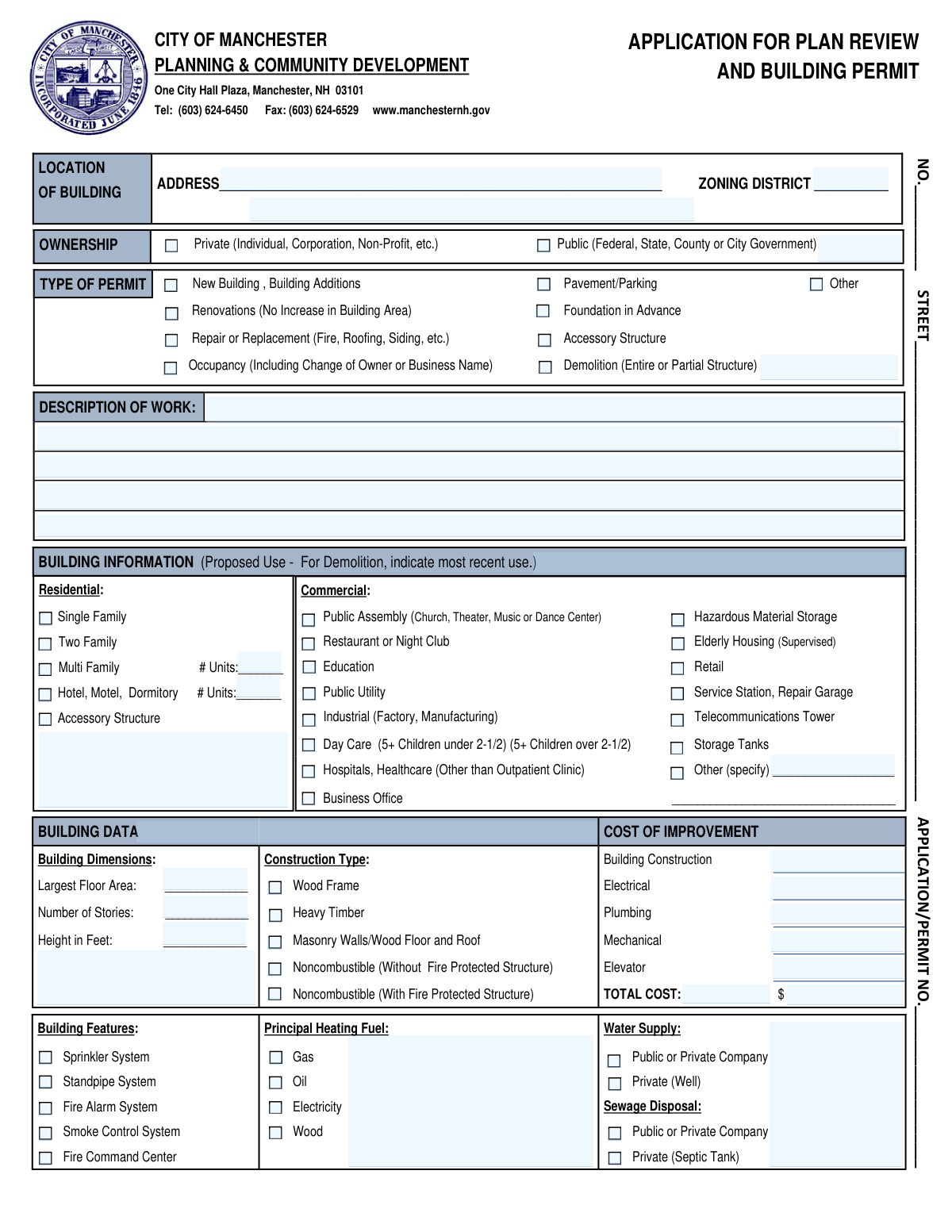
Completing detailed technical documents like the City of Manchester Application for Plan Review and Building Permit can be a meticulous task. Tools like Instafill.ai use AI to fill these forms in under 30 seconds, handling your project data accurately and securely to help you move from the planning phase to construction more efficiently.
Every form on this page can be completed without typing. Instafill is form filling software that reads a PDF and fills it for you — including flat and scanned documents that carry no fillable fields at all.
Forms in This Category
The forms in this category have a median Form Complexity Index of 85/100 (Very Complex), measured across 3 forms by field count, input difficulty, length, conditional logic and structure. See how it is calculated.
| Form Name | Pages | FCI | |
|---|---|---|---|
| 1. | City of Manchester Application for Plan Review and Building Permit | 2 | Complex 70 |
| 2. | IBC/ CBC ABA Treatment Plan/Concurrent Review Template | 7 | Very Complex 85 |
| 3. | Plan Review Submittal Requirements for Commercial Tenant Improvements and/or Additions | 1 | – |
- Enterprise-grade security & data encryption
- 99%+ accuracy powered by AI
- 1,000+ forms from all industries
- Complete forms in under 60 seconds
How to Choose the Right Form
Navigating the permit process in Manchester requires selecting the correct documentation to ensure your project meets local safety and zoning standards. While some jurisdictions split these into multiple documents, the City of Manchester streamlines the process by utilizing a unified application for most construction needs.
Comprehensive Project Coverage
The City of Manchester Application for Plan Review and Building Permit is the primary document required for most construction activities within the city limits. Whether you are a homeowner embarking on a DIY renovation or a contractor managing a large-scale commercial development, this form serves as your essential starting point. It functions as both a request for a technical plan review and the formal application for the permit itself.
Identifying Your Use Case
You should select the City of Manchester Application for Plan Review and Building Permit if your project involves any of the following activities:
- New Construction: Building a residential home or commercial structure from the ground up.
- Additions and Renovations: Expanding an existing footprint or making significant internal changes to a property, such as finishing a basement or remodeling a storefront.
- Demolition: Safely removing existing structures to prepare a site for new development.
- Structural Repairs: Addressing significant damage or wear that requires municipal oversight for safety compliance.
Key Information for Your Application
To fill out this form accurately using Instafill.ai, ensure you have the following details ready to go:
- Project Scope: A clear, concise description of the work being performed.
- Estimated Costs: Accurate valuations for labor and materials, as these figures often dictate the final permit fees.
- Party Information: Contact details and license numbers for the property owner, the applicant, and any professional contractors involved.
- Location Specifics: The exact address and parcel details as recognized by the Manchester Planning & Community Development department.
By using this centralized application, you ensure that your project is properly logged for review against local building codes, helping to avoid costly delays or legal issues during construction.
Form Comparison
| Form | Primary Purpose | Scope of Work | Key Requirements |
|---|---|---|---|
| City of Manchester Application for Plan Review and Building Permit | Obtaining building permits for construction, additions, renovations, or demolition projects. | New builds, structural changes, and renovations within Manchester city limits. | Project location, cost estimates, scope details, and involved party information. |
Tips for plan review forms
When filling out plan review forms, vague descriptions can lead to processing delays or requests for additional information. Clearly outline all aspects of the project, such as structural changes, electrical upgrades, or plumbing modifications, to help reviewers understand the full extent of the work.
Before submitting, double-check that the parcel ID and zoning district are correct for the project location. Incorrect property data is a common reason for application rejection, so verifying these details with local municipal maps can save significant time and revision effort.
Most plan review applications require specific license numbers and contact information for general contractors, electricians, and plumbers. Having these details organized and ready before you start the form prevents interruptions and ensures all professional parties are properly documented from the start.
For those managing multiple projects, AI-powered tools like Instafill.ai can complete plan review forms in under 30 seconds with high accuracy. This technology ensures your data stays secure during the process while significantly reducing the manual effort required for complex applications.
Avoid underestimating the total value of the construction work, as this can lead to issues during the fee assessment or inspection phases. Providing an accurate, market-rate estimate helps the planning department process your permit without unnecessary financial adjustments later.
Missing signatures from property owners or authorized agents are a frequent cause of filing delays. Ensure that every required signature field is completed and that the person signing has the legal authority to represent the project before the document is submitted.
Frequently Asked Questions
Plan review forms are used by municipal planning departments to evaluate proposed construction projects for compliance with local building codes, safety regulations, and zoning laws. Submitting these forms is a critical step in obtaining the necessary permits to begin work on new buildings, additions, or significant renovations.
You should submit a plan review application well before your intended construction start date. Because the review process involves checking architectural plans and structural details, filing early allows time for revisions if the city requests changes to meet safety standards.
While the property owner is ultimately responsible, these forms are often completed by the licensed contractor, architect, or engineer overseeing the project. These professionals have the technical knowledge required to provide accurate details about the construction scope and structural specifications.
Once submitted, the local building department reviews the documents to ensure they align with fire safety, structural integrity, and land-use requirements. If the plans are approved, the city issues a building permit; if not, the applicant is notified of required corrections or additional information needed.
Yes, AI tools like Instafill.ai can be used to fill out plan review forms by extracting relevant project data from your source documents and placing it into the correct fields. This technology simplifies the process of handling complex applications and ensures that all technical details are transcribed accurately.
Using traditional manual entry, these forms can take significant time to complete due to the level of detail required. However, AI-powered services like Instafill.ai can complete these forms in under 30 seconds by automatically identifying and mapping data from your project files.
Most plan review applications must be accompanied by detailed site plans, floor plans, structural calculations, and sometimes energy conservation reports. These attachments provide the visual and technical context necessary for the planning department to verify the project's feasibility.
Requirements vary depending on the scope of the work, but most structural, electrical, or plumbing changes require a plan review. Minor cosmetic updates like painting or flooring usually do not, but it is best to check with the local Planning and Community Development department to confirm.
These forms are generally submitted to the local city or county Planning and Community Development department. Many municipalities now offer online portals for digital submission, though some may still require physical copies of large-scale architectural blueprints.
A plan review is the process of evaluating your construction documents to ensure they meet code, while the building permit is the official authorization granted after the review is successful. You cannot receive a permit until the plan review phase is completed and approved by the city.
Glossary
- Form Complexity Index
- Instafill’s 0–100 measure of how much effort a form takes to complete, calculated deterministically from the form’s own structure rather than estimated. It combines the number of fillable fields (the largest factor), how difficult those fields are to complete based on their type, the number of pages that contain fields, the amount of conditional “fill-only-if” logic, and how many sections the form is divided into, then adds modifiers for tables and repeating lists, bundled instruction pages, and dense page layouts. A higher score means the form is harder to fill out by hand. The forms in this category have a median Form Complexity Index of 85/100 (Very Complex). See exactly how it is calculated.
- Plan Review
- The formal evaluation process where city officials examine construction documents and blueprints to ensure the project complies with building codes, safety regulations, and zoning laws.
- Setback
- The minimum required distance between a building or structure and the property line, street, or other designated boundaries as defined by local zoning laws.
- Zoning Ordinance
- Local regulations that dictate how land in specific areas can be used, such as residential, commercial, or industrial, and the physical requirements for structures in those zones.
- Occupancy Classification
- A category assigned to a building or portion of a building based on its intended use, which determines the specific fire and life safety requirements that must be followed.
- Construction Type
- A classification based on the fire resistance and materials used for a building's structural elements, typically ranging from Type I (fire-resistive) to Type V (wood-framed).
- Easement
- A legal right granted to another party, such as a utility company or the city, to use a specific portion of the property, which may restrict where new construction can be located.
- Site Plan
- A detailed, scaled drawing that shows the entire property, including the location of existing and proposed buildings, driveways, landscaping, and utility lines.
- Valuation
- The estimated total cost of a construction project, including labor and materials, which is used by the Planning & Community Development department to calculate permit fees.