Fill out health treatment forms
with AI.
Health treatment forms are essential components of the medical and behavioral healthcare landscape, serving as the formal bridge between clinical assessment and the actual delivery of care. These documents are primarily used to request precertification or prior authorization for specific therapies, ensuring that treatments meet medical necessity guidelines. Whether it is requesting outpatient Applied Behavior Analysis (ABA) for a child with Autism or documenting a treatment plan for an injured worker under a compensation scheme, these forms provide the structured data insurers and health plans require to approve services and facilitate reimbursement.
By continuing, you acknowledge Instafill's Privacy Policy and agree to get occasional product update and promotional emails.
About health treatment forms
Typically, these forms are completed by licensed healthcare practitioners, such as behavioral health providers, allied health professionals, or school-based medical staff. For example, a clinician might use an ABA Treatment Request to secure funding for therapy, while a school-based practitioner might fill out a Medically Prescribed Treatment form to ensure a student receives non-medication support during the school day. Parents and guardians also play a vital role, often needing to sign consent sections to authorize the implementation of these treatment plans. Because many of these services cannot begin until the paperwork is officially processed, accuracy and timeliness are critical to avoiding treatment interruptions.
Managing this documentation can be time-consuming for busy providers, but tools like Instafill.ai use AI to fill these health treatment forms in under 30 seconds, handling clinical data accurately and securely to streamline the administrative process.
Every form on this page can be completed without typing. Instafill is form filling software that reads a PDF and fills it for you — including flat and scanned documents that carry no fillable fields at all.
Forms in This Category
The forms in this category have a median Form Complexity Index of 58/100 (Moderate), measured across 11 forms by field count, input difficulty, length, conditional logic and structure. See how it is calculated.
- Enterprise-grade security & data encryption
- 99%+ accuracy powered by AI
- 1,000+ forms from all industries
- Complete forms in under 60 seconds
How to Choose the Right Form
Selecting the correct health treatment form is essential for ensuring medical necessity is established and that services are authorized without delay. Most forms in this category are specific to either a particular insurance provider, a geographic region, or a unique setting like a school.
Applied Behavior Analysis (ABA) Therapy
If you are a provider seeking authorization for ABA services for patients with Autism Spectrum Disorder, your choice depends on the insurance carrier and the specific plan year:
- For Aetna and Associated Plans: Use Form BHVH, Outpatient Behavioral Health – ABA Treatment Request for standard precertification. However, if you are preparing for the updated 2026 requirements, use the Outpatient Behavioral Health (BH) – ABA Treatment Request: Required Information for Precertification (GR-69017-4), which replaces older versions for Aetna, Innovation Health, and Banner | Aetna plans.
- For Medi-Cal Members in Los Angeles: The L.A. Care Behavioral Health Treatment Applied Behavioral Analysis Authorization Request Form is the required document for requesting assessments, direct services, or social skills groups through L.A. Care’s BH ASD Program.
School-Based Treatment
If you are a healthcare practitioner or a parent coordinating care for a student, use the Medically Prescribed Treatment (Non-Medication) Form. This form is specifically for the NYC Office of School Health (OSH) and is used to authorize procedures like suctioning, catheterization, or tube feeding that must occur during school hours or afterschool programs for the 2025–2026 school year.
Workers Compensation and Injury Recovery
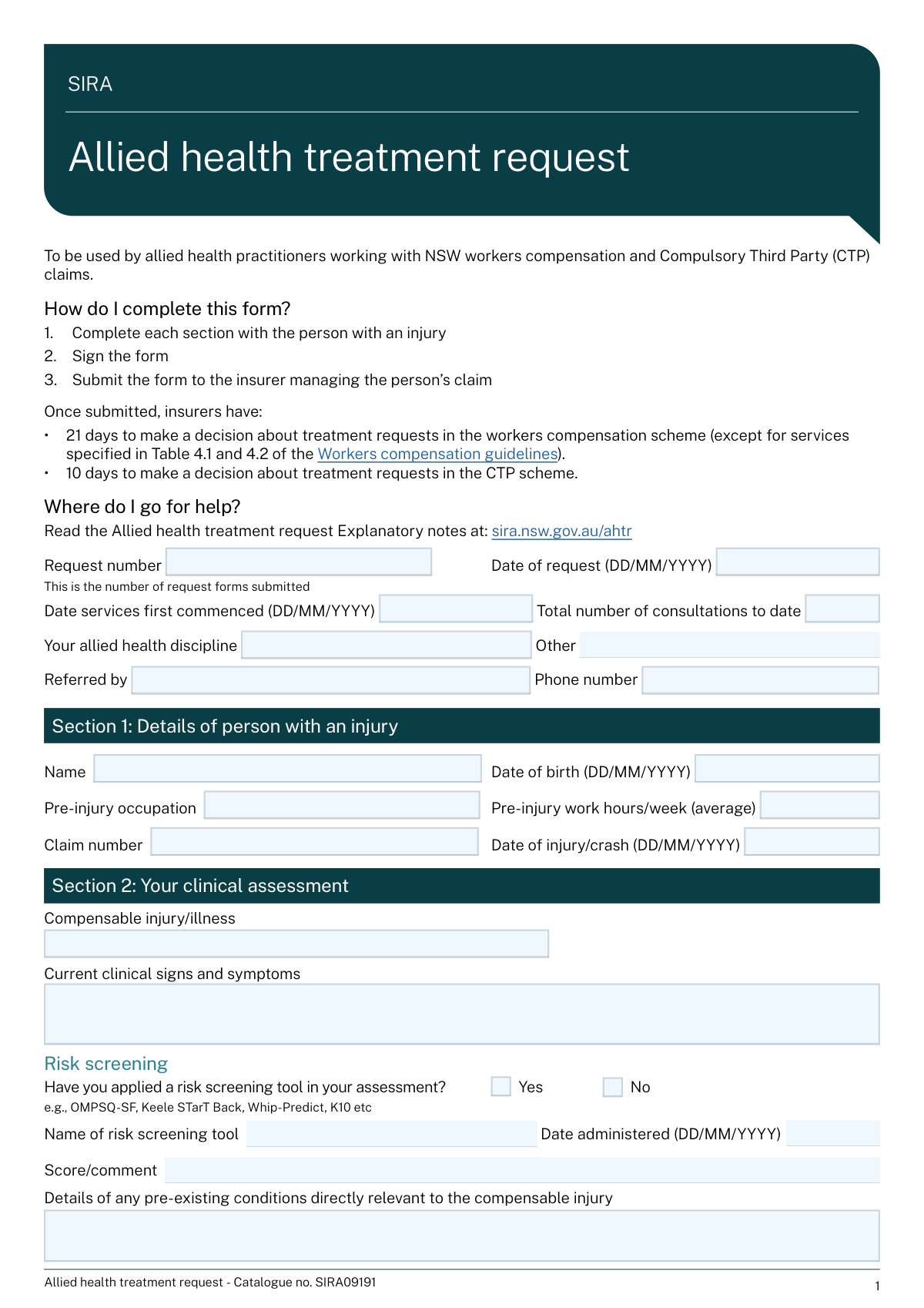
For allied health practitioners (such as physiotherapists or occupational therapists) operating under the New South Wales (NSW) workers compensation or CTP schemes, the SIRA Allied health treatment request (Catalogue no. SIRA09191) is the standard form. It is used to justify clinical rationale and request specific service costs from insurers, typically requiring a decision within 10 to 21 days.
Form Comparison
| Form | Primary Purpose | Intended Patient | Filing Party | Insurance Context |
|---|---|---|---|---|
| Form BHVH, Outpatient Behavioral Health – ABA Treatment Request | Precertification for outpatient ABA therapy and behavioral health services. | Patients under Aetna or associated health insurance plans. | Healthcare providers requesting treatment authorization for patients. | Aetna private health insurance and associated networks. |
| Medically Prescribed Treatment (Non-Medication) Form — Provider Treatment Order Form | Office of School Health | School Year 2025–2026 | Authorizing non-medication clinical procedures during the school day. | Students requiring medical procedures while attending school. | Licensed medical practitioners and the student's parent or guardian. | NYC Office of School Health and school-based programs. |
| SIRA Allied health treatment request (Catalogue no. SIRA09191) | Requesting approval for allied health services and related costs. | Injured individuals covered under workers compensation or CTP. | Allied health practitioners such as physical or occupational therapists. | NSW Workers Compensation and CTP insurance schemes. |
| L.A. Care Behavioral Health Treatment Applied Behavioral Analysis Authorization Request Form | Prior authorization for Medi-Cal ABA services and diagnostic evaluations. | Medi-Cal members requiring behavioral health or ASD treatment. | Contracted behavioral health providers and clinical specialists. | L.A. Care Health Plan Medi-Cal programs. |
| Outpatient Behavioral Health (BH) – ABA Treatment Request: Required Information for Precertification (GR-69017-4) | Detailed clinical precertification for ABA therapy medical necessity review. | Members diagnosed with Autism Spectrum Disorder (ASD). | The patient's attending provider or supervising clinician. | Aetna, Innovation Health, and Banner | Aetna plans. |
Tips for health treatment forms
Double-check all DSM-V and ICD-10 codes before submission, as incorrect coding is a primary cause for treatment denials. Matching these codes accurately with the requested CPT service codes ensures the insurer can verify medical necessity without requesting further clarification.
For behavioral health and allied health requests, provide measurable goals and recent assessment findings to justify the treatment plan. Clear data on a patient's progress or specific barriers to recovery helps reviewers approve the requested hours or services more quickly.
AI-powered tools like Instafill.ai can complete these complex health treatment forms in under 30 seconds with high accuracy. This is a significant time-saver for providers managing multiple patients, and your data stays secure throughout the entire automated process.
Many treatment forms require specific credentials for the supervising provider or attending physician to be valid. Ensure all signature fields for both the licensed practitioner and the parent or guardian are completed to avoid the form being rejected as incomplete.
School-based and long-term behavioral health authorizations often expire at the end of a school year or a specific six-month window. Keep a log of these dates so you can submit renewal forms well in advance, preventing any lapse in the patient's necessary care.
Have recent clinical notes, diagnostic evaluations, and previous treatment plans ready to attach to your primary request form. Providing a comprehensive packet from the start reduces the need for back-and-forth communication with insurance adjudicators and speeds up the final approval.
Frequently Asked Questions
Health treatment forms are used to request medical services, document clinical orders, or seek insurance authorization for specific therapies. They ensure that healthcare providers, insurers, and institutions like schools have the necessary information to provide and pay for care accurately.
These forms are usually completed by the attending healthcare provider, such as a Board Certified Behavior Analyst (BCBA) or a physician. While the provider fills out the clinical details and treatment goals, the patient or their guardian may need to provide personal demographic information and insurance details.
If your child requires a medically prescribed, non-medication procedure—such as tube feeding, suctioning, or glucose monitoring—to be performed during school hours, a school-year treatment order form is required. This document serves as both a clinical order from a doctor and a consent form from the parent or guardian.
Yes, you can use AI tools like Instafill.ai to fill out complex health treatment forms in under 30 seconds. The AI accurately extracts relevant data from your source documents and places it directly into the correct fields, ensuring the form is completed without manual data entry errors.
A prior authorization form is a formal request to an insurance company to approve and fund a service before it begins. A treatment plan is a detailed document included with that request that outlines specific clinical goals, assessment findings, and the frequency of services requested.
While manual completion of detailed medical forms can take 20 minutes or more, AI-powered services like Instafill.ai can complete these forms in under 30 seconds. The system handles the extraction of clinical data and populates the PDF instantly, which is especially helpful for providers managing high volumes of paperwork.
Submission methods depend on the specific form and organization. ABA and allied health requests are typically sent to the insurance carrier's provider portal or via fax, while school health forms should be delivered to the school nurse or the relevant Office of School Health department.
Incomplete forms usually result in a 'pended' or denied status, which can delay the start of essential medical services. Insurers require specific diagnostic codes and clinical justifications, so ensuring every field is accurately filled is critical for a smooth adjudication process.
Most of these forms have a defined period of validity, such as the duration of a school year or a six-month treatment authorization window. Once the period ends, a new form or a progress report must be submitted to continue receiving approved services or funding.
Yes, specific forms like the SIRA Allied Health Treatment Request are designed for injured persons under workers' compensation or CTP schemes. These forms allow practitioners to document barriers to recovery and request specific services necessary for the patient to return to work or health.
Glossary
- Form Complexity Index
- Instafill’s 0–100 measure of how much effort a form takes to complete, calculated deterministically from the form’s own structure rather than estimated. It combines the number of fillable fields (the largest factor), how difficult those fields are to complete based on their type, the number of pages that contain fields, the amount of conditional “fill-only-if” logic, and how many sections the form is divided into, then adds modifiers for tables and repeating lists, bundled instruction pages, and dense page layouts. A higher score means the form is harder to fill out by hand. The forms in this category have a median Form Complexity Index of 58/100 (Moderate). See exactly how it is calculated.
- Precertification / Prior Authorization
- The process of obtaining approval from a health insurance provider before a treatment or service is performed to ensure it is covered under the patient's plan.
- ABA (Applied Behavior Analysis)
- A therapeutic intervention focused on improving specific behaviors and social skills, commonly used in the treatment of Autism Spectrum Disorder (ASD).
- Medical Necessity
- A clinical standard used by insurers to determine if a requested healthcare service is essential, appropriate, and effective for the patient's specific condition.
- CPT Codes (Current Procedural Terminology)
- A standardized set of numeric codes used by healthcare providers to identify and bill for specific medical, surgical, and diagnostic procedures.
- ICD-10 and DSM-V
- International classification systems used by clinicians to code and categorize medical diagnoses and mental health disorders for insurance and clinical records.
- Allied Health
- Healthcare professions distinct from medicine and nursing, including practitioners such as physical therapists, occupational therapists, and speech pathologists.
- SIRA (State Insurance Regulatory Authority)
- The government agency in New South Wales, Australia, that oversees workers' compensation and motor accident insurance schemes.
- CTP (Compulsory Third Party) Insurance
- A mandatory insurance scheme that provides compensation for people injured in motor vehicle accidents, often requiring specialized treatment request forms.