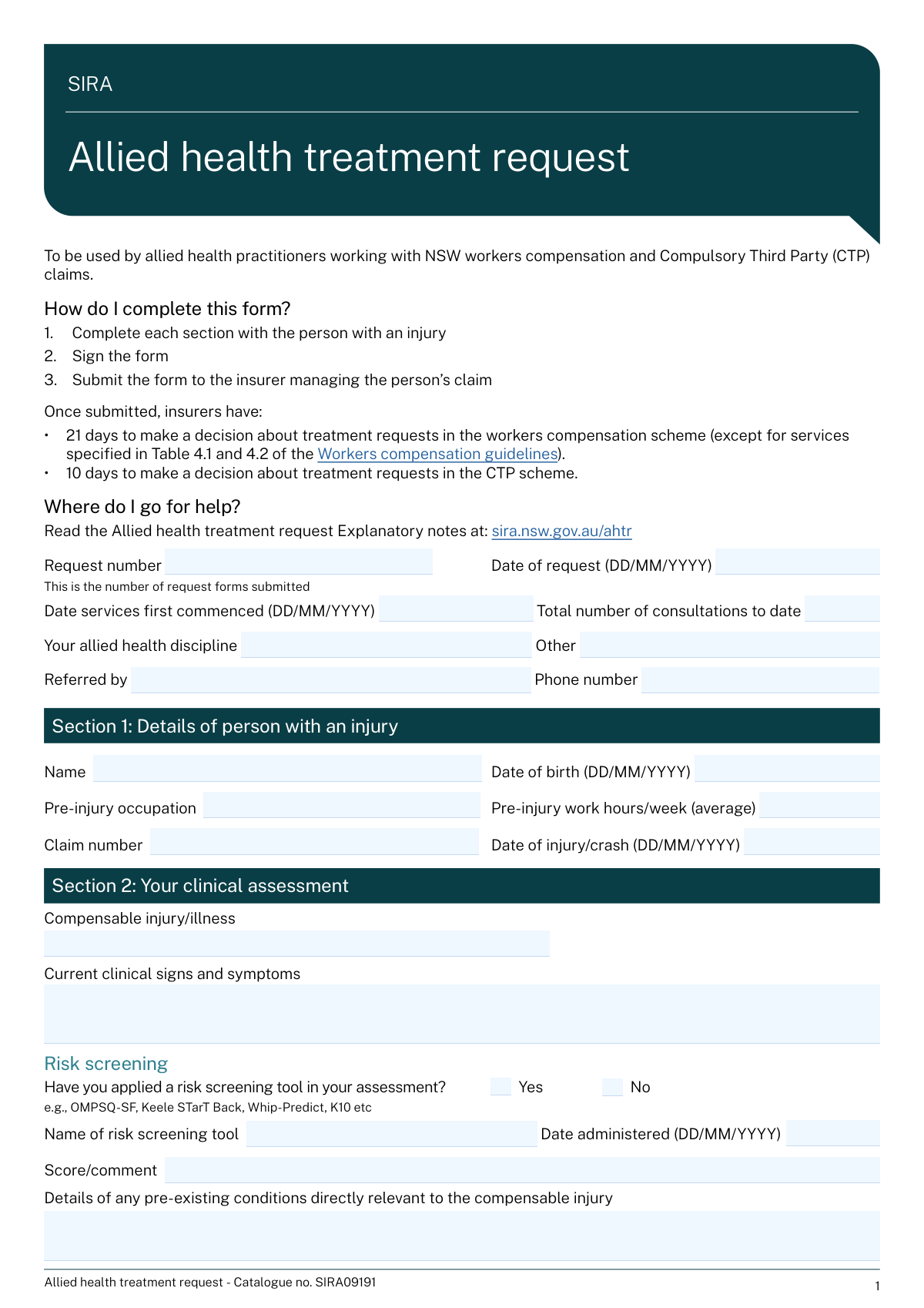
Yes! You can use AI to fill out SIRA Allied health treatment request - Catalogue no. SIRA09191
The Allied Health Treatment Request (AHTR) form, catalogue no. SIRA09191, is a mandatory document for allied health practitioners in New South Wales to request funding approval from insurers for treating individuals with workers compensation or Compulsory Third Party (CTP) claims. It standardizes the reporting of clinical assessments, treatment plans, patient goals, and service costs to facilitate timely decision-making by insurers. Today, this form can be filled out quickly and accurately using AI-powered services like Instafill.ai, which can also convert non-fillable PDF versions into interactive fillable forms.
SIRA09191 is part of the
allied health forms, health forms, health treatment forms, IRA forms and SIRA forms categories on Instafill.
Our AI automatically handles information lookup, data retrieval, formatting, and form filling.
It takes less than a minute to fill out SIRA09191 using our AI form filling.
Securely upload your data. Information is encrypted in transit and deleted immediately after the form is filled out.
Form specifications
| Form name: | SIRA Allied health treatment request - Catalogue no. SIRA09191 |
| Number of fields: | 125 |
| Number of pages: | 4 |
| Language: | English |
Instafill Demo: How to fill out PDF forms in seconds with AI
How to Fill Out SIRA09191 Online for Free in 2026
Are you looking to fill out a SIRA09191 form online quickly and accurately? Instafill.ai offers the #1 AI-powered PDF filling software of 2026, allowing you to complete your SIRA09191 form in just 37 seconds or less.
Follow these steps to fill out your SIRA09191 form online using Instafill.ai:
- 1 Navigate to Instafill.ai and upload or select the SIRA Allied Health Treatment Request form.
- 2 Enter the injured person's details in Section 1, including their name, claim number, and date of injury.
- 3 Complete the clinical assessment in Section 2, providing details on the injury, risk screening, capacity, and standardized outcome measures.
- 4 Define the treatment plan in Section 4, outlining the patient's goals, your proposed interventions, and the rationale for the services.
- 5 Itemize all requested services, including consultations and equipment, with their respective costs and service codes in Section 5.
- 6 Fill in your practitioner and practice details in Section 6, including your SIRA approval number and contact information.
- 7 Review the entire form for accuracy, sign it digitally, and submit it to the insurer managing the person's claim.
Our AI-powered system ensures each field is filled out correctly, reducing errors and saving you time.
Why Choose Instafill.ai for Your Fillable SIRA09191 Form?
Speed
Complete your SIRA09191 in as little as 37 seconds.
Up-to-Date
Always use the latest 2026 SIRA09191 form version.
Cost-effective
No need to hire expensive lawyers.
Accuracy
Our AI performs 10 compliance checks to ensure your form is error-free.
Security
Your personal information is protected with bank-level encryption.
Frequently Asked Questions About Form SIRA09191
This form is used by allied health practitioners to request approval for treatment for a person with an injury under a NSW workers compensation or Compulsory Third Party (CTP) claim. It outlines the patient's assessment, treatment plan, and goals to the insurer.
The allied health practitioner (e.g., Physiotherapist, Psychologist) is responsible for completing the form in collaboration with the injured person. The practitioner then signs and submits it to the insurer managing the claim.
After you submit the form, insurers have 10 business days to make a decision for CTP claims and 21 days for workers compensation claims. These timeframes ensure a timely response to treatment requests.
Once you have completed and signed the form, you must submit it directly to the insurer that is managing the person's claim. You should have the insurer's contact details as part of the claim information.
The 'Request number' is for tracking your submissions for a single patient. You should enter '1' for the first request you submit, '2' for the second, and so on, to create a clear history of treatment plans.
In Section 2, simply check 'No' for the question asking if you have a copy of the position description. The form states that if 'No' is selected, the insurer is then responsible for providing it to you.
You must report at least one relevant SOM by providing the initial score, the score from the previous AHTR (if applicable), and the current score. Remember to include the date for each score and a brief interpretation of the results.
SMART goals are Specific, Measurable, Achievable, Realistic, and Timed. For example, a goal could be 'To return to my usual job as a retail assistant by 4 August,' as it clearly defines the what and when.
If the anticipated discharge date in Section 4 is different from your previous plan, you must provide an explanation in the designated field. This helps the insurer understand the reasons for the change, such as new barriers or slower than expected progress.
Yes, collaborative development is a key requirement. You must indicate in Section 4 whether the plan was developed with the patient, and if you answer 'No,' you are required to provide a detailed explanation.
Yes, services like Instafill.ai use AI to help you fill out forms more efficiently. It can accurately auto-fill fields based on your saved information, reducing manual data entry and saving you valuable time.
Simply upload the Allied Health Treatment Request form to the Instafill.ai platform. The AI will identify all the fields, allowing you to fill them in interactively, save your progress, and use saved details to populate sections instantly.
You can use a service like Instafill.ai to solve this problem. Upload the non-fillable PDF, and the platform's AI will convert it into an interactive, fillable form that you can complete and sign electronically.
Compliance SIRA09191
Validation Checks by Instafill.ai
1
Ensures Logical Chronology of Key Dates
This validation checks that the 'Date of injury/crash' is not after the 'Date services first commenced', and that the 'Date of request' is not before either of these dates. Maintaining a correct chronological order is crucial for claim assessment and understanding the treatment timeline. A failure would indicate a data entry error that could lead to claim processing delays or rejection.
2
Requires Specification for 'Other' Allied Health Discipline
This check ensures that if the practitioner selects 'Other' for their allied health discipline, they must provide a specific description in the corresponding text field. This is vital for the insurer to verify the practitioner's qualifications and determine if the service is appropriate for the claim. If this field is left blank, the insurer cannot properly assess the request, leading to a request for more information.
3
Ensures Completeness of Risk Screening Details
This validation verifies that when a practitioner indicates 'Yes' to using a risk screening tool, all related fields (tool name, date, and score) are filled out. This information is essential for the insurer to understand the clinical reasoning, assess psychosocial risk factors, and approve the proposed treatment plan. Missing details would render the risk screening information incomplete and may result in the insurer requesting more information.
4
Validates Minimum Requirement for Standardised Outcome Measures
This check confirms that at least one Standardised Outcome Measure (SOM) has been reported, including the measure name, initial data, and current data. SOMs provide objective evidence of the person's progress and are critical for justifying the need for continued treatment. An incomplete SOM section prevents the insurer from evaluating treatment effectiveness and may lead to the request being declined.
5
Verifies Chronological Order of Outcome Measure Dates
This validation ensures that for each reported outcome measure, the dates for the initial, previous, and current scores are in the correct chronological sequence. This logical order is necessary to accurately track the patient's progress over time. Incorrect date sequencing suggests a data entry error and undermines the credibility of the reported outcomes.
6
Verifies Accuracy of Overall Service Cost Calculation
This check automatically calculates the sum of the 'Total cost' for each requested service and compares it to the value entered in the 'Overall total cost' field. This is a critical financial validation to prevent billing errors and ensure the requested amount is accurate. A mismatch would cause financial discrepancies and require the form to be corrected before the insurer can process the request.
7
Validates Calculation of Individual Service Line Totals
This validation ensures that for each service line item, the 'Total cost' correctly reflects the 'Number of sessions' multiplied by the 'Cost per session/item'. This prevents mathematical errors at the line-item level, which would lead to an incorrect overall total. Failure to pass this check indicates a calculation error that must be fixed for accurate financial processing.
8
Ensures Practitioner and Practice Identification is Complete
This validation confirms that essential practitioner and practice details, including name, AHPRA/membership number, and practice name, are not empty. This information is mandatory for the insurer to verify the practitioner's credentials, eligibility to provide services, and to direct communications correctly. Missing information would halt the processing of the request until the practitioner can be properly identified.
9
Validates Standard DD/MM/YYYY Date Format
This check ensures that all date fields across the form are entered in the correct DD/MM/YYYY format and correspond to a real calendar date (e.g., 31/02/2023 is invalid). Standardized and valid dates are essential for accurate record-keeping, data processing, and establishing clear timelines for the claim. An invalid format or date would cause a system error and require the user to correct the entry before submission.
10
Requires a Valid Claim Number
This validation ensures that the 'Claim number' field is not left blank. The claim number is the primary identifier used by the insurer to link the treatment request to the correct person and case file. Without a claim number, the request cannot be processed as it cannot be associated with an existing claim, leading to immediate rejection or delay.
11
Requires Explanation for Non-Collaborative Treatment Plan
This check verifies that if the practitioner indicates the treatment plan was not developed collaboratively with the patient ('No' is selected), a reason must be provided in the explanation box. Collaborative goal-setting is a key principle of patient-centered care, and insurers need to understand why this did not occur. Failure to provide an explanation may raise concerns about the treatment approach and prompt further inquiry.
12
Ensures SMART Goals are Defined with Target Dates
This validation ensures that the goal fields are completed with a description of the goal and a target completion date ('by...'). These SMART goals are fundamental to the treatment plan, demonstrating a clear, measurable, and time-bound objective for recovery. Incomplete goals make it impossible for the insurer to assess the purpose and intended outcome of the requested treatment.
13
Validates Request Number is a Positive Integer
This check ensures that the 'Request number' is a whole number greater than zero, as it represents the sequence of requests (1st, 2nd, etc.). This helps track the history of treatment requests for a specific claim in an orderly manner. An invalid entry like zero, a negative number, or text would disrupt record-keeping and could cause processing errors.
14
Requires Participant Details for Case Conference Request
This validation confirms that if a practitioner requests a case conference by selecting 'Yes', they must specify the desired participants in the 'who with' field. This information is necessary for the insurer to organize the conference with the correct stakeholders. A blank participant field makes the request unactionable and will require the insurer to follow up for clarification.
Common Mistakes in Completing SIRA09191
Section 4 requires Specific, Measurable, Achievable, Realistic, and Timed (SMART) goals, but practitioners often submit vague objectives like 'reduce pain'. This makes it difficult for insurers to assess the treatment's purpose and effectiveness, potentially leading to requests for more information or denial. To avoid this, goals must be concrete and time-bound, such as 'To drive for an hour to my parent’s home by 6 July', as shown in the form's example.
The 'Rationale for the services you are requesting' in Section 4 is critical for justifying the treatment plan. A common error is leaving this blank or providing a generic statement that doesn't link the clinical assessment to the proposed interventions. Without a strong rationale, insurers may deem the services not 'reasonably necessary' and decline the request. Practitioners must clearly explain how the requested services will address identified barriers and help the patient achieve their goals.
Section 2 requires reporting on at least one SOM, including initial, previous, and current scores with dates. Practitioners frequently omit the 'Initial score' or 'Previous score,' making it impossible to track progress over time. A more significant error is failing to complete the 'Interpretation of score(s)' field, which leaves the insurer to guess the clinical significance of the numbers and can lead to the form being returned for clarification.
Section 5 requires manual calculation of total costs for each service line and an overall total. Errors in multiplication or addition are extremely common and lead to payment discrepancies and processing delays. These mistakes require the insurer to contact the practice for correction, delaying reimbursement. Using an AI-powered form-filling tool like Instafill.ai can prevent this by automatically performing calculations, ensuring accuracy.
The form requires several key identifiers, including the patient's 'Claim number', the practitioner's 'Ahpra registration number', and the 'SIRA approval number'. Forgetting or mistyping these numbers is a critical error that prevents the form from being processed. An incorrect claim number means the form can't be matched to the right case, while a missing SIRA number will halt a workers' compensation request, leading to significant administrative delays.
The form consistently specifies the DD/MM/YYYY format for all date fields. Users accustomed to other conventions, such as the American MM/DD/YYYY format, often enter dates incorrectly. This creates ambiguity and data entry errors on the insurer's end, potentially leading to an incorrect timeline of the injury and treatment. AI-powered tools like Instafill.ai can automatically format dates correctly to match form requirements.
The 'Request number' field is intended to be a sequential counter for each form submitted for a patient (e.g., 1, 2, 3). Practitioners often forget to increment this number on subsequent requests, submitting multiple forms all labeled as '1'. This makes it difficult for the insurer to track the history and progression of treatment requests, potentially causing confusion and delays in processing the current plan.
The practitioner's signature in Section 6 is a mandatory requirement that validates the entire request. Submitting the form without a signature, whether digital or physical, renders it invalid and results in immediate rejection. This simple but common oversight forces a resubmission, causing unnecessary delays in treatment approval. Digital form-filling tools can help by flagging the empty signature field before submission.
Section 3 asks for 'Barriers to recovery' and then 'Strategies to address' them. A frequent error is listing strategies that do not directly correspond to the identified barriers, or listing barriers without any clear plan to mitigate them. This disconnect can make the treatment plan seem unfocused or poorly justified. Practitioners should ensure every strategy listed clearly and logically addresses a specific barrier mentioned previously.
When this form is only available as a non-fillable PDF, practitioners often print and complete it by hand, leading to illegible entries. Poor handwriting can make critical information like the claim number, clinical notes, and service costs unreadable, forcing the insurer to request clarification and delaying the process. To prevent this, practitioners can use tools like Instafill.ai, which can convert flat PDFs into digitally fillable forms, ensuring all entries are typed and perfectly legible.
Saved over 80 hours a year
“I was never sure if my IRS forms like W-9 were filled correctly. Now, I can complete the forms accurately without any external help.”
Kevin Martin Green
Your data stays secure with advanced protection from Instafill and our subprocessors

Robust compliance program
Transparent business model
You’re not the product. You always know where your data is and what it is processed for.
ISO 27001, HIPAA, and GDPR
Our subprocesses adhere to multiple compliance standards, including but not limited to ISO 27001, HIPAA, and GDPR.
Security & privacy by design
We consider security and privacy from the initial design phase of any new service or functionality. It’s not an afterthought, it’s built-in, including support for two-factor authentication (2FA) to further protect your account.
Fill out SIRA09191 with Instafill.ai
Worried about filling PDFs wrong? Instafill securely fills sira-allied-health-treatment-request-catalogue-no-sira09191-1 forms, ensuring each field is accurate.