Fill out SIRA forms
with AI.
SIRA forms are official documents issued by the State Insurance Regulatory Authority (SIRA) in New South Wales, Australia, used to manage claims and treatment processes under the NSW workers compensation and compulsory third party (CTP) insurance schemes. These forms play a critical role in ensuring that injured workers and road accident victims receive the care they need, while also providing insurers with the structured clinical information required to make timely and informed decisions about treatment approvals.
By continuing, you acknowledge Instafill's Privacy Policy and agree to get occasional product update and promotional emails.
About SIRA forms
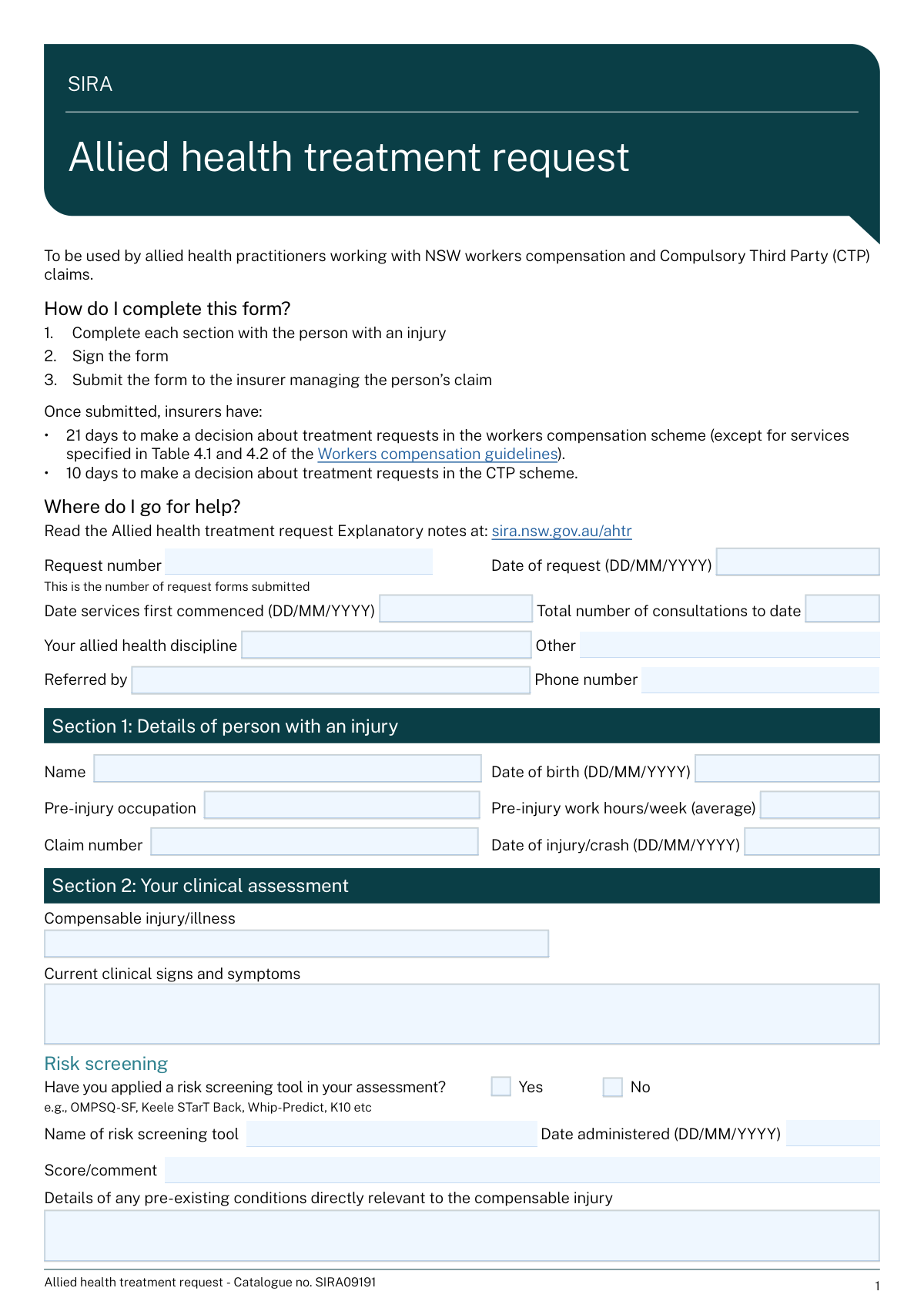
Allied health practitioners — including physiotherapists, psychologists, occupational therapists, and others — are among the primary users of SIRA forms. A key example is the Allied Health Treatment Request (SIRA09191), which practitioners complete to document a patient's clinical assessment, recovery barriers, treatment goals, and the specific services being requested. Accurate and complete submission of these forms is essential, as errors or omissions can delay approvals and, in turn, delay care for the injured person.
For practitioners managing multiple cases, completing these forms thoroughly and on time can be time-consuming. Tools like Instafill.ai use AI to fill these forms in under 30 seconds, handling the data accurately and securely — making it a practical option for busy clinicians who need to stay on top of documentation requirements.
Every form on this page can be completed without typing. Instafill is form filling software that reads a PDF and fills it for you — including flat and scanned documents that carry no fillable fields at all.
Forms in This Category
The forms in this category have a median Form Complexity Index of 69/100 (Complex), measured across 2 forms by field count, input difficulty, length, conditional logic and structure. See how it is calculated.
| Form Name | Pages | FCI | |
|---|---|---|---|
| 1. | SIRA Allied health treatment request (Catalogue no. SIRA09191) | 4 | Complex 69 |
| 2. | SIRA Allied health treatment request - Catalogue no. SIRA09191 | 4 | Complex 67 |
- Enterprise-grade security & data encryption
- 99%+ accuracy powered by AI
- 1,000+ forms from all industries
- Complete forms in under 60 seconds
How to Choose the Right Form
The State Insurance Regulatory Authority (SIRA) regulates motor accidents and workers compensation insurance in New South Wales. When navigating these schemes, using the correct documentation is essential for ensuring injured persons receive timely care and practitioners receive approval for their services.
For Allied Health Professionals
If you are an allied health practitioner (such as a physiotherapist, occupational therapist, or psychologist) providing services under the NSW workers compensation or CTP schemes, you will primarily need the:
- SIRA Allied health treatment request (Catalogue no. SIRA09191): This is the standard form used to request approval for a series of treatments. It acts as both a clinical record and a formal request to the insurer.
When to Use This Form
Use the SIRA Allied health treatment request (SIRA09191) when you need to:
- Document initial or ongoing clinical assessment findings for an injured person.
- Identify specific barriers to a patient's recovery at work or in daily life.
- Outline a structured treatment plan with clear, measurable goals and outcome measures.
- Request specific services and provide a breakdown of associated costs for insurer approval.
Understanding Insurer Timelines
Choosing to submit this form correctly the first time is vital because of the regulatory timeframes insurers must follow to provide you with a decision:
- Workers Compensation: Insurers generally have 21 days to respond to your request.
- CTP (Compulsory Third Party): Insurers typically have 10 days to respond.
Ensuring your SIRA09191 form is comprehensive and clinically justified prevents unnecessary delays in treatment. Using Instafill.ai allows you to quickly convert this PDF into a fillable format, ensuring that your clinical rationale is legible and professional, which helps insurers make faster decisions.
Key Tips for Completion
- Focus on Outcomes: Ensure the goals section aligns specifically with the patient's return-to-work or life activities.
- Be Specific: List the exact service codes and costs to avoid back-and-forth queries from the insurer.
Form Comparison
| Form | Purpose | Who Files It | Scheme Coverage | Key Requirements |
|---|---|---|---|---|
| SIRA Allied health treatment request (Catalogue no. SIRA09191) | To request specific services, costs, and document treatment plans for injured persons. | Completed by allied health practitioners providing clinical services to claimants. | Applies to both NSW Workers Compensation and Compulsory Third Party (CTP) schemes. | Requires clinical assessment findings, recovery goals, and detailed treatment rationale. |
Tips for SIRA forms
Ensure you include clear, quantifiable outcome measures to demonstrate the effectiveness of the proposed treatment. This provides the insurer with objective evidence of the patient's progress and justifies the necessity of continued care.
Focus your treatment plan on improving the patient's functional capacity for work or daily activities. Explicitly linking clinical interventions to specific workplace tasks or barriers helps speed up the approval process for workers compensation claims.
Be specific about the type of therapy, frequency, and duration rather than using broad terms. Providing a detailed rationale for each requested service reduces the likelihood of the insurer requesting further clarification or denying the claim.
Submit your treatment requests as early as possible to allow insurers to review within their standard timeframes. Early submission ensures there is no gap in the patient’s treatment cycle while waiting for approval from the insurer or case manager.
AI-powered tools like Instafill.ai can complete these complex SIRA forms in under 30 seconds with high accuracy, significantly reducing administrative burden. Your data stays secure during the process, making it a reliable way to handle high volumes of allied health paperwork efficiently.
Verify that the claim number, insurer details, and patient information match exactly across all submitted documents. Minor clerical errors in these fields are a common cause of administrative delays or rejected treatment requests.
Use the dedicated sections to identify specific psychosocial or physical barriers that may be hindering the patient's progress. Highlighting these factors allows the insurer to understand the complexity of the case and the need for the requested interventions.
Frequently Asked Questions
SIRA forms are official documents regulated by the State Insurance Regulatory Authority (SIRA) for use within the NSW workers compensation and Compulsory Third Party (CTP) insurance schemes. They facilitate the request, approval, and documentation of medical and allied health services for individuals recovering from workplace or motor vehicle accidents.
This form is typically completed by allied health practitioners, such as physiotherapists, psychologists, or occupational therapists, who are treating a patient under a compensation claim. It serves as a formal clinical justification to the insurer for the funding of specific services, sessions, or equipment.
A request should be submitted whenever a practitioner identifies a need for services that require prior insurer approval or when an existing treatment plan is nearing completion. Submitting the form well in advance of the proposed start date helps prevent interruptions in the patient's recovery process.
Under NSW guidelines, insurers generally have 21 days to respond for workers compensation claims and 10 days for CTP claims. Providing detailed clinical findings and clear outcome measures in the form can help the insurer make a decision more quickly and avoid requests for further information.
Practitioners must include clinical assessment findings, identified barriers to recovery, and specific goals that are measurable and time-bound. The form also requires evidence of outcome measures to track the patient's progress and demonstrate the clinical effectiveness of the proposed intervention.
Completed forms should be sent directly to the insurer managing the patient's workers compensation or CTP claim. It is also standard practice to provide a copy to the patient’s nominated treating doctor to ensure coordinated care and keep all parties informed of the rehabilitation plan.
Yes, AI tools like Instafill.ai can be used to fill out SIRA forms in under 30 seconds by accurately extracting data from your clinical notes or source documents. This technology places the information directly into the PDF fields, reducing manual entry and ensuring that all required sections are completed correctly.
If a form is submitted with missing information or insufficient clinical justification, the insurer may delay the approval process or request additional documentation. Ensuring that all fields, especially those regarding service costs and outcome measures, are filled accurately is essential for maintaining the continuity of patient care.
While manual completion can be time-consuming due to the clinical detail required, using an AI-powered service like Instafill.ai can reduce the process to less than a minute. The AI handles the data mapping and extraction, allowing practitioners to focus more on patient care rather than administrative paperwork.
While some forms like the Allied Health Treatment Request (SIRA09191) are used for both schemes, practitioners must clearly indicate which scheme the patient is claiming under on the form. The specific requirements for approval and the response timeframes for insurers may vary depending on the type of claim.
You do not need specialized medical software; many SIRA forms are available as PDFs that can be managed through web-based tools. Services like Instafill.ai can even convert non-fillable PDF versions into interactive forms, making it easier to complete them digitally without the need for printing and scanning.
Glossary
- Form Complexity Index
- Instafill’s 0–100 measure of how much effort a form takes to complete, calculated deterministically from the form’s own structure rather than estimated. It combines the number of fillable fields (the largest factor), how difficult those fields are to complete based on their type, the number of pages that contain fields, the amount of conditional “fill-only-if” logic, and how many sections the form is divided into, then adds modifiers for tables and repeating lists, bundled instruction pages, and dense page layouts. A higher score means the form is harder to fill out by hand. The forms in this category have a median Form Complexity Index of 69/100 (Complex). See exactly how it is calculated.
- SIRA
- The State Insurance Regulatory Authority, the New South Wales government body that regulates workers compensation, motor accidents (CTP), and home building compensation insurance.
- Allied Health Practitioner (AHP)
- A qualified health professional, such as a physiotherapist, chiropractor, or psychologist, who provides specialized clinical services to injured workers or accident victims.
- AHTR
- Short for Allied Health Treatment Request, the specific form used by practitioners to seek insurer approval for a proposed plan of clinical treatment and associated costs.
- CTP Scheme
- Compulsory Third Party insurance, which provides medical treatment and financial support for people injured in motor vehicle accidents in New South Wales.
- NSW Workers Compensation Scheme
- A state-mandated insurance system that provides medical benefits and wage replacement to employees who suffer work-related injuries or illnesses.
- Outcome Measures
- Standardized clinical tools or tests used by practitioners to objectively track a patient's progress and demonstrate the effectiveness of the treatment provided.
- Clinical Justification
- The evidence-based reasoning a practitioner provides to explain why a specific treatment or service is necessary and appropriate for the patient's recovery.
- Barriers to Recovery
- Physical, psychological, or social factors identified by a practitioner that may hinder or delay an injured person's return to work or their usual daily activities.