Fill out allied health forms
with AI.
Allied health forms are official documents used within healthcare and compensation systems to request, authorise, and record treatment for injured or recovering patients. In the context of workers compensation and compulsory third party (CTP) insurance in New South Wales, these forms play a critical role in connecting clinical care with insurer approval processes. They require practitioners to document detailed clinical findings, treatment goals, outcome measures, and cost justifications — all of which directly influence whether a patient receives timely care.
By continuing, you acknowledge Instafill's Privacy Policy and agree to get occasional product update and promotional emails.
About allied health forms
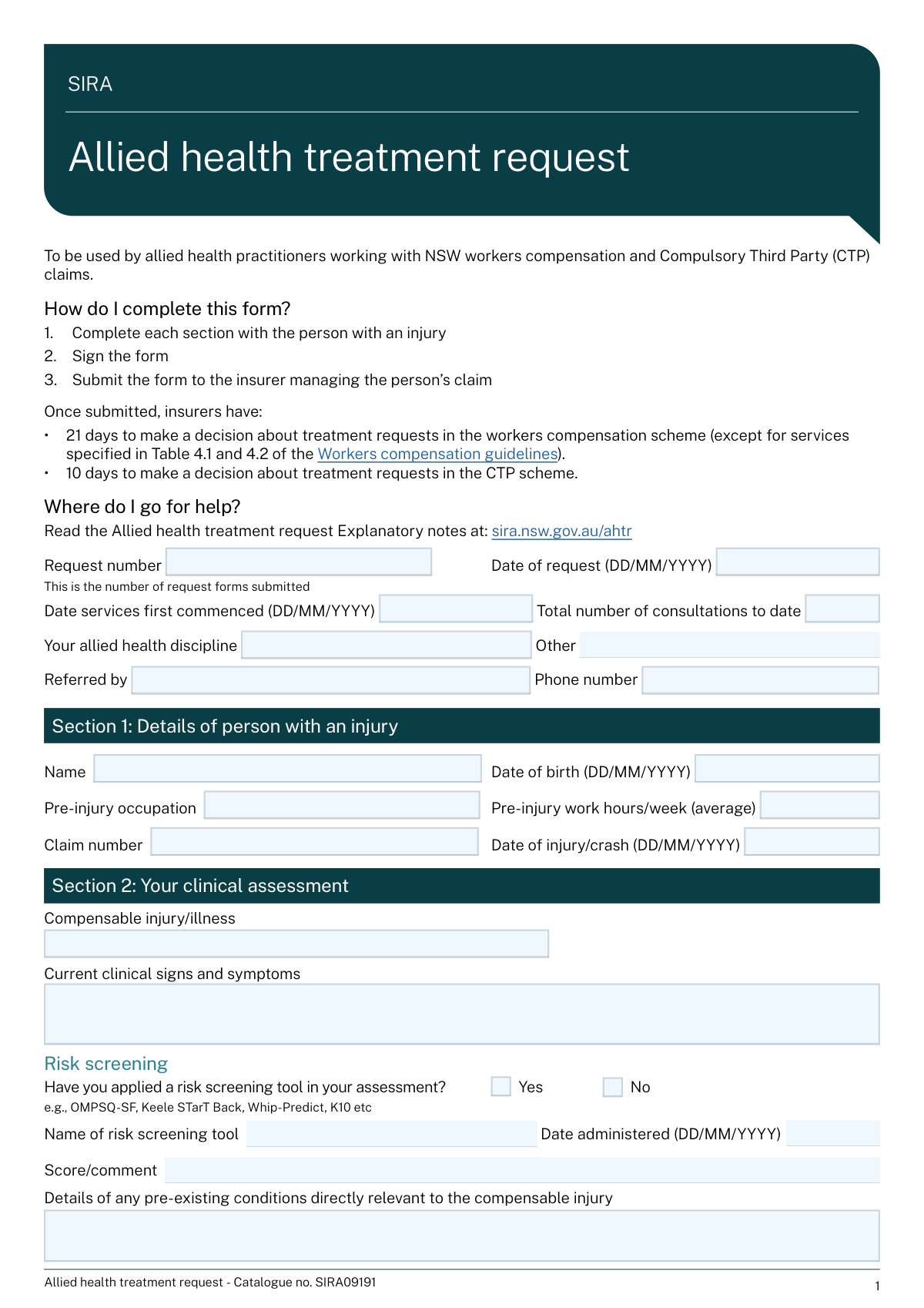
These forms are primarily completed by allied health practitioners — such as physiotherapists, occupational therapists, psychologists, and exercise physiologists — when treating patients under NSW workers compensation or CTP schemes. A common example is the SIRA Allied Health Treatment Request (SIRA09191), which must be submitted to insurers within strict timeframes to avoid delays in patient care. Accurate and thorough completion is essential, as incomplete forms can slow down approvals and disrupt recovery plans.
Given the detail required and the consequences of errors, filling out these forms carefully matters. Tools like Instafill.ai use AI to fill these forms in under 30 seconds, handling the data accurately and securely — a practical time-saver for busy practitioners managing high patient volumes.
Every form on this page can be completed without typing. Instafill is form filling software that reads a PDF and fills it for you — including flat and scanned documents that carry no fillable fields at all.
Forms in This Category
The forms in this category have a median Form Complexity Index of 67/100 (Complex), measured across 3 forms by field count, input difficulty, length, conditional logic and structure. See how it is calculated.
| Form Name | Pages | FCI | |
|---|---|---|---|
| 1. | Allied Health Treatment Request Form | 4 | Complex 66 |
| 2. | SIRA Allied health treatment request (Catalogue no. SIRA09191) | 4 | Complex 69 |
| 3. | SIRA Allied health treatment request - Catalogue no. SIRA09191 | 4 | Complex 67 |
- Enterprise-grade security & data encryption
- 99%+ accuracy powered by AI
- 1,000+ forms from all industries
- Complete forms in under 60 seconds
How to Choose the Right Form
With only one form in this category, the decision is straightforward — but knowing when and how to use it correctly is what matters most.
Who Should Use the SIRA Allied Health Treatment Request (SIRA09191)?
This form is specifically for registered allied health practitioners in NSW who need to request approval for treatment services on behalf of an injured person. It applies under two schemes:
- Workers Compensation — used when your patient has a workplace injury covered under NSW workers compensation legislation
- CTP (Compulsory Third Party) — used when your patient was injured in a motor vehicle accident covered under a CTP insurance claim
When Do You Need This Form?
Use the SIRA Allied Health Treatment Request (SIRA09191) when:
- You are proposing a new treatment plan or continuing care beyond an initial consultation
- You need insurer approval before delivering specific allied health services
- You are documenting clinical findings, recovery barriers, and measurable treatment goals for insurer review
- You need to itemise specific services and associated costs for approval
Key Things to Get Right
- Timeframes matter — insurers generally have 21 days to respond for workers compensation requests and 10 days for CTP requests
- Clinical justification is essential — incomplete or vague rationale is the most common cause of delays or rejections
- Outcome measures and goals must be clearly documented to support approval
Not Sure If This Form Applies?
If your patient's injury falls outside NSW workers compensation or CTP schemes (e.g., private health, DVA, or interstate claims), this form does not apply — check with the relevant insurer for their required documentation.
For practitioners dealing with non-fillable PDF versions of SIRA09191, tools like Instafill.ai can convert and complete the form accurately using AI assistance, reducing errors and saving time.
Form Comparison
| Form | Purpose | Who Files It | When to Use |
|---|---|---|---|
| SIRA Allied health treatment request (Catalogue no. SIRA09191) | Request approval for allied health treatment under NSW compensation schemes | Allied health practitioner treating an injured person | When treatment plan, costs, or services require insurer approval |
Tips for allied health forms
Insurers need to understand why the requested treatment is necessary for the injured person's recovery. Always document specific clinical findings, functional limitations, and how the proposed treatment directly addresses the identified barriers to recovery. Vague or incomplete justifications are a leading cause of delays or rejections.
The SIRA form requires you to outline treatment goals and how progress will be measured. Use specific, measurable outcome tools relevant to the injury type rather than general statements like 'improve function.' This demonstrates clinical accountability and strengthens the case for approval.
Workers compensation requests are generally decided within 21 days, while CTP requests typically have a 10-day timeframe. Submit your request as early as possible and keep a copy for your records so you can follow up promptly if you don't receive a decision within the expected window.
Missing or incorrect provider registration numbers, practice addresses, or referral details are common errors that can hold up processing. Before submitting, verify that all practitioner credentials and contact information are accurate and match what the insurer has on file.
Clearly list each service being requested along with the number of sessions and associated costs. Bundled or unclear cost descriptions can prompt the insurer to request more information, adding unnecessary delays to the approval process.
AI-powered tools like Instafill.ai can complete the SIRA Allied Health Treatment Request form in under 30 seconds with high accuracy, reducing the administrative burden on busy practitioners. Your data stays secure throughout the process, and Instafill.ai can even convert non-fillable PDF versions into interactive forms — a real time-saver when managing multiple patient requests.
Always retain a dated copy of each completed form and any supporting documentation you attach. If an insurer requests additional information or disputes a claim, having a clear record of what was submitted and when protects both you and your patient.
Frequently Asked Questions
Allied health forms in the NSW workers compensation and CTP (compulsory third party) systems are used by allied health practitioners to formally request approval for treatment services for injured workers or road accident victims. They document clinical findings, treatment plans, goals, and associated costs to support insurer decision-making.
SIRA (State Insurance Regulatory Authority) allied health forms are official documents regulated by SIRA in New South Wales, Australia. The primary form in this category — the SIRA Allied Health Treatment Request (SIRA09191) — is used by registered allied health practitioners to request approval for ongoing or new treatment under NSW workers compensation or CTP schemes.
This form must be completed by a registered allied health practitioner, such as a physiotherapist, psychologist, occupational therapist, or similar professional. It is required when requesting insurer approval for treatment services provided to an injured person covered under NSW workers compensation or CTP insurance.
A treatment request should be submitted when an allied health practitioner determines that further treatment is clinically necessary and requires insurer approval before proceeding. It is generally submitted after an initial assessment or when a new course of treatment is being proposed for the injured person.
Under NSW workers compensation, insurers generally have 21 days to respond to an allied health treatment request, while CTP insurers typically have 10 days, though some exceptions may apply. Timely and accurate completion of the form helps avoid unnecessary delays in the approval process.
The completed form is submitted directly to the relevant insurer managing the injured person's workers compensation or CTP claim. Practitioners should confirm the insurer's preferred submission method — whether by email, online portal, fax, or post — as this may vary between insurers.
The form generally requires details about the injured person, the practitioner's clinical assessment findings, identified barriers to recovery, a proposed treatment plan with goals and outcome measures, and a breakdown of the specific services and costs being requested. Providing thorough and clinically justified information helps support timely approval.
Yes — AI-powered tools like Instafill.ai can fill out SIRA allied health forms in under 30 seconds by accurately extracting and placing relevant data from source documents. Instafill.ai can also convert non-fillable PDF versions of these forms into interactive, fillable formats, making the process faster and reducing the risk of errors.
An incomplete or inaccurate form can lead to delays in insurer approval, requests for additional information, or even rejection of the treatment request. Ensuring all clinical details, treatment rationale, and cost information are fully and accurately documented is important for a smooth approval process.
Yes, the SIRA Allied Health Treatment Request form (SIRA09191) is applicable to both NSW workers compensation and CTP (compulsory third party) insurance schemes. The specific response timeframes and requirements may differ slightly between the two schemes, so practitioners should be aware of which scheme applies to their patient's claim.
Manually completing a SIRA allied health form can take considerable time, especially when gathering clinical details and ensuring all fields are correctly filled. Using an AI-powered service like Instafill.ai, the form can be completed in under 30 seconds by automatically extracting and populating the required information from existing documents.
Yes, SIRA forms are specific to New South Wales, as SIRA (State Insurance Regulatory Authority) is the NSW government body that regulates workers compensation and CTP insurance in that state. Practitioners and insurers operating under NSW schemes are required to use these official SIRA-approved forms.
Glossary
- Form Complexity Index
- Instafill’s 0–100 measure of how much effort a form takes to complete, calculated deterministically from the form’s own structure rather than estimated. It combines the number of fillable fields (the largest factor), how difficult those fields are to complete based on their type, the number of pages that contain fields, the amount of conditional “fill-only-if” logic, and how many sections the form is divided into, then adds modifiers for tables and repeating lists, bundled instruction pages, and dense page layouts. A higher score means the form is harder to fill out by hand. The forms in this category have a median Form Complexity Index of 67/100 (Complex). See exactly how it is calculated.
- SIRA
- State Insurance Regulatory Authority — the NSW government body that regulates workers compensation and compulsory third party (CTP) insurance schemes in New South Wales, Australia.
- Allied Health Practitioner
- A regulated health professional (such as a physiotherapist, occupational therapist, psychologist, or chiropractor) who provides treatment and rehabilitation services but is distinct from doctors and nurses.
- CTP (Compulsory Third Party) Insurance
- A mandatory motor vehicle insurance scheme in NSW that covers people injured in road accidents, funding their medical treatment and rehabilitation costs.
- Workers Compensation
- A NSW insurance scheme that covers employees injured at work, providing funding for medical treatment, rehabilitation, and income support during recovery.
- Treatment Request
- A formal submission by an allied health practitioner to an insurer seeking approval and funding for a specific course of treatment for an injured person before services are provided.
- Outcome Measures
- Standardised tools or assessments (such as questionnaires or functional tests) used to objectively track a patient's progress and recovery throughout their treatment.
- Barriers to Recovery
- Physical, psychological, social, or workplace factors identified by the practitioner that may slow or complicate an injured person's return to health or work.
- Insurer Decision Timeframe
- The legally required period within which an insurer must approve or decline a treatment request — generally 21 days for workers compensation claims and 10 days for CTP claims in NSW.
- Clinical Justification
- The evidence-based reasoning provided by the practitioner explaining why a particular treatment is necessary and appropriate for the injured person's specific condition.