Yes! You can use AI to fill out Gallatin City-County Health Department Wastewater Treatment System Application
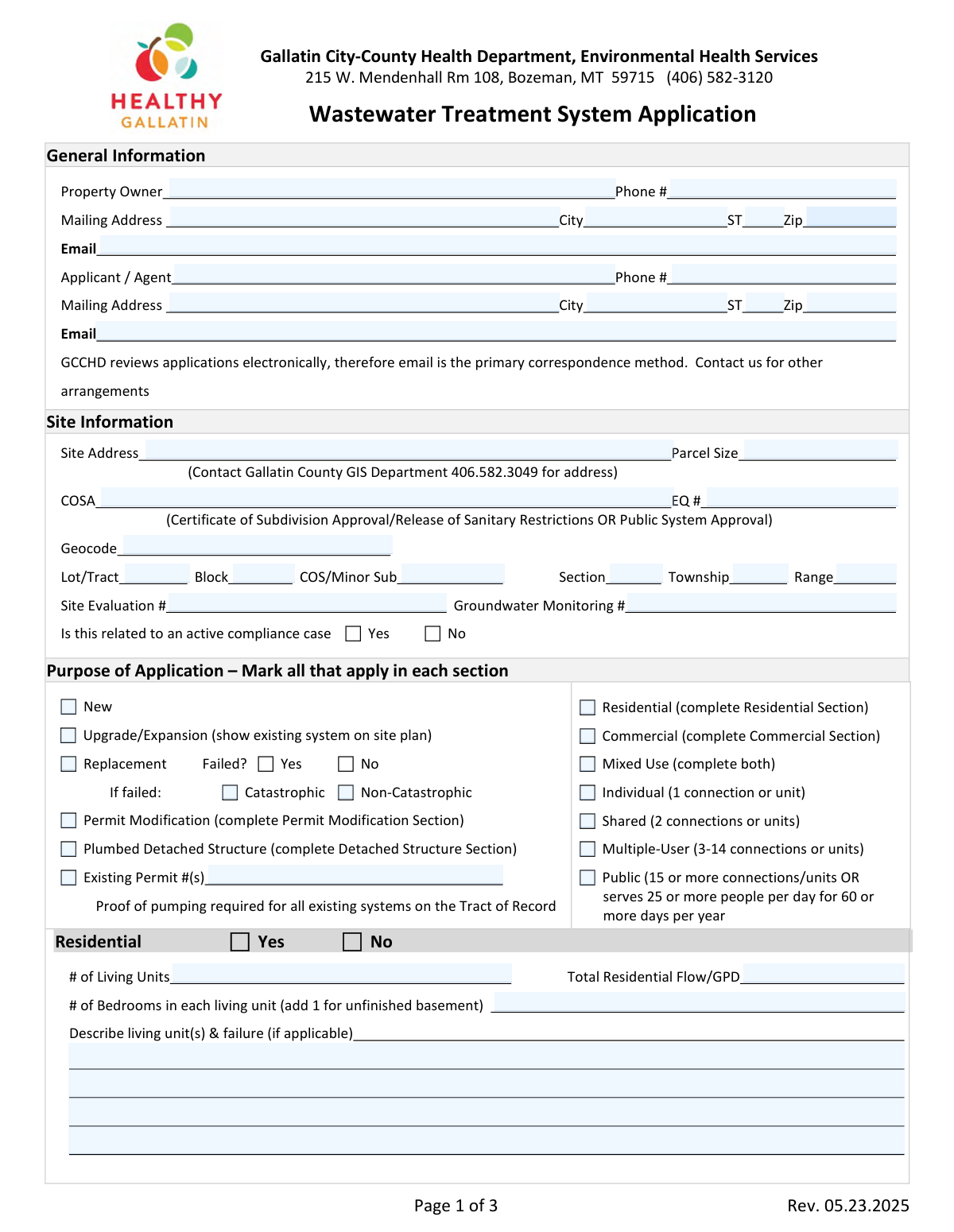
This form is an application submitted to the Gallatin City-County Health Department's Environmental Health Services to obtain a permit for a wastewater treatment system. It is required for new installations, upgrades, replacements, or modifications of residential and commercial septic systems to ensure they comply with local and state environmental health regulations. Today, this form can be filled out quickly and accurately using AI-powered services like Instafill.ai, which can also convert non-fillable PDF versions into interactive fillable forms.
Our AI automatically handles information lookup, data retrieval, formatting, and form filling.
It takes less than a minute to fill out GCCHD Wastewater Application using our AI form filling.
Securely upload your data. Information is encrypted in transit and deleted immediately after the form is filled out.
Form specifications
| Form name: | Gallatin City-County Health Department Wastewater Treatment System Application |
| Number of pages: | 3 |
| Filled form examples: | Form GCCHD Wastewater Application Examples |
| Language: | English |
| Categories: | health treatment forms, health forms, health department forms |
Instafill Demo: How to fill out PDF forms in seconds with AI
How to Fill Out GCCHD Wastewater Application Online for Free in 2026
Are you looking to fill out a GCCHD WASTEWATER APPLICATION form online quickly and accurately? Instafill.ai offers the #1 AI-powered PDF filling software of 2026, allowing you to complete your GCCHD WASTEWATER APPLICATION form in just 37 seconds or less.
Follow these steps to fill out your GCCHD WASTEWATER APPLICATION form online using Instafill.ai:
- 1 Navigate to Instafill.ai and upload or select the Wastewater Treatment System Application form.
- 2 Use the AI assistant to automatically fill in general information for the property owner and applicant/agent, including names, contact details, and mailing addresses.
- 3 Provide detailed site information such as the site address, parcel size, geocode, and legal description (Lot, Block, Section, etc.).
- 4 Indicate the purpose of the application by checking the appropriate boxes for new, replacement, or upgrade, and specify the use type (Residential, Commercial, Mixed Use).
- 5 Complete the relevant sections based on your project, providing details on the number of bedrooms for residential use or business specifics and flow calculations for commercial use.
- 6 Review all the information populated by the AI for accuracy, then proceed to the final page where the property owner(s) must initial all certifications and provide their printed name, signature, and date.
- 7 Securely download, print, or submit the completed and signed application as instructed by the Gallatin City-County Health Department.
Our AI-powered system ensures each field is filled out correctly, reducing errors and saving you time.
Why Choose Instafill.ai for Your Fillable GCCHD Wastewater Application Form?
Speed
Complete your GCCHD Wastewater Application in as little as 37 seconds.
Up-to-Date
Always use the latest 2026 GCCHD Wastewater Application form version.
Cost-effective
No need to hire expensive lawyers.
Accuracy
Our AI performs 10 compliance checks to ensure your form is error-free.
Security
Your personal information is protected with bank-level encryption.
Frequently Asked Questions About Form GCCHD Wastewater Application
This application is used to request a permit for a new, replacement, or modified wastewater (septic) system in Gallatin County. It is required for residential, commercial, or mixed-use properties that are not connected to a public sewer system.
Property owners planning to install a new septic system, upgrade or replace an existing one, or modify a current permit must complete this form. An authorized agent, such as a contractor, can also fill out the application, but all legal property owners must sign it.
You will need your property's legal and site information, including the Geocode, COSA number, and Site Evaluation number. For applications involving an existing system, you will also need proof of recent septic tank pumping and any existing permit numbers.
You must count an unfinished basement as one additional bedroom to ensure the septic system is designed with adequate capacity for potential future use. This is a regulatory requirement to prevent system overload if the basement is later finished into living space.
A system is defined as 'public' if it serves 15 or more connections or is used by 25 or more people per day for 60 or more days per year. If your system does not meet this threshold, you must describe how you will stay below this limit in the Commercial section.
Yes, you must complete this section for any detached structure with plumbing that is not a separate living unit. You will need to describe its use and note if it has any sleeping accommodations or kitchen facilities.
An approved 'Authorization to Construct' is valid for 24 months from the date of issuance. The authorization is also valid for only a single scheduled inspection, so all components must be ready at that time.
Yes, every person shown on the property deed must sign the application. If the property is owned by a corporation or LLC, you must also submit documentation showing who has the authority to sign on behalf of the entity.
Proof of pumping is required for all existing systems on the property to ensure they have been recently maintained and to provide the health department with a baseline of the system's condition. This helps in evaluating the needs for the upgrade or replacement.
You should apply for a permit modification if you need to change an existing, unexpired 'Authorization to Construct' or make changes to a 'Permit to Operate' that do not involve physical alterations to the system components.
The Gallatin City-County Health Department (GCCHD) reviews applications electronically and uses email as its primary method for all correspondence. Providing a valid email ensures you receive important updates and notifications about your application promptly.
Yes, services like Instafill.ai use AI to accurately auto-fill form fields, which can save you time and help reduce errors. These tools can populate your personal information and other known data points on the form.
Simply upload the Wastewater Treatment System Application PDF to the Instafill.ai platform. The AI will identify the fields, allowing you to fill them out interactively online, save your progress, and download the completed form.
You can use a service like Instafill.ai, which can convert flat, non-fillable PDFs into interactive, fillable forms. Just upload the document, and the platform will make it easy to type your information directly into the fields.
Compliance GCCHD Wastewater Application
Validation Checks by Instafill.ai
1
Validates Phone Number Format
This check ensures that the 'Owner Phone Number' and 'Applicant Phone Number' fields contain a valid 10-digit US phone number. It allows for common formats like (XXX) XXX-XXXX or XXX-XXX-XXXX. This is important for ensuring the health department can successfully contact the owner or agent if questions arise. If the format is invalid, the form submission will be rejected with a message prompting the user to correct the number.
2
Validates Email Address Format
This check verifies that the 'Owner Email' and 'Applicant Email' fields contain a string that matches a standard email format (e.g., [email protected]). Since the form explicitly states that email is the primary method of correspondence, a valid email address is critical for application processing, notifications, and approvals. An invalid email will block submission and require correction.
3
Ensures Completeness of Site Address Information
This validation confirms that either the 'Site Address' field or the legal description fields (Lot/Tract, Section, Township, Range) are filled out. This information is fundamental for the health department to locate the property for inspection and to cross-reference with county GIS and permitting records. An application without sufficient location information cannot be processed and will be returned as incomplete.
4
Conditional Requirement for Failure Type
If an applicant checks 'Replacement' and then 'Failed? Yes' in the 'Purpose of Application' section, this validation ensures that they must also select either 'Catastrophic' or 'Non-Catastrophic'. This detail is crucial for the health department to assess the urgency and potential public health risk associated with the failure. Failure to specify the failure type will result in a validation error prompting the user to complete the selection.
5
Conditional Completion of Residential Section
This check ensures that if the 'Residential' or 'Mixed Use' checkbox is selected in the 'Purpose of Application' section, then the 'Residential' section (including '# of Living Units' and '# of Bedrooms') must be completed. This information is required to calculate the design flow for the residential portion of the system. If the section is left blank, the user will be notified that required residential details are missing.
6
Conditional Completion of Commercial Section
This check ensures that if the 'Commercial' or 'Mixed Use' checkbox is selected in the 'Purpose of Application' section, then the 'Commercial' section must be filled out. Commercial systems have unique requirements based on the type of business and number of users. Missing this information makes it impossible to evaluate the application, so the submission will be blocked until the commercial details are provided.
7
Verifies Commercial Flow Calculation
This validation confirms that the value entered in 'Total Commercial Flow / GPD' is equal to the sum of 'Total GPD for employees' and 'Total GPD for customers'. This serves as a mathematical check to ensure the applicant's calculations are accurate before the system is sized. If the numbers do not add up, an error message will appear, asking the user to review and correct their flow calculations.
8
Verifies Total System Design Flow Calculation
This check validates that the 'Design flow – Total GPD' equals the sum of 'Total Residential Flow/GPD' and 'Total Commercial Flow / GPD'. This is a critical final check to ensure the proposed system is sized to handle the total calculated load from all sources. A mismatch indicates a calculation error that could lead to an improperly sized system, so the form will not be accepted until the values are consistent.
9
Conditional Requirement for Level II Component Details
If the 'Level II or NSF 245 Component? Yes' checkbox is selected, this validation requires that the 'Manufacturer' and 'Model' fields must not be empty. Advanced treatment components must be specifically identified for the department to verify they are approved for use. An application proposing such a system without identifying the specific model cannot be reviewed.
10
Conditional Requirement for Grease Trap Information
This validation ensures that if 'Will septic system serve a food service establishment? Yes' is checked, the 'number and size of grease traps' field must be filled in. Grease from food service can cause system failure and environmental contamination, making grease traps a mandatory component. The application will be considered incomplete without this specification.
11
Conditional Requirement for Permit Modification Reason
If 'Permit Modification' is checked in the 'Purpose of Application' section, this validation requires the 'Reason for Request' field to be completed. The health department cannot evaluate a request to change an existing permit without a clear justification. The submission will be blocked until a reason is provided.
12
Ensures All Owner Initials are Provided
This check verifies that all six initial boxes on page 3 have been checked by the property owner. These initials serve as legal acknowledgment of key responsibilities and understandings, such as permit validity and inspection requirements. The form is not legally complete without all initials, and submission will be prevented until they are all marked.
13
Validates Property Owner Signature and Date
This validation ensures that at least one 'Property Owner Name (print)', 'Signature', and 'Date' field set is completed on page 3. The owner's signature is a legal attestation to the accuracy of the information provided and their agreement to comply with regulations. An unsigned application has no legal standing and will be rejected.
14
Non-Public Commercial System Justification
If the application is for a 'Commercial' use but the 'Public' system type is not selected, this check requires the 'Non-public usage justification' field to be filled. This is a regulatory requirement to document how the owner will ensure the system does not meet the threshold for a public system (25+ people/day for 60+ days/yr). Failure to provide this justification will halt the application process.
15
Logical Check for Plumbed Detached Structure Use
If the 'Plumbed Detached Structure' section is completed, this check ensures the 'Describe use' field does not describe a separate living unit, per the form's instruction. This prevents applicants from improperly permitting an accessory dwelling unit (ADU) as a simple detached structure, which has different regulatory requirements. If the description suggests a living unit, a warning will be displayed.
Common Mistakes in Completing GCCHD Wastewater Application
Applicants often struggle to find or correctly transcribe complex legal information like the Geocode, COSA number, or the Section, Township, and Range. Leaving these fields blank or entering incorrect data from memory leads to an immediate application rejection or significant processing delays as the department cannot accurately identify the parcel. To avoid this, consult your property deed or the Gallatin County GIS department records before filling out the form; AI-powered tools like Instafill.ai can also help by auto-populating this information from public records.
The form specifically requires adding one bedroom for any unfinished basement, a detail many applicants overlook when calculating residential flow needs. This miscalculation results in an underestimation of the required wastewater flow (GPD), potentially leading to the design and installation of an undersized system that will fail prematurely. Always count physical bedrooms and add one for an unfinished basement, regardless of its current use, to ensure the system is sized correctly for future capacity.
In the 'Purpose of Application' section, applicants frequently select only one option, such as 'Replacement,' while neglecting to also check 'Residential' and 'Individual.' This incomplete information forces the reviewer to make assumptions or return the application for clarification, delaying the review process. Carefully read all options and check every box that applies to your project across all subsections to provide a complete picture from the start.
For commercial systems trying to avoid a 'Public' classification, the form requires a detailed explanation of how usage will remain below 25 people per day. Applicants often provide a vague, single-sentence answer like 'It's a small office,' which is insufficient and can trigger further scrutiny or reclassification. You must provide a credible, detailed breakdown of expected daily employee and customer traffic to prove you meet the non-public criteria.
The application is a legal document that requires the signature of every individual listed on the property deed. A common error is for only one spouse or business partner to sign, which legally invalidates the submission and requires it to be returned for the missing signatures. To prevent this delay, verify all owners on the deed and ensure each one prints their name and signs the form in the designated areas.
Page 3 contains several statements that the property owner must acknowledge by initialing next to each one, which is a frequently missed step. Each initial confirms understanding of a specific rule or condition of the permit, and missing even one can render the application incomplete and halt the review process. Before signing, double-check that every initial box has been filled out by the property owner(s).
The form explicitly warns against using the 'Plumbed Detached Structure' section for separate living units, yet this mistake is common. Applicants may incorrectly describe a guest house or accessory dwelling unit (ADU) in this section, which has different regulatory requirements than a workshop with a sink. This misclassification can lead to incorrect system design and compliance issues; a 'living unit' must be accounted for in the Residential section.
The Commercial section requires specific calculations for wastewater flow based on employees and customers, but applicants often guess at numbers or leave the calculation fields blank. This forces the health department to reject the application, as the design flow cannot be verified. To avoid this, use industry-standard flow rates for your business type to calculate GPD and clearly show your math in the space provided.
The form mentions several required attachments, such as 'proof of pumping for all existing systems' or 'documentation of signatory authority' for an LLC. Applicants frequently submit the form without these necessary documents, resulting in an incomplete package that cannot be reviewed. Create a checklist of all required documents mentioned in the sections relevant to your project and ensure they are all included with your submission.
The form revision date (Rev. 05.23.2025) is printed on each page, indicating that regulations and requirements change over time. Applicants sometimes find and use an old version of a form they downloaded previously, which may lack new fields or contain outdated information, leading to an automatic rejection. Always download the latest version of the application directly from the Gallatin City-County Health Department website before starting.
Saved over 80 hours a year
“I was never sure if my IRS forms like W-9 were filled correctly. Now, I can complete the forms accurately without any external help.”
Kevin Martin Green
Your data stays secure with advanced protection from Instafill and our subprocessors

Robust compliance program
Transparent business model
You’re not the product. You always know where your data is and what it is processed for.
ISO 27001, HIPAA, and GDPR
Our subprocesses adhere to multiple compliance standards, including but not limited to ISO 27001, HIPAA, and GDPR.
Security & privacy by design
We consider security and privacy from the initial design phase of any new service or functionality. It’s not an afterthought, it’s built-in, including support for two-factor authentication (2FA) to further protect your account.
Fill out GCCHD Wastewater Application with Instafill.ai
Worried about filling PDFs wrong? Instafill securely fills gallatin-city-county-health-department-wastewater-treatment-system-application forms, ensuring each field is accurate.



