Fill out health department forms
with AI.
Health department forms serve as the essential administrative backbone for public health management, ensuring that both individuals and organizations meet strict safety and compliance standards. This category encompasses a wide range of documentation, from personal health screenings required for social service applications to formal contracts between healthcare practitioners and state agencies. These forms are critical because they capture vital medical histories, verify professional certifications, and establish the legal framework necessary for public health programs to function effectively and safely.
By continuing, you acknowledge Instafill's Privacy Policy and agree to get occasional product update and promotional emails.
About health department forms
Typically, these forms are required by healthcare providers, prospective caregivers, and social service applicants who are navigating state-regulated systems. For example, individuals seeking to become foster parents may need to complete detailed health questionnaires like the Resource Family Approval (RFA) form to document their suitability for caregiving. Similarly, medical professionals often encounter health department documentation when entering into provider agreements for Medicaid participation. Because these documents often involve sensitive medical data and legal obligations, completing them accurately is vital to avoid processing delays or compliance issues.
Managing this volume of paperwork can be a significant administrative burden, but tools like Instafill.ai use AI to fill these forms in under 30 seconds while ensuring data is handled accurately and securely. This technology allows users to transform static PDFs into completed documents quickly, providing a practical way to save time on essential healthcare and licensing forms.
Every form on this page can be completed without typing. Instafill is form filling software that reads a PDF and fills it for you — including flat and scanned documents that carry no fillable fields at all.
Forms in This Category
The forms in this category have a median Form Complexity Index of 62/100 (Moderate), measured across 6 forms by field count, input difficulty, length, conditional logic and structure. See how it is calculated.
- Enterprise-grade security & data encryption
- 99%+ accuracy powered by AI
- 1,000+ forms from all industries
- Complete forms in under 60 seconds
How to Choose the Right Form
Navigating health department forms often involves distinguishing between personal health assessments for social services and professional agreements for healthcare program enrollment. Depending on your location and your role—whether as a private citizen or a medical professional—the documentation requirements vary significantly.
Caregiving and Social Services
If you are in the process of becoming a foster parent, kinship caregiver, or legal guardian in the state of California, you will need to provide detailed medical documentation to the state to ensure a safe environment for children in care.
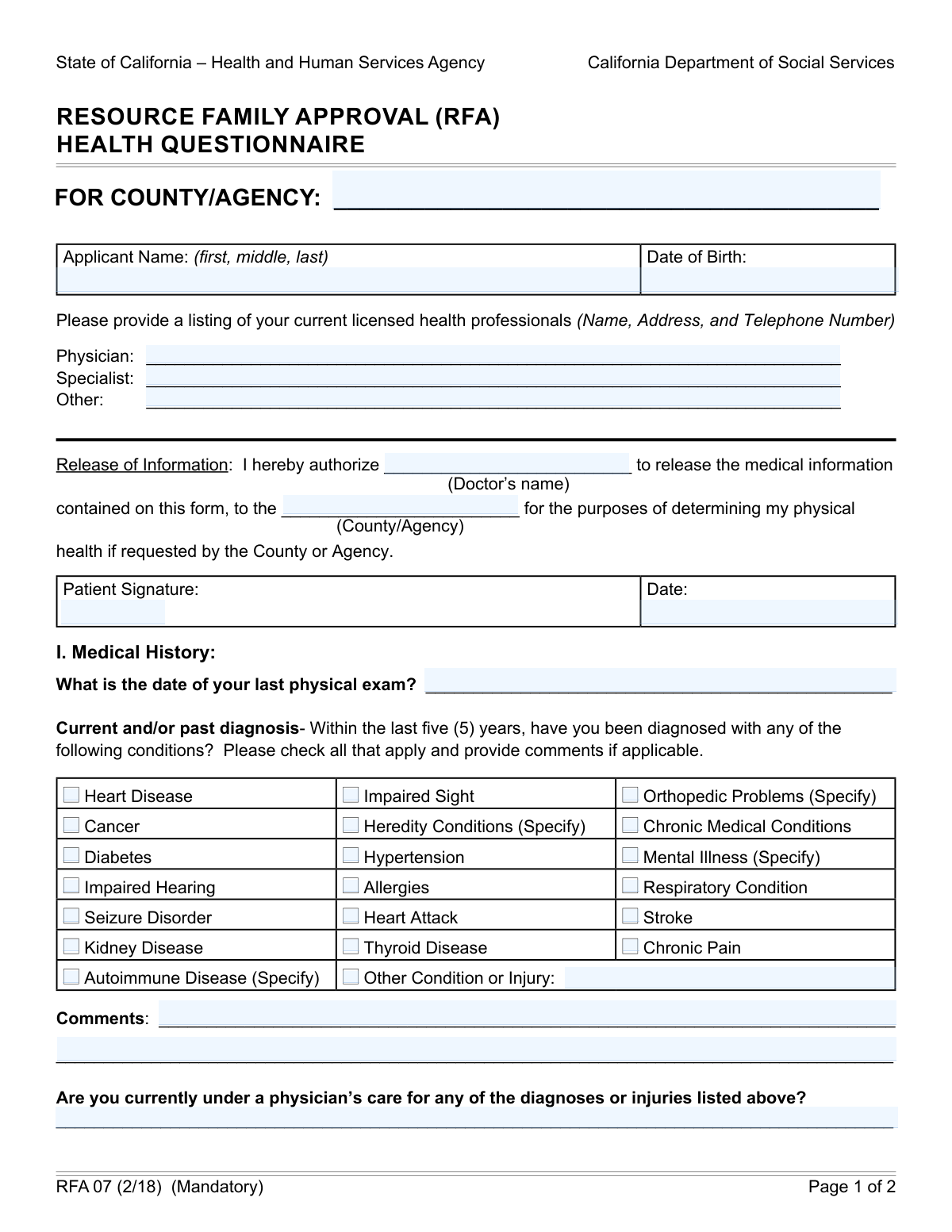
- California Department of Social Services Form RFA 07: This is a mandatory health questionnaire for the Resource Family Approval (RFA) process. You should choose this form if you are an applicant needing to document your medical history, current medications, and physician information. It includes an authorization to release medical information, which is a critical step in the suitability assessment for caregiving.
Medicaid and Healthcare Provider Enrollment
Healthcare professionals and medical facilities looking to offer services through state-funded programs must enter into formal contracts with the state's health department to ensure compliance with billing and legal standards.
- Utah Department of Health Provider Agreement for Medicaid: This document is specific to healthcare providers operating within Utah. You should select this form if you are seeking to participate in the Title XIX Medicaid program. It serves as a binding contract that establishes your responsibilities regarding record-keeping, billing practices, and regulatory compliance.
Quick Selection Tips
- Are you applying to be a foster or resource parent in California? Use the Form RFA 07.
- Are you a medical professional in Utah seeking to bill Medicaid? Use the Utah Department of Health Provider Agreement for Medicaid.
Using Instafill.ai allows you to complete these complex documents accurately. Our AI tools help convert static PDFs into interactive forms, ensuring that mandatory fields—like those in the RFA 07—are filled correctly to avoid processing delays.
Form Comparison
| Form | Primary Purpose | Targeted Filer | Key Requirement | Region |
|---|---|---|---|---|
| California Department of Social Services Form RFA 07 (2/18), Resource Family Approval (RFA) Health Questionnaire (Mandatory) | Assesses physical health and suitability for caregiving responsibilities. | Prospective resource family applicants and caregivers. | Disclosure of medical history, medications, and health provider information. | California |
| Utah Department of Health Provider Agreement for Medicaid | Establishes a binding contract for participation in the Medicaid program. | Healthcare providers seeking to bill Medicaid for services. | Compliance with billing, record-keeping, and legal program standards. | Utah |
Tips for health department forms
When completing health questionnaires like the RFA 07, ensure all dates for surgeries, hospitalizations, and current medications are precise. Inconsistent or missing medical details can trigger additional inquiries from health departments and significantly delay your licensing or approval process.
For Medicaid provider agreements, pay close attention to the sections regarding billing practices and record-keeping compliance. These are legally binding contracts, and understanding your obligations before signing ensures you remain in good standing with state health divisions.
Many health department forms require supplemental proof, such as professional licenses, certifications, or physician signatures. Collecting these documents before you start the digital application prevents the need to pause and search for records mid-process.
AI-powered tools like Instafill.ai can complete complex health department forms in under 30 seconds with high accuracy. Your sensitive data stays secure during the process, providing a practical time-saving solution for professionals dealing with multiple certification or licensing forms.
Health departments frequently update questionnaires and agreements to reflect new regulations. Submitting an outdated version can lead to automatic rejection, so always verify that the form code matches the current requirement listed by the issuing agency.
Forms often ask about tobacco or alcohol use to assess suitability for caregiving or clinical roles. Providing honest and clear disclosures upfront prevents complications during the background check or interview phase of the health department's review.
Health forms often include separate authorization sections for releasing medical information that require their own signatures. Ensure every signature line and date field is completed, as a single missing authorization can render the entire document invalid and stall your submission.
Frequently Asked Questions
This category generally includes administrative and regulatory documents such as healthcare provider agreements, health questionnaires for licensing, and certification forms for social services. These forms are used by state agencies to verify eligibility for medical programs or to assess the health status of applicants for specific caregiving roles.
The requirement depends on the specific form, but typically these are completed by healthcare providers seeking to participate in state programs or individuals applying for professional certifications. For instance, those applying for resource family approval or seeking to become a Medicaid provider must submit these documents to the relevant state health or social services division.
Yes, many health department forms can be completed efficiently using AI-powered tools. Services like Instafill.ai can fill these forms in under 30 seconds by accurately extracting data from your existing source documents and placing it into the appropriate fields on the PDF.
No, health department forms are usually specific to the state or county governing the program. Because regulations for healthcare licensing and social services vary by jurisdiction, you must ensure you are using the specific version required by your local or state agency, such as the California Department of Social Services or the Utah Department of Health.
Submitting incomplete forms can lead to significant delays in the processing of your application or certification. In some cases, failing to disclose required medical history or provider information can result in a denial of your request or the need to restart the entire application process.
While manual entry can be time-consuming due to the detailed information required, using an AI tool can expedite the process significantly. Instafill.ai allows users to complete these forms in under 30 seconds, ensuring that data is accurately mapped from your records to the official form fields.
A provider agreement acts as a legally binding contract between a healthcare provider and the state's health department. It outlines the terms of participation, including billing practices, record-keeping responsibilities, and compliance with federal and state healthcare laws.
Some health department forms, especially those involving personal health assessments, may require you to provide an authorization for the release of medical information. This allows the reviewing agency to verify the data provided in your questionnaire by contacting your healthcare providers directly if necessary.
Submission instructions vary depending on the agency, but most completed forms are sent to the specific state division or county office managing the program. Many departments now provide digital portals for document uploads, though some may still require physical mailings for documents that need original signatures.
Yes, most health department certifications and provider agreements are legal documents that carry professional or personal obligations. By signing, you are typically certifying that all provided information is true and accurate to the best of your knowledge and agreeing to follow the rules of the associated program.
Glossary
- Form Complexity Index
- Instafill’s 0–100 measure of how much effort a form takes to complete, calculated deterministically from the form’s own structure rather than estimated. It combines the number of fillable fields (the largest factor), how difficult those fields are to complete based on their type, the number of pages that contain fields, the amount of conditional “fill-only-if” logic, and how many sections the form is divided into, then adds modifiers for tables and repeating lists, bundled instruction pages, and dense page layouts. A higher score means the form is harder to fill out by hand. The forms in this category have a median Form Complexity Index of 62/100 (Moderate). See exactly how it is calculated.
- Medicaid (Title XIX)
- A joint federal and state program that provides health coverage to eligible low-income individuals and families; Title XIX is the formal legislative name for the program under the Social Security Act.
- Resource Family
- A caregiver, such as a foster parent or relative, who has been approved by the state to provide care and supervision to children in the foster care system.
- Provider Agreement
- A legally binding contract between a healthcare professional or organization and a state agency that outlines the rules for participating in government-funded health programs.
- Authorization to Release Medical Information
- A legal consent form that allows healthcare providers to share an individual's private medical records with specific agencies for the purpose of evaluation or approval.
- Compliance
- The act of adhering to specific laws, regulations, and ethical standards required by health departments, particularly regarding billing and patient privacy.
- Suitability Assessment
- A review process used by agencies to determine if an applicant's physical and mental health status is appropriate for the responsibilities of a specific role, such as caregiving.
- NPI (National Provider Identifier)
- A unique 10-digit identification number issued to healthcare providers in the United States, used for administrative and financial transactions.
- Credentialing
- The process of verifying a healthcare provider's qualifications, experience, and professional standing to ensure they meet the standards required for licensing or participation.