
Yes! You can use AI to fill out Utah Department of Health Provider Agreement for Medicaid
Don't type 23 fields by hand. Tell our AI about yourself, or upload your insurance card, and it fills every field in seconds. You check it, then download, print or sign.
The AI does the filling. You just check it.
No typing into boxes, nothing to install.
What this form asks for
The AI fills all of it, from your answers or your documents.
The AI checks your answers before you download
12 checks built for this form, so a wrong date or a missing answer is caught before anyone else sees it.
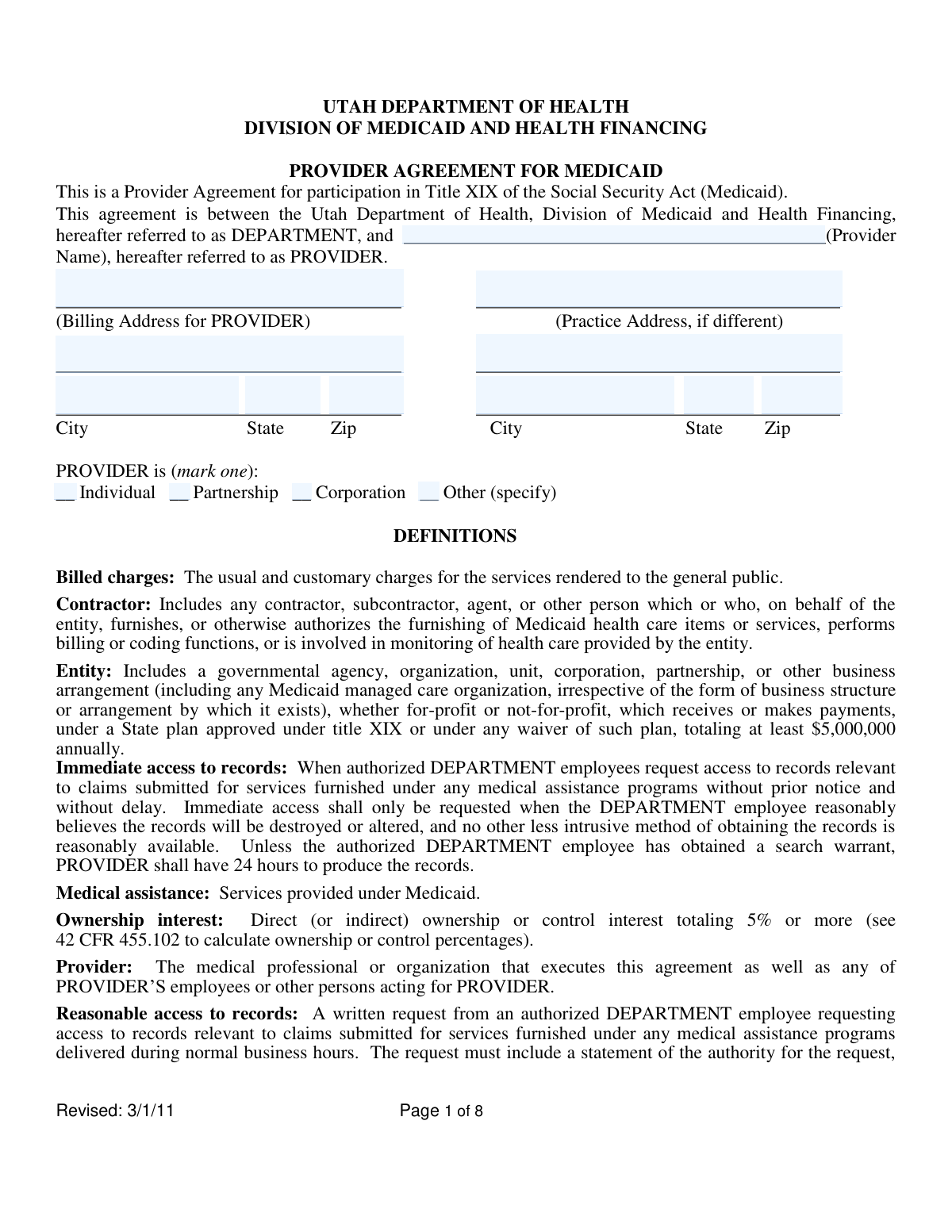
This check verifies that the 'Provider Name' field at the top of the agreement is not empty. This name is fundamental to the legal agreement, identifying the primary party entering into the contract with the Department of Health. If this field is left blank, the form submission will be rejected as the agreement would be invalid without a named provider.
This validation ensures that the 'Billing Address for PROVIDER' section is fully completed, including address line 1, city, state, and zip code. A complete and accurate billing address is critical for official correspondence, payment processing, and legal notices. An incomplete address will cause a validation failure, preventing submission until all required address components are provided.
This check confirms that exactly one option is selected from the 'PROVIDER is (mark one)' checklist (Individual, Partnership, Corporation, Other). This information is essential for determining the legal structure of the provider, which affects ownership disclosure, liability, and other contractual obligations. The form is considered incomplete if zero or more than one option is selected.
This validation is triggered if the 'Other' option is selected under 'PROVIDER is (mark one)'. It ensures that the adjacent '(specify)' text field is filled out with a description of the provider's entity type. This is important for clarity and to ensure the Department understands the legal nature of non-standard entities. Failure to specify the type will result in an error, halting the submission process.
This check verifies that the 'Zip' fields for both the Billing and Practice addresses contain a valid 5-digit or 9-digit (ZIP+4) numeric format. Correctly formatted zip codes are essential for mail delivery and data integrity within the system. An invalid format will trigger an error message prompting the user to correct the entry before proceeding.
This validation compares the 'Provider Name' entered on page 1 with the 'Type or Print PROVIDER Name' in the signature block on page 8. The names must match exactly to ensure the entity signing the agreement is the same one identified at the beginning of the document. A mismatch will result in a validation error, as it raises questions about the identity of the signatory.
And 6 more checks
- Conditional Requirement for Corporation Name
- Verifies Provider Signature Presence
- Validates Provider Signature Date
- Validates NPI or Medicaid Number Format
- Checks for Logical Date Sequence
- Ensures Practice Address Integrity
Let AI fill out your Utah Medicaid Provider Agreement
No typing. Every field filled in seconds, checked, ready to sign.
How to Fill Out Utah Medicaid Provider Agreement Online for Free in 2026
What the AI walks you through.
- Navigate to Instafill.ai and upload or select the Utah Provider Agreement for Medicaid form.
- Use the AI assistant to accurately fill in your provider details, including your legal name, billing and practice addresses, and entity type (Individual, Partnership, Corporation, etc.).
- Carefully review all sections of the agreement, including the terms for payment, record-keeping, non-discrimination, and disclosure requirements, to ensure full understanding and compliance.
- Provide all necessary disclosure information as required by the agreement, such as ownership details, significant business transactions, and any relevant criminal history.
- Electronically sign and date the agreement in the designated 'PROVIDER' section to certify your acceptance of the terms.
- Download the completed and signed agreement, ready for submission to the Utah Department of Health, Division of Medicaid and Health Financing.
Common Mistakes in Completing Utah Medicaid Provider Agreement
The ones the AI is built to catch.
Using an Inconsistent or Incorrect Provider Name
Confusing Billing and Practice Addresses
Incorrectly Identifying the Provider Entity Type
Ambiguous Information in the Signature Section
Failing to Meet Ownership Disclosure Requirements
Overlooking the Third-Party Liability (TPL) Billing Requirement
Misunderstanding Record Retention and Access Rules
Forgetting to Report Adverse Actions on a Professional License
Submitting a Form with Missing Checkboxes or Selections
Failure to Disclose Sanctioned Individuals or Criminal History
Frequently Asked Questions About Utah Medicaid Provider Agreement
Is it really free for 7 days?
Can I fill other forms too?
How do I cancel?
How does the AI fill out Utah Medicaid Provider Agreement?
What happens to my information?
How complex is Utah Medicaid Provider Agreement to fill out?
What is the purpose of the Provider Agreement for Medicaid form?
Who needs to fill out this agreement?
What other documents do I need to submit with this agreement?
How long am I required to keep patient and billing records?
What should I do if I receive an overpayment from Medicaid?
Can I bill a Medicaid recipient for any portion of the service cost?
What if I see a Medicaid patient through an HMO contract?
How can I terminate this agreement?
What does it mean to provide 'reasonable access' to records?
What information do I need to disclose about ownership and business transactions?
Can I use an AI tool to help me fill out this form?
How can I fill out this form online using a service like Instafill.ai?
The PDF of this form I have is not fillable. What can I do?
Get your Utah Medicaid Provider Agreement filled out by AI
$0 today. Cancel before Nov 4 and you pay nothing.
Other forms like this one
Medicaid forms: Alabama Medicaid Agency ABA Therapy Assessment Form (6/20/19) — Behavior Assessment and Treatment Request (CPT 97151) for Applied Behavioral Analysis for Autism Spectrum Disorder, Medicaid Managed Care Applied Behavior Analysis — Authorization Request (Healthy Blue Louisiana, BLAPEC-1989-20), Arkansas Medicaid Applied Behavioral Analysis (ABA) Authorization Request, Agreement of Financial Responsibility - Medicaid, Utah Medicaid Doula Provider Attestation, 42 CFR Part 489 - Provider Agreements and Supplier Approval (Centers for Medicare & Medicaid Services), Medicaid of Alaska Provider Electronic Remittance (835) Authorization and Claims Enrollment Form, Medicaid Alaska EDI Enrollment - Provider Information Submission Agreement, Arkansas Medicaid Provider Application Packet (DMS-652), Form HFS 3082, Drug Prior Authorization Request Form, Medicaid of Minnesota (Administered by HealthPartners of Minnesota) EDI Trading Partner Enrollment Form, New York State Medicaid Enrollment Form (EMEDNY-436701), New York State Medicaid Enrollment Form, Provider Enrollment Agreement (OHA 3975), Oregon Medicaid ID Application Form, Autism Spectrum Disorder Diagnostic Checklist for Medicaid Participants, Form CMS-1539, Long-Term Care Facility Application for Medicare and Medicaid, Medicaid Clinical Trial Attestation Form, West Virginia Medicaid Hepatitis-C Therapy Prior Authorization Form
health forms: Form 1095-A, Health Insurance Marketplace Statement, Form 8889, Health Savings Accounts, Form WH-380-E, Certification of Health Care Provider, Form 7206, Self-Employed Health Ins. Ded., Form 8885, Health Coverage Tax Credit, Form WH-380-F, Certification of Health Care Provider, Form 1095-C, Employer-Provided Health Insurance Offer and Coverage, Form 1095-B, Health Coverage, Form I-905, Application for Authorization to Issue Certification for Health Care Workers, Form BHVH, Outpatient Behavioral Health – ABA Treatment Request, Form SHA, Separation Health Assessment, DHS-6696-ENG, Minnesota Health Care Programs Application (MNsure/DHS), Geisinger Health Plan Behavioral Health Professional Services Questionnaire, Priority Health Small Group Renewal Decision Form, Form CH-006: PA-BH-Res-PCS, Oregon Behavioral Health Support Program Plan of Care Authorization (Plan of Care Request for Behavioral Health Residential or Personal Care Services), Form 7206 (2025), Self-Employed Health Insurance Deduction, HIPAA Authorization Form, Authorization for the Release of Protected Health Information, Prior Authorization (PA) Request Form – Adult Palliative Care (Alameda Alliance for Health), Medicare Enrolment Application (Australia) – Enrol in Medicare, Re-enrol/Extend Eligibility, Enrol a Newborn, and Register for My Health Record, Alameda Alliance for Health Prior Authorization (PA) Request Form – Adult Palliative Care
health department forms: California Department of Social Services Form RFA 07 (2/18), Resource Family Approval (RFA) Health Questionnaire (Mandatory), Gallatin City-County Health Department Wastewater Treatment System Application, New York State Department of Health Certificate of Qualification Questionnaire - Virology, Health & Human Services Agency California Department of Social Services APPLICATION FOR A FAMILY CHILD HOME LICENSE LIC 279, New York State Department of Health Medicare Savings Program Application
provider agreement forms: Connection Dental Network – Provider Application (GEHA Connection Dental Network) and Participating Provider Agreement, 42 CFR Part 489 - Provider Agreements and Supplier Approval (Centers for Medicare & Medicaid Services), Medicaid Alaska EDI Enrollment - Provider Information Submission Agreement, Form HW027, Online Claiming Provider Agreement, Form CMS-1561, Health Insurance Benefit Agreement
state health forms: Form 1095-A, Health Insurance Marketplace Statement, VA Form 21-0781, Statement in Support of Claimed Mental Health Disorder(s) Due to an In-Service Traumatic Event(s), VA Form 21-0781, Statement in Support of Claimed Mental Health Disorder(s) Due to an In-Service Traumatic Event(s), New York State Department of Health Certificate of Qualification Questionnaire - Virology, NY State of Health Appeal Request (Form DOH-5231), New York State Department of Health Medicare Savings Program Application
Utah Medicaid forms: Utah Medicaid Doula Provider Attestation
Let AI fill out your Utah Medicaid Provider Agreement
Your trial starts once a card is added. You pay nothing before Nov 4.
Our AI already knows this form, all 23 fields of it. Skip the typing: tell it about yourself, or upload what you have, and it fills the whole form in seconds.
- AI fills every field on all 8 pages, checkboxes included
- No typing into boxes: answer a few questions, or upload your insurance card, an old copy of this form, a photo of a document
- The AI checks the answers; you review and change anything before you download
- Download the finished PDF, print it, or sign it online
- Encrypted, and never used to train AI
Cancel before Nov 4 and you pay nothing.
A card is needed to start the trial. Cancel in two clicks from your account.
Terms · Privacy