
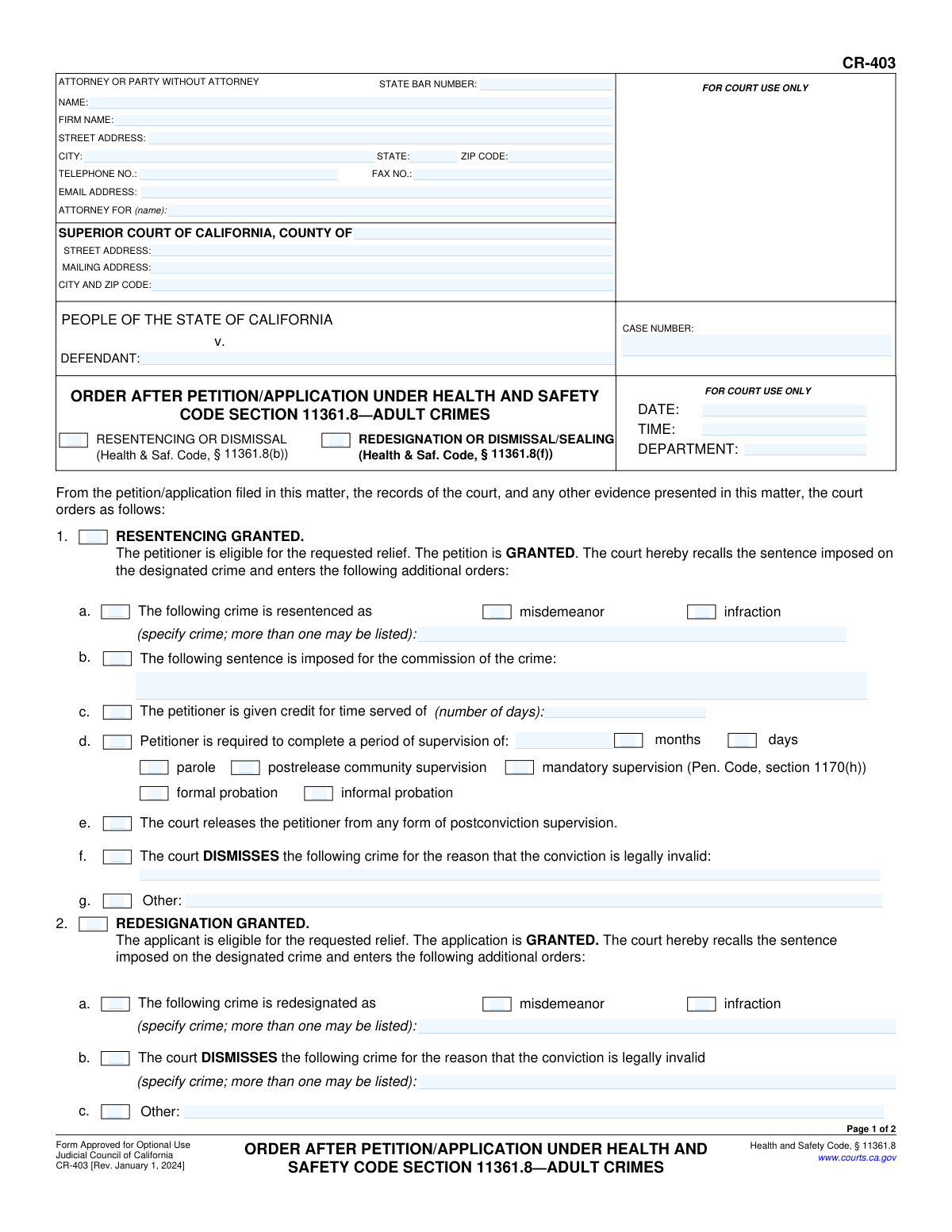
Yes! You can use AI to fill out Form CR-403, Order After Petition/Application Under Health and Safety Code Section 11361.8—Adult Crimes
Don't type 72 fields by hand. Tell our AI about yourself, or upload your insurance card, and it fills every field in seconds. You check it, then download, print or sign.
The AI does the filling. You just check it.
No typing into boxes, nothing to install.
What this form asks for
The AI fills all of it, from your answers or your documents.
The AI checks your answers before you download
12 checks built for this form, so a wrong date or a missing answer is caught before anyone else sees it.
Validates that only one of the primary outcome sections (1. RESENTENCING GRANTED, 2. REDESIGNATION GRANTED, or 3. DENIED) is selected. A petition cannot be simultaneously granted and denied. If this validation fails, it indicates a logical contradiction in the court's order, which must be resolved before finalization.
Ensures the 'CASE NUMBER' field on page 2 is identical to the 'CASE NUMBER' field on page 1. This check is critical for maintaining document integrity, especially if pages are handled separately. A mismatch could lead to incorrect filing or association of the order with the wrong case file.
If 'RESENTENCING/REDESIGNATION DENIED' (Section 3) is checked, this validates that the specific crime is identified and at least one reason for denial (checkboxes 3a-3f) is selected. This is legally required to provide a basis for the denial for the record and for any potential appeals. An order lacking a reason for denial is incomplete.
If 'RESENTENCING GRANTED' (Section 1) is checked, this validation ensures that at least one of the sub-options (1a-1g) is also checked and filled out. This is necessary to specify the exact terms of the resentencing. An order that grants resentencing without detailing the new terms is ambiguous and unenforceable.
If 'REDESIGNATION GRANTED' (Section 2) is checked, this validation ensures that at least one of the sub-options (2a-2c) is completed. This is required to define how the crime is being redesignated or dismissed. Failure to provide these details makes the order incomplete and its intent unclear.
Checks that if any 'Other' checkbox (e.g., 1g, 2c, 3f) is selected, the corresponding text field is not empty. This rule prevents ambiguous orders where a reason or condition is cited as 'Other' without any explanation. The description is crucial for understanding the court's specific ruling.
And 6 more checks
- State Bar Number Format
- Date of Order Validation
- Supervision Period Specification
- Credit for Time Served Format
- Crime Specification for Resentencing/Redesignation
- Defendant Name Consistency
Let AI fill out your CR-403
No typing. Every field filled in seconds, checked, ready to sign.
How to Fill Out CR-403 Online for Free in 2026
What the AI walks you through.
- Navigate to Instafill.ai and upload or select Form CR-403.
- Enter the case number, court information, and the names of the parties involved in the designated fields.
- Provide the attorney or self-represented party's contact information, including name, address, and State Bar number.
- Indicate the court's primary order by checking the box for 'RESENTENCING GRANTED,' 'REDESIGNATION GRANTED,' or 'RESENTENCING/REDESIGNATION DENIED.'
- If the petition is granted, fill in the specific details of the order, such as the crime being resentenced/redesignated, the new sentence, and any supervision requirements.
- If the petition is denied, check the box that corresponds to the court's reason for the denial.
- Review all sections to ensure the court's order is accurately reflected, then present the form for the judicial officer's signature and date to finalize the order.
Common Mistakes in Completing CR-403
The ones the AI is built to catch.
Incorrect or Incomplete Case Number
Filling in 'FOR COURT USE ONLY' Sections
Forgetting to Complete Header on Page 2
Ambiguous Specification of Crimes
Confusing Resentencing with Redesignation
Missing State Bar Number or Contact Information
Leaving Mandatory Checkboxes Unmarked
Illegible Handwriting on a Non-Fillable PDF
Incorrectly Stating the Court's Name or Address
Inaccurate Calculation of 'Credit for Time Served'
Frequently Asked Questions About CR-403
Is it really free for 7 days?
Can I fill other forms too?
How do I cancel?
How does the AI fill out CR-403?
What happens to my information?
How complex is CR-403 to fill out?
What is the purpose of Form CR-403?
Do I need to fill out this form?
What is the difference between 'Resentencing Granted' and 'Redesignation Granted'?
My petition was denied. Where can I find the reason?
What does it mean if my conviction is 'sealed' as noted in Section 6?
What does 'misdemeanor for all purposes' mean?
How do I start the process to get this court order?
What happens to my requirement to register as a narcotics offender?
How long will it take to receive this order after I file my petition?
Can an AI tool help me with Form CR-403?
How can I use Instafill.ai to help with this legal process?
The petition form I need to file is a non-fillable PDF. What should I do?
Get your CR-403 filled out by AI
$0 today. Cancel before Nov 1 and you pay nothing.
Other forms like this one
California court forms: Judicial Council of California Form SC-105, Request for Court Order and Answer (Small Claims), Judicial Council of California Form SC-120, Defendant’s Claim and ORDER to Go to Small Claims Court (Small Claims), Judicial Council of California Form SER-001, Request for Sheriff to Serve Court Papers, Judicial Council of California Form SER-001, Request for Sheriff to Serve Court Papers, Affidavit for Collection of Personal Property California Probate Code Section 13100, Form POS-040, Proof of Service—Civil, Declaration of Facts of Death (California Superior Court), declaration-of-marriage-for-court-proceeding-california-family-law, ADOPT-200, Adoption Request, ADOPT-200, Stepparent Adoption Request, ADOPT-210, Adoption Agreement, ADOPT-310, Contact After Adoption Agreement, Judicial Council of California Form ADOPT-200, Adoption Request, Form ADR-107, Mediation Attendance Sheet, Form ADR-110, Order Appointing Referee, Form ADR-109, Stipulation or Motion for Order Appointing Referee, Form ADR-102, Request for Trial De Novo After Judicial Arbitration, Form ADR-108, Referee's Report (Code Civ. Proc., §§ 638, 639), Form ADR-106, Petition to Confirm, Correct, or Vacate Contractual Arbitration Award, Form ADR-104, Rejection of Award and Request for Trial After Attorney-Client Fee Arbitration
California health forms: California HIPAA Authorization Form, Authorization for the Release of Protected Health Information, California Department of Social Services Form RFA 07 (2/18), Resource Family Approval (RFA) Health Questionnaire (Mandatory), Blue Shield of California Promise Health Plan Long Term Care Treatment Authorization Request Form, Blue Shield of California Promise Health Plan Referral Form, Blue Shield of California Promise Health Plan Health Education Referral Form, Blue Shield of California Promise Health Plan Medi-Cal Group Doula Provider Quality Check Form, Partnership HealthPlan of California Doula Application, Form CR-400, Petition/Application Under Health and Safety Code Section 11361.8—Adult Crimes, Form CARE-101, Mental Health Declaration—CARE Act Proceedings, Form CR-401, Proof of Service for Petition/Application Under Health and Safety Code Section 11361.8—Adult Crimes, Form CR-402, Prosecuting Agency's Response to Petition/Application Under Health and Safety Code Section 11361.8—Adult Crimes, Form CR-412/MIL-412, Petition for Resentencing Based on Health Conditions due to Military Service Listed in Penal Code Section 1170.91(b), Form CARE-102, Petition to Begin CARE Act Proceedings By Licensed Behavioral Health Professional Only, Form HC-002, Petition for Writ of Habeas Corpus—LPS Act (Mental Health), Form HC-003, Petition for Writ Of Habeas Corpus—Penal Commitment (Mental Health), Advance Health Care Directive (California Probate Code Section 4701), Health & Human Services Agency California Department of Social Services APPLICATION FOR A FAMILY CHILD HOME LICENSE LIC 279
Let AI fill out your CR-403
Your trial starts once a card is added. You pay nothing before Nov 1.
Our AI already knows this form, all 72 fields of it. Skip the typing: tell it about yourself, or upload what you have, and it fills the whole form in seconds.
- AI fills every field on both pages, checkboxes included
- No typing into boxes: answer a few questions, or upload your insurance card, an old copy of this form, a photo of a document
- The AI checks the answers; you review and change anything before you download
- Download the finished PDF, print it, or sign it online
- Encrypted, and never used to train AI
Cancel before Nov 1 and you pay nothing.
A card is needed to start the trial. Cancel in two clicks from your account.
Terms · Privacy