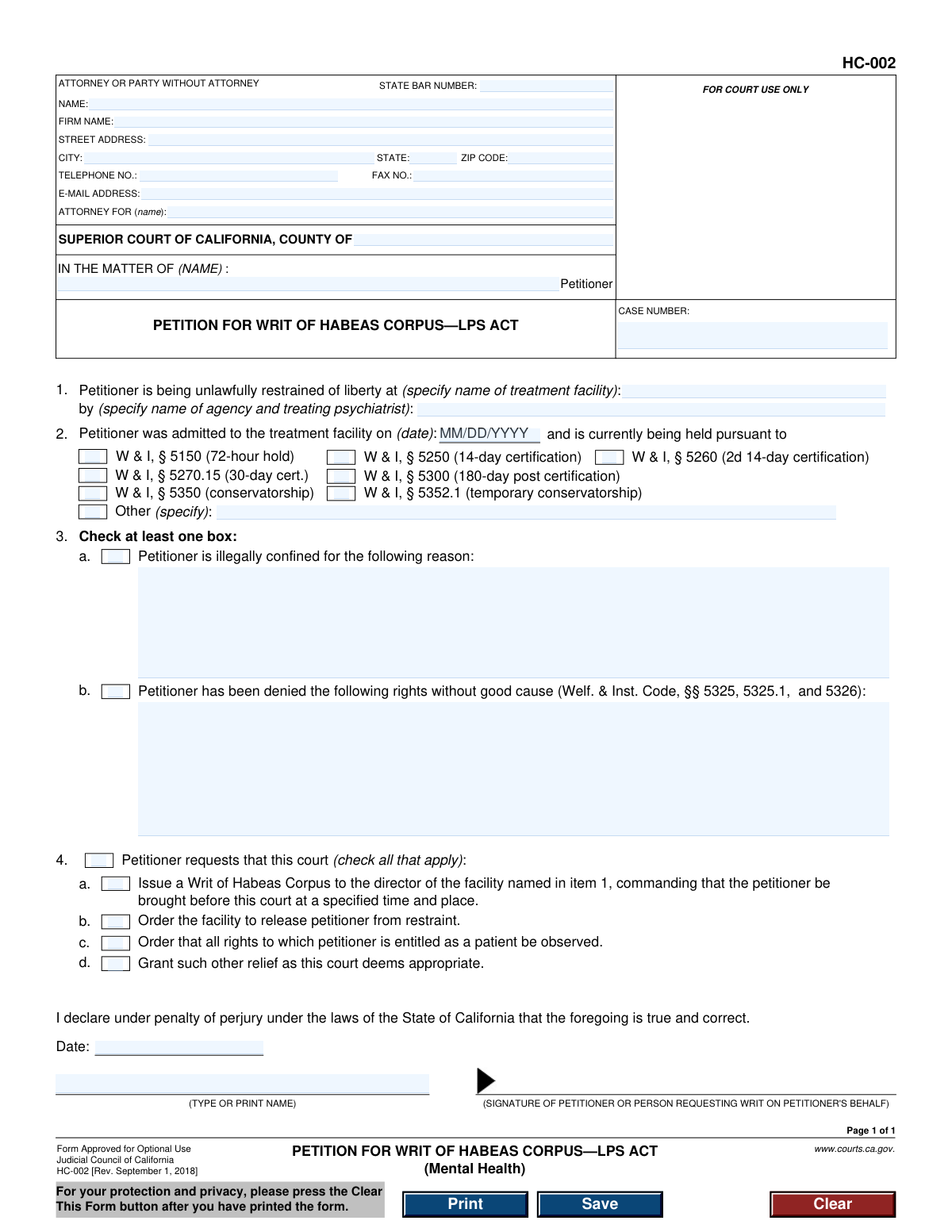
Yes! You can use AI to fill out Form HC-002, Petition for Writ of Habeas Corpus—LPS Act (Mental Health)
California Form HC-002 is a Petition for a Writ of Habeas Corpus specifically used under the Lanterman-Petris-Short (LPS) Act to contest a person's involuntary confinement in a mental health facility. It allows a petitioner or someone on their behalf to argue before a court that the detention is unlawful or that their rights as a patient have been violated, ensuring due process for individuals undergoing mental health holds. Today, this form can be filled out quickly and accurately using AI-powered services like Instafill.ai, which can also convert non-fillable PDF versions into interactive fillable forms.
HC-002 is part of the
ACT Health forms, California court forms, California health forms and mental health forms categories on Instafill.
Our AI automatically handles information lookup, data retrieval, formatting, and form filling.
It takes less than a minute to fill out HC-002 using our AI form filling.
Securely upload your data. Information is encrypted in transit and deleted immediately after the form is filled out.
Form specifications
| Form name: | Form HC-002, Petition for Writ of Habeas Corpus—LPS Act (Mental Health) |
| Number of fields: | 40 |
| Number of pages: | 1 |
| Language: | English |
Instafill Demo: How to fill out PDF forms in seconds with AI
How to Fill Out HC-002 Online for Free in 2026
Are you looking to fill out a HC-002 form online quickly and accurately? Instafill.ai offers the #1 AI-powered PDF filling software of 2026, allowing you to complete your HC-002 form in just 37 seconds or less.
Follow these steps to fill out your HC-002 form online using Instafill.ai:
- 1 Navigate to Instafill.ai and upload or select the California Form HC-002.
- 2 Provide the attorney or petitioner's contact information, including name, address, and State Bar number if applicable.
- 3 Enter the court and case information, specifying the county and the name of the petitioner.
- 4 Detail the petitioner's confinement by naming the treatment facility, the responsible agency, and the date of admission.
- 5 Indicate the legal basis for the current hold by checking the relevant section of the Welfare and Institutions (W & I) Code.
- 6 State the grounds for the petition by explaining why the confinement is illegal or which patient rights have been denied without good cause.
- 7 Select the relief you are requesting from the court, such as issuing the writ or ordering the petitioner's release, then review, sign, and date the form.
Our AI-powered system ensures each field is filled out correctly, reducing errors and saving you time.
Why Choose Instafill.ai for Your Fillable HC-002 Form?
Speed
Complete your HC-002 in as little as 37 seconds.
Up-to-Date
Always use the latest 2026 HC-002 form version.
Cost-effective
No need to hire expensive lawyers.
Accuracy
Our AI performs 10 compliance checks to ensure your form is error-free.
Security
Your personal information is protected with bank-level encryption.
Frequently Asked Questions About Form HC-002
This form is used to legally challenge an involuntary mental health hold in California under the Lanterman-Petris-Short (LPS) Act. It asks a court to review whether a person's confinement in a mental health facility is lawful.
The petition can be filed by the person being held (the petitioner) or by another person, such as a family member, friend, or advocate, on the petitioner's behalf.
You will need the name of the treatment facility, the name of the treating psychiatrist, the date of admission, and the legal code section under which the person is being held (e.g., W&I § 5150, § 5250).
These are sections of the California Welfare and Institutions Code that authorize different types of involuntary holds, such as a 72-hour hold (§ 5150) or a 14-day certification for intensive treatment (§ 5250). You should select the one that matches the reason for the current confinement.
In Section 3, you should briefly explain why you believe the hold is no longer legally justified or list specific patient rights (under Welf. & Inst. Code, §§ 5325, 5325.1) that have been denied without good cause.
No, you are not required to have an attorney. If you are filing on your own behalf, you can enter your own information in the top section of the form.
You must file the completed form with the Superior Court in the county where the mental health facility is located.
After the petition is filed, the court will review it and typically schedule a hearing. At the hearing, a judge will listen to evidence and decide whether the confinement is legal or if the person should be released.
No, there is no filing fee for a Petition for a Writ of Habeas Corpus. It is a fundamental right to challenge your detention, and the court cannot charge you for it.
This button is a privacy feature to protect your sensitive information. After you have printed the form, clicking it will erase all the data you entered, which is important if you are using a public or shared computer.
Yes, services like Instafill.ai use AI to help you accurately auto-fill form fields with your information, which can save time and help prevent errors.
You can use a service like Instafill.ai to upload the PDF form and fill it out interactively online. The platform allows you to type directly into the fields and then download or print the completed document.
If you have a non-fillable or 'flat' PDF, you can upload it to a service like Instafill.ai. Their technology can convert the document into an interactive, fillable form that you can easily complete on your computer.
Compliance HC-002
Validation Checks by Instafill.ai
1
Petitioner Name Presence
This check ensures that the petitioner's name in the 'IN THE MATTER OF (NAME)' field is filled out. This field is critical for identifying the individual on whose behalf the petition is being filed. A failure to provide this name would make the petition legally invalid and unprocessable by the court.
2
Court County Specification
Validates that the 'COUNTY OF' field is completed with a valid California county name. This information is essential for routing the petition to the correct jurisdiction for processing. An omission or incorrect county name will lead to filing rejection or significant delays.
3
Treatment Facility Identification
Ensures that the name of the treatment facility where the petitioner is being held, as specified in item 1, is provided. This is a fundamental piece of information required to direct the writ of habeas corpus to the correct entity. Without it, the court cannot command the petitioner's appearance.
4
Valid Admission Date Format
This check verifies that the admission date in item 2 is entered in a valid date format (e.g., MM/DD/YYYY) and is not a future date. An invalid or future date would be logically impossible and would call the petition's factual basis into question. This ensures the chronological accuracy of the events leading to the petition.
5
Legal Basis for Hold Selection
Verifies that at least one checkbox is selected in item 2 to indicate the legal authority under which the petitioner is being held (e.g., W & I, § 5150, § 5250). This information establishes the legal context for the petition and is mandatory for the court to review the lawfulness of the confinement. Failure to select a basis leaves the petition incomplete.
6
Conditional 'Other' Hold Specification
If the 'Other' checkbox is selected in item 2, this validation ensures the corresponding text field is filled with a specific legal code or reason. This prevents ambiguity and provides the court with the necessary details to understand the unique circumstances of the hold. An empty specification for 'Other' makes the selection meaningless.
7
Reason for Petition Selection
This check confirms that at least one of the two primary reasons in item 3 ('illegally confined' or 'denied rights') is selected. The petition must state a cause of action, and selecting a reason is the first step. Without this, the petition lacks a fundamental legal argument and cannot proceed.
8
Conditional Reason Explanation
If a checkbox in item 3 is selected, this validation ensures the corresponding text box explaining the reason is not empty. The court requires a detailed factual basis for the claim of illegal confinement or denial of rights. A selected reason without an explanation is insufficient to support the petition.
9
Requested Relief Completeness
Validates that at least one box is checked in item 4, specifying the relief requested from the court (e.g., 'Issue a Writ', 'Order the facility to release petitioner'). A petition must ask the court to do something specific. Failure to request relief makes the petition unactionable.
10
Signature Date Presence and Validity
This check ensures the 'Date' field in the declaration section is filled with a valid, non-future date. The signature date is crucial for establishing when the declaration under penalty of perjury was made. An invalid or missing date can nullify the legal weight of the declaration.
11
Printed Name for Signature
Verifies that the printed name of the signatory is provided alongside the signature. This is required for identification purposes and to ensure the signature can be attributed to a specific individual. A missing printed name can create ambiguity and lead to the document's rejection.
12
Attorney Email Format
Validates that the value entered in the 'E-MAIL ADDRESS' field follows a standard email format (e.g., '[email protected]'). This ensures that the court and other parties have a reliable method for electronic communication and service of documents. An invalid format would prevent communication, causing delays.
13
Attorney Phone Number Format
Checks if the 'TELEPHONE NO.' field contains a number in a recognizable format (e.g., (XXX) XXX-XXXX). This is a primary contact method for the court to communicate with the filing attorney or party. An incorrectly formatted number could hinder urgent communications regarding the case.
14
State Bar Number Format
Ensures the 'STATE BAR NUMBER' field, if filled, contains only numbers. This number uniquely identifies the attorney and confirms their standing with the State Bar of California. An incorrectly formatted number could prevent proper identification and verification of the attorney's credentials.
15
Logical Date Consistency Check
This validation compares the signature date with the admission date (item 2) to ensure the signature date is on or after the admission date. It is logically impossible for a petition about a current confinement to be signed before the confinement began. This check prevents logical inconsistencies that would undermine the petition's credibility.
Common Mistakes in Completing HC-002
People filing on behalf of a detained person sometimes mistakenly write their own name in the 'IN THE MATTER OF (NAME)' field instead of the name of the person being held. This causes critical confusion and can lead to the petition being processed for the wrong individual or rejected outright. To avoid this, ensure the name in the main case caption is always the person whose liberty is being restrained, even if you are filling out the form on their behalf.
In Section 1, filers may write a generic facility name like 'the county hospital' or omit the treating psychiatrist's name, often because they don't have the exact details. This ambiguity forces the court to seek clarification, delaying the hearing, as the writ must be served on a specific director at a specific facility. Always provide the full, official name of the treatment facility and the full name of the treating psychiatrist if known.
Section 2 requires checking the specific Welfare & Institutions (W&I) code section for the hold. Filers often guess, check multiple boxes incorrectly, or leave it blank because they are unsure of the legal status. This is a critical error as the legal standard for the hold is the central issue, and a mistake can lead to dismissal. It is crucial to ask facility staff for the specific hold type (e.g., 'Is this a 5250 certification?') and check only the corresponding box.
The admission date in Section 2 is vital for calculating the maximum duration of the current hold, which determines its legality. A simple data entry error, like transposing numbers or recalling the wrong day, can undermine the entire petition and lead to a premature dismissal of a valid claim. Carefully verify the admission date from hospital records or by asking staff before entering it on the form.
Filers must check at least one box in Section 3 (3a or 3b) to establish the legal grounds for the writ. Overlooking this section is a common mistake made under stress, which results in an incomplete and legally insufficient petition that will be rejected by the court clerk. Before signing, double-check that you have selected either 3a (illegal confinement) or 3b (denial of rights) and filled in the required details.
When checking box 3a, filers often write emotional pleas like 'I feel fine' or 'I want to go home' instead of addressing the legal standard for their hold. The court needs a reason why the confinement is *illegal* (e.g., 'I am no longer a danger to myself or others'). A vague statement weakens the petition and makes it less likely to succeed. Clearly and concisely state why you meet the criteria for release under the law.
A petition must ask the court to do something specific, but in Section 4, filers sometimes forget to check any of the boxes, such as 'Order the facility to release petitioner.' This oversight renders the petition ineffective, as it doesn't request any action or relief from the court. Always check all applicable boxes in Section 4 to clearly state what you want the court to order.
An unsigned or undated petition is invalid and will be immediately rejected by the court. This simple oversight often happens when people are in a hurry to file. The signature, made under penalty of perjury, is what legally attests to the truthfulness of the form's contents. Always perform a final review to ensure the date is current and the form is signed in the designated space.
The top section for the 'ATTORNEY OR PARTY WITHOUT ATTORNEY' requires a name, address, and phone number. A person filing for themselves or someone else may leave this blank, thinking it only applies to lawyers. Without this information, the court has no way to provide notifications about hearing dates, which can cause the petitioner to miss their court date. This section must be filled out completely and legibly by whoever is filing the petition.
The petition must be filed in the Superior Court of the county where the petitioner is being detained. Filers might mistakenly list their home county, which is incorrect. Filing in the wrong jurisdiction will cause the petition to be rejected, forcing the filer to start over and lose valuable time. AI-powered form-filling tools like Instafill.ai can help prevent these data entry errors by auto-populating correct jurisdictional information and validating other fields. If the form is a non-fillable PDF, Instafill.ai can also convert it into an interactive version.
Saved over 80 hours a year
“I was never sure if my IRS forms like W-9 were filled correctly. Now, I can complete the forms accurately without any external help.”
Kevin Martin Green
Your data stays secure with advanced protection from Instafill and our subprocessors

Robust compliance program
Transparent business model
You’re not the product. You always know where your data is and what it is processed for.
ISO 27001, HIPAA, and GDPR
Our subprocesses adhere to multiple compliance standards, including but not limited to ISO 27001, HIPAA, and GDPR.
Security & privacy by design
We consider security and privacy from the initial design phase of any new service or functionality. It’s not an afterthought, it’s built-in, including support for two-factor authentication (2FA) to further protect your account.
Fill out HC-002 with Instafill.ai
Worried about filling PDFs wrong? Instafill securely fills form-hc-002-petition-for-writ-of-habeas-corpuslps-act-mental-health forms, ensuring each field is accurate.