Fill out ACT Health forms
with AI.
ACT Health forms cover a range of official documents used in healthcare administration, patient eligibility assessments, leave certifications, and financial assistance claims. Whether you're an ACT resident applying for interstate travel assistance through the ACT IPTAS scheme, a healthcare provider registering a practice with a medical scheme, or an employee seeking FMLA leave certification from a health care provider, these forms play a critical role in ensuring the right information reaches the right people — accurately and on time. Completeness matters: incomplete or inaccurate submissions can lead to delays, denied claims, or gaps in care.
By continuing, you acknowledge Instafill's Privacy Policy and agree to get occasional product update and promotional emails.
About ACT Health forms
The people who typically need these forms include patients and their families navigating long-term care admissions or interstate specialist referrals, employers and HR teams managing medical leave requests, healthcare practitioners completing clinical assessments, and medical practice administrators handling registration and billing. Each form has specific requirements — authorized signatories, supporting documentation, and strict submission timelines — so understanding what's needed before you start can save significant time and frustration.
Tools like Instafill.ai use AI to fill these forms in under 30 seconds, handling the data accurately and securely, which is especially useful when you're dealing with time-sensitive submissions or complex multi-part forms.
Every form on this page can be completed without typing. Instafill is form filling software that reads a PDF and fills it for you — including flat and scanned documents that carry no fillable fields at all.
Forms in This Category
The forms in this category have a median Form Complexity Index of 48/100 (Moderate), measured across 9 forms by field count, input difficulty, length, conditional logic and structure. See how it is calculated.
| Form Name | Pages | FCI | |
|---|---|---|---|
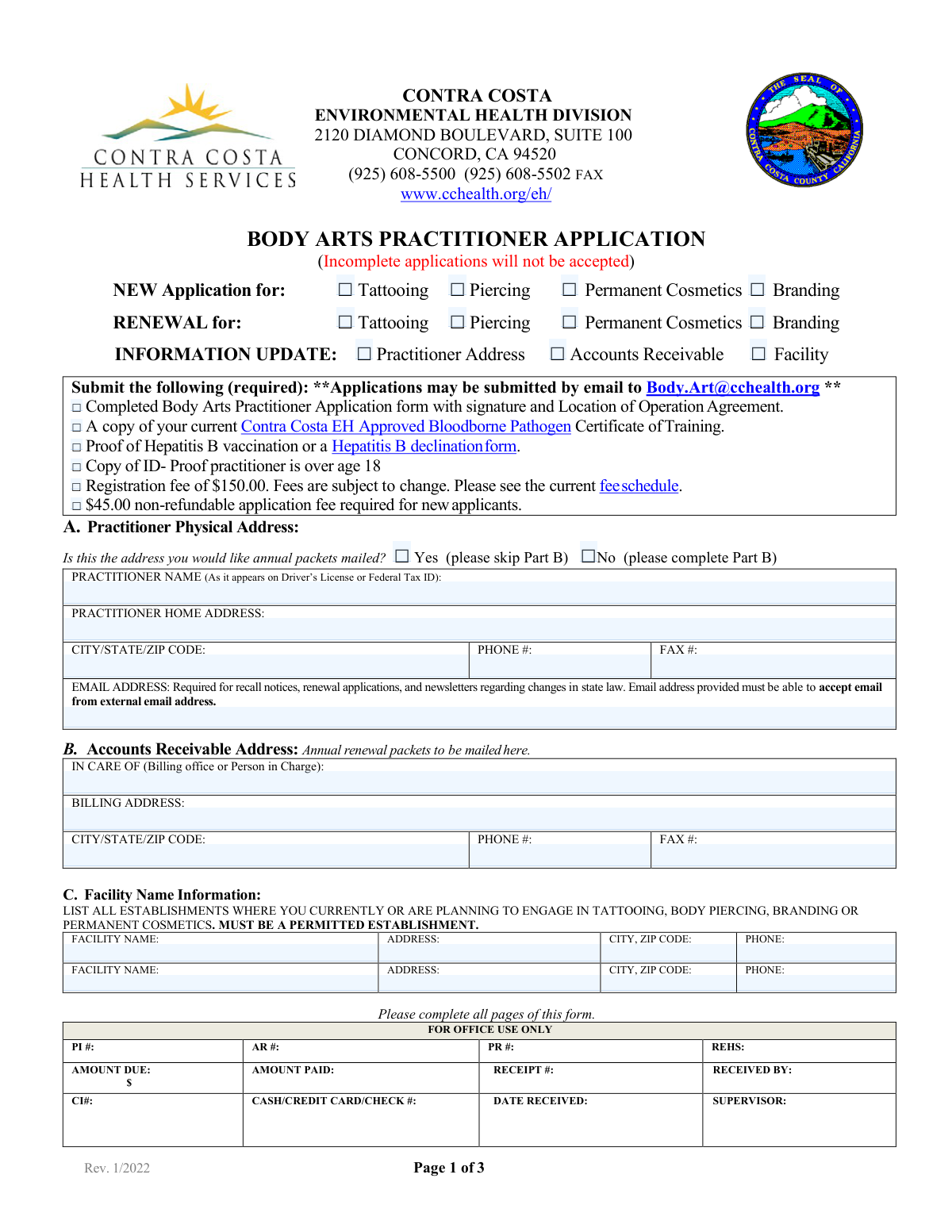
| 1. | Contra Costa Environmental Health Division Body Arts Practitioner Application | 3 | Basic 45 |
| 2. | Discovery Health Practice Registration Form 2026 (DHHPR2001) | 4 | Complex 64 |
| 3. | Form CARE-101, Mental Health Declaration—CARE Act Proceedings | 1 | Basic 42 |
| 4. | Form CARE-102, Petition to Begin CARE Act Proceedings By Licensed Behavioral Health Professional Only | 1 | Moderate 48 |
| 5. | Form CMS-1561, Health Insurance Benefit Agreement | 2 | Basic 36 |
| 6. | Form HC-002, Petition for Writ of Habeas Corpus—LPS Act (Mental Health) | 1 | Basic 36 |
| 7. | Health Assessment – Ontario Health atHome (Fixing Long-Term Care Act, 2021) (Form 4768-69E) | 7 | Complex 70 |
| 8. | Health Assessment - Ontario Health atHome (Fixing Long-Term Care Act, 2021) — Form 4768-69E | 7 | Complex 64 |
| 9. | Form WH-380-E, Certification of Health Care Provider | 4 | Moderate 59 |
- Enterprise-grade security & data encryption
- 99%+ accuracy powered by AI
- 1,000+ forms from all industries
- Complete forms in under 60 seconds
How to Choose the Right Form
These five forms serve very different purposes and audiences — use the groupings below to find the right one quickly.
For ACT Residents Seeking Travel Assistance
- ACT IPTAS Claim Form is the one you need if you're an ACT resident who has travelled interstate for specialist medical care not available locally. It covers patient details, referring practitioner certification, and proof of attendance — and must be lodged within six months of your return.
For FMLA Leave in the United States
- Form WH-380-E applies if you're a U.S. employee (or their health care provider) completing medical certification for the employee's own serious health condition under the Family and Medical Leave Act. This form is returned to the employer — not the Department of Labor.
For Long-Term Care Admission in Ontario, Canada
- Form 4768-69E (Health Assessment – Ontario Health atHome) appears twice in this list as slightly different versions of the same Ontario Ministry of Long-Term Care form. Both capture clinical information needed to determine eligibility for a long-term care home under the *Fixing Long-Term Care Act, 2021*. Choose either version — they serve the same purpose and must be completed by an authorized practitioner (physician or registered nurse).
For Healthcare Providers Registering with Discovery Health (South Africa)
- Discovery Health Practice Registration Form 2026 (DHHPR2001) is for individual, group, or incorporated healthcare practices applying to register with Discovery Health for claims payment purposes. This is a provider-facing administrative form, not a patient form.
Quick Decision Summary
- ACT resident needing travel reimbursement → ACT IPTAS Claim Form
- U.S. employee on medical leave → Form WH-380-E
- Ontario patient applying for long-term care → Form 4768-69E
- South African healthcare provider joining Discovery Health → DHHPR2001
Form Comparison
| Form | Purpose | Who Files It | When to Use |
|---|---|---|---|
| Form WH-380-E, Certification of Health Care Provider for Employee's Serious Health Condition under the Family and Medical Leave Act | Certify employee's serious health condition for FMLA leave | Health care provider completes; employee submits to employer | When employer requests medical certification for FMLA leave |
| Health Assessment – Ontario Health atHome (Fixing Long-Term Care Act, 2021) (Form 4768-69E) | Assess eligibility for Ontario long-term care home admission | Authorized practitioner (physician or RN) completes and signs | When applying for long-term care home eligibility determination |
| Health Assessment - Ontario Health atHome (Fixing Long-Term Care Act, 2021) — Form 4768-69E | Support eligibility determination for long-term care admission | Authorized practitioner submits to Ontario Health atHome | When patient requires long-term care home placement in Ontario |
| Discovery Health Practice Registration Form 2026 (DHHPR2001) | Register healthcare practice with Discovery Health for claims | Healthcare provider or practice administrator submits | When registering a new or updated practice with Discovery Health |
| ACT Interstate Patient Travel Assistance Scheme (ACT IPTAS) Claim Form (Reviewed: July 2023) | Claim travel and accommodation assistance for interstate specialist care | ACT resident patient, referring practitioner, and treating specialist | When ACT resident travels interstate for unavailable specialist services |
Tips for ACT Health forms
Health forms in this category often require specific medical information such as diagnoses, medications, allergies, and treatment dates. Having these details on hand before you begin filling out the form will help you avoid incomplete submissions that can cause delays or denials.
Many of these forms — particularly the Ontario Health atHome assessments and FMLA certification — must be completed and signed by an authorized healthcare provider, such as a physician or registered nurse. Submitting a form signed by an unqualified individual can render it invalid and restart the process from scratch.
Whether you're lodging an ACT IPTAS travel claim or submitting a practice registration, always retain a copy of the completed form and any supporting documents. This protects you if a form is lost in transit or if a dispute arises about what was submitted.
Forms like the ACT IPTAS Claim Form require itemised tax invoices and receipts to be submitted alongside the claim. Missing attachments are one of the most common reasons claims are delayed or rejected, so create a checklist of required documents before lodging.
Some forms in this category have strict lodgement windows — for example, ACT IPTAS claims generally must be submitted within six months of return travel. Check the specific requirements for each form and set a reminder well before the deadline to avoid losing entitlements.
Practice registration forms and claim forms rely on accurate identifiers such as BHF practice numbers, ID numbers, and banking details to process payments correctly. A single digit error can result in failed payments or rejected registrations, so review these fields carefully before submitting.
If you're dealing with several health forms at once, AI-powered tools like Instafill.ai can complete these forms in under 30 seconds with high accuracy, saving significant time compared to manual entry. Your data stays secure throughout the process, making it a practical choice for healthcare providers and patients alike managing multiple applications.
Different forms in this category go to different recipients — for example, the FMLA WH-380-E is returned to the employee (not sent to the Department of Labor), while Ontario Health atHome assessments are submitted directly to Ontario Health atHome. Sending a form to the wrong party can cause delays and potential confidentiality issues.
Frequently Asked Questions
This category includes a range of health-related forms such as the ACT IPTAS Claim Form for interstate travel assistance, FMLA medical certification forms, Ontario long-term care health assessments, and a Discovery Health practice registration form. While they come from different jurisdictions and purposes, they all relate to documenting health conditions, care needs, or healthcare provider details for administrative and eligibility purposes.
ACT residents who have had to travel interstate to access specialist medical services not available in the ACT may be eligible to submit an ACT IPTAS Claim Form. The form requires input from the patient, their referring ACT or Queanbeyan practitioner, and the interstate treating specialist, so all three parties need to contribute to a complete submission.
Form WH-380-E is used when an employer requests medical certification to support an employee's leave request under the Family and Medical Leave Act (FMLA) for the employee's own serious health condition. It should be completed by the employee's health care provider and returned to the employee, who then provides it to their employer — it is not submitted to the Department of Labor.
The Health Assessment – Ontario Health atHome (Form 4768-69E) is the required form under the Fixing Long-Term Care Act, 2021 when someone is seeking a determination of eligibility for admission to a long-term care home in Ontario. It must be completed and signed by an authorized practitioner such as a physician or registered nurse, and submitted to Ontario Health atHome.
The right form depends on your location and purpose: ACT residents seeking interstate travel reimbursement need the ACT IPTAS Claim Form; U.S. employees on medical leave need WH-380-E; Ontario residents applying for long-term care need Form 4768-69E; and South African healthcare providers registering with Discovery Health need the DHHPR2001 form. Reviewing each form's description on this page can help you identify the one that matches your needs.
Requirements vary by form, but generally you should have relevant identification details, medical records or diagnoses, practitioner contact information, and any supporting documentation such as referral letters or receipts. For financial claim forms like the ACT IPTAS, itemised tax invoices and receipts for travel and accommodation are typically required.
Submission destinations differ by form: the ACT IPTAS Claim Form is submitted to ACT Health, the WH-380-E is returned to the employee who then gives it to their employer, Ontario's Form 4768-69E is submitted to Ontario Health atHome, and the Discovery Health Practice Registration Form is submitted to Discovery Health. Always check the specific form instructions for the correct submission address or portal.
Some forms have specific timeframes — for example, ACT IPTAS claims generally must be lodged within six months of the return travel date. FMLA certifications typically must be returned within the timeframe specified by the employer, often 15 calendar days. It is important to check the requirements for each individual form to avoid delays or denial of benefits.
Yes — AI-powered tools like Instafill.ai can fill out these forms in under 30 seconds by accurately extracting and placing data from your source documents. This is especially useful for complex clinical or administrative forms where accuracy and completeness are critical, and Instafill.ai can also convert non-fillable PDF versions into interactive fillable forms.
Manually completing these forms can take anywhere from a few minutes to over an hour depending on the complexity and the information required. Using an AI tool like Instafill.ai, however, the data entry process can be completed in under 30 seconds, with the AI accurately extracting relevant details from existing documents and populating the form fields.
Yes, several forms in this category require a licensed healthcare provider's signature. Ontario's Form 4768-69E must be signed by a physician or registered nurse, the WH-380-E requires completion by the employee's health care provider, and the ACT IPTAS Claim Form requires certification from both the referring practitioner and the treating specialist. Unsigned or incomplete forms may result in delays or rejection.
Most of these forms involve sensitive medical or personal information and are subject to applicable privacy laws. For example, WH-380-E completed certifications must be kept by employers as confidential medical records, and the Discovery Health registration form includes POPIA-related privacy obligations. Always review the privacy notices included with each form to understand how your information will be handled.
Glossary
- Form Complexity Index
- Instafill’s 0–100 measure of how much effort a form takes to complete, calculated deterministically from the form’s own structure rather than estimated. It combines the number of fillable fields (the largest factor), how difficult those fields are to complete based on their type, the number of pages that contain fields, the amount of conditional “fill-only-if” logic, and how many sections the form is divided into, then adds modifiers for tables and repeating lists, bundled instruction pages, and dense page layouts. A higher score means the form is harder to fill out by hand. The forms in this category have a median Form Complexity Index of 48/100 (Moderate). See exactly how it is calculated.
- FMLA (Family and Medical Leave Act)
- A U.S. federal law that entitles eligible employees to take up to 12 weeks of unpaid, job-protected leave per year for qualifying medical or family reasons. Employers may require medical certification to confirm that the leave qualifies under FMLA.
- Serious Health Condition
- Under the FMLA, a illness, injury, impairment, or physical or mental condition that involves inpatient care or continuing treatment by a health care provider. This is a specific legal definition used to determine whether an employee's leave qualifies for FMLA protections.
- Ontario Health atHome
- A provincially funded Ontario organization (formerly known as Home and Community Care Support Services) that coordinates home care and long-term care placement services. It receives and processes health assessments to determine whether applicants are eligible for admission to a long-term care home.
- Long-Term Care Home
- A government-regulated residential facility in Ontario that provides ongoing personal support, nursing, and medical care for individuals who can no longer safely live independently. Admission requires a formal eligibility determination under the Fixing Long-Term Care Act, 2021.
- ARO (Antibiotic-Resistant Organism)
- A microorganism that has developed resistance to one or more antibiotics, such as MRSA or VRE. Long-term care health assessments screen for ARO status to ensure facilities can safely manage infection control for incoming residents.
- ACT IPTAS (ACT Interstate Patient Travel Assistance Scheme)
- An Australian Capital Territory government program that provides financial assistance to ACT residents who must travel interstate to access specialist medical services not available locally. It covers eligible travel and accommodation costs upon submission of a completed claim form with supporting receipts.
- BHF Practice Number
- A unique identifier issued by the Board of Healthcare Funders of Southern Africa to registered healthcare practices. Discovery Health and other South African medical schemes use this number to validate providers and process claims payments correctly.
- POPIA (Protection of Personal Information Act)
- South Africa's primary data privacy law that governs how organisations collect, store, and use personal information. Healthcare providers registering with Discovery Health must acknowledge POPIA obligations, as sensitive patient and practitioner data is involved.
- Intermittent Leave
- A type of FMLA leave taken in separate blocks of time or by reducing the normal weekly or daily work schedule, rather than as one continuous absence. A health care provider must certify the medical necessity and expected frequency of intermittent leave on the certification form.
- Referring Practitioner
- A licensed medical professional, typically a GP or specialist based in the patient's home region, who certifies that a patient requires medical services not available locally and formally refers them to an interstate or out-of-area specialist. For ACT IPTAS claims, the referring practitioner's certification is a mandatory part of the claim.