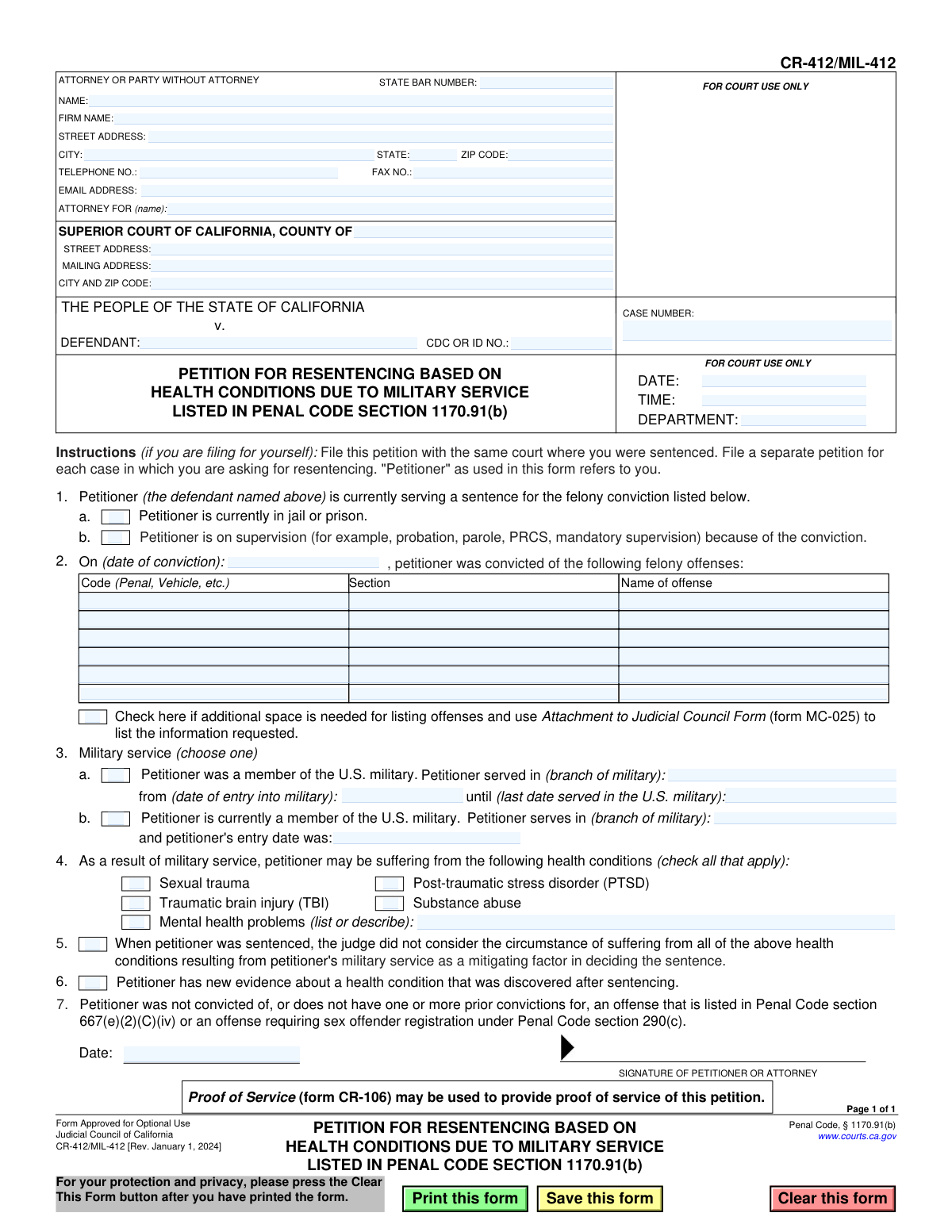
Yes! You can use AI to fill out Form CR-412/MIL-412, Petition for Resentencing Based on Health Conditions due to Military Service Listed in Penal Code Section 1170.91(b)

Form CR-412/MIL-412 is a petition filed with the Superior Court of California by a defendant who is a current or former member of the U.S. military. It is used to request resentencing for a felony conviction, arguing that health conditions like PTSD, traumatic brain injury, or substance abuse resulting from military service were not considered as mitigating factors at the time of the original sentencing. Today, this form can be filled out quickly and accurately using AI-powered services like Instafill.ai, which can also convert non-fillable PDF versions into interactive fillable forms.
CR-412/MIL-412 is part of the California court forms and California health forms categories on Instafill.
Our AI automatically handles information lookup, data retrieval, formatting, and form filling.
It takes less than a minute to fill out CR-412/MIL-412 using our AI form filling.
Securely upload your data. Information is encrypted in transit and deleted immediately after the form is filled out.

Form specifications

Form name: Form CR-412/MIL-412, Petition for Resentencing Based on Health Conditions due to Military Service Listed in Penal Code Section 1170.91(b)
Number of fields: 64
Number of pages: 1
Language: English
main-image

Instafill Demo: How to fill out PDF forms in seconds with AI

How to Fill Out CR-412/MIL-412 Online for Free in 2026

Are you looking to fill out a CR-412/MIL-412 form online quickly and accurately? Instafill.ai offers the #1 AI-powered PDF filling software of 2026, allowing you to complete your CR-412/MIL-412 form in just 37 seconds or less.
Follow these steps to fill out your CR-412/MIL-412 form online using Instafill.ai:
  1. 1 Navigate to Instafill.ai and upload or select the CR-412/MIL-412 form.
  2. 2 Provide your personal details, attorney information (if any), and the specific court and case number information in the top section.
  3. 3 Indicate your current status (in custody or on supervision) and list the felony convictions for which you are seeking resentencing.
  4. 4 Detail your military service history, including the branch and dates of service.
  5. 5 Check the boxes for all applicable health conditions resulting from your military service, such as PTSD, TBI, sexual trauma, or substance abuse.
  6. 6 Confirm the declarations regarding sentencing factors, new evidence (if applicable), and the absence of disqualifying convictions.
  7. 7 Review the completed form for accuracy, then date and sign it before downloading for filing with the appropriate court.

Our AI-powered system ensures each field is filled out correctly, reducing errors and saving you time.

Why Choose Instafill.ai for Your Fillable CR-412/MIL-412 Form?

Speed

Complete your CR-412/MIL-412 in as little as 37 seconds.

Up-to-Date

Always use the latest 2026 CR-412/MIL-412 form version.

Cost-effective

No need to hire expensive lawyers.

Accuracy

Our AI performs 10 compliance checks to ensure your form is error-free.

Security

Your personal information is protected with bank-level encryption.

Frequently Asked Questions About Form CR-412/MIL-412

This form is a petition for a person convicted of a felony to request resentencing based on certain health conditions they suffer from as a result of their U.S. military service, which were not considered as a mitigating factor during their original sentencing.

You are eligible if you are currently serving a sentence for a felony, have served or are serving in the U.S. military, and suffer from a qualifying health condition due to your service. You must not have been convicted of certain serious offenses listed in Penal Code section 667(e)(2)(C)(iv) or an offense requiring sex offender registration.

You must file this petition with the same superior court where you were originally sentenced for the felony conviction.

The form lists sexual trauma, traumatic brain injury (TBI), post-traumatic stress disorder (PTSD), substance abuse, and other mental health problems that resulted from your military service.

You must file a separate petition for each individual case in which you are seeking resentencing.

While the form doesn't list them, it is highly recommended to attach proof of military service (like a DD-214) and medical evidence or records that support your claim of suffering from the listed health conditions.

This means the judge did not formally take into account your service-related health condition as a reason to potentially lessen your original sentence.

The form includes a section (Item 6) to indicate that you have new evidence about a health condition that was discovered after your sentencing.

While you can file the petition yourself, resentencing laws are complex, and it is strongly recommended to consult with an attorney to assist you with the process.

After you file the petition, the court will review it to determine if you are eligible for a resentencing hearing where your case will be reconsidered.

Yes, services like Instafill.ai use AI to accurately auto-fill form fields with your information, which can save you time and help reduce errors.

You can use a service like Instafill.ai to upload the form, fill it out electronically on any device, and then download or print the completed document for filing.

Tools like Instafill.ai can convert flat, non-fillable PDFs into interactive forms that you can easily type into, saving you the trouble of printing and filling it out by hand.

Compliance CR-412/MIL-412
Validation Checks by Instafill.ai

1
Petitioner Identification Completeness
This check ensures that both the 'DEFENDANT' name and the 'CDC OR ID NO.' fields are filled out. These fields are critical for uniquely identifying the petitioner and locating their records within the correctional and judicial systems. A failure to provide this information would make it impossible to process the petition, leading to its rejection.
2
Current Custodial Status Selection
Validates that at least one checkbox in Section 1 is selected, indicating whether the petitioner is currently in jail/prison (1a) or on supervision (1b). This information establishes the petitioner's current status, which is a prerequisite for eligibility under the relevant penal code. If neither is selected, the form is incomplete and the petitioner's standing cannot be determined.
3
Conviction Date Validity
This check verifies that the 'date of conviction' in Section 2 is a valid, fully-formatted date that occurs in the past. The date is essential for identifying the specific conviction being challenged. An invalid or future date would be nonsensical and prevent the court from locating the correct case file, causing an immediate processing error.
4
Conviction Offense Specification
Ensures that at least one complete row in the table under Section 2 is filled out, including the 'Code', 'Section', and 'Name of offense'. This information specifies the exact felony for which resentencing is being requested. Without this detail, the petition is ambiguous and lacks the fundamental information needed for any judicial review.
5
Exclusive Military Service Status
This validation confirms that exactly one of the two options in Section 3 ('Petitioner was a member' or 'Petitioner is currently a member') is selected. The form requires the petitioner to choose one status. Selecting none or both creates ambiguity about their military service history, which is central to the petition's basis, and would require clarification before proceeding.
6
Military Service Date Chronology
If option 3a ('Petitioner was a member') is selected, this check verifies that the 'last date served' is chronologically after the 'date of entry into military'. This ensures the provided service dates are logical and represent a valid period of service. An illogical date range would cast doubt on the accuracy of the information provided and could halt the petition pending correction.
7
Required Health Condition Selection
Validates that at least one health condition checkbox is marked in Section 4. The entire basis for this petition is a health condition resulting from military service, as listed in Penal Code § 1170.91(b). If no condition is selected, the petition has no legal grounds and cannot be considered.
8
Conditional Mental Health Description
This check ensures that if the 'Mental health problems' checkbox is selected in Section 4, the corresponding text field to 'list or describe' the problems is not empty. A generic claim of 'mental health problems' is insufficient; the court requires specific information to evaluate the claim. Failure to provide a description would render the selection incomplete and require a request for more information.
9
Mandatory Mitigating Factor Declaration
Verifies that the checkbox in Section 5 is selected, affirming that the judge did not previously consider the health condition as a mitigating factor. This declaration is a core legal requirement to establish grounds for resentencing under this specific petition. If unchecked, the petitioner has not affirmed a key element of their claim, making them ineligible for relief on this basis.
10
Eligibility Declaration for Prior Convictions
Ensures the checkbox in Section 7 is selected, confirming the petitioner does not have prior convictions for certain disqualifying offenses. This declaration is crucial for establishing the petitioner's basic eligibility to file this petition. Failure to check this box means the petitioner has not attested to their eligibility, and the petition would likely be dismissed without review.
11
Attorney State Bar Number Requirement
This check validates that if the 'NAME' field in the 'ATTORNEY OR PARTY' section is filled and represents an attorney, the 'STATE BAR NUMBER' field is also completed and contains a numeric value. The State Bar Number is required to verify the attorney's credentials and good standing with the bar. A missing or invalid number would prevent the court from recognizing the legal representation.
12
Signature Date Presence
Verifies that the 'Date' field next to the signature line is filled out with a valid date. The signature date authenticates when the petitioner or their attorney signed the document, attesting to the truthfulness of its contents on that day. A missing signature date can invalidate the legal standing of the document, leading to its rejection.

Common Mistakes in Completing CR-412/MIL-412

Entering an Incorrect or Incomplete Case Number

Petitioners often misremember, transpose digits, or leave the case number blank. This number is essential for the court clerk to locate the correct case file for the original conviction. An incorrect case number will lead to the petition being rejected, delayed, or lost, requiring the petitioner to refile and start the process over. To avoid this, carefully copy the case number from official court documents related to the original sentencing.

Filing the Petition in the Wrong Court

The instructions state to file the petition with the same court where the original sentence was imposed. Petitioners, especially those who have been transferred between facilities in different counties, may mistakenly file it in the court local to their current location. This results in the petition being rejected and returned, causing significant delays. Always verify the original sentencing court's name and address before filing.

Listing Offenses from Multiple Cases on a Single Form

The form explicitly requires a separate petition for each case number. However, petitioners often try to consolidate all their convictions onto one form for convenience. This will cause the court to reject the petition and require the individual to resubmit separate forms for each case, delaying any potential resentencing hearing. It is critical to identify the specific convictions tied to a single case number and file one petition per case.

Providing Inaccurate Felony Conviction Details

In Section 2, petitioners frequently enter incorrect penal code sections, use colloquial names for offenses instead of the official legal terms, or forget to list all relevant convictions and enhancements for the case. These inaccuracies create extra work for the court and can undermine the petitioner's credibility, potentially delaying the review process. To prevent this, refer to official court records or sentencing abstracts to ensure the code, section, and offense name are listed exactly as they appear in the legal documents.

Confusing the 'Date of Conviction' with Other Dates

Petitioners often mistakenly enter the date of their arrest, the date the crime occurred, or the date they entered prison instead of the actual 'date of conviction' required in Section 2. The conviction date is a specific legal date that is critical for the court's records. Using the wrong date can cause confusion and delays in processing the petition. This date can be found on the judgment or sentencing documents from the original case.

Misunderstanding the Prior Conviction Exclusion Clause

Section 7 contains complex legal language about ineligibility due to prior convictions for certain serious felonies or sex offenses. Petitioners may not fully understand what Penal Code § 667(e)(2)(C)(iv) or § 290(c) refers to and may incorrectly attest that they are eligible when they are not. This is a fatal error that will lead to the petition's immediate denial after the prosecutor reviews the petitioner's record. If there is any uncertainty, consulting with legal counsel is essential before checking this box.

Failing to Properly Serve the Petition and File Proof

A common procedural error is filing the petition with the court but failing to formally 'serve' a copy to the district attorney's office. The court also requires a separate 'Proof of Service' form (like CR-106) to be filed, confirming that the DA has been notified. Without proper service and proof, the petition will stall indefinitely, as the court cannot proceed until all parties are legally notified. Petitioners must follow the rules of service precisely to avoid this.

Leaving the 'Mental Health Problems' Description Blank

In Section 4, after checking the box for 'Mental health problems,' there is a line to list or describe the issues. Many petitioners check the box but leave this line blank, missing a key opportunity to provide context. A vague or empty field weakens the connection between military service and the health condition. It is crucial to provide a brief but specific description, such as 'Major Depressive Disorder' or 'Anxiety and panic attacks,' to strengthen the petition.

Forgetting to Sign and Date the Form

It is a simple but surprisingly common mistake for a petitioner to submit an unsigned or undated form. An unsigned petition is legally invalid and will be immediately rejected by the court clerk, forcing the entire filing process to start over. Always double-check for a signature and the current date in the designated fields before mailing or filing the document. AI-powered form filling tools like Instafill.ai can often flag empty signature fields to help prevent this error.

Incorrectly Filling Out the 'Attorney For' Section

When a petitioner is filling out the form without a lawyer ('in pro per' or 'pro se'), they can be confused by the 'ATTORNEY FOR (name):' field. They might leave it blank or write 'N/A,' causing administrative confusion. The correct procedure is to enter their own name in this field. This clarifies to the court that the petitioner is representing themselves. Using a tool like Instafill.ai can help pre-populate these fields correctly based on user profile information.
Saved over 80 hours a year

“I was never sure if my IRS forms like W-9 were filled correctly. Now, I can complete the forms accurately without any external help.”

Kevin Martin Green

Your data stays secure with advanced protection from Instafill and our subprocessors

Robust compliance program

Transparent business model

You’re not the product. You always know where your data is and what it is processed for.

ISO 27001, HIPAA, and GDPR

Our subprocesses adhere to multiple compliance standards, including but not limited to ISO 27001, HIPAA, and GDPR.

Security & privacy by design

We consider security and privacy from the initial design phase of any new service or functionality. It’s not an afterthought, it’s built-in, including support for two-factor authentication (2FA) to further protect your account.

Fill out CR-412/MIL-412 with Instafill.ai

Worried about filling PDFs wrong? Instafill securely fills form-cr-412mil-412-petition-for-resentencing-based-on-health-conditions-due-to-military-service-listed-in-penal-code forms, ensuring each field is accurate.

Related forms by category

California court forms Judicial Council of California Form SC-105, Request for Court Order and Answer (Small Claims), Judicial Council of California Form SC-120, Defendant’s Claim and ORDER to Go to Small Claims Court (Small Claims), Judicial Council of California Form SER-001, Request for Sheriff to Serve Court Papers, Judicial Council of California Form SER-001, Request for Sheriff to Serve Court Papers, Affidavit for Collection of Personal Property California Probate Code Section 13100, Form POS-040, Proof of Service—Civil, Declaration of Facts of Death (California Superior Court), declaration-of-marriage-for-court-proceeding-california-family-law, ADOPT-200, Adoption Request, ADOPT-200, Stepparent Adoption Request, ADOPT-210, Adoption Agreement, ADOPT-310, Contact After Adoption Agreement, Judicial Council of California Form ADOPT-200, Adoption Request, Form ADR-107, Mediation Attendance Sheet, Form ADR-110, Order Appointing Referee, Form ADR-109, Stipulation or Motion for Order Appointing Referee, Form ADR-102, Request for Trial De Novo After Judicial Arbitration, Form ADR-108, Referee's Report (Code Civ. Proc., §§ 638, 639), Form ADR-106, Petition to Confirm, Correct, or Vacate Contractual Arbitration Award, Form ADR-104, Rejection of Award and Request for Trial After Attorney-Client Fee Arbitration · + 268 more →
California health forms California HIPAA Authorization Form, Authorization for the Release of Protected Health Information, California Department of Social Services Form RFA 07 (2/18), Resource Family Approval (RFA) Health Questionnaire (Mandatory), Blue Shield of California Promise Health Plan Long Term Care Treatment Authorization Request Form, Blue Shield of California Promise Health Plan Referral Form, Blue Shield of California Promise Health Plan Health Education Referral Form, Blue Shield of California Promise Health Plan Medi-Cal Group Doula Provider Quality Check Form, Partnership HealthPlan of California Doula Application, Form CR-400, Petition/Application Under Health and Safety Code Section 11361.8—Adult Crimes, Form CR-403, Order After Petition/Application Under Health and Safety Code Section 11361.8—Adult Crimes, Form CARE-101, Mental Health Declaration—CARE Act Proceedings, form-cr-401-proof-of-service-for-petitionapplication-under-health-and-safety-code-section-113618adult-crimes, form-cr-402-prosecuting-agencys-response-to-petitionapplication-under-health-and-safety-code-section-113618adult-crimes, form-care-102-petition-to-begin-care-act-proceedings-by-licensed-behavioral-health-professional-only