Fill out long term care forms
with AI.
Long-term care forms are a critical component of the healthcare administrative landscape, serving as the bridge between patient needs and the services provided by facilities and insurance carriers. These documents facilitate essential processes such as determining eligibility for residency, authorizing specific medical treatments, and ensuring that providers are properly reimbursed for their services. Whether dealing with private health insurance forms or government-mandated certifications, accuracy in these documents is vital to ensure that vulnerable individuals receive uninterrupted care and that facilities remain compliant with rigorous health and safety standards.
By continuing, you acknowledge Instafill's Privacy Policy and agree to get occasional product update and promotional emails.
About long term care forms
Typically, these forms are handled by healthcare administrators, medical practitioners, and families navigating the complexities of elder care or chronic illness management. For instance, a facility might use Form CMS-1539 to seek Medicare certification, while an individual might need to submit a John Hancock reimbursement form to cover the costs of an independent care provider. Because these forms often require detailed clinical histories, itemized service lists, and specific provider information, they can be time-consuming to complete manually. Tools like Instafill.ai use AI to fill these forms in under 30 seconds, handling sensitive data accurately and securely to streamline the application process and reduce administrative burden.
Every form on this page can be completed without typing. Instafill is form filling software that reads a PDF and fills it for you — including flat and scanned documents that carry no fillable fields at all.
Forms in This Category
The forms in this category have a median Form Complexity Index of 64/100 (Complex), measured across 6 forms by field count, input difficulty, length, conditional logic and structure. See how it is calculated.
| Form Name | Pages | FCI | |
|---|---|---|---|
| 1. | Anthem Blue Cross Long-Term Care — Authorization Request Form | 1 | Moderate 47 |
| 2. | Blue Shield of California Promise Health Plan Long Term Care Treatment Authorization Request Form | 2 | Moderate 54 |
| 3. | Form CMS-1539, Long-Term Care Facility Application for Medicare and Medicaid | 2 | Moderate 60 |
| 4. | Health Assessment – Ontario Health atHome (Fixing Long-Term Care Act, 2021) (Form 4768-69E) | 7 | Complex 70 |
| 5. | Health Assessment - Ontario Health atHome (Fixing Long-Term Care Act, 2021) — Form 4768-69E | 7 | Complex 64 |
| 6. | John Hancock Independent Care Provider Service Reimbursement | 2 | Complex 66 |
- Enterprise-grade security & data encryption
- 99%+ accuracy powered by AI
- 1,000+ forms from all industries
- Complete forms in under 60 seconds
How to Choose the Right Form
Selecting the correct long-term care form depends primarily on your role—whether you are a healthcare provider seeking treatment authorization, a facility administrator managing certification, or a policyholder requesting an insurance reimbursement.
California Health Plan Authorizations
If you are a healthcare provider in California seeking pre-approval for managed long-term services and supports (MLTSS) under Medi-Cal, you will need forms specific to the patient's insurance carrier:
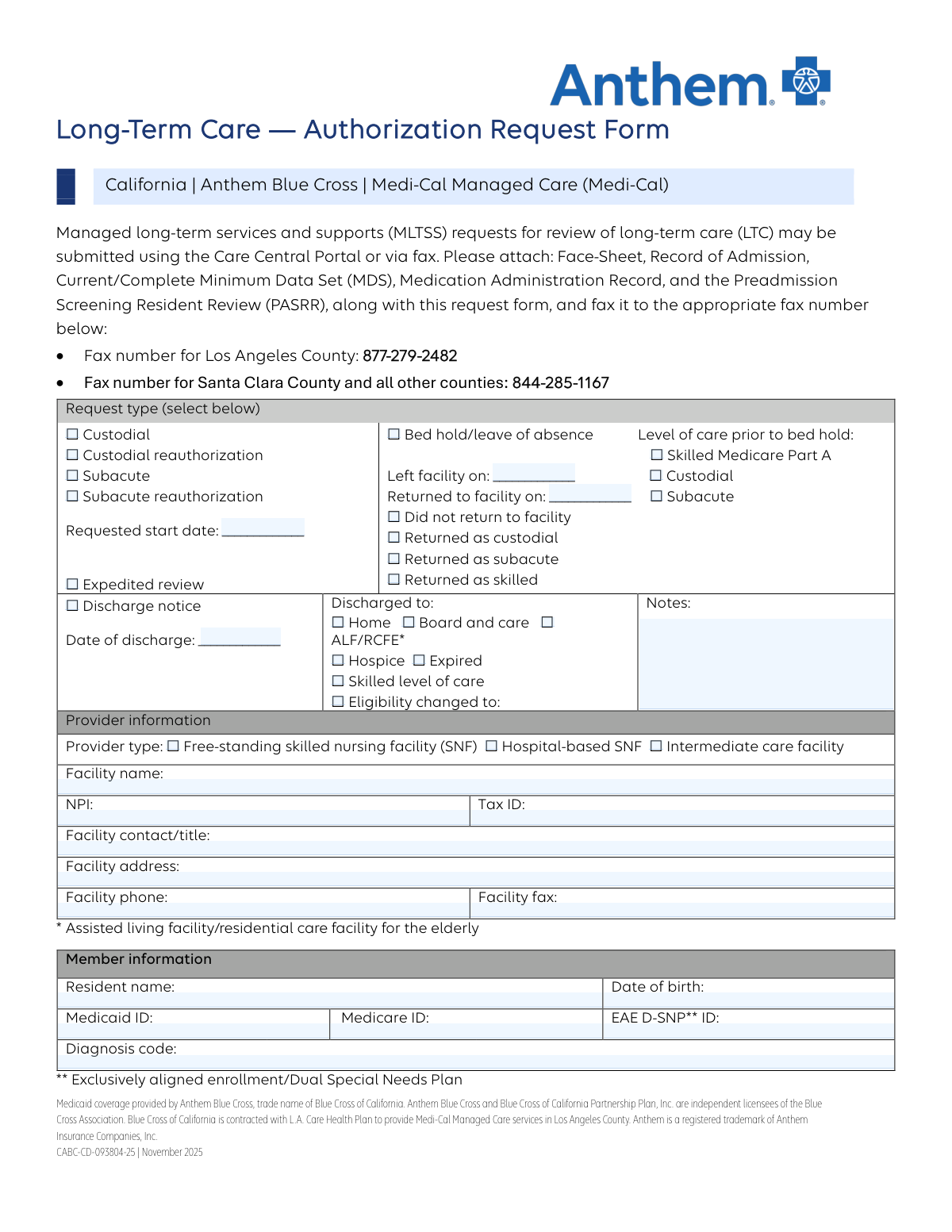
- Anthem Blue Cross Long-Term Care — Authorization Request Form: Use this for initial or reauthorization requests for custodial and subacute care, as well as managing bed holds for Anthem members.
- Blue Shield of California Promise Health Plan Long Term Care Treatment Authorization Request Form: Select this form to confirm medical necessity and ensure reimbursement for admissions or continued stays within the Blue Shield Promise network.
Facility Certification and Government Programs
For administrators of Long-Term Care (LTC) facilities, the focus is often on federal compliance and program eligibility:
- Form CMS-1539, Long-Term Care Facility Application for Medicare and Medicaid: This is the essential application for any facility seeking to participate in or maintain certification for Medicare and Medicaid reimbursement programs.
Patient Eligibility in Ontario, Canada
If you are navigating the placement process for a long-term care home in Ontario, the clinical assessment is the primary requirement:
- Health Assessment – Ontario Health atHome (Form 4768-69E): This form must be completed by a qualified practitioner (such as a physician or RN) to determine an applicant's eligibility for admission based on their medical needs and the facility's ability to provide safe care.
Private Insurance Reimbursement
For individuals managing their own care or the care of a loved one through private insurance:
- John Hancock Independent Care Provider Service Reimbursement: Use this form if you are a John Hancock policyholder seeking to be paid back for services provided by an independent (non-agency) caregiver. You will need to provide itemized details of the services and costs incurred.
Form Comparison
| Form | Purpose | Primary Filer | Key Coverage/Region |
|---|---|---|---|
| Anthem Blue Cross Long-Term Care — Authorization Request Form | Request authorization for managed long-term services and supports. | Healthcare providers and medical facilities. | Anthem Blue Cross Medi-Cal in California. |
| Blue Shield of California Promise Health Plan Long Term Care Treatment Authorization Request Form | Seek pre-approval for admission or continued facility stay. | Healthcare providers and facility staff. | Blue Shield of California Promise Health Plan. |
| Form CMS-1539, Long-Term Care Facility Application for Medicare and Medicaid | Apply for facility certification in federal health programs. | Long-term care facility administrators. | Medicare and Medicaid programs (USA). |
| Health Assessment – Ontario Health atHome (Fixing Long-Term Care Act, 2021) (Form 4768-69E) | Clinical assessment to determine eligibility for home admission. | Authorized physicians or registered nurses. | Ontario Ministry of Long-Term Care. |
| Health Assessment - Ontario Health atHome (Fixing Long-Term Care Act, 2021) — Form 4768-69E | Document clinical information for admission eligibility determination. | Authorized practitioners (Physicians or RNs). | Ontario Health atHome (Fixing LTC Act). |
| John Hancock Independent Care Provider Service Reimbursement | Request reimbursement for costs of independent care services. | Long-term care insurance policyholders. | John Hancock private insurance policies. |
Tips for long term care forms
Long-term care forms often require specific medical diagnoses, medication lists, and treatment histories. Double-check that all clinical data matches your official medical records exactly to avoid claim denials or admission rejections.
Many authorization forms require signatures from specific authorized practitioners, such as a physician or a registered nurse. Ensure their license numbers and contact information are current and clearly legible before you submit the paperwork.
Reimbursement and admission forms typically require attachments like itemized bills, clinical notes, or TB screening results. Keeping an organized digital folder of these documents allows you to quickly reference and upload them alongside your forms.
AI-powered tools like Instafill.ai can complete these complex long-term care forms in under 30 seconds with high accuracy. This technology ensures your data stays secure during the process, making it a major time-saver for those managing multiple applications.
Insurance carriers and government agencies frequently update their forms, such as CMS-1539 or Blue Shield authorization requests. Always verify the form ID and version date to ensure you aren't using an obsolete document that could be rejected.
For Treatment Authorization Requests (TARs), pay close attention to the requested start and end dates for custodial or subacute care. Mismatched dates are a frequent cause of reimbursement delays and can disrupt the continuity of care for the patient.
Frequently Asked Questions
Long-term care forms are used to manage admissions, authorize specialized medical services, and process insurance reimbursements for extended healthcare needs. They ensure that patients receive appropriate care levels and that healthcare facilities or policyholders are properly compensated by insurance or government programs.
Facility applications, such as Form CMS-1539, are for the care centers themselves to obtain certification for programs like Medicare. In contrast, authorization forms from providers like Anthem or Blue Shield are used by healthcare professionals to request approval for a specific patient's admission or continued stay.
If you are a policyholder seeking repayment for care, you should use the John Hancock Independent Care Provider Service Reimbursement form. This document requires detailed itemization of services, including dates and costs, to ensure your insurance claim is processed correctly.
In Ontario, Form 4768-69E must be completed for anyone seeking admission to a long-term care home under the Fixing Long-Term Care Act, 2021. The form must be filled out and signed by an authorized practitioner, such as a physician or registered nurse, to determine eligibility based on clinical needs.
Insurance companies like Blue Shield of California Promise Health Plan use these forms to verify that the requested long-term care is medically necessary before services begin. This pre-approval process ensures that the care is covered under the member's plan and helps maintain a continuous record of the patient's treatment.
Yes, most forms related to health assessments or treatment authorizations require a signature from a licensed healthcare professional, such as a physician or nurse practitioner. This validates the clinical information provided and confirms that the level of care requested is appropriate for the patient's condition.
Submission instructions vary depending on the form; facility certification forms are usually sent to state survey agencies or CMS, while reimbursement and authorization forms are submitted directly to the insurance carrier. It is important to review the specific form instructions for the correct mailing address, fax number, or digital upload portal.
Form CMS-1539 is the official application for long-term care facilities seeking to participate in Medicare and Medicaid programs. It records essential details about the facility's ownership and compliance with federal health and safety standards, which is required for federal reimbursement.
Yes, you can use AI-powered tools like Instafill.ai to complete these forms quickly and accurately. The AI can extract data from your supporting documents and place it directly into the required fields, reducing the risk of manual entry errors.
Using advanced AI tools, you can fill out most long-term care forms in under 30 seconds. This technology automates the process of transferring complex data like medical codes, provider information, and itemized costs from your records into the PDF.
You should generally have the patient's medical history, insurance policy numbers, provider contact details, and any itemized invoices or clinical assessments on hand. Having this information prepared ensures that the form is completed accurately and prevents delays in authorization or reimbursement.
Glossary
- Form Complexity Index
- Instafill’s 0–100 measure of how much effort a form takes to complete, calculated deterministically from the form’s own structure rather than estimated. It combines the number of fillable fields (the largest factor), how difficult those fields are to complete based on their type, the number of pages that contain fields, the amount of conditional “fill-only-if” logic, and how many sections the form is divided into, then adds modifiers for tables and repeating lists, bundled instruction pages, and dense page layouts. A higher score means the form is harder to fill out by hand. The forms in this category have a median Form Complexity Index of 64/100 (Complex). See exactly how it is calculated.
- LTC (Long-Term Care)
- A range of medical and personal services designed to support individuals who have lost some capacity for self-care due to a chronic illness or disability.
- Custodial Care
- Non-medical assistance with activities of daily living, such as bathing, dressing, and eating, which is typically provided by non-licensed caregivers.
- TAR (Treatment Authorization Request)
- A formal document submitted by a healthcare provider to an insurance plan to seek pre-approval for a patient's admission or continued stay in a care facility.
- MLTSS (Managed Long-Term Services and Supports)
- A delivery system that provides long-term services through managed care programs, such as Medi-Cal, to help seniors and people with disabilities live independently.
- Subacute Care
- A level of care for patients who are stable but still require specialized medical monitoring or rehabilitation that is more intensive than standard nursing home care.
- Responsive Behaviours
- A clinical term used to describe actions or words—such as agitation or wandering—that are a person's reaction to something frustrating or confusing in their environment.
- ARO Screening
- A medical test used to detect Antibiotic-Resistant Organisms to ensure the safety of other residents before an individual is admitted to a communal living facility.
- Bed Hold
- A provision or payment that ensures a resident's spot in a long-term care facility is reserved while they are temporarily away, such as during a hospital stay.