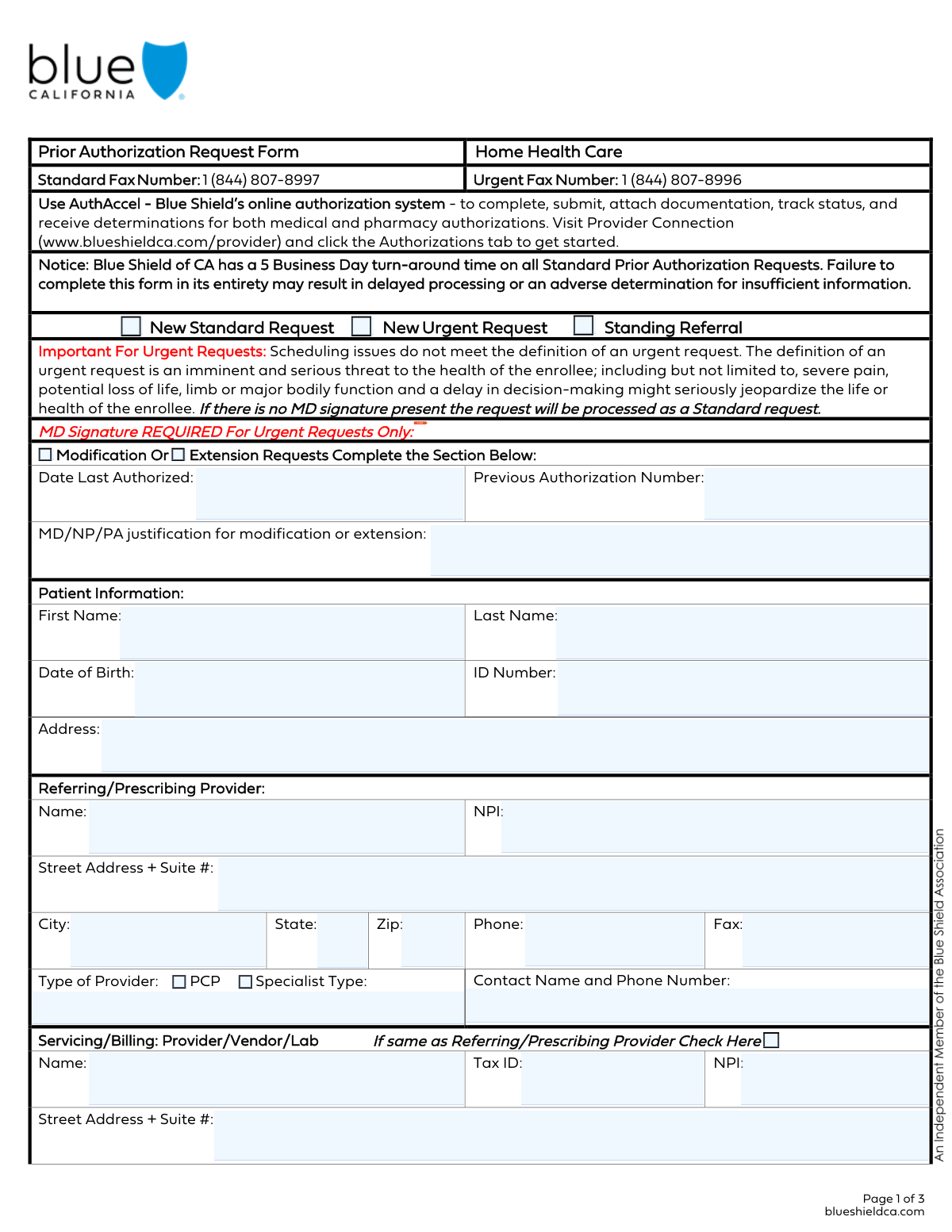
Yes! You can use AI to fill out Blue Shield of California Prior Authorization Request Form
This is a Prior Authorization Request Form used by healthcare providers to seek approval from Blue Shield of California before a patient receives specific medical services or prescriptions. Submitting this form is essential to confirm that the proposed treatment is medically necessary and covered under the patient's plan, thereby ensuring reimbursement. Today, this form can be filled out quickly and accurately using AI-powered services like Instafill.ai, which can also convert non-fillable PDF versions into interactive fillable forms.
Our AI automatically handles information lookup, data retrieval, formatting, and form filling.
It takes less than a minute to fill out Blue Shield of CA Prior Authorization Request using our AI form filling.
Securely upload your data. Information is encrypted in transit and deleted immediately after the form is filled out.
Form specifications
| Form name: | Blue Shield of California Prior Authorization Request Form |
| Number of pages: | 3 |
| Language: | English |
| Categories: | prior authorization forms, authorization forms, Blue Shield of California forms |
Instafill Demo: How to fill out PDF forms in seconds with AI
How to Fill Out Blue Shield of CA Prior Authorization Request Online for Free in 2026
Are you looking to fill out a BLUE SHIELD OF CA PRIOR AUTHORIZATION REQUEST form online quickly and accurately? Instafill.ai offers the #1 AI-powered PDF filling software of 2026, allowing you to complete your BLUE SHIELD OF CA PRIOR AUTHORIZATION REQUEST form in just 37 seconds or less.
Follow these steps to fill out your BLUE SHIELD OF CA PRIOR AUTHORIZATION REQUEST form online using Instafill.ai:
- 1 Navigate to Instafill.ai and upload the Blue Shield of CA Prior Authorization Request Form or select it from the template library.
- 2 Provide the patient's information, including their full name, date of birth, and Blue Shield ID number.
- 3 Enter the details for the referring/prescribing provider and the servicing/billing provider, including names, NPI numbers, and contact information.
- 4 Indicate the request type (e.g., New Standard, Urgent, Modification) and fill in previous authorization details if it's an extension or modification.
- 5 Specify the requested services by entering the relevant ICD-10 and CPT/HCPCS codes, along with the place of service and anticipated service dates.
- 6 If the request is for home health, provide specific details about visit frequency, duration, and any related medication authorizations.
- 7 Review all the information automatically populated by the AI for accuracy, ensure all required fields are complete, obtain an MD signature for urgent requests, and submit the form as instructed.
Our AI-powered system ensures each field is filled out correctly, reducing errors and saving you time.
Why Choose Instafill.ai for Your Fillable Blue Shield of CA Prior Authorization Request Form?
Speed
Complete your Blue Shield of CA Prior Authorization Request in as little as 37 seconds.
Up-to-Date
Always use the latest 2026 Blue Shield of CA Prior Authorization Request form version.
Cost-effective
No need to hire expensive lawyers.
Accuracy
Our AI performs 10 compliance checks to ensure your form is error-free.
Security
Your personal information is protected with bank-level encryption.
Frequently Asked Questions About Form Blue Shield of CA Prior Authorization Request
This form is used by healthcare providers to request pre-approval from Blue Shield of California for specific medical services, procedures, or medications to ensure they are covered by the patient's plan.
The patient's healthcare provider, such as the referring or servicing provider's office, is responsible for filling out and submitting this form on behalf of the patient.
You can submit the completed form by fax, or for a more efficient process, use Blue Shield's online system, AuthAccel, through the Provider Connection portal to submit requests and track their status.
Blue Shield of California has a 5-business-day turnaround time for all standard prior authorization requests. Urgent requests are processed more quickly, but submitting an incomplete form may cause delays.
An urgent request is for a condition that poses an imminent and serious threat to the patient's health and requires a physician's signature. Standard requests are for non-emergent services and follow the standard 5-day turnaround time.
Failure to complete the form in its entirety may result in processing delays or an adverse determination due to insufficient information. It is crucial to provide all requested patient, provider, and service details.
To request a modification or extension, check the appropriate box on the form and be sure to complete the section requiring the previous authorization number and a clinical justification for the change.
For home health requests, you must provide supporting clinical documentation, specify the frequency and duration of visits, and include the total number of visits or hours requested. If for medication administration, the medication itself must be authorized first.
A physician's signature is mandatory for a request to be considered urgent. If the signature is missing, your request will automatically be processed as a standard request.
You must enter all relevant ICD-10 diagnosis codes and CPT/HCPCS procedure codes for the services being requested. Be sure to also include the quantity and any applicable modifiers for each code.
Yes, services like Instafill.ai use AI to accurately auto-fill form fields from your records, which can save significant time and reduce errors. This helps ensure all required information is completed correctly before submission.
You can use a service like Instafill.ai to fill the form online. Simply upload the PDF, and the AI will identify the fields for you to fill, or it can auto-fill them from your data, making the process faster than manual entry.
If your PDF is a flat, non-fillable scan, you can use a tool like Instafill.ai to convert it into an interactive, fillable form. This allows you to easily type your information into the correct fields before printing or saving.
Compliance Blue Shield of CA Prior Authorization Request
Validation Checks by Instafill.ai
1
Urgent Request Signature Requirement
This check verifies that if the 'New Urgent Request' box is selected, an MD signature is present on the form. According to the form's instructions, an urgent request is invalid without a physician's signature and will be downgraded to a standard request. This validation prevents incorrect processing and ensures compliance with the urgency criteria.
2
Modification/Extension Prerequisite Fields
This validation ensures that if either the 'Modification' or 'Extension' request box is checked, the 'Date Last Authorized' and 'Previous Authorization Number' fields are both completed. This information is essential for locating the original authorization and processing the change request correctly. Failure to provide these details would make it impossible to process the modification or extension, leading to rejection or delay.
3
Patient Date of Birth Validity
This check validates that the 'Patient Date of Birth' is a complete and valid date in a recognized format (e.g., MM/DD/YYYY) and that the date is in the past. An invalid or future date of birth would be a data entry error, preventing proper patient identification and eligibility verification. This ensures the fundamental patient data is accurate before proceeding.
4
National Provider Identifier (NPI) Format
This validation confirms that all National Provider Identifier (NPI) fields contain a valid, 10-digit numeric value. The NPI is a standard, unique identifier for health care providers, and an incorrect format indicates a data entry error. Correct NPIs are critical for provider identification, network status verification, and claims processing.
5
Servicing Provider Information Completeness
This check enforces the rule that if the 'Same as Referring/Prescribing Provider' box is not checked, then the key fields for the Servicing/Billing Provider (Name, NPI, Address) must be filled out. This ensures that the entity performing the service is clearly identified for authorization and billing purposes. Incomplete information for a distinct servicing provider will halt the authorization process.
6
Single Place of Service Selection
This validation ensures that exactly one checkbox is selected in the 'Place of Service' section, as instructed on the form. Selecting multiple locations or none at all creates ambiguity regarding where the service will be rendered, which can affect coverage and reimbursement rates. The check prevents submission until a single, valid place of service is designated.
7
Medical Code Completeness
This check verifies that both the 'ICD-10 Code(s)' and 'CPT/HCPC Code(s)' fields are populated. These codes are the basis for determining medical necessity and what specific service is being requested. Submitting a request without diagnosis and procedure codes would result in an automatic rejection for insufficient information.
8
Home Health Visit Calculation Consistency
For Home Health requests, this validation cross-references the 'Frequency of visits', 'Length of each visit', and 'Anticipated dates of service' to ensure the 'Total number of visits requested' and 'Total number of hours requested' are arithmetically correct. For example, (visits per week) * (number of weeks) should equal 'Total visits'. This logical check catches potential data entry errors and ensures the requested units are accurate.
9
Conditional Medication Name Requirement
This check ensures that if the question 'Is home health requested for medication administration?' is answered 'Yes', then the 'Name of the medication' field must be filled in. It is impossible to evaluate a request for medication administration without knowing which medication is involved. A failed validation would prompt the user to provide the required medication name.
10
Conditional Medication Prior Authorization Number
This validation enforces a critical workflow rule: if 'Does the medication require prior authorization?' is answered 'Yes', the 'Prior authorization number' field must be populated. The form explicitly states to stop and obtain the medication authorization first. This check prevents the submission of an incomplete home health request that is dependent on a separate, unobtained authorization.
11
Patient Identifier Completeness
This check ensures that the 'Patient First Name', 'Patient Last Name', and 'Patient ID Number' fields are all completed. These three fields are the minimum necessary to uniquely and accurately identify the member in the system. A request missing any of this core information cannot be processed and would be rejected.
12
Anticipated Date of Service Logic
This validation verifies that the 'Anticipated Date of Service' is not a date in the past. Prior authorizations are by definition for future services, so a past date indicates a data entry error or a misunderstanding of the process. This ensures the request is for a prospective service as intended.
13
Provider Type Selection
This check ensures that for the 'Referring/Prescribing Provider', either the 'PCP' or 'Specialist' checkbox is selected. If 'Specialist' is chosen, the 'Specialist Type' text field must also be completed. This information is important for network management and applying the correct clinical review criteria based on the provider's role.
Common Mistakes in Completing Blue Shield of CA Prior Authorization Request
Users often mark a request as 'Urgent' for scheduling convenience, which does not meet the form's strict criteria of an imminent, serious threat to health. They also frequently forget the required MD signature for urgent requests. This results in the request being downgraded to 'Standard' processing time, delaying patient care and defeating the purpose of the urgent submission. To avoid this, ensure the case truly meets the urgency definition and that a physician signs the designated field.
When requesting a modification or extension to an existing authorization, providers frequently forget to include the 'Previous Authorization Number' and a detailed clinical justification. Without this information, the reviewer cannot locate the original case or understand the need for the change, leading to automatic rejection or significant processing delays. Always fill out this section completely when checking the 'Modification' or 'Extension' box.
The form has separate, detailed sections for Referring, Servicing/Billing, and Group providers, which can be confusing. A common error is entering the same provider's information in multiple sections manually instead of using the 'If same as Referring... Check Here' box, which introduces typos. This can cause billing errors and claim denials. To prevent this, carefully identify each provider type and use the provided checkbox to auto-populate information where applicable.
Submissions are often delayed or denied due to missing, incomplete, or invalid ICD-10 (diagnosis) and CPT/HCPCS (procedure) codes. The form also requires a description for any unlisted codes, which is often overlooked. Inaccurate codes prevent the reviewer from determining medical necessity. Using an AI-powered tool like Instafill.ai can help validate codes against a current database to ensure accuracy before submission.
On page 3, for home health requests involving medication administration, the form explicitly states to 'Stop' and obtain medication authorization first if it's required but not yet approved. Users often miss this instruction and submit the form anyway, leading to an automatic denial of the home health request. Always verify that the medication itself is authorized and provide the authorization number before requesting services for its administration.
The Home Health section requires specific details on the frequency, length, and duration of visits, but providers often enter vague information like 'as needed'. This ambiguity makes it impossible for the payer to authorize a specific quantity of services, resulting in requests for more information and delays. Be explicit by providing exact numbers, such as '2 visits per week' and '1 hour for each visit' for a duration of '3 months'.
The form requires submission of supporting clinical documents, such as a history and physical, treatment plans, and notes justifying why the member is homebound. Failing to fax or attach these documents with the form is a primary reason for denials due to 'insufficient information'. Always create a checklist of required documents and ensure they are included with the submission to support medical necessity.
The form lists two different fax numbers: one for 'Standard' requests and one for 'Urgent' requests. Sending the form to the wrong number can cause significant delays, as it may be routed to the incorrect queue or get lost. To avoid this, double-check the request type and match it to the correct fax number listed at the top of the form before sending.
This form is often a non-fillable PDF, forcing users to print it and complete it by hand. Illegible handwriting for critical data like patient IDs, NPI numbers, and medical codes leads to data entry errors by the receiving party, causing denials and delays. To prevent this, use a tool like Instafill.ai, which can convert flat PDFs into digitally fillable forms, ensuring all information is clear, legible, and accurate.
Each provider section includes a field for a specific 'Contact Name and Phone Number,' which is frequently left blank. When the insurance reviewer has a simple question, the absence of a direct contact forces them to call the main office line, leading to wasted time and potential delays. Providing a direct contact person ensures that any issues can be resolved quickly, speeding up the authorization process.
Saved over 80 hours a year
“I was never sure if my IRS forms like W-9 were filled correctly. Now, I can complete the forms accurately without any external help.”
Kevin Martin Green
Your data stays secure with advanced protection from Instafill and our subprocessors

Robust compliance program
Transparent business model
You’re not the product. You always know where your data is and what it is processed for.
ISO 27001, HIPAA, and GDPR
Our subprocesses adhere to multiple compliance standards, including but not limited to ISO 27001, HIPAA, and GDPR.
Security & privacy by design
We consider security and privacy from the initial design phase of any new service or functionality. It’s not an afterthought, it’s built-in, including support for two-factor authentication (2FA) to further protect your account.
Fill out Blue Shield of CA Prior Authorization Request with Instafill.ai
Worried about filling PDFs wrong? Instafill securely fills blue-shield-of-california-prior-authorization-request-form forms, ensuring each field is accurate.