Fill out medical authorization forms
with AI.
Medical authorization forms are essential documents in the healthcare system, primarily used to request approval for specific treatments or services before they are provided. These forms ensure that the proposed medical care meets the necessary criteria for coverage and medical necessity. Without proper authorization, patients may face unexpected costs, and providers might experience delays in reimbursement. This category includes critical documents like Applied Behavior Analysis (ABA) service requests and prior authorization forms required by state health departments and insurance plans.
By continuing, you acknowledge Instafill's Privacy Policy and agree to get occasional product update and promotional emails.
About medical authorization forms
Healthcare providers, including therapists, physicians, and clinical administrators, typically handle these forms when coordinating care for their patients. They are frequently required when initiating new treatments, such as in an initial service authorization request, or when continuing ongoing therapy through concurrent authorization forms. For instance, providers working with Medicaid or organizations like the Alameda Alliance often need to submit detailed clinical data, diagnosis codes, and treatment goals to ensure uninterrupted patient care.
Completing these detailed healthcare forms manually can be a time-consuming administrative burden that takes away from direct patient care. Tools like Instafill.ai use AI to fill these forms in under 30 seconds, handling sensitive data accurately and securely. By automating the data entry process, providers can ensure that complex fields—such as CPT codes and diagnosis criteria—are correctly populated, reducing the risk of administrative denials and streamlining the authorization workflow.
Every form on this page can be completed without typing. Instafill is form filling software that reads a PDF and fills it for you — including flat and scanned documents that carry no fillable fields at all.
Forms in This Category
The forms in this category have a median Form Complexity Index of 56/100 (Moderate), measured across 8 forms by field count, input difficulty, length, conditional logic and structure. See how it is calculated.
- Enterprise-grade security & data encryption
- 99%+ accuracy powered by AI
- 1,000+ forms from all industries
- Complete forms in under 60 seconds
How to Choose the Right Form
Navigating Virginia Department of Medical Assistance Services (DMAS) requirements for Applied Behavior Analysis (ABA) therapy requires selecting the specific form that matches your patient's phase of treatment and the date of service. These forms are essential for establishing medical necessity and ensuring Medicaid reimbursement.
Starting New ABA Services
If you are requesting Medicaid coverage for a youth member who is beginning therapy for the first time, you need the Department of Medical Assistance Services Applied Behavior Analysis (97155, Et al.) Initial Service Authorization Request Form. This document is designed to capture the initial DSM/ICD-10 diagnosis, social and behavioral challenges, and preliminary treatment goals required for a first-time approval.
Continuing Care for Existing Patients
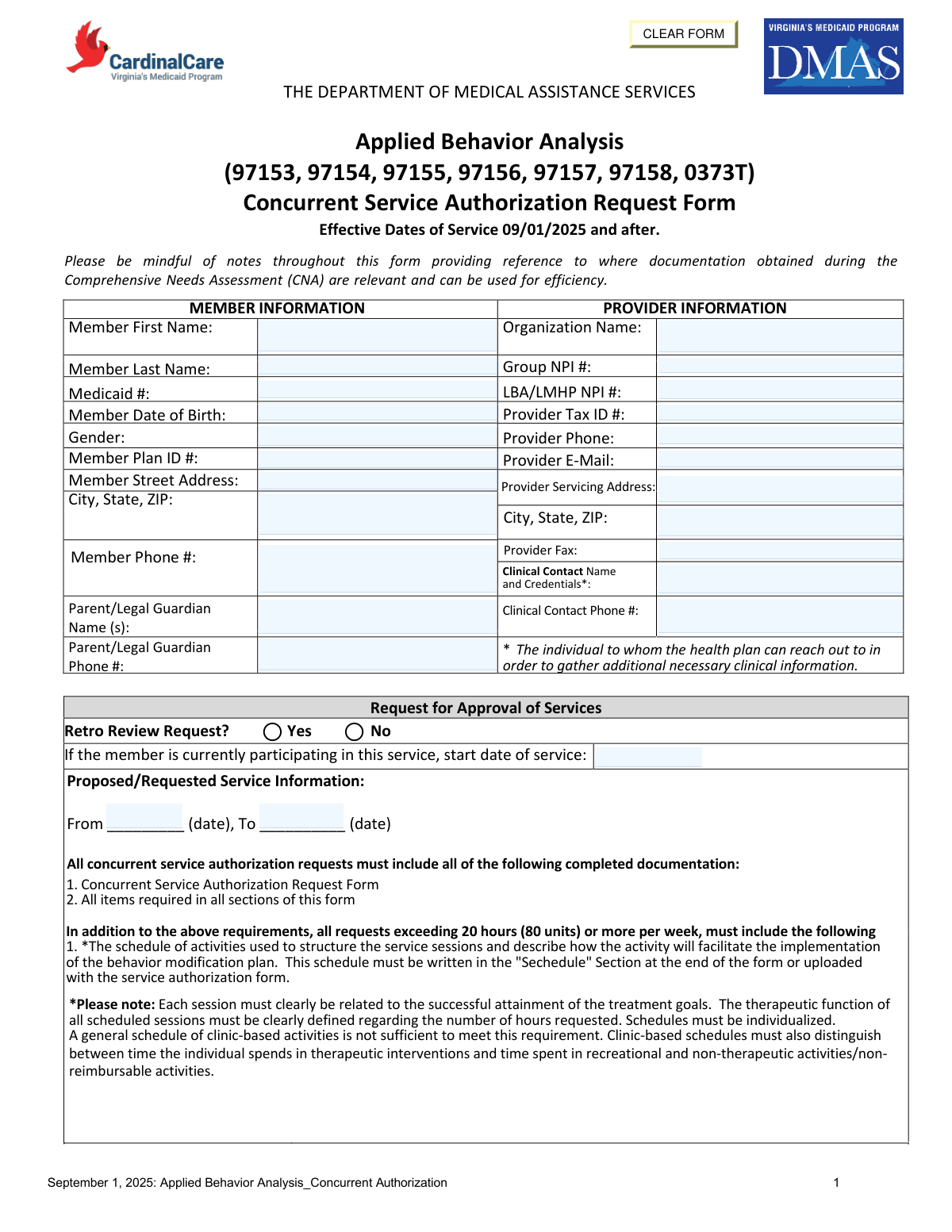
For patients already enrolled in treatment who require an extension of services, you must use the Applied Behavior Analysis Concurrent Service Authorization Request Form (CPT Codes 97153, 97154, 97155, 97156, 97157, 97158, 0373T).
- Use this form if: The patient is currently receiving ABA therapy and you need to demonstrate ongoing medical necessity.
- Effective Date: This specific version is required for dates of service starting September 1, 2025.
- Focus: It emphasizes treatment progress, care coordination, and updated discharge planning.
Preservice and Prior Authorizations
When you need to approve the amount, type, and duration of services before they are delivered, select The Department of Medical Assistance Services Applied Behavior Analysis Preservice Service Authorization Request Form.
- Best for: Requesting authorization for specific CPT codes (97153–97158 and 0373T) for services scheduled on or after September 1, 2025.
- Key Detail: This form is specifically used by health plans to determine medical necessity for upcoming service units and telemedicine documentation.
Quick Tips for Providers
- Check the Effective Date: Several of these forms are mandate-specific for services provided on or after September 1, 2025.
- Required Signatures: Ensure a Licensed Mental Health Professional (LMHP) or Licensed Applied Behavior Analyst (LABA) signs the request to avoid processing delays.
Form Comparison
| Form | Primary Purpose | Clinical Stage | CPT Codes Covered | Key Focus |
|---|---|---|---|---|
| The Department of Medical Assistance Services Applied Behavior Analysis Preservice Service Authorization Request Form (Effective Dates of Service 09/01/2025 and after) | Requesting preservice approval for ABA services for 2025 dates. | Preservice (prior to treatment delivery). | 97153–97158 and 0373T. | Medical necessity, requested service units, and telemedicine documentation. |
| Department of Medical Assistance Services Applied Behavior Analysis (97155, Et al.) Initial Service Authorization Request Form | Obtaining first-time authorization for youth Medicaid ABA therapy. | Initial (start of a new treatment cycle). | 97155 and related codes. | Diagnostic criteria, specialist attestation, and preliminary treatment goals. |
| Applied Behavior Analysis Concurrent Service Authorization Request Form (CPT Codes 97153, 97154, 97155, 97156, 97157, 97158, 0373T) – Virginia Department of Medical Assistance Services | Requesting continued authorization for ongoing ABA treatment. | Concurrent (during active treatment). | 97153–97158 and 0373T. | Treatment progress, updated Individual Service Plans, and discharge planning. |
Tips for medical authorization forms
AI-powered tools like Instafill.ai can complete these detailed ABA authorization forms in under 30 seconds with high accuracy. The data stays secure during the process, providing a massive time-saving advantage for healthcare providers who manage multiple patient files and recurring authorizations.
Medical authorization forms for ABA services require precise CPT codes (such as 97153 or 97155) and matching ICD-10 diagnosis codes. Double-check these entries against the patient's clinical record to prevent administrative denials or delays in service approval.
Filling out the form is only the first step; most DMAS requests require an attached Individual Service Plan (ISP) or a treatment progress summary. Ensure all supporting clinical documents are organized and ready to be submitted alongside the form to demonstrate medical necessity.
Initial and concurrent authorization forms must be signed by a Licensed Mental Health Professional (LMHP) or Licensed Applied Behavior Analyst (LABA). Confirm that the appropriate clinician has reviewed and signed the document to meet Medicaid compliance and attestation standards.
For concurrent requests, it is essential to link current treatment goals with long-term recovery and discharge planning. Clearly documenting how the member is progressing toward specific milestones helps justify the ongoing need for ABA services to the reviewing health plan.
Pay close attention to the version of the form you are using, as requirements often change with specific effective dates (such as those for September 2025 and after). Using an outdated form can result in the entire request being returned as incomplete.
Frequently Asked Questions
Medical authorization forms are used by healthcare providers to request approval from insurance companies or state agencies before delivering specific treatments. These forms help determine medical necessity and ensure that the requested services, such as Applied Behavior Analysis (ABA), are covered under the patient's healthcare plan.
An initial authorization form is required when a patient is first starting a treatment program to establish eligibility and necessity. A concurrent authorization form is used for patients already in treatment to request continued services and provide updates on the patient's progress and ongoing clinical needs.
Typically, the healthcare provider or a Licensed Applied Behavior Analyst (LABA) is responsible for filling out and submitting these forms. They must provide clinical data, diagnoses, and treatment goals, though they often require the member's insurance information and personal details to complete the filing.
Yes, AI tools like Instafill.ai can be used to fill out medical authorization forms by accurately extracting data from source documents and placing it into the correct fields. This helps healthcare providers maintain accuracy and ensure that complex codes and member details are entered correctly without manual transcription.
Using an AI-powered service like Instafill.ai, you can complete complex medical forms in under 30 seconds. The technology automates the data entry process, which is significantly faster than manual typing and helps prevent administrative delays in the prior authorization process.
Most medical authorization requests must be accompanied by supporting clinical documentation, such as an Individual Service Plan (ISP), diagnostic evaluations, and progress summaries. For concurrent requests, providers often need to submit data showing the member's response to previous treatment and updated recovery goals.
Different CPT codes represent specific types of medical services or levels of care intensity. Payers like the Department of Medical Assistance Services (DMAS) use specific forms for certain code groups to ensure the clinical criteria for those particular services are met and documented appropriately.
Using an outdated form can lead to processing delays or immediate denial of the authorization request. It is important to check the effective dates listed on the form—for example, several ABA forms are specifically designated for service dates on or after September 1, 2025.
Completed forms are generally submitted to the state's medical assistance department or the specific Managed Care Organization (MCO) managing the patient's benefits. Most organizations prefer submission through a secure online provider portal, though fax and mail options are often still available.
Many medical authorization forms now include specific sections to document the use of telemedicine. Providers must indicate if services will be delivered remotely and ensure that the CPT codes used are eligible for telemedicine reimbursement according to the payer's current policies.
The discharge planning section requires providers to outline the expected criteria for a patient to transition out of the current level of care. This includes identifying community supports, setting long-term stability goals, and planning for the eventual reduction of service intensity.
Glossary
- Form Complexity Index
- Instafill’s 0–100 measure of how much effort a form takes to complete, calculated deterministically from the form’s own structure rather than estimated. It combines the number of fillable fields (the largest factor), how difficult those fields are to complete based on their type, the number of pages that contain fields, the amount of conditional “fill-only-if” logic, and how many sections the form is divided into, then adds modifiers for tables and repeating lists, bundled instruction pages, and dense page layouts. A higher score means the form is harder to fill out by hand. The forms in this category have a median Form Complexity Index of 56/100 (Moderate). See exactly how it is calculated.
- Prior Authorization
- A requirement where a provider must obtain approval from a health insurer before providing a specific medical service to ensure the cost will be covered.
- DMAS
- The Department of Medical Assistance Services, which is the state agency responsible for administering the Medicaid program in Virginia.
- Medical Necessity
- A clinical standard used by health plans to determine if a requested service is reasonable, necessary, and appropriate for the diagnosis or treatment of a condition.
- ABA (Applied Behavior Analysis)
- A type of therapy focused on improving specific behaviors, such as social skills and communication, frequently used for individuals with developmental disorders.
- CPT Codes
- A standardized set of five-digit numeric codes used by healthcare providers to identify and bill for specific medical, surgical, and diagnostic services.
- Concurrent Service Authorization
- An authorization request submitted to extend or continue services that have already been initially approved and are currently being delivered.
- LMHP (Licensed Mental Health Professional)
- A practitioner licensed by the state, such as a psychiatrist or clinical social worker, who is qualified to sign off on medical necessity for mental health services.
- ISP (Individual Service Plan)
- A detailed document that outlines a patient's specific treatment goals, the interventions to be used, and the criteria for measuring progress.